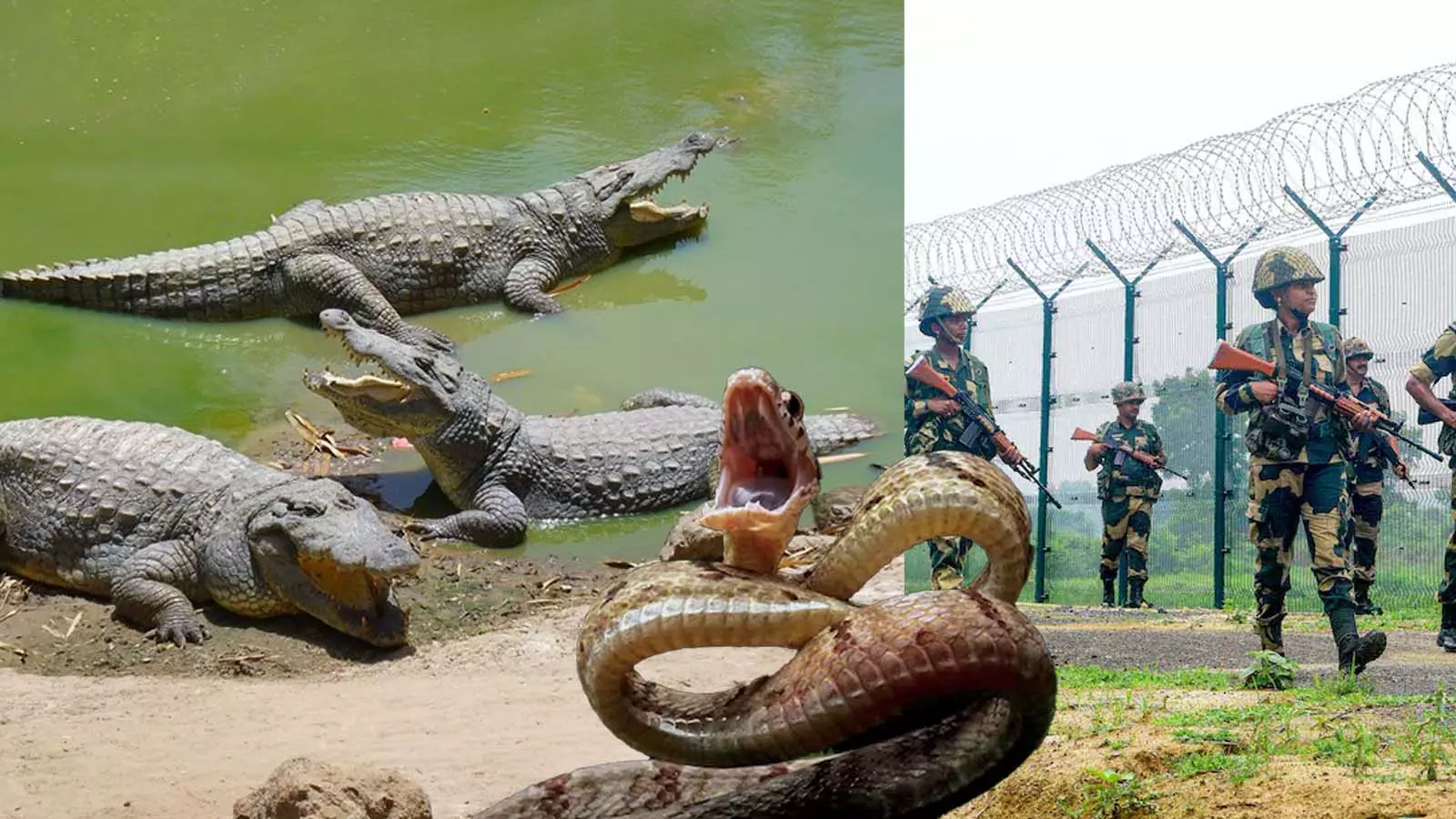
India is looking at deploying reptiles in its border areas with Bangladesh that are not easy for traditional barriers.
Wild East? BSF may use snakes, crocodiles to guard porous Bangladesh border
Following Amit Shah's directive, reptiles may be deployed to secure 175 km India-Bangladesh border where rivers, marshland make traditional fencing impossible

Stories of crocodile-filled moats used as a line of defence around palaces and forts in the bygone eras of kings and emperors are not new. Even today, they serve as sensational pieces of history to those who are curious about the past.
Now, such a concept could become a reality in India of the 21st century in terms of national security.
Border control reptiles
In an unusual twist to the country’s border-management strategy, the Border Security Force (BSF) is exploring the feasibility of deploying reptiles, such as snakes and crocodiles, across riverine gaps along the border with Bangladesh that are otherwise not favourable for erecting traditional barriers.
Also read: China to strengthen highways along India border under 15th 5-year plan
A directive in this regard is said to have come from Union Home Minister Amit Shah, according to an internal communication seen by The Federal.
“Exploring use of reptiles in riverine gaps in line with Honourable HM’s direction. Feasibility of deploying reptiles (such as snakes /crocodiles) in vulnerable riverine gaps is to be explored and examined from operational perspectives,” read a confidential message circulated to senior frontier-level officers in the force's eastern and northeastern sector headquarters on March 26.
'Alligator Alcatraz'
The Centre's move has an uncanny parallel with the Donald Trump administration’s new detention centre in Florida, dubbed “Alligator Alcatraz”.
The facility, surrounded by the Everglades wetlands, relies on alligators, crocodiles, and pythons as natural deterrents to prevent detainees from escaping the detention centre.
Trump also reportedly mentioned in 2018 that he was considering putting alligators or crocodiles in the Rio Grande River between the southern American state of Texas and Mexico to deter southern border crossings, though he later clarified that it was intended as a humorous, extreme suggestion.
Deterrance first approach
While the American measure has sparked controversy over environmental and humanitarian concerns, India’s consideration of reptiles for border security similarly reflects a dramatic, deterrence‑first approach, literally turning nature into a frontline tool for managing unauthorised crossings.
Also read: Pakistan’s water woes to deepen as India may restrict Ravi’s flow across border
The government’s push to “go wild” in protecting vulnerable border stretches also comes at a time when the BSF is allegedly grappling with outdated infrastructure and a manpower crunch.
The BSF is stretched thin, with around 2.65 lakh personnel guarding nearly 4,000 km of the India-Bangladesh border and over 2,200 km along the Pakistan frontier. That averages roughly 41 personnel per km. Much of the force is tied up in non-border guarding jobs, including ceremonial duties, internal security, anti-Naxalite operations, election management, and overseas peacekeeping.
While nearly 20 per cent of its personnel are aged between 45 and 60, another 20 per cent is medically unfit for frontline duties, according to BSF sources. These manpower challenges are compounded by outdated infrastructure and limited high-tech surveillance, leaving key stretches vulnerable to smuggling and security threats.
Modernising BSF
Last November, Shah announced a five‑year plan to transform the BSF into one of the most modern and technologically advanced frontier forces in the world, with emphasis on implementing the new concept of “e‑Border” security across India’s frontiers.
Also read: Why BSF needs a big upgrade, physically and technologically
Under this roadmap, the Home Ministry aims to fully roll out electronic border surveillance and management systems—integrating sensors, real‑time monitoring, and advanced tech solutions—alongside infrastructure and welfare upgrades, to strengthen the force’s ability to detect and respond to cross‑border threats more effectively.
The latest directive suggests that the government is now blending modern technology with primal deterrents.
Building fences
The signal messages, circulated to senior frontier-level officers following a March 20 meeting at the BSF’s New Delhi headquarters, also instructed sector headquarters to map border outposts located in areas with poor mobile connectivity and to submit detailed information on registered cases involving border villagers, highlighting the continuing need for intelligence-backed security measures.
Also read: What triggered the Pakistan-Afghanistan conflict and its geopolitical impact?
Out of the total 4,096.7 km of the India-Bangladesh border, only about 3,240 km has been fenced.
Of the remaining 850 km of unfenced border, around 175 km is considered unsuitable for fencing due to rivers and marshy terrain, where constructing a traditional barrier is extremely difficult or impossible. It is in this stretch that the government is exploring the possibility of deploying reptiles.