Bengal polls: 20 days to go for phase 1, chaos continues over missing names after SIR
Mass deletions across communities, protests and blockades push SIR to centre stage, as voters remain divided and confused over the process

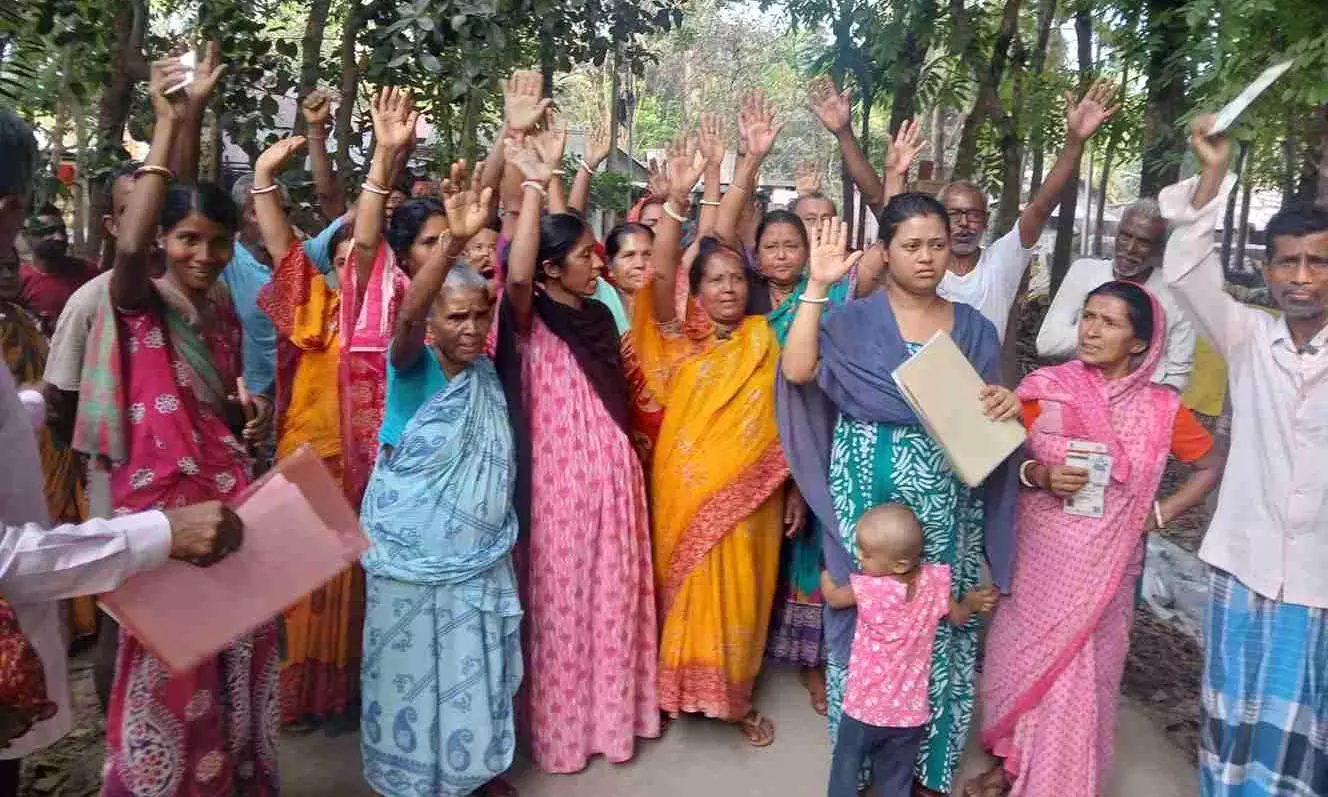
Protests over the Special Intensive Revision (SIR) of electoral rolls in West Bengal, which had been simmering for weeks, have now spilled onto the streets, with road blockades, demonstrations and confrontations with officials reported across multiple districts.
From the minority-dominated districts of Murshidabad and Malda to the Matua belts of North 24-Parganas and beyond, aggrieved voters have blocked arterial roads, surrounded local election offices and held demonstrations in the past couple of days, prompting an National Investigation Agency (NIA) probe into the gherao of judicial officers in Malda’s Kaliachak area and the arrest of at least 35 people, including an Indian Secular Front (ISF) candidate.
Also read: Bengal elections: SIR row, two-phase polling dominate debate | AI With Sanket
What began as scattered complaints about missing names and documentation hurdles is fast turning into a politically charged flashpoint just days before polling.
Missing of several names
At Malda’s Mothabari, Kaliachak, and adjoining areas this week, protests turned volatile as hundreds of residents blocked highways and surrounded administrative offices, alleging large-scale deletions from voter rolls.
Sources indicate that nearly 30,000 voters have been removed from the rolls in the Mothabari assembly constituency alone. “The issue must be resolved first, only then can elections be held,” protesters demanded in unison.
Also read: SIR, infiltration, women’s safety: 10 factors set to dominate Bengal polls
Similar sentiments played out in several other parts of the state that witnessed mass-scale detention. “My name has been there for 20 years. Suddenly they say it is ‘under scrutiny’,” said 62-year-old Rahima Bibi from Murshidabad’s Domkal. “If I do not exist on the voter list, where do I exist?”
Officials have maintained that the SIR is a routine exercise aimed at cleaning up electoral rolls by removing duplicates, deceased voters and ineligible entries. However, the scale and pattern of deletions alleged by residents have raised concerns among opposition parties and civil society groups.
The BJP is misleading people through whisper campaigns to shift the blame onto us. We had no role in the deletions. The names of many TMC supporters have also been removed. There is no clarity on why these names were deleted, despite all the required documents being submitted.
Nagendranath Sardar, BLO
Prominent families affected
The scale of alleged irregularities in the SIR exercise has raised serious concerns, with even historically prominent families finding themselves excluded.
In a striking instance, around 346 descendants of Mir Jafar, the erstwhile Nawab of Bengal, were removed from the electoral rolls in the Lalbagh area of Murshidabad during the revision process.
Also read: Bengal SIR: How did a former IPS officer's name vanish from voter list? | Interview
In another strikingly similar instance, Suprabuddha Sen, the maternal grandson of Nandalal Bose, who illustrated the original manuscript of the Constitution of India and designed emblems for government awards like the Bharat Ratna, had his name, along with his wife’s, removed from the voter rolls in Santiniketan in Birbhum.
While Muslims appear to be the worst affected, according to Opposition claims and multiple ground reports, the discontent is not confined to one community.
Matua voters excluded
In North 24-Parganas’ Bongaon subdivision, members of the Matua community, a key Scheduled Caste group with roots in Bangladesh, have also reported exclusion.
At a protest near Gaighata, demonstrators blocked a highway for over an hour, demanding simplification of documentation requirements.
In the Bagda assembly constituency, 1,993 names were removed from the voter rolls, while 2,240 names were deleted in Gaighata. Similarly, numerous names were dropped in the Bongaon North and South assembly constituencies. Nearly all of those removed belong to the Matua community. Many are still in the adjudication process.
“Names of all the 10 members of my family, including my son who is an army jawan, have been disfranchised,” Sushil Biswas from Dhulani block under Bagdah assembly constituency said. “We are citizens, but we are being treated like outsiders.”
Women, particularly in rural areas, have emerged as another group disproportionately affected.
In Dhulani as well, of the 129 names dropped, the majority are women, whose names were missing due to discrepancies in marital records or changes in surnames, a situation that often occurs in India.
Wider debate
These widespread deletions have complicated the political narratives around the SIR. The issue is no longer framed solely around minority disenfranchisement, but around administrative opacity and access barriers affecting multiple social groups.
The protests have sparked a debate on whether the SIR process is inadvertently triggering political consolidation among communities that feel scrutinised, and whether that could translate into electoral advantage for any party.
The reaction to the SIR so far shows a mixed and divided response, rather than a clear shift towards one party.
The Muslim community, in general, believes the voter roll exercise was carried out at the behest of the central government to target their community. TMC leaders have amplified this narrative, alleging an “EC‑BJP nexus” aimed at disenfranchising marginalised groups.
Also read: Bengal SIR: Voter roll scrutiny strains judiciary amid rising vacancies
Chief Minister Mamata Banerjee has repeatedly accused the poll panel of acting under pressure from the BJP, saying recent deletions disproportionately affected Muslim women and other vulnerable groups, and framing the exercise as a threat to democratic rights.
Most Muslim voters, whether or not their names were ultimately missing from the rolls, view the process through a communal lens, seeing it as targeting their community.
This has fuelled protests in constituencies with high Muslim populations, and contributed to a sense of solidarity around grievances against perceived exclusion.
The BJP and the TMC are both playing politics over the SIR. We had said long ago that this would become a key election issue. In the last election, it was the CAA-NRC that both parties used politically. This time, it is the SIR. Mamata Banerjee had once said the SIR would happen over her dead body. Where are they now?
Naushad Siddiqui, Indian Secular Front leader
TMC faces backlash
Yet that sentiment is not uniform, with some Muslim voters in affected districts expressing frustration not only with the BJP-led Centre but also with the ruling TMC, accusing it of failing to prevent large-scale deletions in its strongholds.
“The TMC’s opposition to the SIR, even though the chief minister herself went to the Supreme Court, was not forceful enough on the ground,” said Asif Faruk, general secretary of the Forum for Migrant Unity. “There is a big gap between what leaders say and what they actually deliver.”
This sentiment was also echoed in the large-scale protests seen in the Malda district over the past couple of days.
Also read: BJP trying to add outsiders to Bengal voters' list, alleges Mamata, writes to CEC
“The BJP and the TMC are both playing politics over the SIR. We had said long ago that this would become a key election issue. In the last election, it was the CAA-NRC that both parties used politically. This time, it is the SIR. Mamata Banerjee had once said the SIR would happen over her dead body. Where are they now?” Indian Secular Front (ISF) leader Naushad Siddiqui said.
Confusion over deletion
Among Hindu voters, opinion is more divided. A section embraces the BJP’s narrative that the SIR exercise is necessary to weed out illegal entries from the rolls.
Conversely, other voters, both Hindu and Muslim, blame the process itself for causing administrative harassment, arguing that administrative bickering between the TMC government and the Election Commission has only complicated the revision exercise.
Some allege that local party‑leaning booth‑level officers (BLOs) were complicit in irregular deletions.
“I am a BJP supporter, and perhaps that is why my name has been deleted. I had submitted all my documents to the BLO,” said Rajnandini Bala of Dhulani in Bagda, an allegation strongly denied by the booth-level officer (BLO) of Part 199 of the constituency.
“The BJP is misleading people through whisper campaigns to shift the blame onto us. We had no role in the deletions. The names of many TMC supporters have also been removed. There is no clarity on why these names were deleted, despite all the required documents being submitted,” said BLO Nagendranath Sardar.
Nonetheless, several Matua protesters appear to be subscribing to the “BLO sabotage” theory.
Demand to scrap SIR
Meanwhile, in an open letter, the Votadhikar Raksha Manch (Forum for the Protection of Voting Rights) on Friday (April 3) urged people to “stand up for democracy” by demanding the scrapping of the SIR and conducting elections based on the 2025 summary revision.
It called on citizens to join street protests, warning that failing to resist would betray the legacy of figures like Pritilata Waddedar, Surya Sen, Rabindranath Tagore, and Kazi Nazrul Islam.
Also read: Mamata blames AIMIM, ISF for gherao of judicial officers; accuses Congress, BJP of instigation
“We believe that fighting to annul SIR is the only way to stop this injustice. We believe that no democratic electoral process can exist while a person’s citizenship and voting rights are uncertain or stripped away. We believe that those whose labour built this country are its citizens; our labour, memories, blood, and sweat are our proof of citizenship,” the forum appealed, adding another dimension to the fluid narrative.