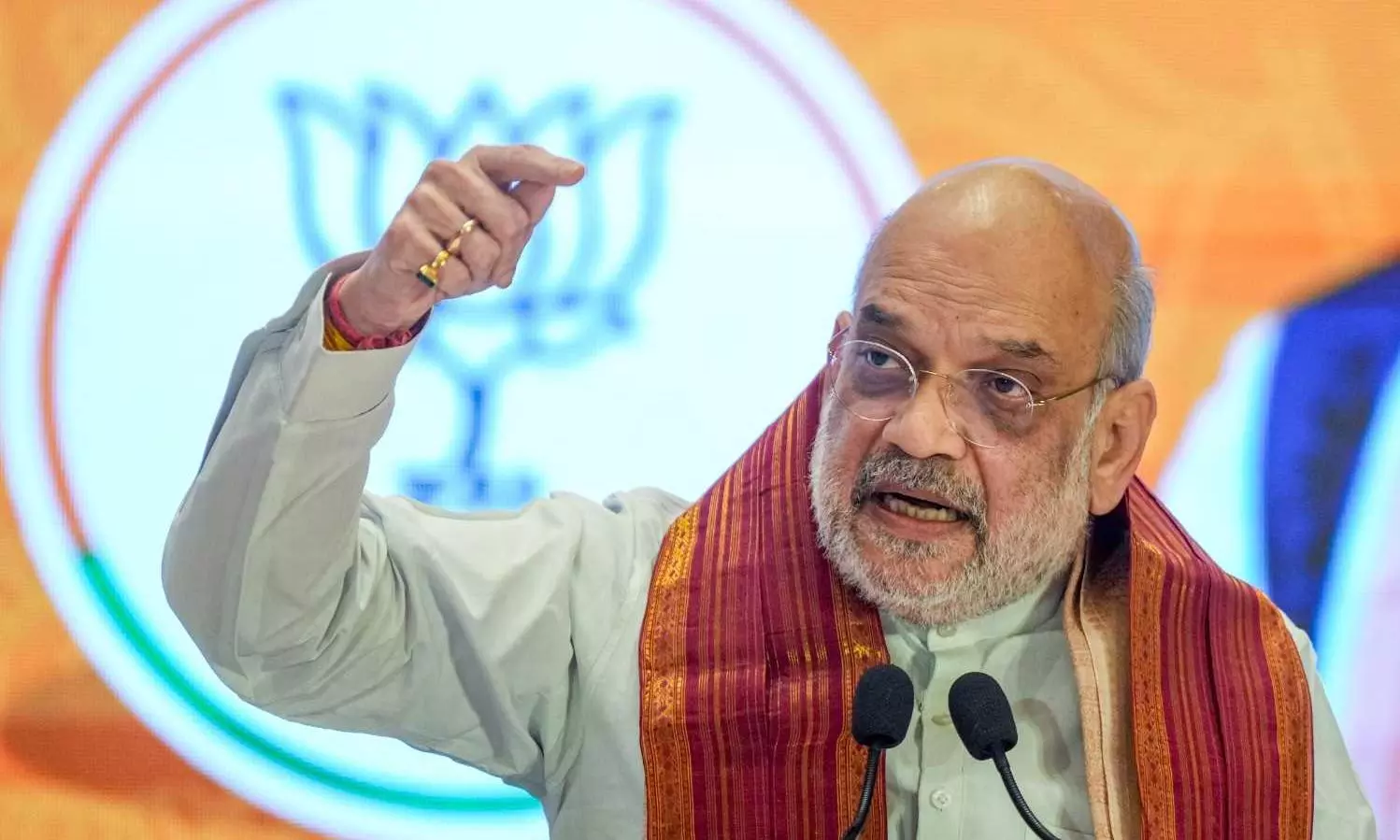
At a recent rally, Union Home Minister Amit Shah warned that a vote for the TMC would usher in 'bhaipo (nephew) raj', saying 'if you vote for TMC again, bhaipo will rule here, not Mamata Didi'. Photo: PTI
From ‘Didi-o-Didi’ to welfare push, softer tone, cultural reset: BJP reworks Bengal playbook
Learning from its 2021 defeat, the party shifts from attacking TMC schemes to outbidding them, tempers its rhetoric against Mamata, and roots its Hindutva pitch in Bengal’s cultural idiom

Five years after an aggressive but ultimately unsuccessful campaign in West Bengal, the Bharatiya Janata Party (BJP) has recalibrated its electoral strategy ahead of this year’s assembly polls. The shift is less about any ideological dilution and more about a change in approach.
The party has moved away from criticising the Trinamool Congress (TMC) government’s welfare schemes, opting instead to compete on the same terrain by promising enhanced benefits.
It has also repackaged its Hindutva plank by blending it with Bengali Hindu cultural symbols and motifs, instead of relying predominantly on the Ram-centric, aggressively-mobilised religious appeal that underpinned its previous campaign.
Another striking departure this time is the toning down of sharp, personalised attacks on Chief Minister Mamata Banerjee by the BJP’s central leadership, a clear break from its earlier, arguably-misjudged strategy of casting the 2021 elections almost as a direct face-off between Prime Minister Narendra Modi and Banerjee.
Lessons learnt from party’s 2021 defeat
The changes reflect lessons drawn from the party’s 2021 defeat, when it fell short despite a high-decibel campaign centred on polarisation, central leadership projection, and direct attacks on Banerjee.
Party insiders and observers describe the changes as a conscious attempt to address specific weaknesses in its strategy that were exposed last time.
Also Read: Mamata’s 'I am the candidate' gambit returns for 2026 Bengal battle
A Delhi-based agency that carried out a confidential survey to assess the party’s strengths and weaknesses identified welfare beneficiary backlash, weak local connect, a sympathy swing towards Mamata Banerjee, and flawed candidate selection as the key factors behind the defeat, a BJP office-bearer told The Federal on condition of anonymity.
Apart from the survey, the BJP leader further disclosed that the feedback collected from its district units echoed the same concerns.
“The feedback was clear. The messaging needs to be rooted in Bengal’s social and cultural realities,” he added.
U-turn on welfare schemes
A key element of this changed approach is the party’s repositioning on welfare schemes, an issue that has now come to define electoral politics in the state.
The BJP in 2021 had been particularly sharp in its criticism of the TMC’s poll promise to introduce the “Lakshmir Bhandar” scheme if re-elected, portraying the proposed direct cash transfers to women as “free money” or handouts aimed at influencing voters. Some BJP leaders had even described it as alms.
The prime minister, after the previous Bengal elections, expanded this criticism nationally, warning against what he termed a “revdi culture” - the practice of seeking votes through freebies - which he described as “very dangerous” for the country’s development.
Also Read: EC transfers 173 police station heads across Bengal ahead of Assembly elections
Earlier this year, remarks by a BJP leader suggesting that women beneficiaries of Lakshmir Bhandar be prevented from voting sparked widespread outrage, with the party forced to distance itself from the comments. The episode highlighted the political sensitivity around welfare schemes, particularly those targeting women, a key voter group that has consistently backed the TMC.
Women voters are seen as central to Banerjee’s electoral success, with welfare programmes forming a critical link between the government and households across rural and urban Bengal.
Rather than questioning the intent of the TMC government’s schemes, the BJP is now trying to outbid them. The party now promises to offer beneficiaries double or more than what is currently provided under the state’s Lakshmir Bhandar and Yuva Sathi schemes. State BJP president Samik Bhattacharya has said that, if elected to power, his party would provide Rs 3,000 per month to women under an “Annapurna Yojana”, which it plans to introduce in place of Lakshmir Bhandar.
Also Read: BJP uses RG Kar victim’s mother’s candidacy to push poll agenda on safety and justice
Taking a U-turn from its earlier criticism of the TMC’s Yuva Sathi, which provides Rs 1,500 per month to unemployed youth, the BJP is now considering a “Yuva Shakti” scheme under which financial assistance is expected to be significantly higher, party insiders said.
The party’s youth wing has also proposed that the BJP manifesto should include a scheme to provide a stipend of up to Rs 25,000 for a certain period for individuals aged 18 to 40 who have completed secondary education.
The political significance of this shift has not gone unnoticed by the TMC. Senior leaders, including Mamata Banerjee and Abhishek Banerjee, have argued that the BJP’s promises effectively validate the popularity of the state government’s welfare model, while warning voters not to be swayed by what they describe as the BJP’s “false promises”.
BJP attacking Abhishek instead of Mamata
Besides policy shifts, the BJP has also moderated its personalised attacks against the TMC supremo.
In 2021, the prime minister’s repeated “Didi-o-Didi” jibe at Banerjee became emblematic of a campaign that critics said crossed into personal attacks. The slogan drew sharp reactions in Bengal, where Banerjee’s image as a regional leader carried strong emotional resonance.
Also Read: Amit Shah, Mamata Banerjee clash over infiltration, SIR in West Bengal
This time, BJP leaders have largely avoided direct personal attacks on the chief minister, focusing instead more on targeting the TMC’s national general secretary Abhishek Banerjee.
At a recent rally, Union Home Minister Amit Shah set the tone for this line of attack, warning that a vote for the TMC would usher in “bhaipo (nephew) raj”, saying that “if you vote for TMC again, ‘bhaipo’ will rule here, not Mamata Didi”.
Blending Hindutva with local cultural symbols
The party is also attempting to modify its cultural messaging.
Rather than over-emphasising on pan-Hindu slogans like “Jai Shri Ram”, the BJP is now blending its Hindutva narrative with local cultural symbols, invoking deities such as Kali and Durga and even local deities such as "Maa Hantakali”.
At the high‑profile Modi’s rally in Kolkata’s Brigade Parade Ground recently, the stage was framed to resemble the iconic Dakshineswar Kali, signalling the party’s new cultural outreach approach.
Also Read: West Bengal elections: Why Owaisi-Humayun alliance could hurt Congress, more than TMC
In the previous assembly elections, the party used the “Jai Shri Ram” slogan as an overbearing political war cry, sometimes almost as a taunt directed at TMC leaders, including Mamata Banerjee.
“The BJP is trying to speak in a more Bengali idiom this time,” said Anusua Roy Choudhury, a retired professor and a political observer.
This shift aims at countering the TMC’s narrative that portray the BJP as culturally alien to Bengal, a factor that had largely shaped voter sentiment.
No tickets to TMC rebels this time
Another area of recalibration is candidate selection.
In 2021, the BJP had poached many leaders from the TMC to expand its electoral support base. But the move triggered internal resentment and questions about ideological coherence.
Also Read: Ram Navami clashes rock Murshidabad in poll-bound Bengal
This time, the party proceeded more cautiously, according to BJP insiders, refusing to give tickets to the TMC rebels. This time, the TMC denied tickets to 74 of its sitting legislators, many of whom had reportedly approached the BJP unsuccessfully for nominations. Sources indicate that some of these former TMC MLAs are now likely to receive Congress tickets.
The BJP has also focused on improving coordination between its state leadership and central command, seeking to present a more unified campaign.