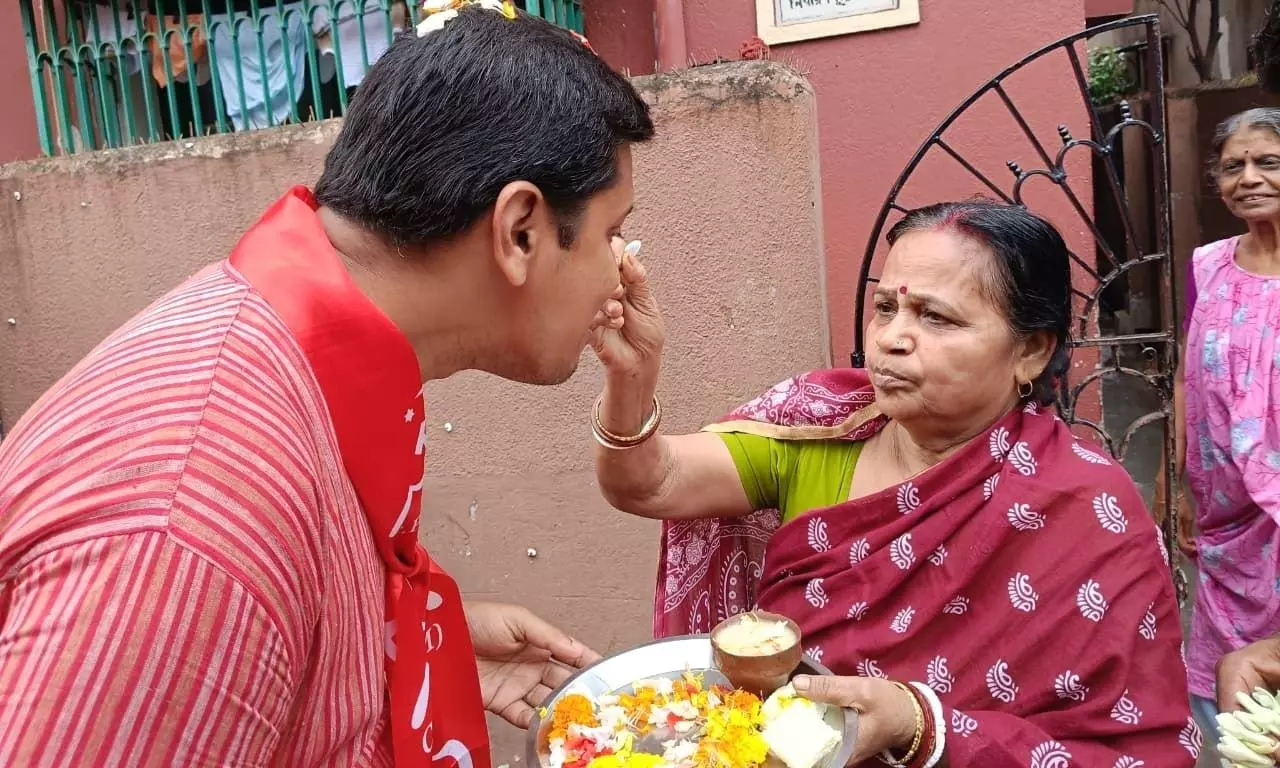
Bengal Leftists shed atheist avatar to keep up with times, don religion on sleeve
As the CPM seeks to regain relevance after years out of power, it has shed its earlier inhibition about embracing religious symbolism for public messaging

In a telling sign of the growing omnipresence of Hindu religious symbolism in West Bengal’s political campaigning, leaders across the state’s political spectrum—including those from the Left, once famously atheist—are embracing spiritual rituals and imagery as never before.
Being demonstratively religious is now politically compelling as society at large is increasingly assertive of its religious identity. And in keeping with the times, Marxist leaders in Bengal, who for decades described religion as a distraction from class struggle, echoing Karl Marx’s famous dictum that “religion is the opium of the people,” have hopped on the bandwagon too.
The compulsion is best reflected when CPI(M) state secretary Mohammad Salim says that the party does not emphasise its atheist ideology in electoral politics. It marks a stark departure from a time when any association with religion was frowned upon within the party, to the extent that even a leader of the late Subhash Chakraborty’s stature drew strong internal censure for performing Kali puja at Tarapith temple.
Looking for divine intervention?
As the party seeks to regain relevance after years out of power, it has shed its earlier inhibition about embracing religious symbolism for public messaging, a repositioning now clearly evident on the ground in the current campaign.
Also read: From ‘Didi-o-Didi’ to welfare push, softer tone, cultural reset: BJP reworks Bengal playbook
Minakshi Mukherjee, a firebrand CPI(M) leader, conducted a yajna, a Vedic fire ritual, pouring ghee into the sacred fire while campaigning in her Uttarpara constituency.
Her party colleague Kalatan Dasgupta began his campaign in Panihati by offering prayers at a temple.
“These are not just isolated personal choices but reflect a deliberate engagement with Hindu rituals as part of the party’s more pragmatic approach to religion to compete with its opponents. It would be naïve for any political party to ignore a societal landscape that is now more infused with religious expression,” said Mohammad Saduddin, a Communist intellectual and author associated with the CPI-affiliated Bengali publication Kalantar.
“The widespread use of religious symbolism by parties across all hues points to an erosion of ideological barriers not only in politics but in society more broadly,” he added, attributing the shift to wider national trends in identity politics.
Hindu vs Muslim, temple vs mosque
The Trinamool Congress (TMC) has increasingly leaned into Hindu symbolism as part of its governance narrative since the emergence of the BJP as a major political force in the state.
The BJP, of course, remains the most vociferous self-proclaimed champion of the Hindu cause, weaving its campaign narrative around Hindutva rhetoric, including claims that the majority community in the state is at risk of being outnumbered by minorities due to demographic changes driven by the alleged influx of illegal migrants from Bangladesh.
The TMC government introduced an honorarium for Hindu priests in 2020, ahead of the 2021 Assembly elections, and followed it up with a spate of temple construction and renovation projects, in a move seen as countering the BJP’s charge that Chief Minister Mamata Banerjee was trying to appease the minority community.
Also read: West Bengal elections: Why Owaisi-Humayun alliance could hurt Congress, more than TMC
This was followed by a series of temple construction and renovation initiatives across the state. Among the most prominent recent example is the government-funded construction of a grand Jagannath Temple in Digha that was inaugurated last year.
The government has also undertaken redevelopment of key pilgrimage sites such as the Kalighat temple in Kolkata and the Jalpesh temple in Jalpaiguri district, while earlier upgrades were carried out at Tarapith and Tarakeswar. It has further announced plans to build the ‘Mahakal Mahatirth’ in north Bengal and the ‘Durga Angan’ complex in New Town, Kolkata, for which the foundation stone was laid last December.
Her government, since 2018, has also been providing annual grant to all the major Durga Puja committees.
Ram Navami contest
The party is now highlighting these policies and projects as part of its Hindu outreach, projecting them as a marker of its cultural and religious credentials.
“Why are they so angry just because we have built a Jagannath temple in Digha? Is it a crime to worship Lord Jagannath in West Bengal?” Mamata asked at several election rallies in recent weeks.
The TMC now even competes with the BJP in organising Ram Navami processions in the state.
Mamata and her party, however, have defended such moves as recognition of Bengal’s religious heritage, though she often frames her rhetoric in terms of pluralism, stating in campaign speeches that “in Bengal, we live with all religious communities in unity” and that “religion means humanity.”
Religion as a political tool
She has also cited Bengal’s literary icons, from Rabindranath Tagore to Kazi Nazrul Islam, to underscore the state’s syncretic tradition amid rising political competition.
Critics say it was Mamata and her party that normalised religious outreach as a political strategy when the TMC-led government introduced an allowance for imams and muezzins soon after coming to power in 2011. The move was widely seen as aimed at expanding the party’s influence in Muslim-dominated areas where the Congress still held sway, particularly in districts such as Murshidabad, Malda and Uttar Dinajpur.
Also read: Ram Navami clashes rock Murshidabad in poll-bound Bengal
After her minority outreach drew flak from Hindu right-wing groups, her government also expanded its engagement with Hindu institutions, stepping up spending on temple construction and renovation and providing financial support to Durga Puja committees.
“That marked a tipping point in breaking the mental block or reservations that existed in society about mixing religion with politics,” said political commentator and author Amal Sarkar. “When a popular government and a mass leader openly use religion as a political tool, it effectively gains legitimacy.”
Building on this trend of the explicit use of religious identity in politics, it acquired a minority dimension this time, with suspended TMC legislator Humayun Kabir launching a new outfit ahead of the upcoming assembly elections, positioning it around minority concerns and promising the construction of a grand Babri Masjid in Murshidabad district.