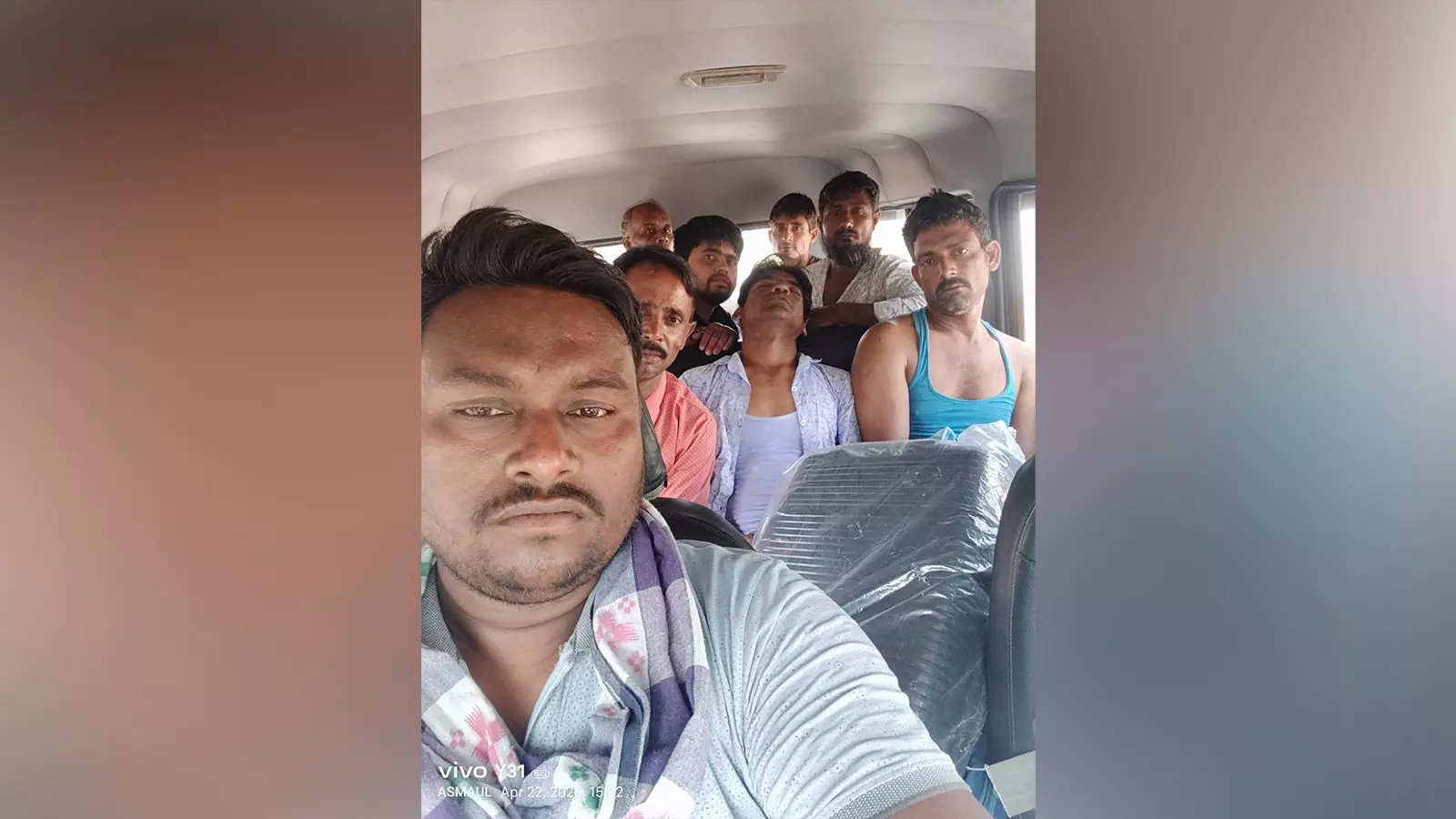
Samayun Sheikh (front) and other migrant workers from West Bengal who hired an SUV to return home in Murshidabad district from neighbouring Odisha to cast votes in the April 23 elections.
Second disenfranchisement? Travel hurdles rob Bengal’s migrant workers of their votes
No special trains, police seizures of vehicles leave thousands stranded as the first phase of polling takes place on April 23

When 36-year-old migrant worker Samayun Sheikh’s name was finally enrolled in the electoral roll, after adjudication, in his home village in Raghunathganj in West Bengal’s Murshidabad district, he thought the hardest part was over, and that he was all set to vote in the Assembly elections of 2026.
It was not.
After weeks of trying and failing to secure train tickets back to Bengal from their workplace in Sambalpur district of neighbouring Odisha, Samayun, along with 63 others from the same district, hired a bus to travel home and vote in the first phase of the state election, which is on Thursday (April 23).
Also read: From land crusade heart, Nandigram emerges as Hindutva hub in Bengal | Ground Report
Police seize bus alleging overcrowding
The vehicle was rented to cover a distance of more than 750 kilometres for Rs 70,000, of which Rs 50,000 was paid in advance. However, disaster struck just before departure from Kuchinda in Sambalpur district, where they work, around 6 am on Tuesday (April 21), as police seized the bus (registration no: WB19G8407) on charges of carrying excess passengers.
The bus (left) which over 60 migrant workers from West Bengal working in Odisha's Sambalpur district hired to return home to cast ballots in the April 23 elections but was seized by the local police; (right) the RTO's release order for the vehicle which was refused by the police.
The workers were asked to deposit a fine of Rs 12,000 at the regional transport office (RTO) in Sambalpur.
“We rushed to the RTO after arranging funds again. But there, we were made to run from one official to another, and were finally told to come the next day. This (Wednesday) morning, around 10 am, the fine was accepted and a release order for the vehicle was issued,” he told The Federal over the phone.
No, the ordeal was not over yet.
Even after the RTO issued the release order, the police did not release the vehicle.
“After waiting for hours and pleading with the police in vain, we finally decided in the afternoon to make alternative arrangements. Some of us booked private vehicles, some got rides on trucks, while a few others took connecting bus journeys,” said Taimur Sheikh, another migrant worker from the group.
Samayun and Taimur, along with six others, finally began their journey home at 3 pm on Wednesday, hiring an SUV for Rs 12,000.
“We had to pool all our savings and even take loans from relatives to cover the shortfall for hiring vehicles. The entire bus fare went to waste,” said Samayun.
However, the group has crossed its fingers crossed till they cross the Odisha-Bengal border and reach their home district and successfully cast the votes on Thursday, thanks to a series of unpleasant experiences.
'Second layer' of disenfranchisement
Samayun and his group are not the only ones to go through such an experience. Thousands of migrant workers from Bengal face what analysts call a “second layer” of disenfranchisement. It is not about names being deleted from voter lists. It is about something simpler — and harder. Getting home to vote.
Also read: Why BJP’s ‘women insult’ pitch may not work in Bengal: 'Not primary concern' | AI With Sanket
Suman Ali, another migrant worker from Murshidabad, however, was less fortunate. Hailing from Lalbagh, he was set to miss voting after failing to secure a train ticket home from Mumbai, where he is employed.
We are desperate to return and vote because who knows, if we do not vote, our names may get deleted again, or our children may face problems enrolling in voter lists in the future.
“No seats are available on any train to Bengal, and airfares have shot up to over Rs 30,000, which is beyond my capacity,” Ali said over the phone.
He added that around 150 migrant workers from Bengal are currently stranded in the Khar Road station area in Mumbai, looking for ways to return home to exercise their franchise.
Migrant workers form a significant electoral constituency in Bengal, with estimates suggesting around 22 lakh voters live and work outside the state. Many are employed in southern states such as Kerala, Tamil Nadu and Karnataka, as well as in Maharashtra and Delhi.
People ride on the roof of a bus near Howrah Railway Station as they leave for their hometowns across West Bengal on the eve of the Assembly elections, on April 22, 2026, to cast ballots on April 23. Photo: PTI
Over the past decade, the state has emerged as a major labour-exporting one, with workers leaving districts such as Murshidabad, Malda, Uttar Dinajpur and South 24 Parganas in search of better wages.
“They are politically aware and often highly motivated to vote,” said Murshidabad-based social worker Mosarekul Anwar. “In closely contested seats, even a small drop in turnout among migrants can matter.”
This year, the urgency to return home has increased amid concerns about identity and enrolment in the electoral roll.
Also read: Election Commission's transfer puzzle: Is India's federalism at risk?
“We are desperate to return and vote because who knows, if we do not vote, our names may get deleted again, or our children may face problems enrolling in voter lists in the future,” Samayun said, reflecting the extent of apprehension the special intensive revision exercise has generated, particularly among Muslims.
It has triggered a rush among migrant workers to travel back and cast their vote in person.
But for many, that urgency is colliding with a hard logistical reality.
No special trains for Bengal polls
Railways remain the primary mode of transport for long-distance migrant workers, particularly those travelling from southern India, with journeys that can take anywhere between 30 and 48 hours.
With no additional or special train services arranged ahead of the Bengal assembly elections, many migrant workers employed across the country have either been unable to return home or have been forced to pay exorbitant fares for private transport.
Asraful Islam, who works in Kerala’s Kannur district as a mason, said he had been trying for days to secure a train ticket but failed. “We want to go home and vote. But there are no tickets available. Even the general compartments are overcrowded. Finally, we hired buses,” he said.
Kerala hosts an estimated 500,000 to 600,000 workers from Bengal.
“There are simply not enough trains,” said Asif Faruk, general secretary of the Parijayi Sramik (migrant workers) Aikya Mancha.
“People are trying through agents, through apps, through everything, but tickets are not available,” he said.
The platform had requested the railways and the Election Commission well in advance, urging them to arrange additional train services.
“Even a limited number of special trains could have enabled large numbers of workers to travel back and participate in the democratic process,” he added.
Also read: In Bengal's Muslim heartland, quiet discontent tests TMC's grip
According to information provided by Eastern Railway in response to a Right to Information query filed by Faruk, no trains were operated specifically for migrant workers.
Nearly 2,000 special trains ran during Bihar polls 2025
This stands in sharp contrast to the nearly 2,000 special trains run by Indian Railways for Bihar around the November 2025 assembly elections and the Chhath Puja festival.
Unlike voter roll deletions, which can be quantified and contested, the impact of travel shortages is harder to measure and therefore less visible.
Also read: Bengal elections: Peace came to Jangalmahal, but prosperity didn't follow | Ground Report
“There is no official restriction preventing them from voting,” said a rights activist working with migrant communities. “But if there are no trains, or tickets are unaffordable, the outcome is the same, they are excluded,” said Ranjit Sur of the Association for Protection of Democratic Rights.