west bengal elections
Why BJP’s ‘women insult’ pitch may not work in Bengal: 'Not primary concern' | AI With Sanket
Senior journalists tell The Federal that local issues, welfare schemes and voter list concerns may outweigh the saffron party's narrative against Mamata Banerjee

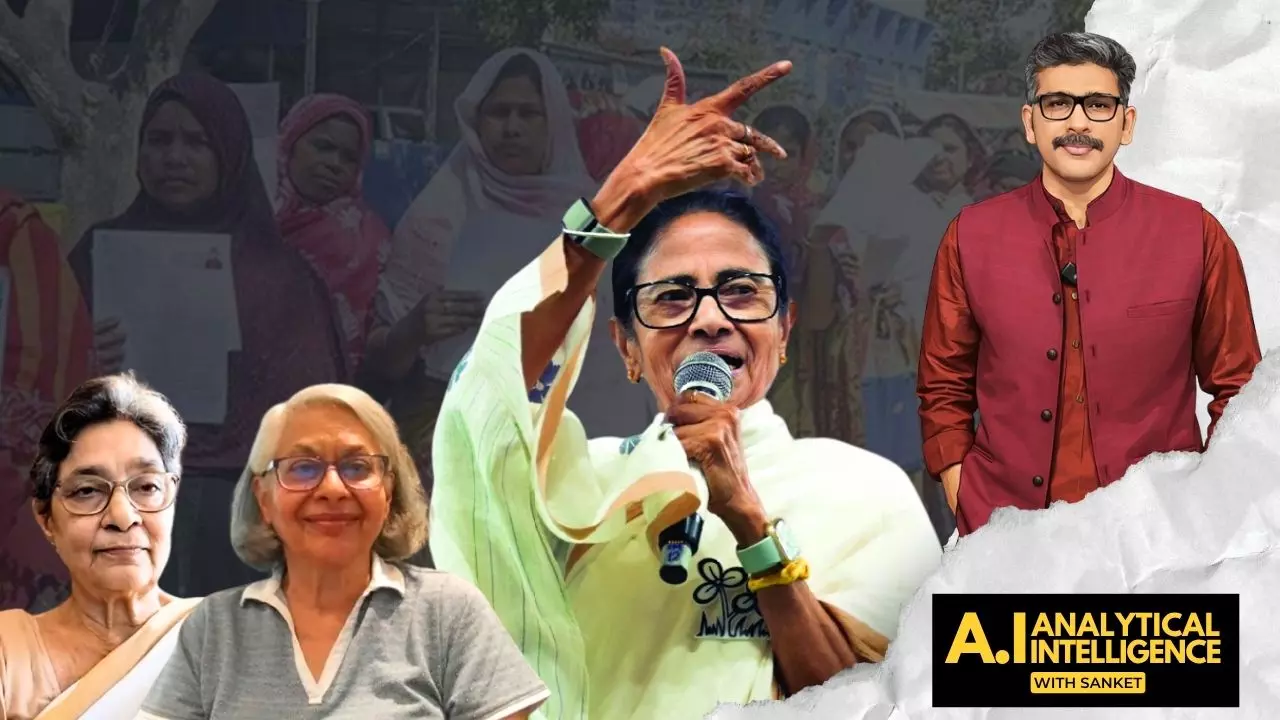
As Prime Minister Narendra Modi and his Bharatiya Janata Party (BJP) try to make a villain out of the opposition after the women's quota amendment bill failed to cross the Lok Sabha hurdle last week, senior journalists Shikha Mukherjee and Arati R Jerath came together in this episode of AI With Sanket to discuss whether the saffron party's "women being insulted" narrative to corner West Bengal Chief Minister Mamata Banerjee ahead of the state elections would pay off.
Also read: Beyond empowerment, India needs women leaders for its own good
Mukherjee feels it would not. “The BJP is wrong at this point—women’s reservation is not the primary concern in West Bengal right now,” she told The Federal.
The BJP’s campaign, which initially revolved around state issues and electoral roll revisions, has pivoted sharply toward women-centric rhetoric, particularly after the much-debated amendment Bill failed to gather a two-thirds majority.
Prime Minister Modi has accused Bengal's ruling Trinamool Congress (TMC) of blocking women’s representation. Mukherjee felt such a narrative may not align with ground realities.
“The primary concern is whether people will be able to vote peacefully and whether their names are on the voter list,” she said, highlighting anxieties around voter deletions and tribunal processes.
Mukherjee pointed out that nearly 60 per cent of those affected by deletions are women, which could create resentment rather than support for the BJP’s campaign.
BJP's 'hypocrisy' exposed?
Questions around women’s representation have also exposed contradictions in the BJP’s own record. The party has fielded only about 11 per cent women candidates in the current election, significantly lower than the TMC.
Mukherjee noted that Mamata’s party has consistently promoted women leaders and ensured higher representation over the years.
Also read: 'Brand Modi' under strain? Campaign makeover raises trust question | Capital Beat
“Women in Bengal are confident their voices are not being suppressed,” she said, adding that the state has long experience with grassroots reservation through panchayats.
Jerath echoed this, stressing that symbolic issues such as parliamentary reservation may not have an immediate electoral impact.
“Assembly elections are fought on local issues. Women’s reservation in Parliament is still an abstract idea for many voters,” she said.
Local factors
Jerath emphasised that leadership and welfare schemes will play a bigger role than rhetoric. She pointed out that Mamata remains a strong, identifiable face, while the BJP lacks a chief ministerial candidate in the state.
“This is not a vote for Narendra Modi. It has to be a vote for a local leader, and the BJP does not have one,” she said.
She added that welfare schemes—particularly direct cash transfers to women—have been a decisive factor in recent elections across states.
“If anything wins women’s loyalty, it is money coming into their bank accounts every month,” she noted, referring to schemes expanded by the TMC government.
Narrative battle
Mukherjee argued that the BJP’s campaign may be an attempt to shift focus from the controversies surrounding electoral roll revisions.
However, she said such narrative management may not succeed in the face of “lived experience” on the ground.
“Nothing beats lived experience. People standing in long queues, unsure if they can vote—that matters more than hypothetical debates on reservation,” she said.
She also observed that information consumption is increasingly shifting to digital platforms, where narratives are more fragmented and contested.
“The national media framing does not always match what people are seeing on their phones,” she added.
Missed opportunity
Both panellists suggested that the BJP may have missed an opportunity to capitalise on anti-incumbency against Mamata, who has been in power since 2011.
Jerath said the saffron party could have focused on development and governance issues instead.
“They probably stood a better chance if they had projected a strong local face and focused on anti-incumbency,” she said.
Also read: Nari Shakti: A convoluted stratagem to preserve male dominance
Instead, she argued, issues such as electoral roll revision have created insecurity among voters.
“It has made people anxious about their rights and benefits, which could backfire,” she said.
Strategy gaps
Mukherjee was more blunt in her assessment of the BJP’s long-term strategy in the state.
“You can’t make a big push unless you have a positive agenda for the local population,” she said.
She criticised the party for focusing primarily on attacking Mamata without offering concrete solutions on employment or economic revival.
“They keep talking about problems, but what are they going to do about them?” she asked.
Mukherjee added that industrial and economic concerns remain central in a state such as Bengal, and voters expect clarity on these issues.
BJP faces uphill task
On the question of electoral prospects, both speakers were cautious but suggested the BJP faces an uphill battle.
Mukherjee said the party appears to be at a disadvantage and unlikely to win unless there is a dramatic shift.
Jerath agreed that a BJP victory is unlikely but said the party’s realistic goal may be to increase its seat tally and emerge as a stronger opposition.
“If they cross into three figures, they can become a strong opposition and make governance difficult for Mamata Banerjee,” she said.
Also read: Women's quota: Opposition has not averted delimitation danger, only deferred it
As the campaign enters its final stretch, the BJP’s attempt to turn women’s representation into a central electoral issue faces significant challenges in West Bengal.
With voter list concerns, welfare benefits, leadership clarity, and local issues dominating public discourse, the panellists suggest that the “women insulted” narrative may have limited traction on the ground.
The content above has been transcribed from video using a fine-tuned AI model. To ensure accuracy, quality, and editorial integrity, we employ a Human-In-The-Loop (HITL) process. While AI assists in creating the initial draft, our experienced editorial team carefully reviews, edits, and refines the content before publication. At The Federal, we combine the efficiency of AI with the expertise of human editors to deliver reliable and insightful journalism.