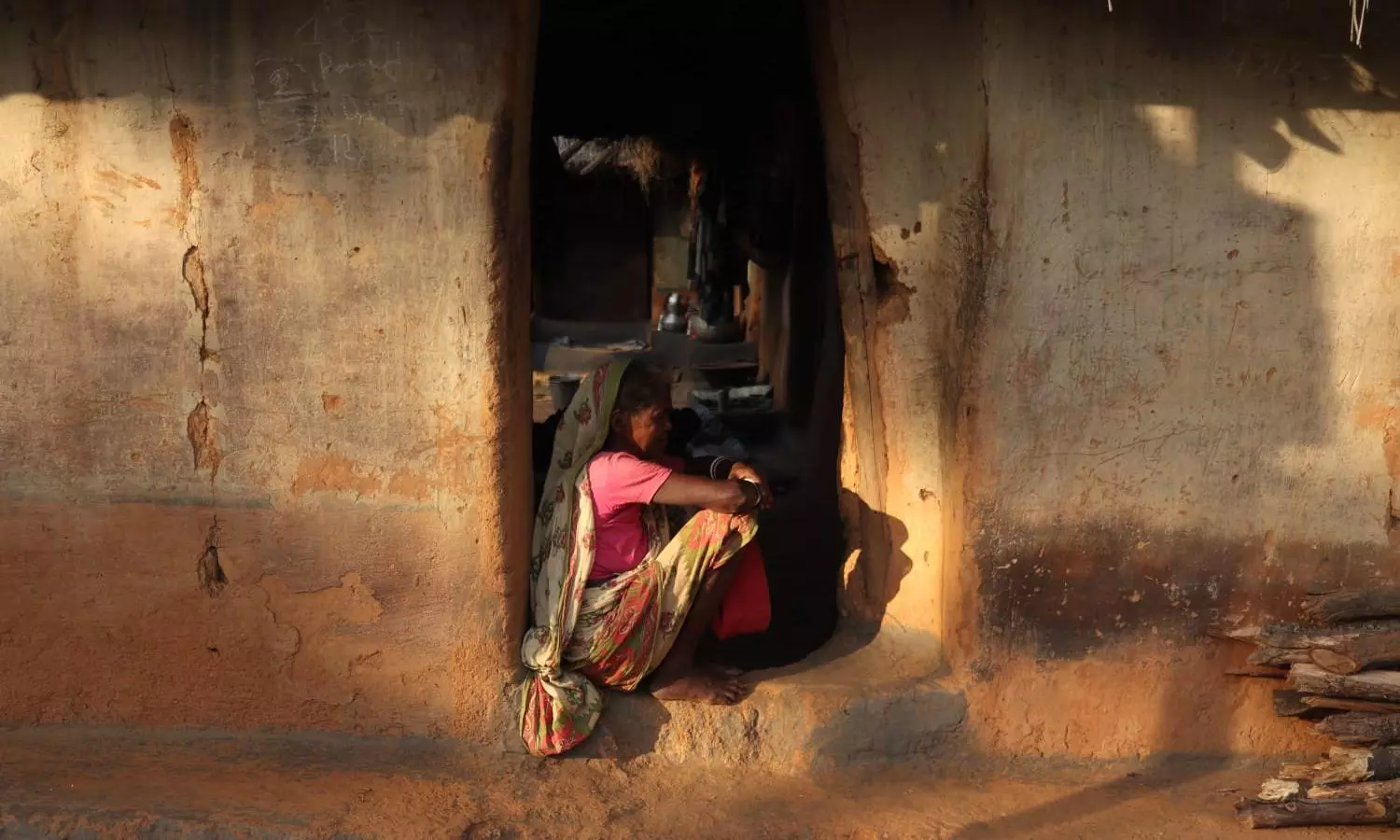
While the region witnesses return of tranquility after the Maoist disturbance ends, development challenges persist with jobs, water and infrastructure dominating voter concerns ahead of the 2026 electoral battle. Photo: Abhishek Sharma
Bengal elections: Peace came to Jangalmahal, but prosperity didn't follow | Ground Report
A decade after the Maoist insurgency faded, the red-soil belt of the state heads into polls haunted by socio-economic challenges that bar long-time development

A wooden plough weighed heavily on his ageing, frail shoulders as 65-year-old Sambhu Soren trudged back from the fields after another day of arduous labour.
In the rain-fed farmlands of Jangalmahal region of south-western West Bengal, where agriculture still depends almost entirely on the monsoon, this has been his routine for years.
'Has our life changed?'
Governments have come and gone, promises have been made and forgotten, but little has changed in the life of Shambhu, a farmer from Kalabani village in Jhargram district. “Peace has come, yes,” he said, pausing to wipe sweat off his brow. “But has our life changed?”
Also read: Holy Mackerel! BJP, TMC in serious debate over fish ahead of Bengal polls
That question now echoes across Jangalmahal—the red-soil belt spanning Purulia, Jhargram, Bankura and parts of West Midnapore—as Bengal heads toward another Assembly election this month.
2011 political shift
There was a time when fear defined life in the region that accounts for about 40 assembly seats. Villages would fall silent before dusk, and the sound of boots or gunfire at night was not uncommon. The Maoist insurgency had turned large parts of the belt into a conflict zone, feeding on deep-rooted poverty, alienation and lack of development.
Incomplete houses, modest village roads, water scarcity... life in Jangalmahal still has a long to way to go toward fulfilment. Photo: Abhishek Sharma
“We were caught in the crossfire,” recalled Rameswar Kisku, who was arrested along with his wife and neighbours in 2003 in connection with a Maoist attack on police in Bandwan, in which the officer-in-charge of the Bandwan police station was killed.
Also read: Bengal SIR’s 91 lakh voter deletions shrink TMC cushions, unsettle BJP’s Matua base
“The Maoists would come at night, asking for food and shelter at gunpoint. And the next day, the police would arrive and brand us as Maoists or their sympathisers. We had nowhere to go,” said Kisku.
There is a severe water crisis here. We have to walk far to fetch water. And we women have no choice but to bathe in the open, by the roadside. It is humiliating.
The political turning point came after 2011, when the Trinamool Congress (TMC) came to power and adopted what party leaders often describe as a “twin-track” approach, combining security measures with outreach, welfare delivery and dialogue aimed at isolating insurgents from local communities.
“Maoist leaders were given jobs. Many from our area were even absorbed into the police. But look at me, we were innocent and yet the case against me is not withdrawn,” Kisku said, with a note of irony.
'One of TMC's biggest achievements'
Villagers like Kisku, however, acknowledge that the fear is gone and that Maoism is a closed chapter.
“This is one of the biggest achievements of our 15-year rule. Jangalmahal is now smiling because the law and order are definitely in order,” TMC candidate from Jhargram Mangal Soren told The Federal.
But even as the ruling party highlights the restoration of peace as a defining success, a quieter, more complex narrative is emerging on the ground. It is one of rising expectations and growing dissatisfaction.
For many residents, the end of violence more than a decade ago should have led to sustained economic transformation over the years. Instead, they say, the progress has been uneven at best.
Also read: Mamata's pre-poll strike: Bengal CM to form development boards for five communities
“Yes, there are roads in most villages. Some schemes have also helped,” said social activist Deben Soren, who is also the traditional village headman of Kalabani. “But jobs, industry, and irrigation—they are still missing.”
Major concerns remain
Across villages, three concerns recur consistently—unemployment, lack of irrigation, and allegations of corruption in welfare delivery.
Agriculture, the backbone of the region, remains overwhelmingly dependent on rainfall. Large stretches of farmland lie fallow during dry months due to inadequate irrigation infrastructure.
Sambhu Soren, a farmer from Kalabani village in Jhargram district in West Bengal's Jhargram district located in the Jangalmahal area, asks whether peace has changed the life of people like them for the better. Photo: Abhishek Sharma
“You get one crop if the rains are good,” said Sambhu Soren. “Otherwise, nothing.”
It is not just irrigation. In many villages across the region, known for significant groundwater stress, even potable drinking water is not adequately available.
“There is a severe water crisis here. We have to walk far to fetch water. And we women have no choice but to bathe in the open, by the roadside. It is humiliating,” said Nayan Manna, a resident of Dakshin Sol village in Midnapore.
The lack of local employment is another major issue weighing heavily on the voters in the region as they prepare to cast their votes on April 23, when the first of the two phases of polling will be held. Unemployment has led to large-scale migration, particularly among young men.
‘No work after farming season’
Jangalmahal is now among those regions of Bengal with the highest outmigration in the state, second only to districts such as Murshidabad, Malda and Cooch Behar. Workers migrate to Delhi, Maharashtra and southern states in search of construction and factory jobs.
Even those who remain often rely on irregular daily wage labour or government schemes. “There is no work here after the farming season,” said 34-year-old Srimanta Soren of Kalabani, who works as a daily wage labourer despite having a graduation degree and a diploma in physical education.
“There are many like me in my village alone,” he added. “Many have been forced to migrate.”
Daily wages are as low as Rs 300, and even that is irregular. “We hardly get work for 15 days,” Soren added.
Rural unemployment has been further worsened by the Centre’s withholding of funds, such as those under the former Mahatma Gandhi National Rural Employment Guarantee Act, for Bengal since 2022.
The ruling party views the fund freeze as a deliberate political ploy by the Bharatiya Janata Party (BJP)-led Centre to pose challenges to its government, even at the cost of hurting the people of Bengal. “This step-motherly attitude towards West Bengal is hurting the people. Without funds, how can we ensure development?” asked Soren.
BJP accuses of a lack of development
Opposition parties, however, are pulling out all the stops to seize on unemployment and other governance deficiencies, accusing the ruling party of failing to translate peace into sustainable development in the region.
“People of Jangalmahal got nothing. Where is the work? There was so much talk about industries in Salboni (Paschim Medinipur district), but where is it on the ground? Today, educated unemployed youth, those with M.A., B.A., M.Com, B.Tech, even doctorate degrees, are leaving for other states in search of jobs,” said BJP candidate from Medinipur, Sankar Kumar Guchhait.
They are going to Uttar Pradesh, Gujarat, and even Mumbai. Where is the work here? No industry has come up in Salboni, none in Garhbeta (Paschim Medinipur district). No real work has happened in Jangalmahal. Show me even one instance of the chief minister inaugurating an industrial factory,” he added.
“If you go village to village in Jangalmahal, especially in the remote areas, you will see how people are really living. Farmers are not getting a fair price for their crops. They are forced to buy fertilisers, seeds and pesticides at high costs, but are unable to recover even their basic inputs and labour costs, let alone make a profit. This is the reality for farmers here. There is still not enough water for agriculture, with a persistent lack of proper irrigation systems,” said the Socialist Unity Centre of India (Communist) party's Medinipur candidate Sushrita Soren.
The campaign of SUCI(Communist) candidate from Medinipur Assembly constituency of West Bengal, Sushrita Soren, ahead of the 2026 Assembly elections. Photo: Abhishek Sharma
TMC govt's mixed performance
It is not that the state government's welfare schemes have not made a visible presence on the ground. However, it has not proved to be adequate.
Cash-transfer programmes such as Lakshmir Bhandar, pension schemes for the elderly, and initiatives such as Sabooj Sathi, which provides bicycles to students, are widely acknowledged by beneficiaries.
“If I get something, I won’t deny it. I received Lakshmir Bhandar and also got money to build a house, but it was not enough to complete it,” said Manna, who also spoke of the water crisis in her village, reflecting a mixed picture of the government’s performance.
Welfare alone no longer satisfies a population whose aspirations have grown alongside improved connectivity and exposure. “People now want stable income, not just schemes,” said Buddeshwar Murmu of Adivasi Sengel Abhiyan (ASA), a tribal rights organisation.
Corruption allegations
Another persistent complaint is about alleged corruption in the implementation of government programmes. Allegations range from favouritism in beneficiary selection to cuts demanded by intermediaries.
Housing remains a particularly sensitive issue. Under the Bangla Awas Yojana (Banglar Bari), beneficiaries receive financial assistance to build homes. But, according to villagers, the sanctioned amount of Rs 1.20 lakh is insufficient, given rising material costs.
“You cannot build a proper house with this money,” said Lulu Mandi, a resident of Amlasole village in Jhargram district. “We have to either borrow or leave it incomplete.”
Farmers are not getting a fair price for their crops. They are forced to buy fertilisers, seeds and pesticides at high costs, but are unable to recover even their basic inputs and labour costs, let alone make a profit. This is the reality here.
There are also complaints about deserving families being left out, fuelling resentment at the local level.
Privately, even some within the ruling party acknowledge the problem. “Funds get sanctioned, but not everything reaches the ground,” admitted a local TMC leader on condition of anonymity. “There are leakages.”
In the 2021 assembly elections, the TMC dominated Jangalmahal, winning 28 of the region’s 40 seats. But five years later, party insiders concede that the electoral mood is more uncertain.
Also read: Kudmi test continues for TMC in Jangalmahal; will new outreach work?
“There is no wave against us,” said another TMC functionary. “But there is definitely some anti-incumbency.”
Identity politics a challenge
The region’s demographic complexity adds another layer to the political contest. With a large tribal and Kurmi population, identity politics continues to play an important role.
An influential Kurmi organisation has even issued a “no vote” call against the ruling party, reflecting simmering discontent among sections of the community.
BJP banks on governance failures
The BJP, the principal opposition in the state, is attempting to capitalise on these grievances. Its campaign focuses on unemployment, alleged corruption, land rights issues and demands related to tribal identity.
However, the party also faces its own challenges.
Also read: Modi’s six promises as he calls out TMC rule as 'Nirman Sarkar'
Concerns over policies such as a proposed uniform civil code and forest land regulations have made tribal voters cautious.
“There is hesitation,” said Buddeshwar. “The BJP is gaining ground in some pockets, but trust among tribal communities is not automatic.”
At the same time, grassroots mobilisation around indigenous religious identity, particularly campaigns by the ASA emphasising 'Sarna' or traditional tribal beliefs, has added a new dimension, potentially complicating the BJP’s Hindutva-centric outreach.
Despite the criticisms, it would be inaccurate to portray Jangalmahal as unchanged.
Infrastructure has improved significantly over the past decade. Roads, bridges, schools and healthcare facilities have expanded.
Tourism has begun to take root, with Belpahari in Jhargram district alone having nearly 70 homestays, creating new and limited opportunities.
But the pace of change has not kept up with rising expectations. “Earlier, people wanted peace,” said Deben. “Now they want prosperity.”
As the election approaches, the central question in Jangalmahal is no longer about security, but about delivery.