



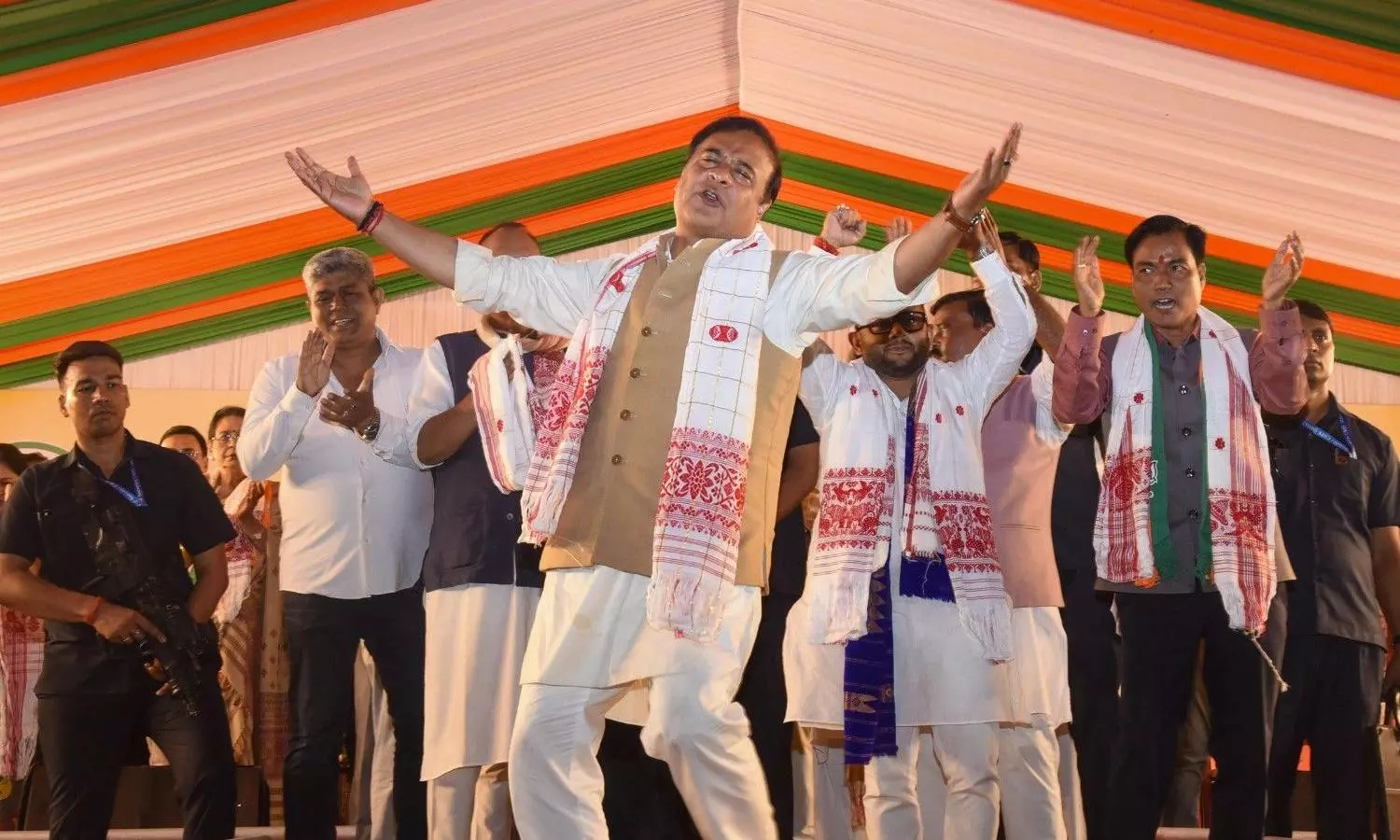
Assam Chief Minister Himanta Biswa Sarma at a Vijay Sankalp Sabha rally ahead of the April 9 Assembly elections, in Guwahati, on April 5, 2026. Photo: PTI
Assam election saw industrial-scale AI disinformation campaign: Report
DAHRD report says '6-tier content ecosystem' used AI to target political rivals; deepfakes, minority targeting, weak vigilance raise concerns on electoral integrity

As Assam goes to the polls on Thursday (April 9) in a highly charged, polarised political ambience, a report on the use of artificial intelligence in the campaign reveals some worrying facts.
What we are seeing in the northeastern state is the “first industrialised AI disinformation operation in an Indian state election”, says a report by the Diaspora in Action for Human Rights and Democracy (DAHRD), a civil society organisation based in the Netherlands.
Also read: Pawan Khera row: 'Assam Police search is fraud being played on public' | Capital Beat
The election-monitoring report, titled AI-Weaponised Disinformation, Systematic Exclusion, and Institutional Failure in India’s 2026 Assam Assembly Election, says the campaign was far from a conventional one. Rather, it was a “a documented architecture of disinformation that manufactures an altered reality—one in which an entire community is simultaneously dehumanised, disenfranchised, displaced, and erased from cultural memory”.
Source: DAHRD report on Assam elections 2026
Source: DAHRD report on Assam elections 2026
Weaponised disinformation
The 72-page report shares several facts to back its claim. According to the DAGRD, it checked 273 social media accounts across Facebook, Instagram and X with a combined follower reach of more than 407 million, which is slightly less than the population of the European Union, to find that the campaign was run targeting a particular community.
Assam is the laboratory. The rest of India is the intended market: DAHRD report
To support its assertion that a massive AI-run campaign was being held for the elections, the report said 432 AI-generated posts on Facebook and Instagram reached more than 45 million views. A single Instagram account, politoons, accounted for 88 per cent of all AI content views. It generated more than 40 million views across 102 AI posts.
Also read: Identity politics, beef row turn Assam's debut seat in Guwahati into volatile contest
With just a 1 per cent engagement rate, a solitary post within this network can reach four million individuals—one-sixth of the registered voters in Assam.
'An industrialised operation'
“A total of 432 posts across Facebook and Instagram were classified as Very Likely or Likely AI-generated using a 13-signal detection rubric, generating 45.4 million views and over 100,000 likes. The operation was industrialised, not improvised: a six-tier content ecosystem produced synthetic images, deepfake videos, and AI-generated communal content at volume,” the report said.
The operation was front-loaded: 70 AI posts were made in January, 58 in February, and 18 in March. A full-fledged narrative was in place by the time the Model Code of Conduct came into effect on March 15.
Source: DAHRD report on Assam elections 2026
Talking about the role of deepfakes, the report said 31 of them targeted Gaurav Gogoi, the main Opposition face and the Congress’s chief ministerial candidate in the state. He was projected as a Pakistani agent and Muslim sympathiser. The deepfakes targeting Gaurav, an MP, were distributed through official BJP accounts and even a verified handle belonging to a cabinet minister of the state.
Gaurav’s British wife, Elizabeth Colburn, was not spared either, even though she is not into politics, and it was unprecedented. “Six AI-fabricated videos targeted Gogoi’s wife Elizabeth Colburn — a private individual holding no public office—with intimate and communal scenarios. No comparable deepfake campaign targeting a political spouse has been documented in any previous Indian election,” it said.
Four operations targeting Muslims
Explaining an ‘Exclusion Architecture’ targeting Assam’s Muslim communities, the report said four such operations were being run simultaneously against the minority communities.
Also read: Congress accuses Assam CM's wife of holding multiple foreign passports: What rules say
They are: dehumanisation through AI content and 18 verified statements made by Chief Minister Himanta Biswa Sarma; a voter-roll purge removing 2.43 lakh names alongside a delimitation exercise that reduced Muslim-majority seats from 35 to 20; a 68-post eviction campaign hailed as governance; and the systematic removal of the 17th-century Sufi saint Azan Fakir from Assamese cultural identity.
Also, for the first time, the AI propaganda was directly transformed into enacted legislation within a single electoral cycle. The narrative of "Land Jihad" evolved into a law restricting property rights. The propaganda was, therefore, codified into law.
Breach of MCC
Besides the campaign, even institutional accountability failed, the report said.
A total of 119 breaches of the MCC resulted in no enforcement actions by the Election Commission, it added. There were no takedowns of platforms. The judiciary arranged its hearing 12 following the polling, on April 21.
Source: DAHRD report on Assam elections 2026
Most notably, Himanta acknowledged on record that the terminology used in his campaign was intentionally varied to avoid legal responsibility — even though the targeting remained consistent.
Also read: Late Congress-Raijor Dal alliance may help AIUDF in Assam's minority-dominated Dhubri
“We had not added the word Bangladeshi—it was constitutionally and legally wrong. But we will correct it and post it again,” he said publicly on March 12.
The DAHRD report also said that the Assam model was not found to be restricted to its border. Even in neighbouring West Bengal, the 2026 voter roll saw millions of voters getting suspended under a similar mechanism. Bengal is also going to elections this month, on April 23 and 29.
“Assam is the laboratory. The rest of India is the intended market,” it said.