Pawan Khera row: 'Assam Police search is fraud being played on public' | Capital Beat
Panellists debate legality, timing, and political motives after Assam Police search Congress leader Pawan Khera’s Delhi home amid passport fraud allegations

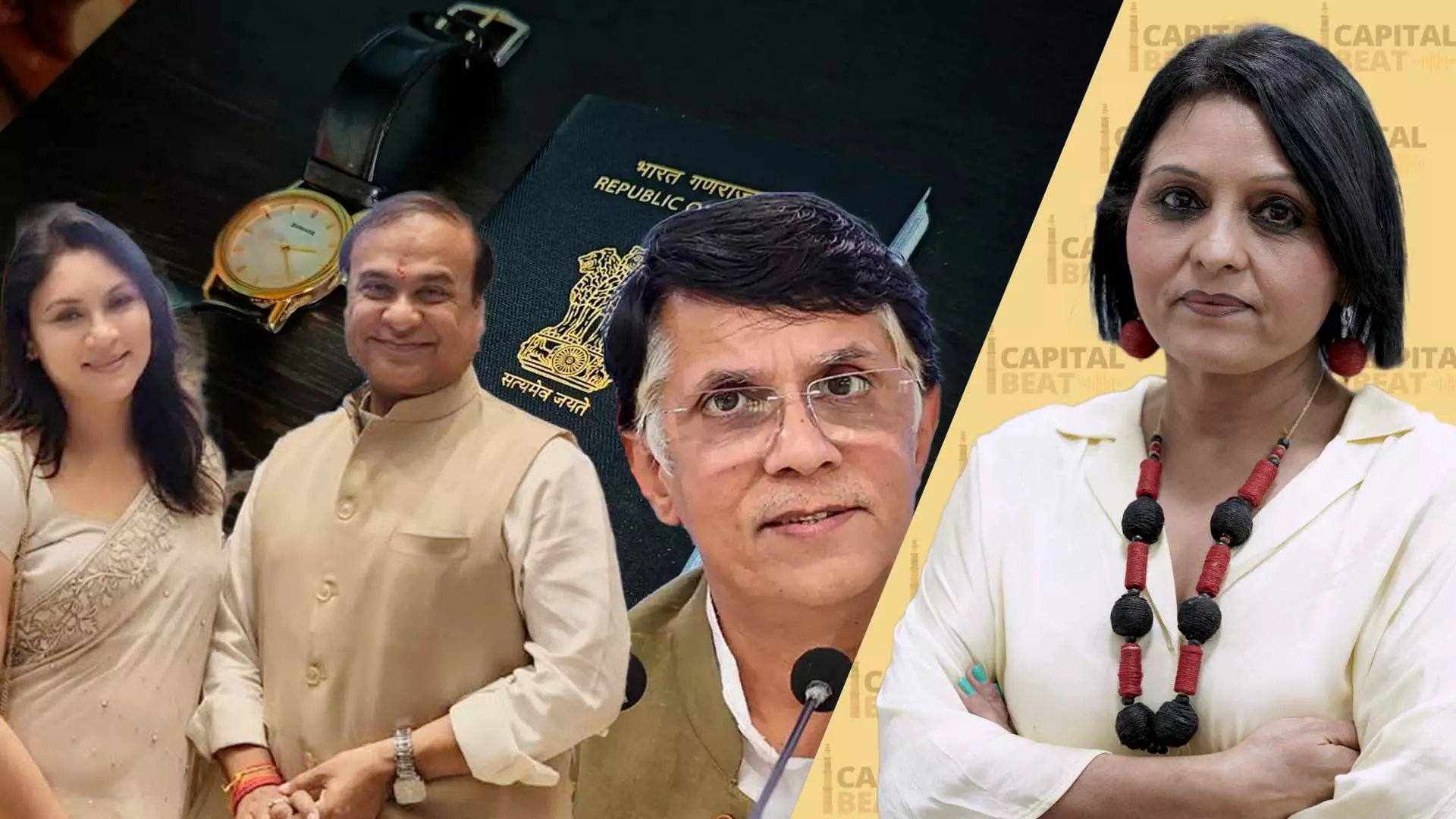
A controversy erupted after Assam Police conducted searches at Congress leader Pawan Khera’s home in Delhi following an FIR filed over allegations he made against Assam Chief Minister Himanta Biswa Sarma’s wife, Rinki Bhuyan Sarma.
On Capital Beat, The Federal spoke to former IPS officer Yashovardhan Jha Azad, senior journalist Javed Ansari, and The Federal’s Samir Purkayastha to unpack the legal, political, and electoral implications.
Police action
Assam Police, assisted by Delhi Police, searched Khera’s residence in the Nizamuddin area a day after an FIR was registered against him. The case stems from allegations Khera made during a press conference claiming that Rinki Bhuyan Sarma held multiple passports and had links to shell companies abroad.
Also read: Assam Police reach Congress leader Pawan Khera’s Delhi residence for questioning
“This is a fraud being played on the public… a complete waste of state machinery,” said Azad, sharply criticising the Assam Police’s action.
The timing of the action—during the Model Code of Conduct ahead of elections—raised immediate questions. However, Azad clarified that the code does not bar police action in alleged criminal cases.
“Model code of conduct does not prohibit police action against alleged criminal activity,” Azad said, adding that the issue lies not just in legality but in the manner and urgency of the action.
He questioned the need for such swift movement: “Within 12 hours of the FIR, police reached Delhi. What was the urgency?”
Legal questions
Azad also raised concerns about the nature of the case itself. He pointed out that if the FIR pertains to criminal defamation, it is a bailable offence with a maximum punishment of two years.
Also read: Kharge, Himanta clash over corruption allegations amid Khera probe row
“In such a case, there is no reason for arrest. Even if arrested, bail has to be granted,” he said.
He further questioned the necessity of a physical search. “If documents were needed, they could have been requested. The questioning could have been done via video conference,” he added.
The former IPS officer termed the exercise a “colossal waste of money” and suggested that such actions should be scrutinised.
Political optics
For Ansari, the issue goes beyond legality and enters the realm of political theatre. He argued that both sides are engaged in narrative-building during a crucial election period.
“You make an allegation and then events overtake you. Nobody revisits the truth after elections,” he said.
He stressed that similar allegations made by both sides should be treated equally. “There cannot be one yardstick for Khera and another for the Chief Minister,” Ansari noted.
The senior journalist also questioned the role of institutions, particularly during elections, when the Election Commission (EC) is expected to oversee administrative neutrality.
Narrative battle
Purkayastha described the episode as a “classic pre-election controversy”, highlighting how perception rather than proof often shapes political outcomes.
“There is no verified proof yet. But perception is what matters,” he said.
According to him, the BJP is attempting to counter the Congress narrative by portraying Khera as evasive. “Today’s developments are meant to show that Khera has something to hide,” he explained.
At the same time, he noted that allegations against Himanta could resonate more strongly with certain voters due to pre-existing perceptions.
Unequal response
A key point raised during the discussion was the alleged disparity in institutional response. While swift action followed the FIR against Khera, panellists questioned whether similar urgency was shown in examining allegations made against others.
Purkayastha pointed out that a complaint seeking cancellation of Himanta’s nomination had not seen comparable action.
“It is evident that two yardsticks are being applied,” he said.
Ansari echoed this concern, asking whether authorities had even conducted preliminary inquiries into counter-allegations.
Election impact
With Assam heading to polls, the controversy is expected to influence voter perception—particularly among urban and younger voters.
Purkayastha noted that the issue has gained traction on social media, potentially amplifying its reach.
However, he added that rural voters may remain less affected by such controversies.
Azad, meanwhile, dismissed the entire episode as a political spectacle. “Both sides benefit from publicity. We are all sitting here discussing it—that is the objective,” he remarked.
System under strain
Ansari delivered the most sobering assessment, warning of long-term damage to democratic institutions.
“I can tell you who is losing—the system, the rule of law, the democratic process,” he said.
He argued that repeated episodes like this erode public trust in institutions and governance.
“The credibility of politicians is already low. If this continues, the situation will become irreversible,” he added.
(The content above has been transcribed from video using a fine-tuned AI model. To ensure accuracy, quality, and editorial integrity, we employ a Human-In-The-Loop (HITL) process. While AI assists in creating the initial draft, our experienced editorial team carefully reviews, edits, and refines the content before publication. At The Federal, we combine the efficiency of AI with the expertise of human editors to deliver reliable and insightful journalism.)