- Home
- India
- World
- Premium
- THE FEDERAL SPECIAL
- Analysis
- States
- Perspective
- Videos
- Sports
- Education
- Entertainment
- Elections
- Features
- Health
- Business
- Series
- In memoriam: Sheikh Mujibur Rahman
- Bishnoi's Men
- NEET TANGLE
- Economy Series
- Earth Day
- Kashmir’s Frozen Turbulence
- India@75
- The legend of Ramjanmabhoomi
- Liberalisation@30
- How to tame a dragon
- Celebrating biodiversity
- Farm Matters
- 50 days of solitude
- Bringing Migrants Home
- Budget 2020
- Jharkhand Votes
- The Federal Investigates
- The Federal Impact
- Vanishing Sand
- Gandhi @ 150
- Andhra Today
- Field report
- Operation Gulmarg
- Pandemic @1 Mn in India
- The Federal Year-End
- The Zero Year
- Science
- Brand studio
- Newsletter
- Elections 2024
- Events

Why roses on Valentine’s Day are a must, commercialisation of love, moral policing notwithstanding
For days leading up to Valentine’s Day, florists’ shop windows are stacked with roses. It’s peak season for those in the business of blooms. In India, however, Valentine’s Day goes hand-in-hand with attempts to curb its public celebration by self-appointed custodians of ‘Indian culture’.

“When love came first to Earth, the Spring spread rose beds to receive him.”This line, by Scottish poet Thomas Campbell, perhaps best confirms how in popular psyche the idea of love, or the communication of it, is inextricably linked with roses. In the lead up to Valentine’s Day — or now week, since the day dedicated to the celebration of love has been converted to a whole week...
“When love came first to Earth, the Spring spread rose beds to receive him.”
This line, by Scottish poet Thomas Campbell, perhaps best confirms how in popular psyche the idea of love, or the communication of it, is inextricably linked with roses. In the lead up to Valentine’s Day — or now week, since the day dedicated to the celebration of love has been converted to a whole week of commercialisation of romance, with ideas like ‘hug day’, ‘kiss day’, ‘promise day’, ‘cuddle day’, and of course, ‘rose day’ — florists’ shop windows are lined up with varying arrangements of roses; mostly red, big, long-stemmed and fragrant.
“These small roses are not what I sell on that day [Valentine’s Day],” says Kamakshi (identified by first name only), as she prepares a small pouch of pink roses. The woman, who runs a small road-side flower stall in Chennai, adds, “For that day, I get these big, red ones, plump, with the stems attached.”
She adds: “Different types of couples come to buy flowers on Valentine’s Day; some are married, some not, but they all want roses for their partners. The prices of the flowers are also very different that day than on regular days.”
While for a roadside flower seller, the usual price for a small bag of roses, containing about 30 flowers would be around Rs 50 on a normal day, on Valentine’s Day, a single red rose fetches Rs 50, she adds.
Of course, prices vary greatly depending on city, location and scale of the shop, but the concept of premium rates on Valentine’s Day remains common to all florists. It’s peak season for those in the business of blooms.
Also read: In India, why being vocal about relationships is not easy for adolescents in love
In a shop inside a bustling mall in the same city, 60-year-old Naidu (identified by a single name) gestures at the bouquets lined up on the shelves. Pointing to a small red rose wrapped in a plastic cone, he informs, “Last year these were selling for about Rs 50, but this year the price has gone up to Rs 100.”
His shop is crammed with knick-knacks, gift items and fresh, as well as artificial, flowers. “On Valentine’s Day, people tend to pick up more of the real stuff. While gift items are in demand too, usually they are accompanied by flowers,” he adds.
As multicultural artist Efrat Cybulkiewicz has said, “In a rose, all love stories fit.”
Forty-three-year-old Udhaya S, a Chennai-based professional, agrees wholeheartedly. "Roses are the best way to show love and affection. It makes our valentine feel special," he says. Adds 23-year-old Delhi-based teacher Nikita Singh, "When words are not enough, flowers speak for you.”
Forty-five-year-old Raghavendran P, also a Chennai resident, offers an interesting perspective. "Growing up in the ’80s we couldn't express our feelings openly in front of our families. The younger generation is much more confident about their love," he says.
Not that social discomfort has disappeared completely, he clarifies.
In fact, in the past decade or more, in addition to the fear of family censure upon discovery, couples out to celebrate Valentine’s Day have had to contend with self-appointed custodians of ‘Indian culture’ swarming the streets to nip all such ‘Western ways’ in the bud.
In Sagar, Madhya Pradesh, Shiv Sainiks have already issued warning to couples to desist from public celebrations of love. Last year, there were reports of couples on Valentine’s Day being targeted in Hyderabad, Patna, and parts of north India, including Uttar Pradesh.
Past efforts at curbing the celebration of Valentine’s Day have included efforts to rebrand February 14 as “Matri Pitri Poojan Diwas” (a day to worship parents).
“Valentine’s Day in India has never really been about flowers, it’s about control,” says author Meghna Pant. “A rose becomes political because love itself is policed. We are a society that celebrates grand weddings but remains deeply uncomfortable with everyday expressions of affection, especially when they are public, autonomous, or chosen outside traditional boundaries. The scrutiny around a simple gesture like giving a flower reveals our larger anxieties about gender, freedom, and moral authority. As a writer and observer of Indian society, I see this tension as a reflection of a country in transition, where young people are negotiating new ideas of love and consent, while older power structures struggle to keep up. Ironically, the more we attempt to regulate love, the more it finds creative ways to assert itself.”
Or at least, it finds safe spaces where it may blossom unfettered.
For 28-year-old Garima, a teacher in Bengaluru, "the concept of Valentine’s Day is a commercial one, which developed when India's youth grew into dating. But flowers have always been part of religious and spiritual practices here, and even for romance; we have always had the culture of buying jasmine flowers for women [to adorn their hair], which is a romantic gesture". She adds: "However, since ours is a nation with a culture that emphasises marriage over pre-marital relationships, of course the scrutiny will be higher for unmarried couples."
Agrees Meera (identified by first name only), 23, a student in Chhattisgarh, “Moral policing is there in many parts of India. Apart from social judgment, there are also cases where certain groups actively monitor public places on Valentine's Day and confront or harass couples. Owing to the fear of negative reactions or harassment or even physical attacks in some cases, many couples avoid public display of affection or public gifting [of flowers] and prefer celebrating privately or in safer places."
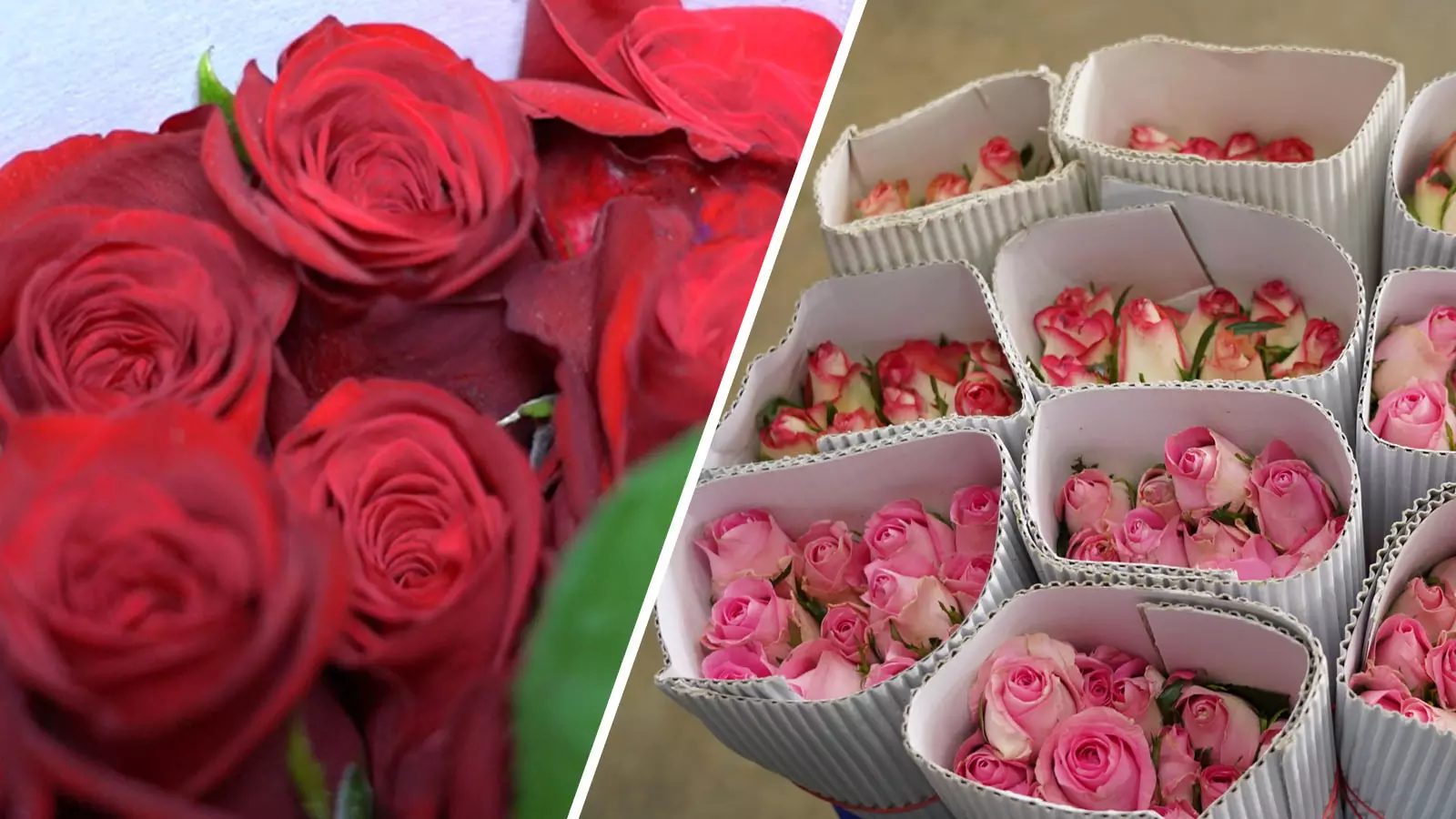
While prices vary greatly depending on city, location and scale of the shop, the concept of premium rates for roses on Valentine’s Day remains common to all florists. It’s peak season for those in the business of blooms. Photo: Raghu RD
For 27-year-old Aliya M, a PhD scholar at a university in Hyderabad, her campus is her safe place. Though she herself is single, she says, “there is no moral policing at all [on campus], so people are free to indulge in public display of affection (PDA) round-the-year and not just on a specific day like Valentine's Day”.
Agrees Devi A, a 25-year-old IT professional in Bengaluru, “It really depends on where you are living. In Bengaluru, it is very common to be seen gifting flowers, Valentine’s Day or no Valentine’s Day.” But she adds in the same breath, “With all these orange scarf groups [saffron fringe groups] going around literally hitting people with sticks and stones [targeting couples], yes, I do think people are wary about public displays of affection. Still, I think romance is slowly getting normalised and I'm loving it.”
While some feel cities are more accepting of PDA, 24-year-old Aishwarya R, a master's student in Ernakulam, adds, “There are corners of the same city that remain conservative.”
Perhaps the ones who are worst hit are those who do not have a safe space to spend time with their partners even at home, or for whom space constraints leave little scope for privacy. “Such couples get the worst of the moral policing,” feels Akshay (identified by first name only), a 25-year-old-engineer based in Mumbai.
But as writer Thomas Holcroft has famously said, “Love and a red rose can’t be hid.”
Today not everyone who is picking up a rose to communicate his or her love this Valentine’s Day is, however, physically visiting a florist to choose the flowers personally. Selections are made on smartphone screens, orders placed online and the bouquets get delivered to that special someone, either in the same town, or across city and state borders; long-distance today has made love as virtual as the option of gifting.
With the convenience of app-based delivery services, Naidu too admits that many of his orders now are received online.
“People buy many things from plastic roses to real roses and bouquets and gifts like chocolates. It is much more hectic on Valentine’s Day, with several orders coming in,” says a delivery partner at an app-based service, speaking on condition of anonymity.
At an offline store of a popular flower delivery platform in Chennai, an employee sits amidst pink and red heart-shaped decor. The heady smell of flowers greets one even before they step inside. “Most orders are online these days, with a large variety of options available on the shop’s official site,” he says.
For flower cultivators too, these e-commerce platforms are important customers.
“Compared to other days, the demand for roses is definitely higher during the Valentine’s Day season,” admits Aravind T M, a flower cultivator in Karnataka.
He adds: “Demand increases by about 30 per cent compared to regular days. Around 50,000 flowers are being sent every day to the International Flower Auction Centre. Since good prices are being received at the auction centre, about 50 percent of the produce are sent there. The remaining 50 per cent are bought by people who come directly to the farms. Some e-commerce platforms also purchase directly from farmers.”
Also read: In dating app era, why Indian professionals continue to fall for the charm of a workplace romance
According to poet Mar Overby, “Love is much like a wild rose, beautiful and calm, but willing to draw blood in its defense.”
And so, no amount of judgment or moral policing can truly stop lovers from finding a way to celebrate their relationship.
"We adorn ourselves with flowers on all special occasions. The flowers may change to roses [on Valentines Day], but they are a part of our culture," says Aishwarya. "More than getting an expensive gift, getting a flower makes a day special," she adds.
After all, the bard Shakespeare himself once compared a lover to a rose in that play which remains a textbook for young lovers’ across the world, Romeo & Juliet.
“That which we call a rose by any other name would smell as sweet; So Romeo would, were he not Romeo call’d retain that dear perfection which he owes without that title.”