- Home
- India
- World
- Premium
- THE FEDERAL SPECIAL
- Analysis
- States
- Perspective
- Videos
- Sports
- Education
- Entertainment
- Elections
- Features
- Health
- Business
- Series
- In memoriam: Sheikh Mujibur Rahman
- Bishnoi's Men
- NEET TANGLE
- Economy Series
- Earth Day
- Kashmir’s Frozen Turbulence
- India@75
- The legend of Ramjanmabhoomi
- Liberalisation@30
- How to tame a dragon
- Celebrating biodiversity
- Farm Matters
- 50 days of solitude
- Bringing Migrants Home
- Budget 2020
- Jharkhand Votes
- The Federal Investigates
- The Federal Impact
- Vanishing Sand
- Gandhi @ 150
- Andhra Today
- Field report
- Operation Gulmarg
- Pandemic @1 Mn in India
- The Federal Year-End
- The Zero Year
- Science
- Brand studio
- Newsletter
- Events

In India, why being vocal about relationships is not easy for adolescents in love
The Supreme Court recently urged a ‘Romeo-Juliet’ clause in the POCSO Act to ensure that the law is not misused to penalise consensual relationships. But in a country where bonds between even adults require family approval and moral policing is dressed up as anti-harassment ‘Romeo squads’, can teens open up about their feelings?

The Rajasthan high court last month reportedly quashed proceedings under the Protection of Children from Sexual Offences (POCSO) Act, 2012, against a 19-year-old, whose legal troubles were purportedly born of a consensual relationship with a 17-year-old. Holding that the provisions under POCSO were not meant to persecute “close-of-age teenagers in a consensual relationship”, the...
The Rajasthan high court last month reportedly quashed proceedings under the Protection of Children from Sexual Offences (POCSO) Act, 2012, against a 19-year-old, whose legal troubles were purportedly born of a consensual relationship with a 17-year-old. Holding that the provisions under POCSO were not meant to persecute “close-of-age teenagers in a consensual relationship”, the court reportedly further added that there was a “pressing need to bridge the gap between the protective intent of the POCSO Act and the sociological reality of adolescent autonomy”.
Reports of the Rajasthan HC order came in the close heels of a recent urging by the Supreme Court to include a ‘Romeo Juliet’ clause in the POCSO Act to exempt genuine adolescent relationships from its purview.
The subject of young love has long been a conflicted one.
Reams have been written about it — from the Shakespearean play which lends its name to the legal exemption to POCSO suggested by the Supreme Court, Romeo & Juliet, to The Fault In Our Stars. Filmmakers over the years, too, have given in to its charms; in the 1978 Grease, the 1999 Nagesh Kukunoor coming-of-age Rockford and more recently, the Netflix series Never Have I Ever, where the highs and lows of love and heartbreak are among the many things that Indian-American protagonist Devi Vishwakumar and her friends must negotiate.
Also read: In dating app era, why Indian professionals continue to fall for the charm of a workplace romance
But in a country like India, divided on regional, religious and caste lines, where bonds between even two adults require family approval more than mutual acceptance and where moral policing and the bogey of love jihad are dressed up as anti-harassment ‘Romeo squads’ — yes, we have turned that same Romeo who for generations has been a poster-boy of love to something which is quite the antonym of romance — can teens open up about their feelings to grown-ups around them?
“Definitely not. Caste issues are still prevalent. Also, parents don't want any scandal,” says 18-year-old Rex.
Adolescents in north India would identify it with the “chaar log kya kahenge”, which loosely translates to “what will society say/think”, something that is hammered into them from a young age; be it career or romance, choices and behaviour must fit into socially-acceptable patterns.
And so, teens learn to put off sharing till they feel their parents are more ready to accept.
“As long as my parents are comfortable with it, I can feel safe opening up to them. The same can be said of my friends. Personally, I would rather keep it safe for a while. I can open up about it [a romance] once it’s going well,” says 17-year-old Amar.
Age is also a factor when you are an adolescent in love; even a year or two can give more confidence and acceptance.
Agrees Adi, who is now 20. “I think Indian teens on the older side can more easily open up to their parents about dating.”
Of course, there are many conditionals involved. How conservative are the parents, how complex is the relationship — teens in same-sex, interfaith, or inter-caste relationships are likely to feel more unsure about confiding in parents.
“I've never felt safe about opening up about dating or crushes to my parents. Especially because I'm queer which makes it twice as hard,” says JR.
The 18-year-old adds: “For my parents, dating equals marrying. In their minds, even teenage relationships mean to settle down, instead of a process that takes us through many trials and errors through which we learn and grow.”
In clear acceptance of the often-transitory nature of teen relationships, adolescents at times appear more mature than their parents.
“Most Indian parents are quite strict when it comes to dating. Their usual reasons are that ‘you'll end up getting hurt’, ‘your studies will suffer’...I'm not really sure how some person you're dating could possibly make you fail your exams. It's your responsibility to balance things and if you can't do that then maybe you're not ready yet. As for getting hurt, who knows if I will be with the same person for the rest of my life? If not, I may be heartbroken for a while and then move on,” says 16-year-old Reema.
She adds: “Since most Indian kids are brought up strictly and parents are emotionally unavailable, they end up hiding everything. That's why we're such good liars.”
Most of us have experienced it too — the shy locking of eyes across a school or coaching centre classroom, the holding of hands on walks back home, the planning for that first real Valentine’s Day or coffee date. And yet, almost always, the heady joy of budding romance has been accompanied by frantic attempts at concealment; calls are made furtively, to avoid detection by family members and friends painstakingly tutored to ensure that they back our claims of having been with them when we were actually in the company of that special someone.
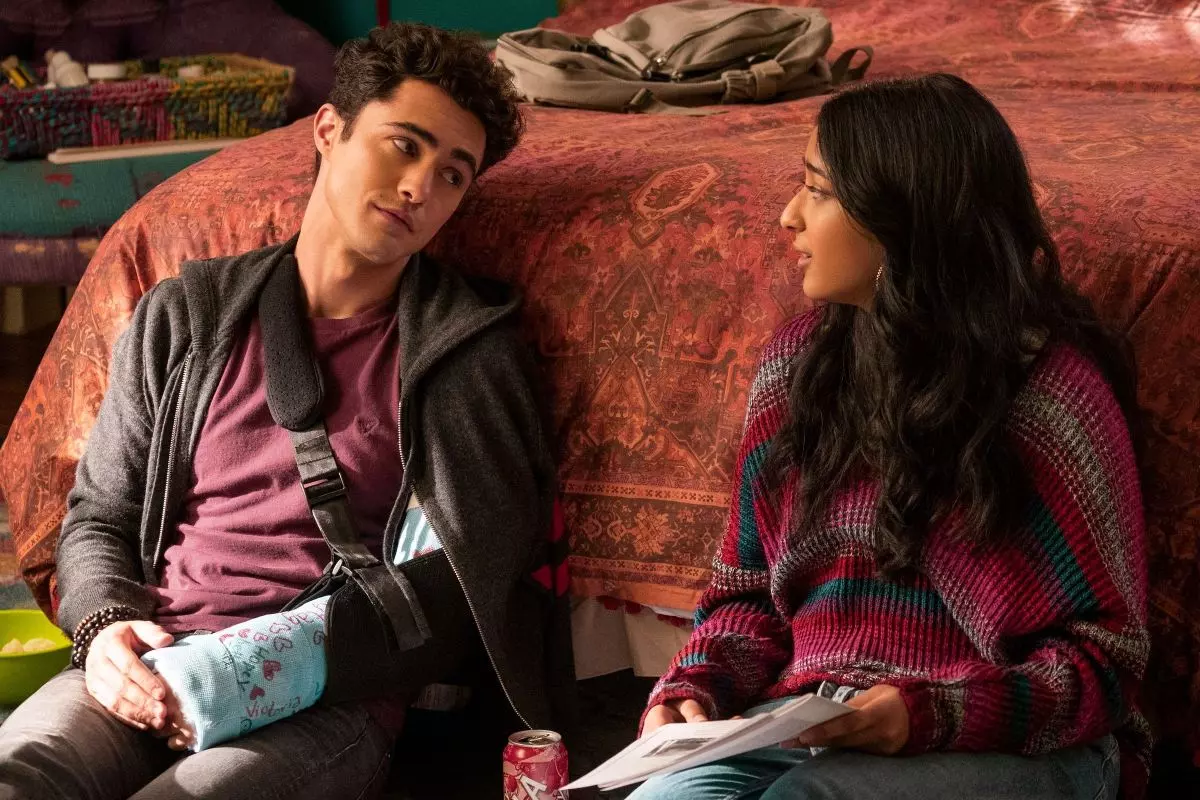
A scene from the Netflix series 'Never Have I Ever'. Excessive control and the fear that parents and teachers can’t be trusted can end up putting teenagers more at risk, one that they are at times aware of.
At times, teenagers learn to present the truth in what they feel will be more acceptable forms. Reema says she talks about her crushes as “gossip” with her father, who is more welcoming of the “tea spilled”, while her mother remains completely against it. Even so, she says, “I try not to hide everything from my parents”.
There are moments of vulnerability, times when the teenager may crave for a word of wisdom, advice which is based on experience, without the filters of judgment or undue concern.
And parents are beginning to understand this, trying to check their concerns about how the distraction of a romance may affect studies and the fear that “the teens are too young to date”, with the need to ensure their kids’ security at a time when social media has opened up the possibilities of meetings and interactions for adolescents. With the result that at least some of them are opting to instil the confidence in their children that they are available to listen and support.
Like 41-year-old Rajani, a media professional and mother of a 13-year-old. “I don't remember telling her about relationships, but I remember talking to her about safe sex, teen pregnancies, etc. I'm not vehemently opposed to the idea of her having boyfriends. I trust her to judge and act for herself. But I also know that like many teens, she probably only tells me half or maybe a quarter of what's actually going on in her world,” she admits.
For many parents, this parenting style will require some adjusting, taking a conscious step away from how they themselves were brought up.
The one thing Amar remembers talking about with his parents while discussing issues like “consent and relationships, is to just focus on myself and set up boundaries. It's essential in any relationship, not just for teens,” he says.
Where parents are less forthcoming, a teacher can sometimes become that adult person of trust.
“I have had inklings of some of my students dating, but I maintain that it is none of my business unless it disrupts my work. My students have the sense to keep their drama out of my classes. That being said, I have had open discussions with them about relationships outside of class. It was an honour to be considered 'safe' to speak to,” says Gauri, a 28-year-old school teacher.
But even here, age plays a part. Teachers aged in their 40s and 50s that The Federal spoke to, those likely to have teenage children of their own, say they found the idea of teens dating to be inappropriate.
At times, trusting an adult may even have disastrous results, claim students.
Vishwas, a 20-year-old college student remembers an incident from school when he and his friends felt betrayed. “When I was in twelfth, there was a couple in class who were dating. Somehow, our teachers found out and the information reached the principal and she called their parents and they were suspended for 15 days. All of us were scolded for not informing the teachers. Our guess is that the couple had opened up to the school counsellor and she divulged the information to the teachers,” he says.
Ironically, excessive control and the fear that parents and teachers can’t be trusted can end up putting teenagers more at risk, one that they are at times aware of.
“Indian society still hasn't normalised teenage dating, which makes it what they call ‘dangerous’ for young people, owing to the lack of non-judgmental spaces to share and get guidance from,” rues JR.
Agrees Rajani: “Indian society is very judgmental about teen relationships. My daughter talked about it as early as the fifth standard. The hypocrisy of Indian society around gender. That only girls will get slut shamed if caught kissing.”
For Rajani, her daughter having urges or desires is a natural part of growing up. “She also knows if she ever acted upon those urges, she needs to not get caught… which is sad, and could be dangerous if a teenage Indian girl needs to go to a secret place to be with a boy."
The need for concealment, the feeling of being ‘isolated’ can, at times, get overwhelming.
The 41-year-old recalls a case where a high-school girl in Bengaluru jumped off a 12th-floor balcony after she was shamed by her parents and school principal for kissing a boy. “I have told my daughter that nothing is worth losing your life over. ‘You call Amma over any trouble…I want you safe no matter what’,” she says.
Also read: Why law banning commercial surrogacy has landed women who rented their wombs in greater misery
As per reports, a study of judgments in 7,064 POCSO cases between 2016 and 2020 in Assam, Maharashtra and West Bengal had revealed that approximately 23–25 per cent of these were “romantic cases” in which the relationship was consensual. Also, 47 per cent of these romantic cases involved girls aged 16–18 years. Recent years have seen debates over the lowering of the age of consent from 18 to 16 years. Lawyers and academics have repeatedly highlighted the misuse of POCSO to settle personal scores.
But while legal change may help in decriminalising consensual relationships, what is equally needed is empowering adolescents to voice their consent, while at the same time preparing them to shoulder the responsibility of their choices.
In a paper titled ‘Navigating consensual relationships: Understanding the POCSO Act’, published in the International Journal of Civil Law and Legal Research in 2024, authors Sunil Sudhakar Varnekar and Dr. Upankar Chutia insist, “fostering healthy, equitable, and respectful relationships necessitates acknowledging and honouring boundaries, enabling people to identify and exercise their rights, and placing a high value on consent and communication.”
They add: “The legal system, educational institutions, and social agencies must all adopt culturally aware strategies in order to handle the intricacies of consenting relationships.”
(Names have been changed to protect identities)