- Home
- India
- World
- Premium
- THE FEDERAL SPECIAL
- Analysis
- States
- Perspective
- Videos
- Sports
- Education
- Entertainment
- Elections
- Features
- Health
- Business
- Series
- In memoriam: Sheikh Mujibur Rahman
- Bishnoi's Men
- NEET TANGLE
- Economy Series
- Earth Day
- Kashmir’s Frozen Turbulence
- India@75
- The legend of Ramjanmabhoomi
- Liberalisation@30
- How to tame a dragon
- Celebrating biodiversity
- Farm Matters
- 50 days of solitude
- Bringing Migrants Home
- Budget 2020
- Jharkhand Votes
- The Federal Investigates
- The Federal Impact
- Vanishing Sand
- Gandhi @ 150
- Andhra Today
- Field report
- Operation Gulmarg
- Pandemic @1 Mn in India
- The Federal Year-End
- The Zero Year
- Science
- Brand studio
- Newsletter
- Elections 2024
- Events

Professional milestones to personal moments — what Umar and Sharjeel have lost since 2020 arrest
Rules for the CAA that drew them into the streets have been notified. New flashpoints like the SIR have emerged. There have been celebrations and mournings in their families and among friends. The question that lingers is who Umar and Sharjeel would have been had time not been seized from them.

Time has not stood still for Umar Khalid and Sharjeel Imam. It has simply moved on without them.Five-six years is a long time in Indian politics, and for Umar and Sharjeel, it has unfolded without their participation, commentary or dissent. The law that drew them into the streets and eventually into prison, the Citizenship Amendment Act (CAA), has since been operationalised through...
Time has not stood still for Umar Khalid and Sharjeel Imam. It has simply moved on without them.
Five-six years is a long time in Indian politics, and for Umar and Sharjeel, it has unfolded without their participation, commentary or dissent. The law that drew them into the streets and eventually into prison, the Citizenship Amendment Act (CAA), has since been operationalised through notified rules, even as the questions it raised about citizenship, exclusion and the idea of India remain unresolved.
The Bharatiya Janata Party (BJP) has returned to power once again at the Centre, reshaping institutions and public life with greater confidence. New flashpoints like the Special Intensive Revision (SIR) of electoral rolls have emerged, echoing older anxieties around disenfranchisement and democratic backsliding that both Umar and Sharjeel had once publicly warned against.
Outside prison walls, protest itself has been redefined. The vocabulary of dissent they were part of, mass protests, university-led mobilisations and neighbourhood assemblies, has been hollowed out by arrests, fatigue and fear, even as sporadic resistance continues in altered forms. Movements have dispersed, student politics have thinned and the costs of speaking have risen sharply.
Umar and Sharjeel, both former research students of Delhi’s Jawaharlal Nehru University, were taken into custody for alleged links to the 2020 Delhi riots, triggered by protests against the CAA. Sharjeel was arrested in January 2020 — even before the riots broke out in February that year — for alleged inflammatory speech during the CAA protest, which was later extended to a larger conspiracy case. Umar was arrested in September 2020. Both have been prima facie accused of playing a “central role” in the conspiracy linked to the clashes.
In denying bail to the two yet again, the Supreme Court (SC) earlier this month acknowledged the long years already spent in custody but refused to restore either of them to public life. With its decision, which includes asking them to wait one year before next applying for bail, the highest court marked five years not as an exception but as an acceptable condition. Their detention has hardened into a form of punishment without conclusion, where the future is postponed one order at a time.
Also read: How the fatal attack on Anjel Chakma is symbolic of a growing bloodlust in 'Devbhoomi' Uttarakhand
Outside, it is not only politics that has moved on. It is life. There have been weddings, births and deaths in their families. Friends have also hit academic, professional and personal milestones. Yet, inside jail, time has collapsed.
Apeksha Priyadarshini, a journalist and Umar’s friend, recalls him saying, “I don’t remember time on a daily basis, and the calendar means nothing to me anymore. There are chunks of periods in these five-six years where I don’t remember what happened. My calendar is from one court date to another date, or in terms of meeting friends and family, it is from one mulaqat [meeting] to another mulaqat.”
Umar has been out thrice since 2020 — the latest in December last year, when he got a two-week interim bail to attend his sister’s wedding.
“For 14 days, he slept barely two or two-and-a-half hours a night. He wanted to talk to everyone, know everything. It was like he had so little time and so much catching up to do. He felt he shouldn’t miss anything,” Umar’s mother, Sabiha Khanum, tells The Federal.
One morning, she says, he woke up instinctively reaching for the iron bars of his prison cell before realising he was at home.
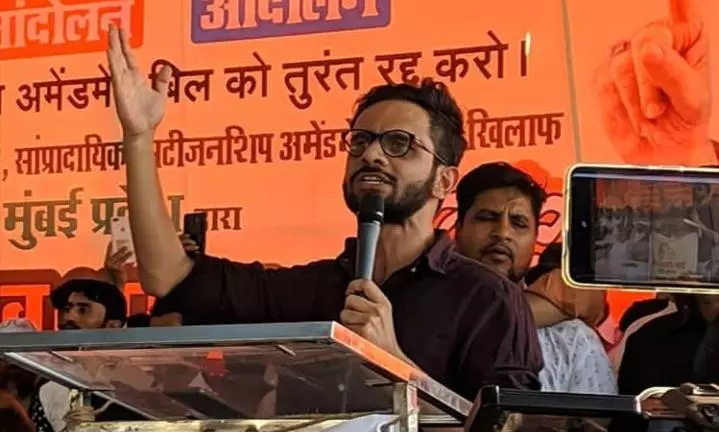
Umar Khalid has been out thrice since 2020 — the latest in December last year, when he got a two-week interim bail to attend his sister’s wedding. File Photo
Apart from the daily flashes, there have been significant moments when the absence has felt greater. “On January 16, 2021, his sister gave birth to twins. I called all my relatives. Then I realised I can’t tell Umar,” says his mother, wiping away tears.
“Eid passes without him. When it’s biting cold, like right now [she was talking to The Federal earlier this month, when Delhi was in the grip of a cold wave], and we are in comfort, I think of how he must be in pain inside [the prison],” she says.
For both Umar and Sharjeel’s families, maternal grandmothers have been a shared cause of grief and unease. Sharjeel lost both a grandmother and another grandmother-like figure while in custody. “Both died in his absence. One in 2021 and the other in 2023. Cremations have to happen quickly. There was no time to apply for parole. If we were in Delhi, it would be different… My mother has been in depression since his arrest and keeps unwell. We miss him not just during happy times but difficult ones too,” says Muzammil Imam, Sharjeel’s younger brother, who divides his time between Patna and Jehanabad, in Bihar, but is primarily based in Jehanabad.
Umar’s mother also rues the time he is unable to spend with his maternal grandmother, especially now that she is ageing. “She misses him. He is her favourite, so she keeps asking after him. I keep thinking, if he were out, he would have helped [with her care],” she says.
Also read: Why a 29-year-old’s MD degree is a milestone moment for the Koraga tribe
For their friends, the memories are ever-present.
“Every small thing we do, we have a lingering feeling. We tell each other, if he was here, what he would have said, how he would have reacted. It’s not momentous junctures alone, but in the small bits of life that we also think of him. He comes to us unplanned, unannounced,” says Anirban Bhattacharya, a close friend of Umar’s.
Often, those memories are almost absurdly ordinary. “We used to go to a cafe in Jama Masjid, particularly in the winters, a rooftop, oddly located. There was a hanging chair that he loved sitting on. We have photos of him on that. Every time we see such a chair anywhere, we think of him… When The Trial of the Chicago Seven released [based on the trial of activists linked to protests against the 1968 Democratic National Convention protest in Chicago], each of us individually felt almost simultaneously that we wished we could watch it with him,” he says.
For many around Umar and Sharjeel, the past five years have been years of accumulation, degrees earned, jobs found, cities changed, relationships broken and formed. The contrast is unavoidable.
“When Umar went to jail in 2020, I had just passed my PhD synopsis,” says Apeksha, Umar’s friend from his Jawaharlal Nehru University (JNU) days. “Over the time that he’s been incarcerated, I managed to finish my PhD, get my degree, and get employment. At all these junctures when I could have spent a lot of time going back and forth with him, which I did when he was out, and we were together in university, that was the time I missed him the most,” she says.
For Sharjeel’s friends, too, life has taken paths that seem almost unreal when placed alongside his enforced stasis. “Since he has been in jail, I’ve finished a PhD, broken up with a partner, found a new partner, am thinking about marriage, moved cities, got a job, financial security, so much,” says Preeti Gulati, his senior from JNU who’s currently working as an Assistant Professor at Krea University in Andhra Pradesh.
For those outside, there’s “survivor's guilt”, and it surfaces repeatedly, not just at milestones, but in comfort.
“When you’re enjoying the winter sun, you wonder how he’s dealing with it inside, or in summers, when it’s very hot,” says Apeksha.
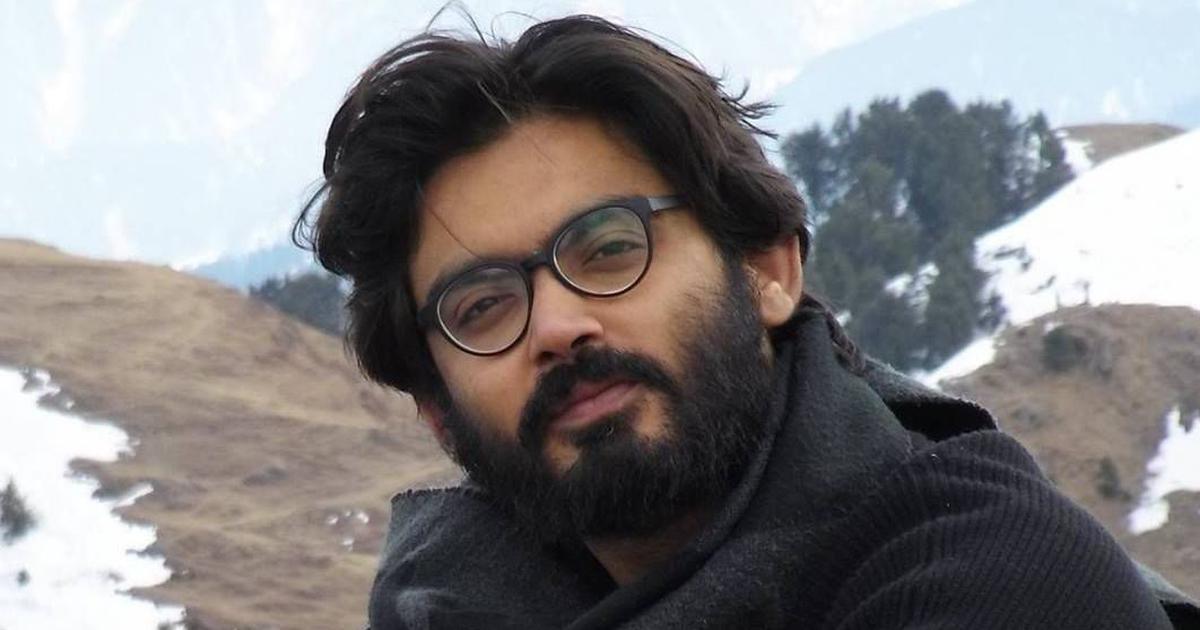
Sharjeel’s trajectory had been anything but conventional. He left a high-paying job to join JNU. For friends life has taken paths that seem almost unreal when placed alongside his enforced stasis. File photo
Anirban — who too has spent time in custody in the past, after being arrested in 2016 in a sedition case while a student at JNU — puts it more starkly. “Each time we think of him, [while we are] sitting in a restaurant, or at the sea front, or just in my home with the air conditioner and heater on, the overwhelming feeling is guilt. He doesn’t like that I think this way, but the guilt prevails,” he says.
And yet, the outside world does at times intrude even behind bars for Umar and Sharjeel. When the film The Kashmir Files [based on the exodus of Pandits from the Valley] released in 2022, Umar spoke to friends about how the atmosphere inside the prison changed. “He told me that things became more tense, more polarised, more communal. The way people looked at each other had changed,” Apeksha recalls.
Also read: How a chain of community-led libraries is reimagining public reading spaces in Delhi-NCR
Meanwhile, outside, there were moments when both men would once have been central voices, say those close to them. One such would be the Israel-Palestine conflict.
“For Sharjeel, history or politics was never abstract. Whether it’s the release of a film like Chhaava [based on the life of Maratha ruler Sambhaji] or Palestine, which is a huge issue, Sharjeel’s voice would have been very important. Because his hot takes are rooted in historical archives,” says Preeti.
Umar’s mother also believes her son would have been “leading” protests on Palestine.
“He had so much to say when the genocide was actively going on. He was always vocal on these issues when he was out. When the Ram temple construction happened, when the sthapana happened in Ayodhya, these were moments when he would have added something meaningful to public discourse, as a public intellectual. That role was denied to him because he was inside,” says Apeksha.
As students of history from JNU – those who know them, recall that they both were “exceptionally bright, with great futures ahead”. In a Facebook post after bail was denied to the duo by the SC, Retd Professor Janaki Nair wrote: “I taught both of them, and they impressed me with their intelligence, diligence and capacity for thinking differently. I did not always agree with the ideas they had. I was often irritated by their style of learning, which bordered on the irreverent. But like most JNU (and CHS) students, they were passionately attached to argument, driven by the elemental hunger to read, write, argue, and speak boldly, sometimes even giddily, of many things that had come into their grasp.”
Yet, despite their intellect, friends insist neither would have fit neatly into academic isolation. “The knowledge and the passion that Sharjeel had with his research, you knew that he wanted to do more than just teaching. But at the same time, ironically, the way he explained things to us, to his peers, there could not have been a better teacher either. I think that's true of Umar as well,” says Preeti.
Sharjeel’s trajectory, especially, had been anything but conventional. “For an IIT Bombay MTech student in computer science, the career path is a given. The blueprint is already there. He was extremely bright, very sharp. But unlike other IITians, he never stuck only to technology. His room was filled with non-fiction. He was deeply aware of socio-political conditions, culturally rich, poetry, shairi, and languages. That’s very rare,” recalls Vaibhav Sorte, his junior from IIT Bombay.
Many of Sharjeel’s peers now work abroad, earning in crores, or hold senior bureaucratic positions, says his brother Muzammil Imam. “When he left his high-paying job and decided to join JNU [in 2013], we had understood that he was not going to work again as an engineer earning in crores. That was never his guiding factor,” he says.
Meanwhile, for Umar, the prospect of a comfortable teaching job was never exciting. “He never wanted to move abroad; he was very clear from the start. He had got a scholarship from Yale, but he showed no interest. He didn’t even get a passport made. When there were discussions about someone earning well in a comfortable job abroad, he would say, ‘They are only earning well. But what is their contribution to society?’,” says his mother.
But the question that lingers is who Umar Khalid and Sharjeel Imam would have been by now, had time not been seized from them.
“I’m sure he would have been an activist in some capacity. If being an activist is about swimming against the mainstream, speaking for those sidelined, and defending the secular fabric of the Constitution, he would have been doing precisely that. Which means he would have continued doing what he was doing before jail,” says Anirban.
Muzammil says Sharjeel once told him he wanted to go to London for further studies. “But Sharjeel bhai is very unpredictably decisive. Eight-nine years ago, he told me he had no interest in politics and that I should carry forward our father’s legacy. [Sharjeel’s father, Akbar Imam, passed away in 2014 from cancer. He was associated with the Janata Dal United (JDU).] So it’s difficult to say what he would have done. But whatever it is, it would have involved working for his own people and community,” says Muzammil.
Also read: Emergency era to Nepal agitation: Decoding youth protests and what puts these movements at risk
Despite the trials and tests, there is a refusal to be reduced to seen as victims. “He [Umar] says we need to change the ‘perception of my incarceration’,” Apeksha recounts. “I have no regrets. If I had to do it again, I would do it again, because we were on the right side of history,” she recalls him as saying.
For friends, that conviction is both sustaining and painful. “A part of you is always behind bars with the person. You don’t feel completely free till they are freed. It shapes the decisions you take. I chose to stay in Delhi because he was incarcerated. I wanted to be present,” she says.
Those who know them best insist that when Umar and Sharjeel walk free, they will carry forward the same refusal to bend, the same willingness to confront injustice that defined them before jail. Even with their differing ideologies, their path is probably rooted in being public intellectuals.
Their families, too, are refusing to relent in their fight for justice. “The SC verdict is a dangerous precedent and it will not remain limited to Umar and Sharjeel. It’s a judgment beyond the scope of UAPA. How can they stop anyone from applying for bail for one more year? So, we feel this judgment must go, and that it should be legally challenged,” says SQR Ilyas, Umar’s father.