- Home
- India
- World
- Premium
- THE FEDERAL SPECIAL
- Analysis
- States
- Perspective
- Videos
- Sports
- Education
- Entertainment
- Elections
- Features
- Health
- Business
- Series
- In memoriam: Sheikh Mujibur Rahman
- Bishnoi's Men
- NEET TANGLE
- Economy Series
- Earth Day
- Kashmir’s Frozen Turbulence
- India@75
- The legend of Ramjanmabhoomi
- Liberalisation@30
- How to tame a dragon
- Celebrating biodiversity
- Farm Matters
- 50 days of solitude
- Bringing Migrants Home
- Budget 2020
- Jharkhand Votes
- The Federal Investigates
- The Federal Impact
- Vanishing Sand
- Gandhi @ 150
- Andhra Today
- Field report
- Operation Gulmarg
- Pandemic @1 Mn in India
- The Federal Year-End
- The Zero Year
- Science
- Brand studio
- Newsletter
- Elections 2024
- Events

Why a 29-year-old’s MD degree is a milestone moment for the Koraga tribe
Classified as a ‘Particularly Vulnerable Tribal Group’ in Karnataka and Kerala, the community has faced social ostracisation for generations. As Sneha KA, becomes the first Koraga doctor, reflective of a steady spread of education among the tribe, community members now hope for jobs and dignity.

Surrounded by Karnataka’s coastal forests, where the stillness of the woods blends seamlessly with the sounds of the sea, are the villages of the Koraga community, classified as a ‘Particularly Vulnerable Tribal Group (PVTG)’ in Karnataka and Kerala. Legend has it that a king named Hubashika established the Koraga kingdom in Tulunadu — covering modern-day Dakshina Kannada and Udupi...
Surrounded by Karnataka’s coastal forests, where the stillness of the woods blends seamlessly with the sounds of the sea, are the villages of the Koraga community, classified as a ‘Particularly Vulnerable Tribal Group (PVTG)’ in Karnataka and Kerala.
Legend has it that a king named Hubashika established the Koraga kingdom in Tulunadu — covering modern-day Dakshina Kannada and Udupi in Karnataka and the northern part of Kasaragod district of Kerala up to the Payaswini river — sometime in the 15th century. But their security was short-lived. Hubashika was duped and killed by the members of a rival clan.
There are, however, varying versions of how Hubashika came to establish the Koraga kingdom and of his death. In his novel Kotta, former Karnataka chief minister and Union minister M Veerappa Moily writes that king Hubashika was killed by one Angara Varma, king of Manjeshwar (now part of the region in Karnataka bordering Kerala). According to Colonel Mark Wilks, a historian who has done extensive work in Mysore, in 1450 CE. Hubashika mobilised an army of Koragas and invaded Mangalore (now Mangaluru) and Manjeshwar areas, establishing his kingdom there and ruling for over 12 years.
Whatever be the exact circumstances of his death, following the killing, the leaderless Koragas fled to the forests, relying on the forest produce for survival.
Centuries passed, but there has been little improvement in the condition of the Koragas. Stigmatised as ‘untouchable’, the community, which has traditionally depended upon basketweaving as a means to earn its livelihood, has been known to face entrenched economic hardship and social marginalisation for years. Community members claim their struggle for dignity and visibility has remained largely ignored, despite civil society activists repeatedly highlighting their plight.
Also read: How a film in a ‘nearly extinct’ tongue turns the focus on Kerala’s ‘vulnerable’ Cholanaikkan tribe
In recent decades, some of the children from the community have started stepping out of the shadows to seek education and employment in a bid to improve their lives.
“A quiet academic revolution is taking shape. In the past two decades, a new wave of students has been pursuing higher education for the first time,” admits Dr Sabitha Koraga, an assistant professor at Mangalore University and the first woman from the Koraga community to earn a doctoral degree. Yet, their numbers are still marginal. "Our community has around 15,000 to 16,000 people across the coastal districts and Kasaragod. Yet, fewer than 150 have completed postgraduation and only five hold PhDs. Around 1,000 have completed undergraduate studies," she said.
In such a scenario, a 29-year-old from the community acquiring an MD (Doctor of Medicine) degree is being celebrated as a milestone moment not just for the young doctor and her family, but for the entire Koraga community.
Sneha KA, the first doctor from the Koraga community, completed her MBBS from AJ Medical College, Mangaluru, in 2020, and went on to pursue MD from the University College of Medical Sciences, New Delhi, completing the course in December 2025.
Sneha herself is reticent about talking about her achievements.
“Being the first person in your family to do something means you've got to figure everything out by yourself. That's what I'm trying to do. Till I feel I'm somewhat stable, I can't speak on how I can support others, because I don't know. Not everyone has some grand plan and as of now, I'm just trying to figure out my life,” she told The Federal.
The sense of achievement in the community is hard to miss.
“She was always a talented student,” says Sneha’s mother, Jayashree Shedageri, a teacher by profession. Perhaps it was her mother’s occupation that inspired Sneha to reach for the stars. “But we are not rich. Sneha’s education was only made possible through the support of various social organisations, family members and other donors,” Jayashree added.
After completing her primary, she got a seat in a Navodaya Vidyalaya, a system of central schools for students from socially and economically weaker sections, particularly from rural areas. “She completed her high school in Jawahar Navodaya Vidyalaya, Hebri. Recognising her talent, Dr M. Mohan Alva provided her with free education for her pre-university (PUC) studies in a college run by Alva’s Education Foundation [set up by Dr Mohan in 1995]. She scored 96% marks in the PUC exams,” says Sneha’s proud father, Ganesh V. President of the taluk-level Koraga welfare committee, Ganesh has spent nearly four decades working for the educational and social upliftment of Koraga children. He was instrumental in setting up a residential home for Koraga children at Kumbhashi, a village in Udupi district, and continues to work on community awareness initiatives. The family is based in Udupi’s Kundapura.
After completing her MBBS, Sneha worked at a primary health centre for a while, before deciding to pursue an MD degree. “With her salary of 45,000 rupees, she would support our family and her younger sister's education,” recalls Jayashree fondly.
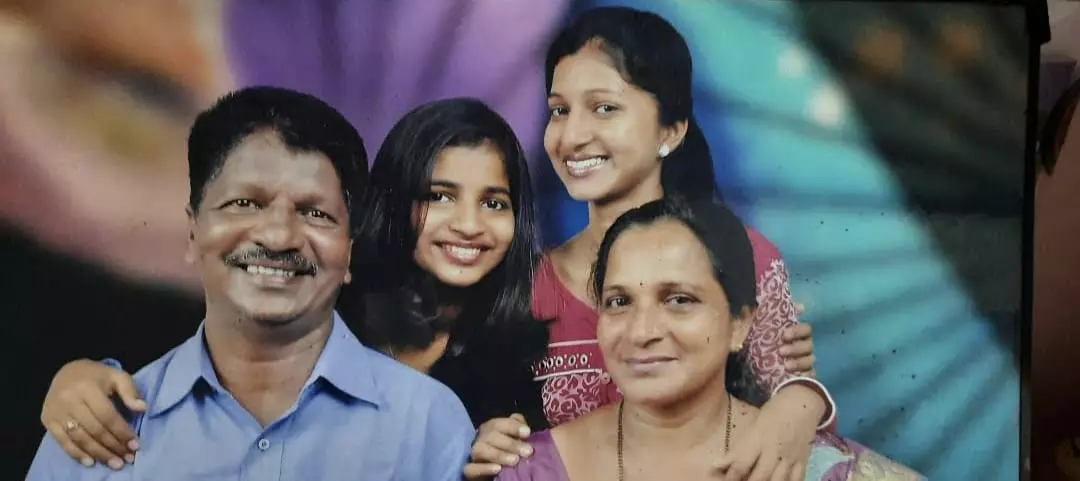
Sneha with her family. Photo: By special arrangement
According to Dr Mohan, Sneha’s achievements bear out his conviction that simply making reservations in education or jobs is not enough to uplift a community. “The real challenge lies in training students to successfully face competitive exams,” he says. “True educational reform must begin at the primary level and strengthen progressively through higher education to build a solid foundation for every child. We have taken a special interest in the Koraga community of Dakshina Kannada, Udupi, and Shivamogga,” he added.
But, despite her achievements, Sneha has not been able to completely avoid the discrimination meted out to those from her community.
“When she was working at the primary health centre, patients would ask her about her caste,” remembers her father, regretting that this may make it difficult for her to practice in her hometown in the future.
Also read: What Telangana’s Mudumal Menhirs say about India’s past astronomical prowess
According to Dr PV Bhandari, psychiatrist and head of AV Baliga Hospital, Doddannagudde, Udupi, it is this persistent social stigma that pushes many children from the Koraga community to drop out of schools.
“Members of the Koraga community are ostracised and discriminated against even now. This leaves them feeling inferior and shy, preventing them from joining the mainstream,” agrees Sabitha PG, assistant professor at the department of sociology at Mangalore University, who did her PhD research on the Koraga community.
The acute discrimination against the tribe included the Ajalu practice, where members of the Koraga clan were given food mixed with hair, nails and other such inedible things. The practice was banned under the Karnataka Koragas (Prohibition of Ajalu Practice) Act, but reports still surface of it being in use as a form of humiliating members of the tribe. Koraga community members were also forced to run before the animals in the Kambala buffalo race festival.
“For decades, our families have been considered inhuman. We have been subjected to abuse and exploitation, made to eat food mixed with nails and hair. Our wounds are deep. Lack of education prevents us from making a decent living. NGOs help us get access to some help here and there, but it is inadequate,” says Anitha Koraga, who lives in Belthangady.
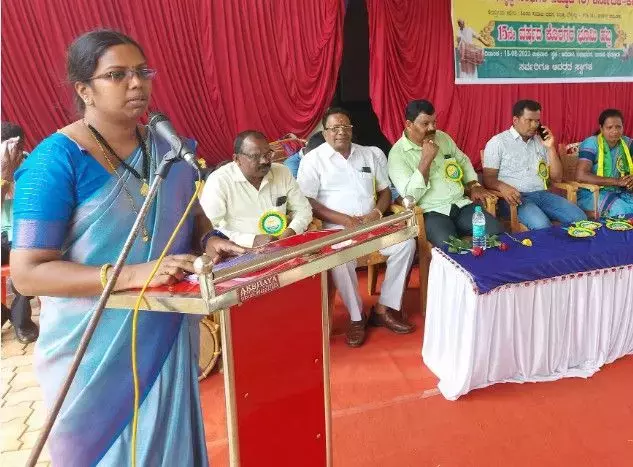
Sabitha Koraga, the first woman from the Koraga community to earn a doctoral degree. Photo: By special arrangement
The improvement in education reach among children from the community is being viewed as an encouraging trend by civil society workers.
“In the 1990s, children in the Koraga community often dropped out of school as early as in the 4th, 5th, or 6th grade, and for the generations before that, formal education was almost non-existent. Recently, children within these organised groups have started pursuing education more seriously, and success stories like Sneha’s show that having a strong educational foundation from parents who are active in the movement makes a significant difference,” says Sushila Nada, social activist and president of the Federation of Koraga Development Associations.
But now, employment remains a curveball for the community. Karnataka provides 7 per cent reservation in government jobs for members of the Scheduled Tribes (ST) communities. “But because there are 52 tribes in the ST list, the most backward communities like the Koraga and Jenu Kuruba are unable to compete with more powerful groups within the same category. Consequently, they are losing out in the competitive world,’’ explains Nada.
For the community, the slow loss of their language, also known as ‘Koraga’ is another deep source of pain. In 2011, as many as about 15,000 out of 23 lakh people in Dakshin Kannada and Udupi districts of Karnataka spoke the language, which was described as a ‘secret Dravidian language of Madras’ by Irish administrator and linguist in British India George Abraham Grierson.
Also read: Living on the Zero Line: Why life is a daily struggle for residents of Bengal's Hakimpur village
But today, the very tribe, a patrilineal community practicing endogamy, or marrying within the clan, is seeing a slow decline in numbers. According to the 1981 Census, the Koraga population was over 15000, which had come down to 14,794 by the 2011 Census. Current estimates peg their number at 10,000-12,000. Civil society workers cite malnutrition, anemia, hereditary diseases and tuberculosis as diseases that the Koragas are living with.
“Their condition is pitiable. If the government does not act quickly, it will be responsible for the disappearance of a whole community from our country," says a state official speaking on condition of anonymity.
For those who know this truth, the silence of the Koragas' traditional habitat would not be one of peace. It would be the quiet of grief and suffering that has been endured for so long that it has lost all lamentation.