- Home
- India
- World
- Premium
- THE FEDERAL SPECIAL
- Analysis
- States
- Perspective
- Videos
- Sports
- Education
- Entertainment
- Elections
- Features
- Health
- Business
- Series
- In memoriam: Sheikh Mujibur Rahman
- Bishnoi's Men
- NEET TANGLE
- Economy Series
- Earth Day
- Kashmir’s Frozen Turbulence
- India@75
- The legend of Ramjanmabhoomi
- Liberalisation@30
- How to tame a dragon
- Celebrating biodiversity
- Farm Matters
- 50 days of solitude
- Bringing Migrants Home
- Budget 2020
- Jharkhand Votes
- The Federal Investigates
- The Federal Impact
- Vanishing Sand
- Gandhi @ 150
- Andhra Today
- Field report
- Operation Gulmarg
- Pandemic @1 Mn in India
- The Federal Year-End
- The Zero Year
- Science
- Brand studio
- Newsletter
- Events

How 'Madras Time' played a crucial role in the evolution of Indian Standard Time
At a conference in Ujjain earlier this month, Union education minister Dharmendra Pradhan asked why the centre of global timekeeping should not be shifted from Greenwich to Ujjain. While Greenwich Mean Time has not been the universal standard since 1972, in this second of a two-part series, we look back at the evolution of the concept of 'standard time' in India and beyond.

Consider an everyday event. An online meeting is scheduled for noon. Participants in Bombay, Kolkata, Port Blair, Srinagar, and Madurai all join at 12:00 sharp.Now, look back at this press report from December 23, 1872. The viceroy's train left Kirkee (Khadki, near Poona) at 7 o'clock, railway time. Local people were expected to be there to send him off. Alas, not many turned up. The...
Consider an everyday event. An online meeting is scheduled for noon. Participants in Bombay, Kolkata, Port Blair, Srinagar, and Madurai all join at 12:00 sharp.
Now, look back at this press report from December 23, 1872. The viceroy's train left Kirkee (Khadki, near Poona) at 7 o'clock, railway time. Local people were expected to be there to send him off. Alas, not many turned up. The reason? Confusion about the time.
In those days, the 'local time' in Poona (now Pune) was different from 'railway time'; and hence, the local residents did not arrive on time. For them, 7 O'clock did not mean 7 O'clock!
The uniformity in time in India is a modern evolution.
(At a conference in Ujjain earlier this month, Union education minister Dharmendra Pradhan called for the centre of global timekeeping to be shifted from Greenwich, United Kingdom, to Ujjain. While Greenwich Mean Time has not served as the universal standard since 1972, read Part 1 of this two-part series on the evolution of standard time for more on why his argument for ‘Mahakal Standard Time’ falls flat.)
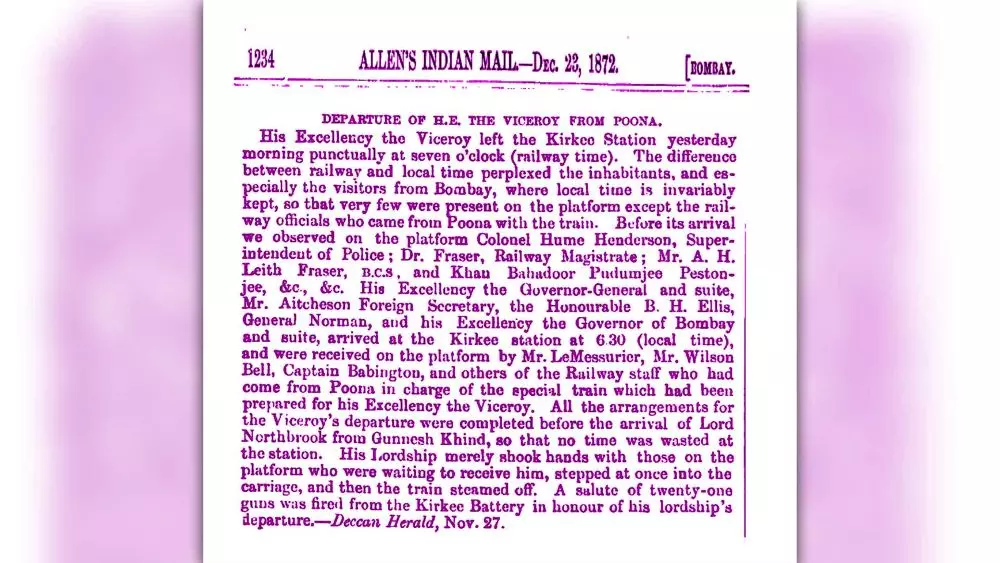
An old news report on the 1872 fiasco surrounding the seeing off of the viceroy's train from Poona (now Pune).
There was a time when "noon" did not mean the same thing everywhere.
In its strict astronomical sense, noon is simply the moment the Sun reaches its highest point in the sky. It is noon, and the centre of the Sun's disc crosses the meridian overhead. That moment varies slightly from place to place.
Imagine a line drawn from the North Pole to the South Pole passing directly overhead through your position; this is the local meridian. When the Sun aligns with this line, it is noon for you.
Thus, when it was noon in Chennai, it would be 11:47 a.m. in Coimbatore, 11:53 a.m. in Kanyakumari, 11:55 a.m. in Madurai, 11:57 a.m. in Trichy, and slightly different again elsewhere. Each town had its own local time.
In premodern times, social life was structured around this local time. In ancient India, without mechanical clocks, time was measured using sundials and water clocks (Nazhigai Vattil in Tamil). Calls for prayer and Uchikala Puja (midday worship) from temples and mosques were announced in local time to the village's population.
And that was perfectly acceptable, until the modern world arrived.
The turning point came not from astronomy, but from infrastructure.
Railways began running. Telegraph lines connected cities. Weather data had to be synchronised. Suddenly, local time became a problem.
India's first railway line opened in 1853. Now consider a train scheduled to depart at 8:13 p.m. But whose 8:13? Bombay's? Calcutta's? Madras's? (Now Mumbai, Kolkata and Chennai, respectively) What was once manageable turned into operational confusion.
Standard time was no longer optional. It became imperative.
Also read: How the failure of a satellite’s atomic clock has put India’s national security at risk
‘Madras Time’ played a crucial role.
By 1887, a railway timetable noted: "Calcutta time is observed on East Bengal and North Bengal Railways. On all other railways in India, Madras time is observed." The table listed the differences: Madras time was 33 minutes behind Calcutta time, 7 minutes behind Allahabad, 30 minutes ahead of Bombay local time, 23 minutes ahead of Lahore, 36 minutes ahead of Mooltan, and 47 minutes ahead of Kotri local time.
Likewise, the telegraph services, introduced in 1851, increasingly relied on ‘Madras Time’ as a common reference.
Ships depended on precise time differences to calculate longitude at sea. The time difference between the ship's local time and, say, Madras helps the captain compute the longitude; for every four minutes, the ship is 1 degree of longitude away from the port. Thus, at a major port of call, the maritime fleet needed accurate timekeepers.
The Madras Observatory, established in 1792 at Egmore, provided accurate time signals for maritime navigation. At exactly noon, when the centre of the Sun reaches the meridian, the Madras Observatory will signal. A canon will fire at the port. Ships docked in the port, and those who can see the flash or hear the sound will reset their clocks.
By 1802, astronomer John Goldingham had determined that Madras time was 5 hours, 21 minutes, and 14 seconds ahead of Greenwich (UK); which was used by the English ships as a time reference. Therefore, the ship's captain will set the clock to 17:21:14 once the signal is seen. Now the clock on the ship will show precise Greenwich time.
The French used Paris time for the same purpose. In French territories, the time signals were provided for the French ships to correct the maritime chronometer to Paris time.
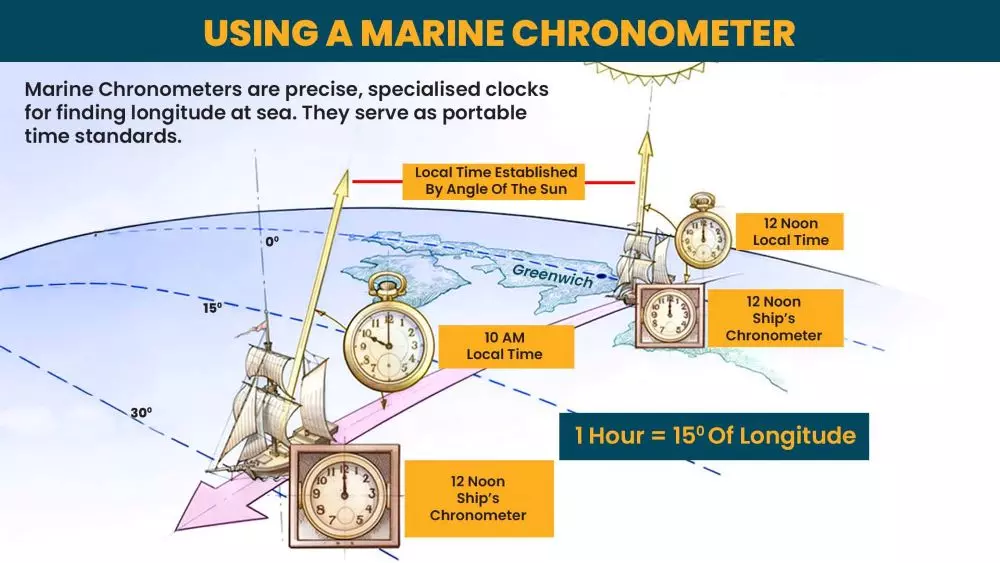
The Madras Observatory's instruments, especially the meridian circle calibrated with mercury, enabled remarkable precision. So reliable was this system that Madras came to be known as the 'Greenwich of the East'. The 'Madras Time' was famous among seafarers and travellers in the 19th century.
By the middle of the nineteenth century, the British East India Company established a network of postal and telegraph offices across India. Hundreds of these outposts, and each major town, had its own 'local time'. Offices and civil life were organised around this 'local time'. A table of time difference in minutes between the Madras Time and local time was prepared and published as part of the 'Indian Telegraphic Guide'.
Across British India, the Madras Observatory transmitted a daily time signal to all the Telegraph offices and railway stations, sharp at 4 pm Madras Time. Using conversion tables, each postal and telegraph office and railway station adjusted its local clock accordingly.
For administrative convenience in 1884, the British divided peninsular British India into three time zones: Calcutta Time for the east, Bombay Time for the west, and Madras Time as an intermediate time zone between the two. Railway companies in India began using Madras Time as a common standard, and it became known as 'Railway Time of India' among the masses. It became, in effect, India's first unified time.
What made 'Madras Time' special? The transit instrument at the Madras Observatory enabled the precise computation of time, every day, accurate to parts of a second. The time signal from this observatory was used to set clocks across British India. This computation of time became the backbone of timekeeping during colonial rule.
Also read: A life in orbit: How serendipity played a role in catapulting Sunita Williams to space
But how did Greenwich Mean Time (GMT) become the universal standard till 1972, before the world moved to Coordinated Universal Time (UTC), which relies on a global network of more than 450 atomic clocks?
As international telegraphy and science expanded, a global standard was needed. The question arose: Which meridian should be the Prime Meridian (Zero degrees)?
In 1884, representatives from across the world gathered in Washington to settle this practical question: where should zero longitude be?
In this debate, Greenwich was not inevitable; the scientific and political factors gave it an advantage.
The key to being the Prime Meridian was not just location, but astronomical precision. The Madras Observatory possessed a Meridian Circle (a highly accurate transit instrument) installed in 1862. This allowed incredibly precise calculation of local time.
As was being done at the Paris Observatory and Greenwich (where the Airy Transit Circle had been operating with great renown since 1851).
Hence, Paris made a bid. So did Greenwich. Madras was a colonial backwater and hence no one even made that suggestion. The superpowers competed vigorously.
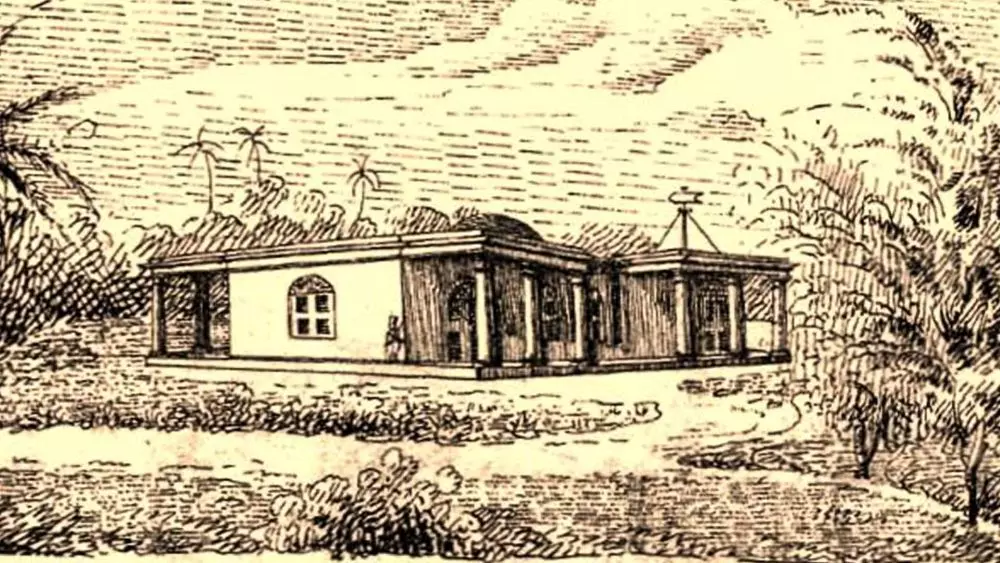
The Madras Observatory, established in 1792, provided accurate time signals for maritime navigation. The observatory's instruments enabled remarkable precision. So reliable was this system that Madras came to be known as the 'Greenwich of the East'.
There were even compromise suggestions. Some Europeans suggested retaining El Hierro in the Canary Islands, which, according to Ptolemy, was supposed to be the westernmost point of the known world and served as the prime meridian in earlier times. Even older European maps used this meridian, 20 degrees east of Paris, as the zero meridian.
But in the end, Greenwich prevailed. Not because it was culturally superior, but because it had something crucial for timekeeping. It had the sustained, reliable, long-term data. By then, most seafaring nations were using the precise timekeeping from Greenwich for their navigation.
But the political clout too played a part.
British colonial possessions were spread across the world; after all, it was an empire where the Sun never set. Thus, the British could have their way. In the final vote, 22 nations (including the USA and Britain) voted in favour of Greenwich. France abstained and continued using the Paris Meridian for its own timekeeping until 1911. Then fell in line with the international usage.
Ujjain, despite its ancient astronomical significance in Indian texts, had no functional modern observatory or Meridian Circle in the 18th or 19th centuries. It was not a contender. Timekeeping, in the modern world, depended on science and power.
Also read: How rare interstellar comet 3I/ATLAS is whizzing through our solar system
Even within India, adopting a single time was not easy.
Following the 1884 international conference, time zones were established worldwide, with a one-hour difference from GMT.
India argued for a special case. Madras Time was de facto a unified time; for railways, telegraphs, and scientific record-keeping, such as meteorological data.
But it was 5 hours, 21 minutes and 14 seconds ahead of Greenwich Mean Time. Thus, it was suggested that if a special time zone with a 5:30- hours difference could be allowed, India need not make a major change; Madras Time would be just 8 minutes and 46 seconds from GMT +05:30.
Thus came the Indian Standard Time, GMT+05:30 or Madras Time+8 minutes and 46 seconds.
But this was not implemented immediately. Only on July 1, 1905, could the British colonial government muster the courage to declare Indian Standard Time (GMT +5:30). The Madras Time was easily changed. The transit instrument from Madras Observatory was moved to Shankargarh Fort near Allahabad to be as close as possible to 82.5° E (the standard meridian of India). The Madras Observatory was also shifted to Kodaikanal for a superior atmospheric location and the study of the Sun.
When Indian Standard Time was introduced in 1905, it disrupted everyday life. In Bombay, the difference between local time and IST was nearly 40 minutes. Workers found themselves effectively starting their day earlier than before.
Protests followed.
Calcutta resisted too, partly for political reasons. 1905 was the year of the Bengal partition; nationalist sentiment was high. For years, major cities clung to their own clocks.
Only after India attained independence in 1947 did IST fully settle into place and even then, not without delay. Bombay revolted and refused to accept IST, continuing to use Bombay Time officially until 1955. Calcutta similarly held onto Calcutta Time until 1948.