- Home
- India
- World
- Premium
- THE FEDERAL SPECIAL
- Analysis
- States
- Perspective
- Videos
- Sports
- Education
- Entertainment
- Elections
- Features
- Health
- Business
- Series
- In memoriam: Sheikh Mujibur Rahman
- Bishnoi's Men
- NEET TANGLE
- Economy Series
- Earth Day
- Kashmir’s Frozen Turbulence
- India@75
- The legend of Ramjanmabhoomi
- Liberalisation@30
- How to tame a dragon
- Celebrating biodiversity
- Farm Matters
- 50 days of solitude
- Bringing Migrants Home
- Budget 2020
- Jharkhand Votes
- The Federal Investigates
- The Federal Impact
- Vanishing Sand
- Gandhi @ 150
- Andhra Today
- Field report
- Operation Gulmarg
- Pandemic @1 Mn in India
- The Federal Year-End
- The Zero Year
- Science
- Brand studio
- Newsletter
- Elections 2024
- Events

A life in orbit: How serendipity played a role in catapulting Sunita Williams to space
The journey of Sunita Williams, who retired from NASA on December 27, 2025, could be described by one word: happenstance. From wanting to be a veterinarian to foraying into space, her path was a series of deviations, each paving the way for a more resonant success.

The trajectory of life, much like the path of a spacecraft aimed towards the Moon or Mars, is seldom a straight line. It is impelled by the fire of intentions, but is always moderated by the gravitational pull of unseen interplanetary objects. The journey of Sunita Williams, who retired from NASA on December 27, 2025, could be described by one word: happenstance. Her path, which took her to...
The trajectory of life, much like the path of a spacecraft aimed towards the Moon or Mars, is seldom a straight line. It is impelled by the fire of intentions, but is always moderated by the gravitational pull of unseen interplanetary objects. The journey of Sunita Williams, who retired from NASA on December 27, 2025, could be described by one word: happenstance. Her path, which took her to space and made her a star, was a series of deviations, each rejection quietly paving the way for a more resonant success.
Born in Euclid, Ohio, to an Indian father, Dr Deepak Pandya, and a Slovenian-American mother, Ursuline Bonnie Pandya (née Zalokar), Sunita "Suni" Williams had three passions early on — pets, swimming, and science. In childhood, her future seemed clearly drawn. With a father renowned for his research in the fledgling field of neuroanatomy and schoolteachers who happily nurtured a bright, inquisitive mind, the expectation that she would pursue the sciences was natural. With her profound love for pets, Sunita's dream was to become a veterinarian. It was a path that made sense, a logical next step for a girl with a passion for animals and a keen interest in science.
As anticipated, after graduating from school, Sunita applied to various universities, including the hallowed halls of Columbia, to study veterinary sciences. Life, however, had other plans.
A family journey to Annapolis, Maryland, for her brother Jay's graduation from the United States Naval Academy (USNA) became the first unexpected turn. The impressive campus facilities for athletics, in particular the swimming pool, the crisp uniforms and Jay's own persuasive encouragement, tantalised Sunita. This was a world that promised to combine her love of swimming with a strong academic discipline. The temptation was strong, but it came with a price. Joining the USNA meant giving up her dream of becoming a veterinarian and getting her long hair cut according to naval rules.
In the mid-1980s, the Academy’s halls, only recently opened to women, echoed with the footsteps of a pioneering few. Sunita was among that early batch of women trainee naval cadets. Later in a media interview, she recalled, "I wanted to be a veterinarian and sort of went the wrong turn and actually didn't get into the universities that I wanted to do that and ended up under the influence or guidance of my older brother to go to the Naval Academy."
Also read: Why ISRO’s handling of post-failure transparency after PSLV-C62 mission loss will be closely watched
Graduation from the USNA in 1987 brought a new crossroads. In an interview, she reminisced that after she finished the cadet training, she was wondering what to do. She set her sights on becoming a Navy diver, a natural extension of her swimming accomplishments. But there was only a single slot available and she was not chosen. It was her first rejection. "I was not the top, not the end, somewhere in the middle. And I wanted to be a diver because I was a swimmer. I didn't get that billet, at the same time 'Top Gun' came out, so I thought I would be Tom Cruise and go fly aeroplanes. So, that was my goal."
Undeterred, she looked skyward, gravitating towards Naval Aviation. Yet again, her first choice proved elusive. “It was the time of Top Gun, so I wanted to be a jet pilot. That did not pan out either, I became a helicopter pilot,” she said. She was not selected to train as a jet pilot, and she had to accept the second choice, training as a helicopter pilot.
After her training, as a helicopter pilot with the Helicopter Combat Support Squadron, she was deployed during the Gulf War and on missions in Saudi Arabia and Iraq. Afterwards, aiming higher still, she joined the Naval Test Pilot School in 1993. After successful training, she became a test pilot, pushing unproven aircraft to their limits. She tested 30+ flying machines as a naval test pilot. This skill helped her become a test pilot for the newly developed Boeing spacecraft. Later, she was promoted to test pilot instructor.
It was during this phase of becoming a naval test pilot, on a mandatory orientation visit to the Johnson Space Centre in Houston that the pieces of her fragmented path suddenly clicked into a coherent picture. The speaker was John Young, a legend who had landed on the Moon twice and flown to space six times. As he addressed her group, he mentioned, almost in passing, a critical part of his own preparation — learning to fly a helicopter to simulate the lunar landing module. In that quiet auditorium, a spark fired in Sunita’s mind. "I can fly a helicopter. Maybe I, too, can go to space."
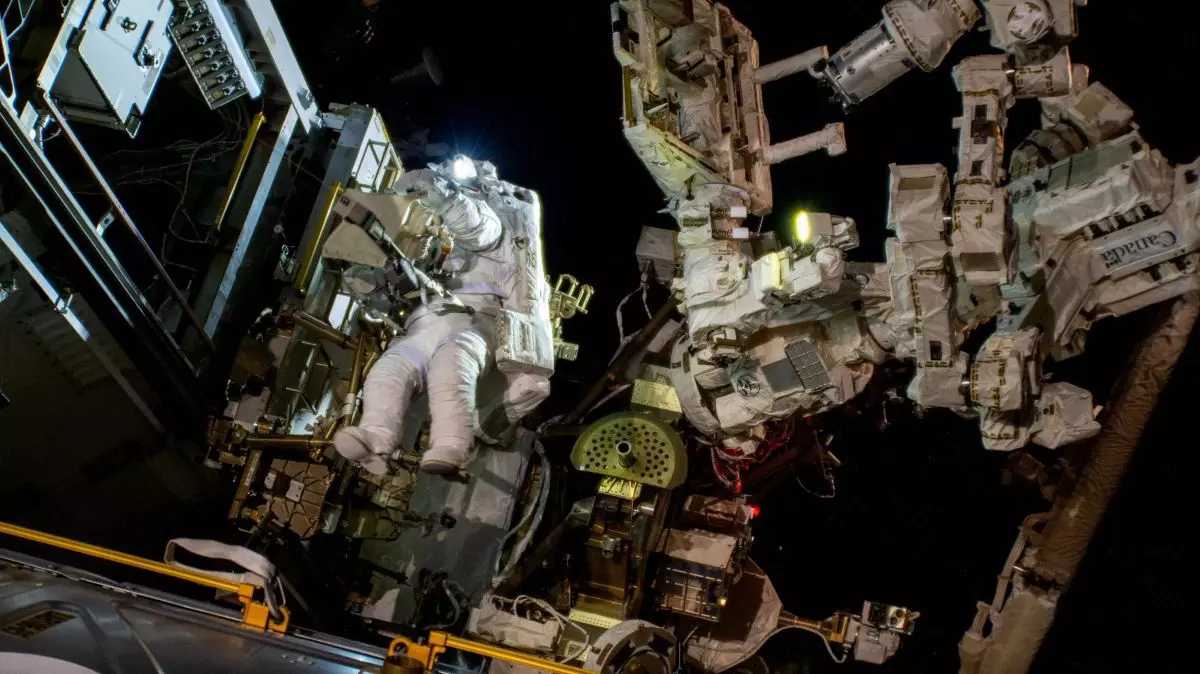
Sunita Williams outside the International Space Station during a spacewalk in 2025. Photo: www.nasa.gov
From then on, life was not the same for Sunita. Her application to NASA was immediate and the rejection that followed was just as swift. But this was no longer a young woman facing a closed door with disappointment. She decided to build her resume and knock on NASA's doors with better qualifications. She enrolled in a master's programme in engineering, joined a diving school and qualified as a deep-sea diver. Two years later, she was an engineer, a diver, a helicopter pilot and a test-pilot instructor who had logged more than 3,000 hours of flight time. In 1998, when she applied again, NASA had no choice but to answer 'yes'. The happenstance helicopter pilot, the one who did not get her first choice, not once but repeatedly, making do with the second, was now a much-coveted trainee astronaut.
Also read: How rare interstellar comet 3I/ATLAS is whizzing through our solar system
Perhaps all the universe had conspired to help her. Reflecting on the zigzag route that led her to the International Space Station and into history, she once said, “Don’t be afraid to fail, because you find out a little more about yourself when you don’t get your first choice and then you end up finding something that you will do well because you like it. When you like something, you will do it well and then you are going to get the rewards at the end.”
When Sunita received the long-awaited call from NASA in 1998, the International Space Station (ISS) was just taking shape. In November 1998, the Russian Zarya module was launched, marking the start of the assembly phase. America's primary vehicle for this monumental construction project was the Space Shuttle, which ferried astronauts and vital components into orbit.
Sunita, alongside seventeen batchmates selected as astronaut candidates, now embarked upon a gruelling two-and-a-half-year training. The ‘Astronaut Candidate Training’ was an exhaustive regimen designed to prepare for every contingency. It began with orientation briefings and tours, soon giving way to scientific and technical lectures. Trainees received intensive instruction on Space Shuttle and nascent ISS systems. They underwent physiological conditioning and trained to fly T-38 jets. Survival skills were imperative, with courses in water and wilderness survival techniques. The physical demands were unyielding; one test required swimming 75 metres in a pool nonstop while wearing a flight suit and shoes. Candidates learned about orbital mechanics and space science in class, then practised what they learned in flight simulators. They learnt how to fix and troubleshoot every piece of equipment on the ISS, from the microwave oven to the life support systems.
Because the ISS was a joint American-Russian project, a significant part of the training took place in the famous Yuri Gagarin Cosmonaut Training Centre in Star City, near Moscow. For months, the candidates learned to use the Soyuz spacecraft, the station's lifeboat. They learned how to speak Russian well enough to work together without any problems. Sunita excelled, and as her training neared completion, NASA delivered momentous news: she was formally assigned to a mission slated for 2003. Her path to space, it seemed, was finally secured.
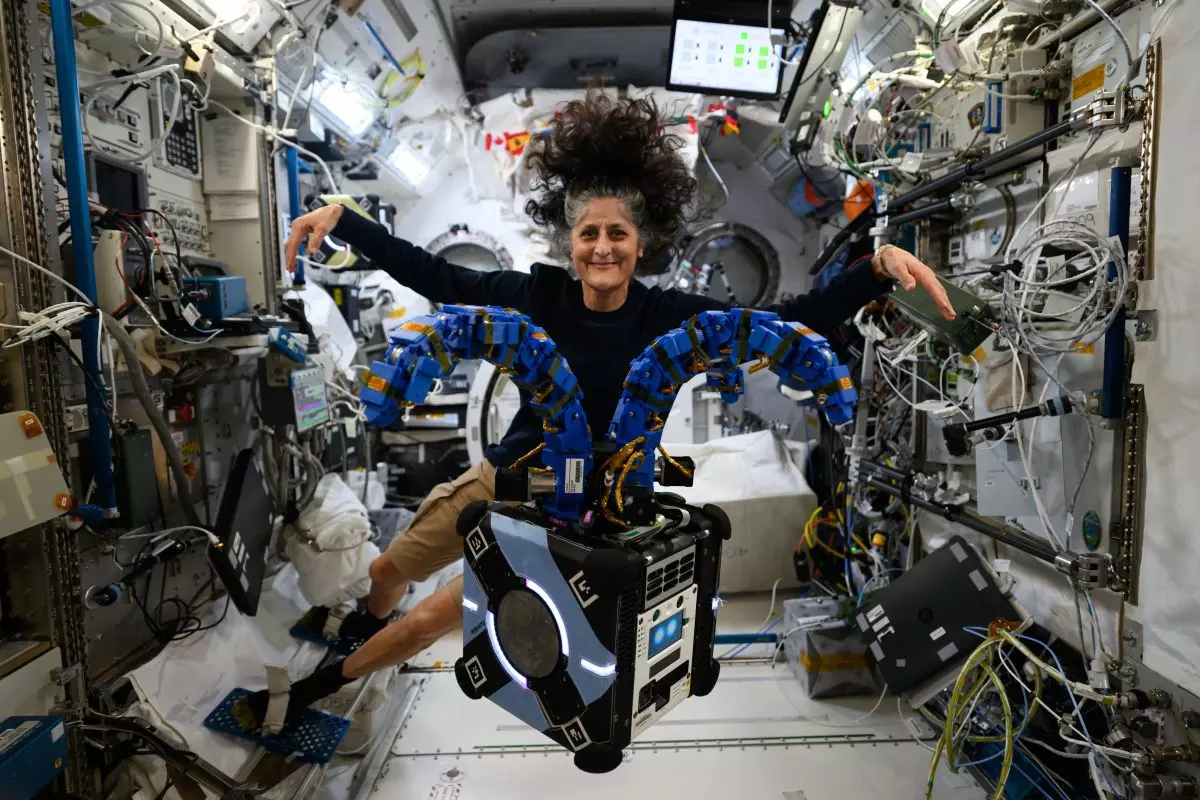
Sunita Williams checks out the Astrobee robotic free-flyer in a 2024 image. Photo: nasa.go.in
Alas, once again, there were many slips between the cup and the lip.
On the morning of Saturday, February 1, 2003, the Space Shuttle Columbia disintegrated during re-entry, tragically claiming the lives of all seven astronauts on board. Among them was Kalpana Chawla, an astronaut of Indian origin and a personal friend of Sunita. This was the second terrible loss of a Shuttle, after the Challenger tragedy in 1986 — which had seen the Space Shuttle Challenger explode soon after launch, killing all crew members. The catastrophe of the Space Shuttle Columbia plunged NASA into deep confusion and self-reflection. The entire Shuttle fleet was grounded, leaving American trips to the ISS in severe uncertainty. The setback was very personal for Sunita and her fellow trainees, who were about to start their careers. They acquired an unofficial nickname: 'The Penguins', alluding to the bird that cannot fly.
It would take over two years of meticulous investigation and safety modifications before NASA cautiously resumed Shuttle operations. Finally, on December 9, 2006, Sunita stepped aboard the Space Shuttle Discovery. She was on her way to the International Space Station, commencing the first of her historic sojourns to the ISS.
Also read: How astronomers spotted birth of a new solar system around baby star HOPS-315
Her maiden voyage into space was nothing short of spectacular. Launched aboard the Space Shuttle Discovery on December 9, 2006, as part of the STS-116 mission, Sunita arrived at the International Space Station two days later to begin her tenure with Expedition 14. Within the first few days of settling into the rhythm of microgravity, she attended to a personal need: a haircut. After the strict regulations of the Naval Academy, she had let her hair grow long. She was well aware that in the weightless environment of the station, free-flowing hair would become an unmanageable nuisance. Yet she chose not to cut it before launch, allowing herself the whimsical joy of feeling it billow about her face in microgravity. This small personal pleasure was coupled with a deeper purpose. The hair she cut was carefully preserved and later donated to Locks of Love, a charity that creates wigs for children suffering hair loss due to medical conditions like cancer.
Her task as a mission specialist was extended, thus she stayed on the station to join Expedition 15. She was supposed to come home aboard the Space Shuttle Atlantis in April 2007, but technical problems delayed the return. Finally, on June 22, when the craft was ready for the return trip, terrible weather on Earth delayed the re-entry by nearly 24 hours. This extra day, however, proved fortuitous. It allowed her to set a new world record for the longest single spaceflight by a woman, with a total of 195 days in orbit (which, of course, has since been surpassed).
Her first mission marked several notable achievements. She also set a record for female astronauts by conducting four arduous spacewalks, totalling 29 hours and 17 minutes outside the station, three of which were completed within just nine days. The process of an Extra-Vehicular Activity, or spacewalk, is torturous and arduous. Preparation begins hours before exiting the airlock, with a meticulous 'pre-breathe' protocol. Clad in their spacesuits, which are pressurised with pure oxygen, astronauts slowly purge nitrogen from their bloodstreams to avoid the crippling pain of decompression sickness, known colloquially as 'the bends'. The spacewalk itself often lasts six to seven hours, meaning an astronaut may be confined in the suit for nearly 10 hours. During this time, they cannot eat or drink freely, relying on liquid nourishment through a straw port in the helmet and using specially designed diapers for excretion.
Amidst the demanding schedule of science and station maintenance, Williams found a moment for her passion, a marathon. She participated in the 2007 Boston Marathon, running the full 42-kilometre distance on the station's treadmill in 4 hours, 23 minutes, and 10 seconds, becoming the first person to complete the race from orbit.
Her scientific duties were varied and deep. One memorable experiment involved cultivating soybeans; observing the tender green sprouts defy gravity and reach for the station's lights made Sunita jump with joy.
When Sunita Williams returned to the International Space Station for her second mission on July 14, 2012, much had changed. The station itself was finished and its huge structure was now as wide as a football field, enabling a six-person crew to live and work comfortably. It now boasted the famed Cupola, an observatory module with seven windows that offered stunning views of Earth and space. Also, as NASA's Space Shuttle fleet was permanently retired, she and all-American astronauts had to rely on the Russian Soyuz ship. She joined Expedition 32, later transitioning to command Expedition 33, becoming only the second woman (after astronaut Peggy Whitson) to hold that responsibility at the time.
This mission, too, was defined by intense extra-vehicular activity. Her first spacewalk lasted 10 hours, and though the primary task remained unfinished, she and Japanese astronaut Akihiko Hoshide persevered. On a second walk later that week, they successfully installed a critical Main Bus Switching Unit and repaired a camera on the station's robotic arm. Through these efforts, Williams surpassed astronaut Peggy Whitson's record for the most cumulative spacewalk time by a woman. The expedition was a hive of scientific activity, with the crew executing over 200 experiments across fields ranging from biology to physics.
After 125 days, she returned to Earth on November 19, 2012. Yet, her destiny with space was not complete.
Sunita set out on a third mission on June 5, 2024, along with Butch Wilmore on Boeing's Starliner spacecraft. This mission was supposed to be a simple week-long test flight for the new ship, but things did not go as planned. A series of technical anomalies, including thruster issues and helium leaks, necessitated a prolonged stay at the station for the crew while the uncrewed Starliner was returned to ground for analysis. Stranded on the ISS, she and Wilmore were integrated into Expedition 72. Their week-long test flight turned into a 286-day-long space mission.
Sunita contributed to ISS activities throughout this unexpected stay. During a spacewalk with Wilmore, she helped take hardware from the station's truss and gathered microbiological samples from the outside of the station. She added to her total during this expedition and, with 62 hours and 6 minutes, broke Peggy Whitson's record for the longest total time spent on a spacewalk by a female astronaut. This put her fourth on NASA's all-time list of men and women for longest total spacewalk. She finally returned on March 18, 2025.
While in India the media often identifies her as Indian-American, in Slovakia, as one of Slovenian heritage, Sunita has often emphasised that "You don't see any borders between countries from space. That's man-made and one experiences it only when you return to Earth".
Sunita Williams completed three space flights and spent 608 cumulative days in space during her 27 years at NASA. She went on two scheduled long trips and a third that lasted longer than planned. Sunita was the first astronaut to fly four different kinds of spacecraft. Her three missions involved flying or piloting the Space Shuttle, the Russian Soyuz, the Boeing Starliner, and the SpaceX Crew Dragon. She retired from NASA having accrued the second-highest cumulative time in space among American astronauts.