- Home
- India
- World
- Premium
- THE FEDERAL SPECIAL
- Analysis
- States
- Perspective
- Videos
- Sports
- Education
- Entertainment
- Elections
- Features
- Health
- Business
- Series
- In memoriam: Sheikh Mujibur Rahman
- Bishnoi's Men
- NEET TANGLE
- Economy Series
- Earth Day
- Kashmir’s Frozen Turbulence
- India@75
- The legend of Ramjanmabhoomi
- Liberalisation@30
- How to tame a dragon
- Celebrating biodiversity
- Farm Matters
- 50 days of solitude
- Bringing Migrants Home
- Budget 2020
- Jharkhand Votes
- The Federal Investigates
- The Federal Impact
- Vanishing Sand
- Gandhi @ 150
- Andhra Today
- Field report
- Operation Gulmarg
- Pandemic @1 Mn in India
- The Federal Year-End
- The Zero Year
- Science
- Brand studio
- Newsletter
- Elections 2024
- Events

How maiden Ranji win has given momentum to the J&K youths’ dreams of a professional cricket career
Long known for its prized willow, used to craft the best cricket bats, Kashmir has in recent years been extending its association with the game, with a crop of young players dreaming to make it big at the national level. But J&K's volatile past, infrastructural lacks and few platforms to showcase talent pose a challenge.

Every afternoon after school, at around 1 pm, 14-year-old Adnan Bashir leaves home in Halmula, a village in Kashmir’s Anantnag district, to begin a 21-kilometre journey to Pulwama — often associated in public memory with a horrific 2019 terror attack — to train at the Umar Nazir Cricket Academy (UNCA), a private institute located in the district’s Wagum village. “I usually bowl...
Every afternoon after school, at around 1 pm, 14-year-old Adnan Bashir leaves home in Halmula, a village in Kashmir’s Anantnag district, to begin a 21-kilometre journey to Pulwama — often associated in public memory with a horrific 2019 terror attack — to train at the Umar Nazir Cricket Academy (UNCA), a private institute located in the district’s Wagum village. “I usually bowl around 10 to 15 overs in the nets every day,” Bashir told The Federal. "I want to become a fast bowler.”
For decades, Kashmir has been known for its prized willow, used to craft some of the best cricket bats. In recent years, however, a young crop of players from the Union Territory are scripting a new association with the game, dreaming to make it big at the national level. This dream gained fresh momentum recently, as J&K claimed its maiden Ranji Trophy last month.
“Children in J&K have always played cricket in streets, open fields and village grounds,” says Ameek Khan, a coach. “The difference now is that many of these children want to move from gully cricket to professional training academies.
Khan, a former national-level player who now runs the AK Cricket Academy in Mattan, near Anantnag, says a lot has changed in the past decade. “Earlier, most young players relied only on local matches or informal practice, but now more academies are coming up and players are getting structured coaching. After the Ranji win, I received dozens of calls from teenagers and their parents asking about joining the academy. Many young players now believe that if the state team can achieve such success, they too can aim high.”
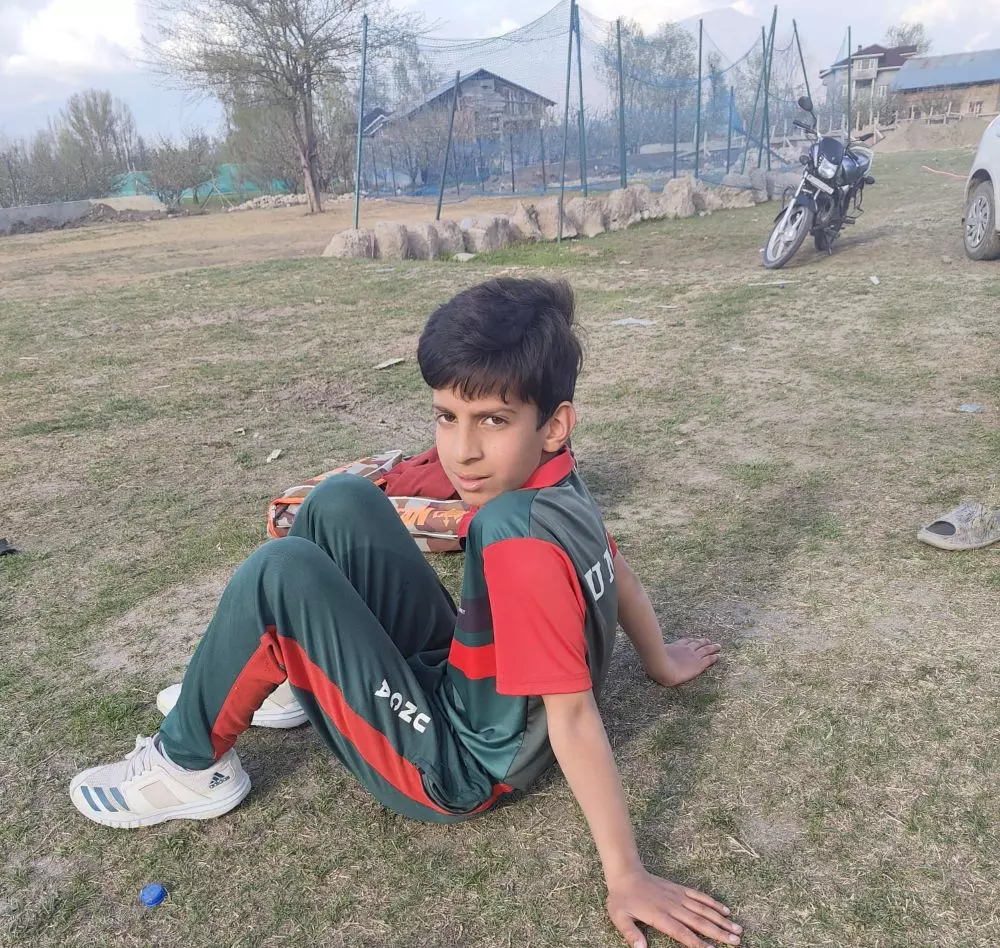
Adnan Bashir, 14, at the cricket training academy in Pulwama. Photo: By special arrangement
Bashir has been training at the UNCA since 2020. The daily commute on public transport can be exhausting, but the teen says the excitement of bowling keeps him motivated.
For his father, Bashir Ahmad, supporting his son’s cricketing ambition has become an important part of life. “Adnan has been passionate about cricket since childhood,” says Ahmad, adding, “When he asked to join the academy in Pulwama, we decided to support him. Every day he travels there for practice and comes back in the evening, but he never wants to miss training.”
For Ahmad, who runs a cricket bat manufacturing unit in Halmula, the change is striking. Halmula has long been associated with the manufacturing of cricket bats, with many families involved in shaping Kashmir willow into equipment used by players across the country. But in recent years, he says, the younger generation has begun dreaming of becoming cricketers themselves.
“Earlier, people here were mainly connected to cricket through making bats,” he said. “Now, children want to play the sport professionally. They follow matches closely and want to represent the state and country.”
Also read: How communities of urban Indians are ditching the screen to bond over board games
From another Kashmir village, Subhanpora Bijbehara, sixteen-year-old Suhaib Showkat Ganie walks nearly five kilometres daily to the Bijbehara Cricket Academy to train under former cricketer Parvez Rasool, and coaches Mujtaba Yusuf and Yawar Hasan.
“After the Ranji Trophy win, the passion among young players has increased,” he admits. “Several of my friends called me and said they also want to join the academy and start playing cricket seriously.” Ganie himself has his eyes set on joining the Indian cricket team and says, “I will give everything to achieve that dream.”
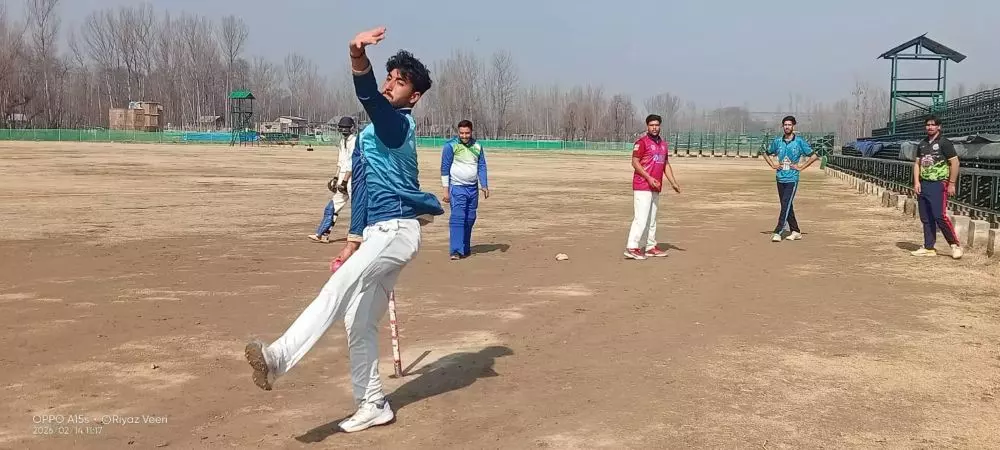
Sixteen-year-old Suhaib Showkat Ganie trains at an academy at Bijbehara. Photo: By special arrangement
Like every other social and economic aspect in J&K, cricket here too has long remained stunted under the shadow of the volatile situations in the then state, now Union Territory, since the growth of terror in the region in the early ‘90s.
Independent researcher Faizan Bhat argues that cricket in the subcontinent has never existed in isolation from politics.
“There were periods when the situation on the ground was not very stable and that naturally impacted sporting activities,” says a coach, speaking on condition of anonymity. “Matches would get cancelled, practice sessions would get disrupted, and many players lost opportunities during those years.”
The Sher-I-Kashmir Cricket Stadium (one of only two cricket stadiums in J&K, the other being the Hostel Ground GGM Science College Jammu) was established in 1983. The last ODI player here was in 1986, between India and Australia. The stadium, with a capacity of 12000, was occupied by the Central Reserve Police Force for 18 years at the peak of militancy in J&K. After they vacated the space in 2007, first-class cricket resumed here in 2009.
Also read: Why bird droppings episode at India Open forces question on state of India's non-cricket stadiums
According to Umar Nazir Mir, a senior player of the Jammu and Kashmir cricket team and coach at the UNCA in Pulwama, one of the biggest strengths of young cricketers from the region is their natural talent and passion for the game, their strong commitment to the game despite limited resources. “The youngsters here have great determination and raw ability. They are eager to learn and ready to work hard, which is very important for any sportsperson,” he says.
According to the player-coach, once any player is picked up by the Jammu and Kashmir Cricket Association (JKCA), responsible for governing and developing cricket across the Jammu and Kashmir and Ladakh, resources and facilities improve. It is often the local players who are left with proper infrastructure.
While according to locals the Jammu and Kashmir Sports Council too has also been trying to expand grassroots cricket, running training academies, turf wickets and practice facilities, “organised training and regular competitions are essential for developing the next generation of cricketers in the region,” says former cricketer Parvez Rasool, a technical advisor with the Jammu and Kashmir Sports Council.
“A new player will emerge only when he is given a platform,” he says. “If there is no platform, how will a player grow?” While only a small number of cricketers go on to represent India, play in the Indian Premier League or compete in the Ranji Trophy, Rasool argues that a broader cricket ecosystem can still support many others. “All players cannot reach the international level or play in the IPL or Ranji. But there should at least be a platform where players can play regularly and earn their livelihood.”
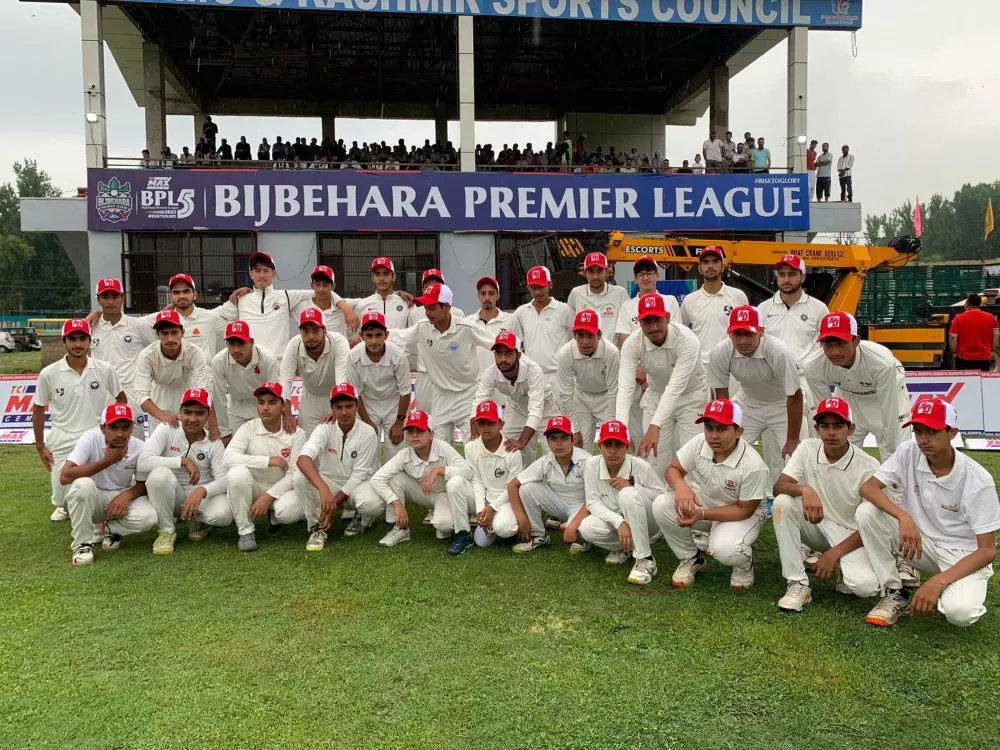
Players at a Bijbehara Premier League match. Photo: By special arrangement
A senior domestic cricketer from Jammu and Kashmir, speaking on condition of anonymity, echoes Rasool’s concern. “Since there are very few platforms created by the Jammu and Kashmir Cricket Association for local cricketers, players now participate in local leagues such as the Red Premier League, Bijbehara Premier League, Royal Premier League and dozens of other tournaments across the Valley,” he says.
The player adds: “These leagues are organised and sponsored by local business owners and community members who hire players and support the tournaments. In many ways, these local organisers are doing more to keep cricket alive in Kashmir than the administration. Without their support, many players would not have any platform to play or earn.”
Expressing frustration over the slow pace of cricket development in J&K, the player further alleges that “in many places there are no proper turf wickets, no quality practice grounds and very limited coaching support. A lot of players depend on private academies or travel to other states to get basic training.”
He also claims that the Jammu and Kashmir Cricket Association has not held “proper open trials”, where young players from different districts can showcase their talent, “for years”, alleging “favouritism, political influence and nepotism” have affected opportunities for local cricketers.
Also read: How ‘desi fitness’ is changing workout goals and life aspirations in Haryana
However, while Brigadier Anil Gupta (Retd), member administration, Jammu and Kashmir Cricket Association, acknowledged that cricket facilities in Jammu and Kashmir remain far behind those in many other parts of India, he insisted that every year the association “registers about 30 to 40 players in each age group, both for men and women”.
The gap, according to him, was in available infrastructure.
“We believe there should be a cricket academy which will operate under JKCA and we are planning for it. There are cricket academies in J&K, but none that are run by the association,” he says. The association, according to him, also hopes to build two new stadiums — one in Jammu and one in Srinagar — and eventually develop turf-wicket grounds in every district.
“We are in touch with the government,” he said. “Once land is made available, we will develop these facilities. For our teams, we have adequate facilities. At Jammu and Srinagar, we have created the most modern infrastructure facilities which are required. What we are lacking is facilities at the district headquarters," he adds.
Also read: Mumbai to small-town nets, how World Cup win is redrawing the map of women’s cricket in India
Meanwhile, as the day’s practice winds down, Bashir picks up his training kit to make the long journey back home. Often, Ahmad says, the boy is too tired to study in the evenings, waking up early to finish his school work. “Still, he manages to be among the top three students in his class,” says Ahmad, whose two other sons are more academically inclined.
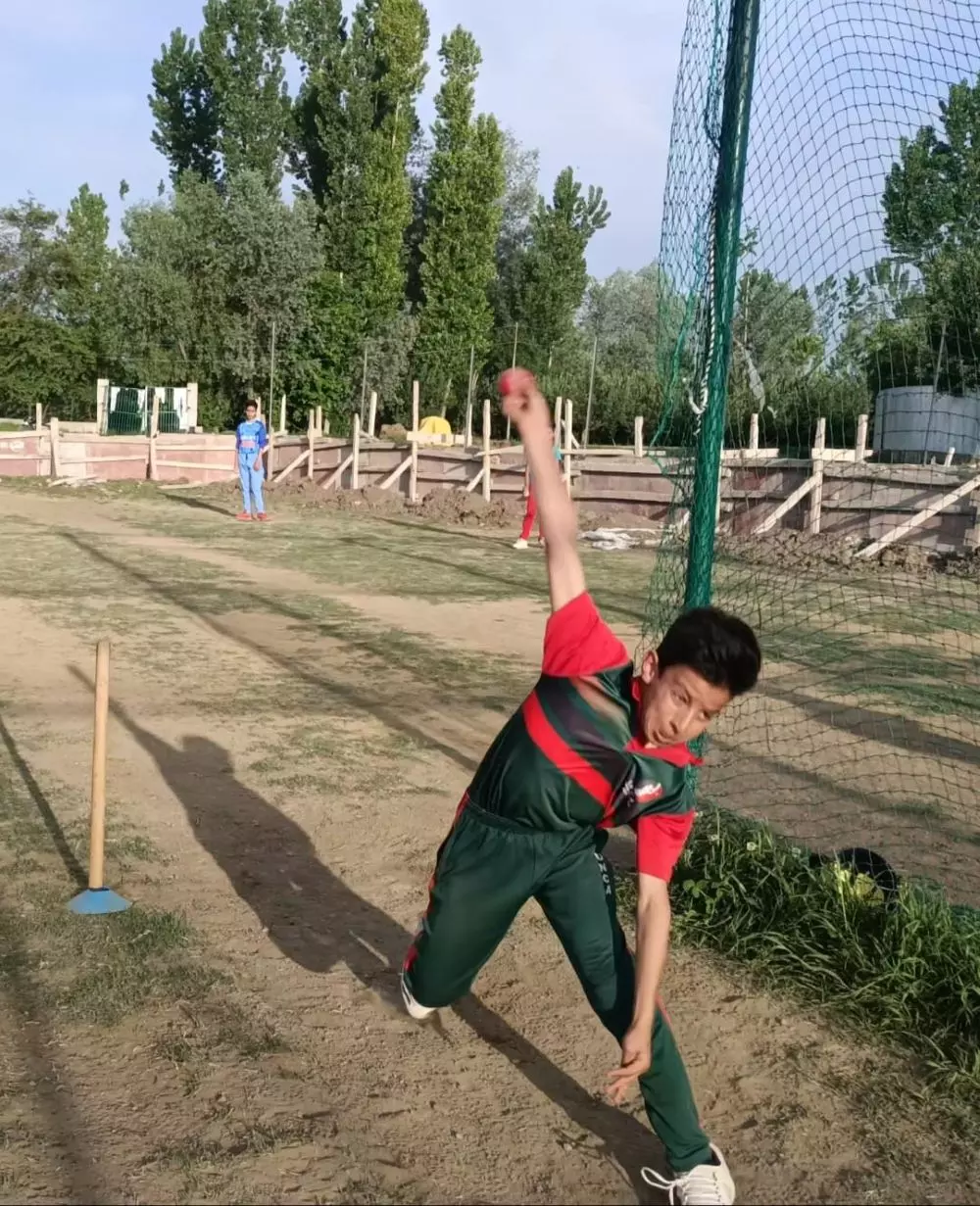
Adnan Bashir practices bowling at the academy. Photo: By special arrangement
The family’s support for Bashir’s dream, is, according to coaches The Federal spoke to, reflective of a growing change among parents, who are beginning to be more supportive of the children’s sporting aspirations.
“When Adnan was about nine years old, he could not travel to the academy alone,” recalls Ahmad. “I would close the factory around 1 pm and accompany him to the UNCA and wait there for him to finish.”
Between his training at the UNCA, where the monthly coaching fee is Rs 3,000, plus transportation costs and another Rs 180000 that they spend for his training and accommodation in Uttar Pradesh during the winter months, Ahmad estimates the family spends about Rs 6 lakh annually on Bashir’s cricketing aspirations. “But the family considers it an investment in his dream of becoming a professional cricketer,” says the father.
Bashir pipes in, “I want to play for Jammu and Kashmir in the Ranji one day and then represent India.”