- Home
- India
- World
- Premium
- THE FEDERAL SPECIAL
- Analysis
- States
- Perspective
- Videos
- Sports
- Education
- Entertainment
- Elections
- Features
- Health
- Business
- Series
- In memoriam: Sheikh Mujibur Rahman
- Bishnoi's Men
- NEET TANGLE
- Economy Series
- Earth Day
- Kashmir’s Frozen Turbulence
- India@75
- The legend of Ramjanmabhoomi
- Liberalisation@30
- How to tame a dragon
- Celebrating biodiversity
- Farm Matters
- 50 days of solitude
- Bringing Migrants Home
- Budget 2020
- Jharkhand Votes
- The Federal Investigates
- The Federal Impact
- Vanishing Sand
- Gandhi @ 150
- Andhra Today
- Field report
- Operation Gulmarg
- Pandemic @1 Mn in India
- The Federal Year-End
- The Zero Year
- Science
- Brand studio
- Newsletter
- Elections 2024
- Events

Why bird droppings episode at India Open forces question on state of India's non-cricket stadiums
Without regular competitions, venues remain underused. Without usage, maintenance declines. And without maintenance, facilities rapidly deteriorate. In some places, private turfs, often expensive and technically unsuitable, fill the gap, while most public grounds remain poorly maintained or inaccessible.

The rally was in progress when play suddenly stopped. At Delhi’s Indira Gandhi Indoor Stadium, during a men’s singles match at the India Open badminton tournament in mid-January, players began looking up instead of across the net. Officials walked in, towels appeared, television cameras zoomed closer.And focused on bird droppings.The match between India’s H.S. Prannoy and Singapore’s...
The rally was in progress when play suddenly stopped. At Delhi’s Indira Gandhi Indoor Stadium, during a men’s singles match at the India Open badminton tournament in mid-January, players began looking up instead of across the net. Officials walked in, towels appeared, television cameras zoomed closer.
And focused on bird droppings.
The match between India’s H.S. Prannoy and Singapore’s Loh Kean Yew had to be halted, not once but twice. Each time, the court was wiped clean and play resumed, only for the same problem to return. Birds had found their way into one of India’s most prominent indoor sporting venues and there was no immediate solution.
After the match, Prannoy said simply, “It was bird droppings that kind of halted the game.” Loh spoke about the air inside the hall, saying it was difficult to breathe and affected stamina. The remarks were measured, almost understated. They didn’t need to be dramatic. What unfolded at the India Open was already telling its own story.
Because this was not just an embarrassing viral moment. This was a collision between India’s ambition to project itself as a global sporting host and the reality of maintenance and basic operational control. In the days that followed, other international players spoke more bluntly. Danish shuttler Mia Blichfeldt publicly described the stadium as “dirty” and “unhealthy,” pointing out that birds were flying inside the hall and defecating near the courts. On another day, visuals of a monkey, purportedly inside the spectator area, were circulated widely on social media, reinforcing the sense that the venue was struggling to manage even the most fundamental aspects of an indoor event.
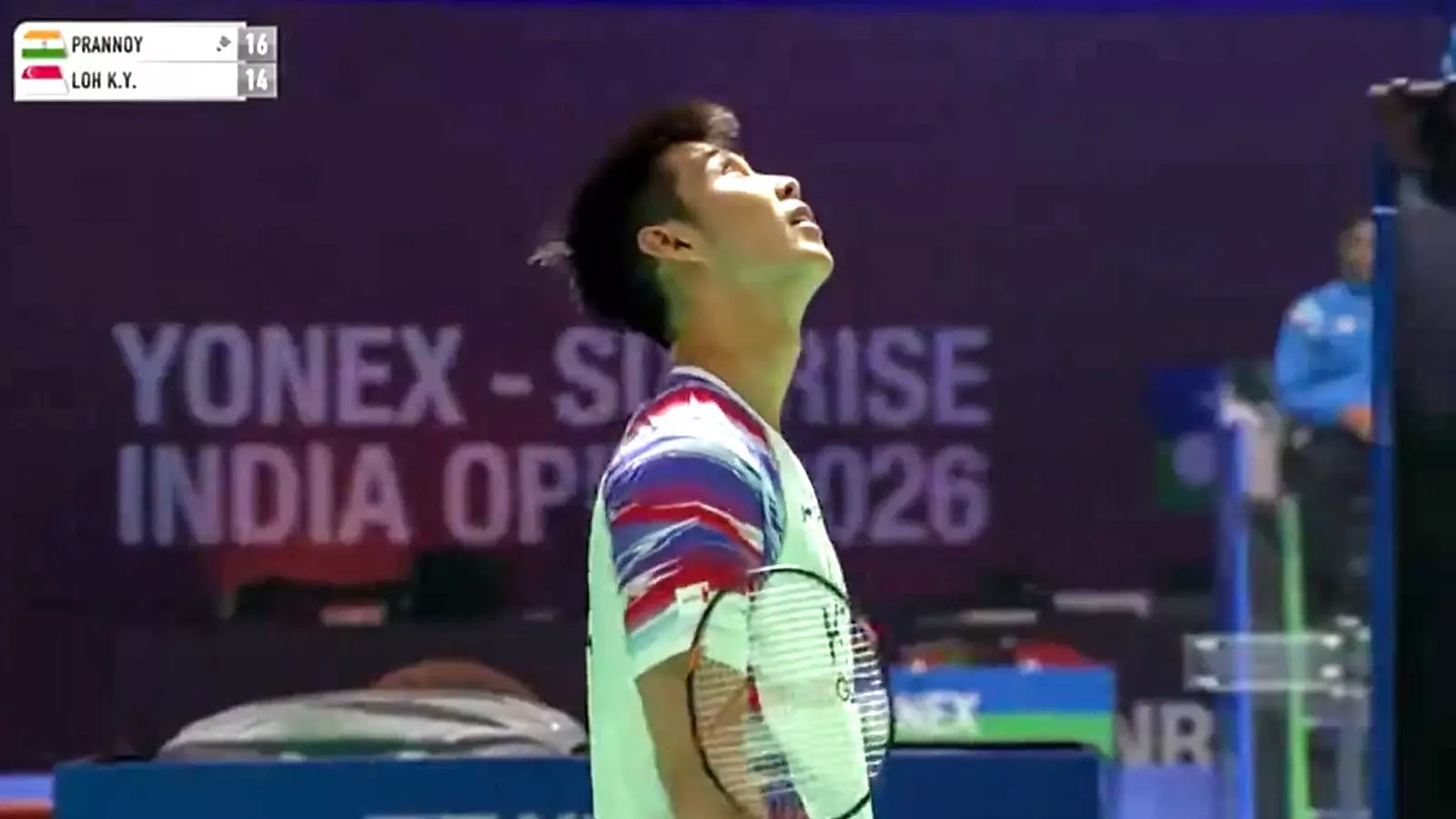
The match between India’s H.S. Prannoy and Singapore’s Loh Kean Yew had to be halted, not once but twice. Each time, the court was wiped clean and play resumed, only for the same problem to return. Photo: Screengrab from X
The Badminton World Federation responded with a statement saying the field of play met required standards and that environmental challenges, including air quality, were being managed. Organisers insisted the situation had been addressed. But within the sports community, especially among those who travel the international circuit regularly, the response felt defensive rather than reassuring.
Senior sports journalists and administrators quietly point to a more uncomfortable truth. For nearly three years now, several Danish players have been reluctant to travel to India for tournaments. This is rarely said on record. Players, they say, fear scrutiny, backlash, or being labelled “difficult”. But the reluctance exists, and it exists for reasons that go beyond competitive conditions.
The India Open episode forced a question Indian sport has often avoided asking itself honestly: Are India’s non-cricket sporting spaces actually fit for elite competition or even safe for everyday training?
In Haryana, the answer has already come in the most tragic way possible. Between mid-2025 and early 2026, a series of incidents exposed the cost of poor infrastructure not just in lost training days or disrupted preparation, but in human lives.
On November 18, 2025, a 17-year-old basketball trainee died at a government sports facility in Gurugram after being fatally injured when a basketball pole collapsed during practice. Preliminary findings pointed to rusted joints and faulty anchoring, suggesting the structure had not been inspected or certified for safety.
Barely a week later, on November 25, another tragedy struck. A 16-year-old basketball player lost his life after being injured at a district-level sports complex in Jind, again due to unstable equipment. The back-to-back deaths sent shockwaves through the sporting community, particularly because both victims were minors training at public facilities meant to nurture talent.
Emergency inspections followed. Committees were formed. Assurances were issued. But among athletes and coaches, the dominant emotion was anger rather than relief. Because for them, the warning signs had been visible for years.
At Nehru Stadium in Gurugram, basketball players had reportedly repeatedly complained of uneven and slippery court surfaces through late 2025, resulting in frequent falls, ankle injuries, and interrupted training cycles. Coaches claimed modifying drills simply to minimise risk which is an admission that the infrastructure itself could not be trusted.
In Faridabad, athletes training at a government stadium reportedly found used syringes inside washrooms located near training halls. The discovery pointed to poor supervision and hygiene control in spaces frequented by teenagers. In Rohtak, the Rajiv Gandhi State Sports Complex and Chhotu Ram Stadium, the latter a facility where Olympic medal-winning wrestler Sakshi Malik once trained, have repeatedly made headlines for alleged lack of usable toilets, broken doors, garbage-strewn washrooms, and courts lying in dilapidated condition. The badminton hall at Chhotu Ram Stadium, where Odisha Open gold medallist Unnati Hooda once trained, is said to be crying out for repairs and the appointment of a full-time government coach.
Announcements to build or upgrade stadiums in the villages of Olympic medallists have also moved slowly. The proposed stadium in sharp shooter Manu Bhaker’s village, Goria in Jhajjar, is yet to take off, while work on facilities linked to Sakshi Malik’s village has stalled, purportedly owing to fund constraints. These are not isolated failures. They form a pattern, one that extends well beyond Haryana.
Also read: Mumbai to small-town nets, how World Cup win is redrawing the map of women’s cricket in India
Rajasthan is often projected as an emerging sporting hub, with Jaipur positioned as a future centre for elite competition. Yet the contrast between history and present reality is striking. Jaipur has hosted Davis Cup ties in the past, a reminder that the city was once trusted with international tennis and capable of meeting global standards. That legacy makes today’s struggles harder to dismiss as teething problems.
Dilip Shivpuri, president of the Rajasthan Tennis Association, describes the challenge as structural rather than accidental. He says, “Lack of funds is the central issue that cripples all non-Cricket Sports organisations in India. The lack of popular interest leads to hardly any media coverage, which in turn makes finding sponsors a big headache and a severe dearth of money for all sports other than cricket, which has televised coverage almost every day. This is a vicious cycle that hinders the growth of facilities and infrastructure in non-cricket sports.”
Shivpuri adds that while cricketers mint millions, players in other sports don’t see much of a future for themselves as non-cricket sports hardly ensures them a respectable earning. “Inevitably, in my experience as a sports administrator over the past 35 years, I have often seen high dropout rates even among talented players, whether in tennis, table tennis, badminton or any other sports. Even players who do quite well at the junior level are unable to continue devoting all their time or energy to their chosen sport as seniors, as they don’t see a bright future for themselves in any non-cricket sport,” he says.
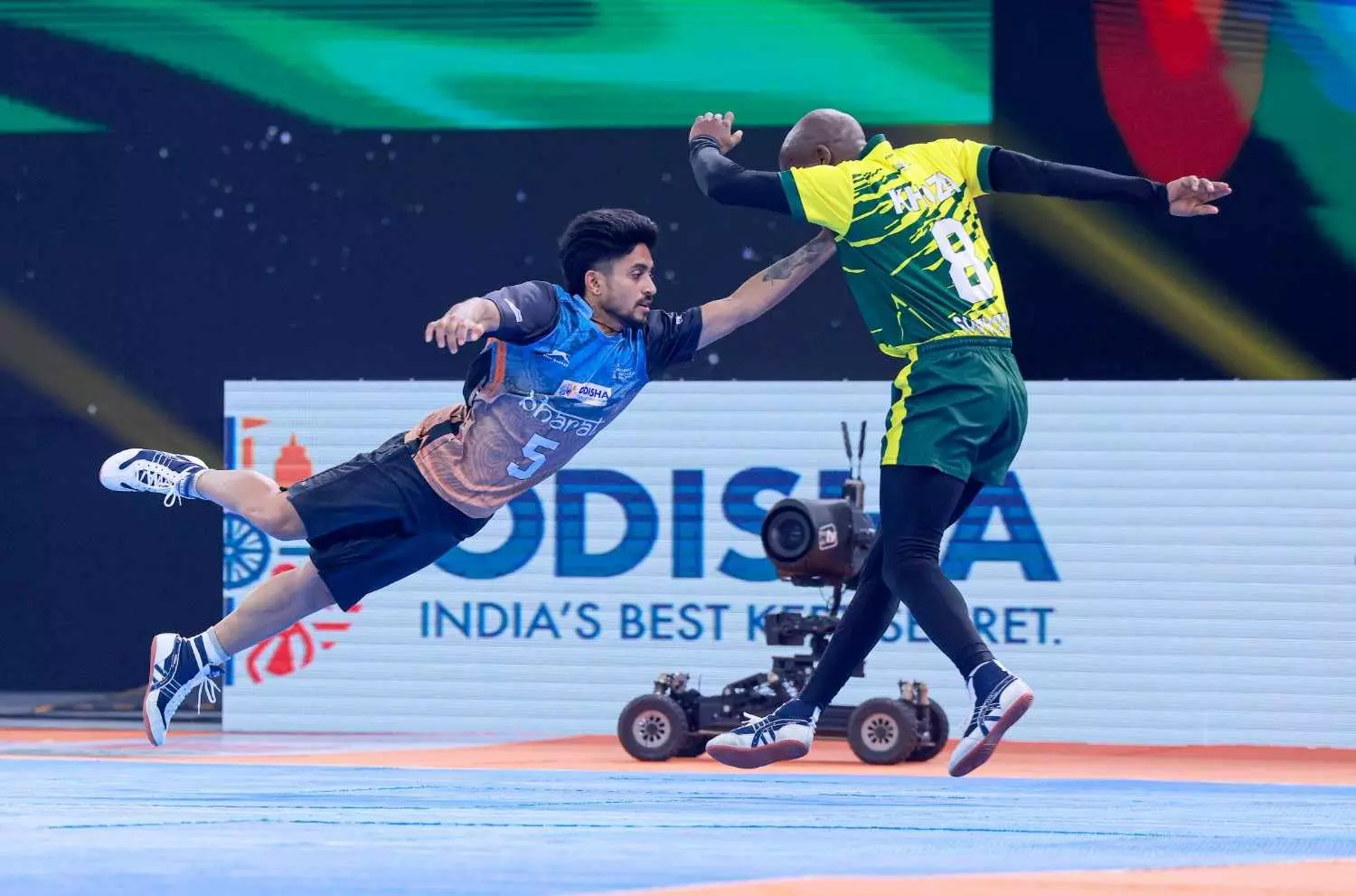
File photo of the semi final match at last year's Kho Kho World Cup at the Indira Gandhi Indoor Stadium last year.
Badminton administrators echo the concern at a more granular level. Manoj Dasot, vice president of the badminton association in Rajasthan, points to the difficulty of organising even district and state-level tournaments. “Sponsorship for non-cricket sports is extremely limited, and without assured money, it becomes difficult to organise regular tournaments. Many events happen only because officials and associations manage through personal networks. Without consistent competitions, infrastructure also remains underused, and players lose vital match exposure,” Dasot says.
The result is predictable. Without regular competitions, venues remain underused. Without usage, maintenance declines. And without maintenance, facilities rapidly deteriorate.
Further south, athletes describe a different but equally troubling reality. A state-level kabaddi player from Tamil Nadu claims many athletes train on corporation grounds because there are no designated kabaddi courts. Facilities such as the old Vepery court or the Nungambakkam tennis complex, managed by the Sports Development Authority of Tamil Nadu, are described as poorly maintained.
“A lot of players leave non-cricket sports in India because they do not get equal support,” the athlete says.
Footballers echo the sentiment. One Tamil Nadu footballer, who has represented India internationally, told The Federal that “there are no football-exclusive stadiums in the state”. Grounds are shared with athletics, damaging playing surfaces and increasing injury risk, he claims.
“There are not even proper dressing rooms,” the footballer alleges. “Even if players play well, the poor condition of the ground does not allow them to perform well.”
Former India international footballer and coach Raman Vijayan adds another layer to the problem. He explains that stadiums built for professional tournaments are often inaccessible to training athletes. Even venues like the Nehru Stadium are maintained meticulously only during high-profile events such as the Indian Super League. Once the tournament ends, maintenance drops sharply.
Private turfs, often expensive and technically unsuitable, fill the gap. But for athletes from less privileged backgrounds, they are not an option. “As a coach, I would never recommend those turfs,” Vijayan says. “You cannot skill yourself properly there.”
In Mumbai, the issue is not the absence of infrastructure but access and affordability. A club-level footballer training in the city claims most public grounds are either overbooked, poorly maintained, or controlled by associations that restrict entry. Training often happens late at night, squeezed between commercial bookings.
“You spend more time managing schedules than actually training,” he alleges. “Private turfs are expensive, and the surface isn’t suitable for serious football. But there’s no alternative.”
Mumbai’s real estate pressure magnifies a national problem. The sporting land is “scarce” and “governance fragmented”. Most of the time, athletes claim they are forced to adapt to systems which are allegedly dilapidated.
Data from the Ministry of Youth Affairs and Sports and national surveys underline the scale of the problem. Fewer than half of India’s schools have access to usable playfields. In rural areas, the number drops further, with only around 30 per cent of schools having playgrounds.
Even where facilities exist, access to equipment and trained physical education teachers remains uneven. This makes early talent identification difficult and pushes promising athletes towards expensive relocations or early dropouts.
Government-run stadiums, meant to function as public assets, frequently operate at less than 50 per cent utilisation, claim sources. According to the Annual Status of Education Report (ASER) 2024, a large proportion of rural schools in India lack access to usable playgrounds and basic sports infrastructure, highlighting gaps at the very first level of the sporting pipeline.
The contrast with cricket is stark. Cricket accounts for the overwhelming majority of India’s sports revenue, enjoys wealthy and autonomous governing bodies, and benefits from sustained commercial backing. Non-cricket sports rely heavily on limited government funding and sporadic sponsorship.
Also read: How ‘desi fitness’ is changing workout goals and life aspirations in Haryana
Veteran sports journalist Gulu Ezekiel, who has authored several noted books on Indian sports, believes the picture is not entirely bleak. A keen observer of the Indian sporting landscape for over four decades, Ezekiel argues that “the situation of facilities and infrastructure is gradually improving today for even non-Cricket sports in India”.
He points out, “compared to 30–40 years ago, India has unquestionably improved in many aspects, from more stadiums and more academies, to the introduction of schemes like Khelo India.”
Ezekiel, however, places India’s sporting evolution in a wider historical context. He asserts, “India’s success in the 2008 Olympics was a major factor which gave a boost to non-Cricket sports. Sadly, the super commercial success of the IPL [Indian Premier League] from 2008 coincided with the Indian progress at 2008 Olympics. That in turn has hampered greater improvement in non-Cricket sports.”
Despite the contradictions, Ezekiel believes the direction of travel is positive and says that a brighter future for non-Cricket Indian sports is imminent.
Recent increases in national and state sports budgets are widely welcomed. States like Tamil Nadu point to expanded funding, plans for a global sports city in Mahabalipuram, district-level Olympic academies, and renovation of indoor stadiums and training facilities.
But even officials concede that utilisation remains the critical challenge. Facilities that remain locked, underused, or controlled by restrictive associations are unlikely to be maintained. Funds allocated but inefficiently implemented do little for athletes training every day. Lack of usage leads to lack of maintenance and the cycle repeats.
Weeks have passed since play stopped at the India Open because of bird droppings. But the incident lingers because it symbolised something deeper. India wants to host global events. It wants Olympic medals, world-class leagues, and international respect. But sport does not run on ambition alone. It runs on clean courts, safe equipment, breathable air, functional toilets, and basic dignity for athletes. The list goes on.
Until those fundamentals are addressed, questions will remain. Not whether India can host the world, but whether its athletes are being given a place fit enough to prepare for the world events.
(With inputs from Sat Singh and Shweta Tripathi)