- Home
- India
- World
- Premium
- THE FEDERAL SPECIAL
- Analysis
- States
- Perspective
- Videos
- Sports
- Education
- Entertainment
- Elections
- Features
- Health
- Business
- Series
- In memoriam: Sheikh Mujibur Rahman
- Bishnoi's Men
- NEET TANGLE
- Economy Series
- Earth Day
- Kashmir’s Frozen Turbulence
- India@75
- The legend of Ramjanmabhoomi
- Liberalisation@30
- How to tame a dragon
- Celebrating biodiversity
- Farm Matters
- 50 days of solitude
- Bringing Migrants Home
- Budget 2020
- Jharkhand Votes
- The Federal Investigates
- The Federal Impact
- Vanishing Sand
- Gandhi @ 150
- Andhra Today
- Field report
- Operation Gulmarg
- Pandemic @1 Mn in India
- The Federal Year-End
- The Zero Year
- Science
- Brand studio
- Newsletter
- Elections 2024
- Events

How communities of urban Indians are ditching the screen to bond over board games
From strategy cards to role-playing games and deduction-based forensic ones, the options are endless. A particularly exciting trend, according to players, has been the growth of India-made games. Mental health therapists believe that the digital disconnect to play board games helps reduce stress.

When Akshit Shrivastava, a 32-year-old teaching fellow, moved to Chandigarh from Bengaluru a few years ago, he noticed something missing. “Gaming hadn’t really caught on here,” he recalls. “Nothing much was happening, and I wanted to build something constructive.”What followed was far from easy. He would approach strangers in cafés, travel long distances by bus to venues and...
When Akshit Shrivastava, a 32-year-old teaching fellow, moved to Chandigarh from Bengaluru a few years ago, he noticed something missing. “Gaming hadn’t really caught on here,” he recalls. “Nothing much was happening, and I wanted to build something constructive.”
What followed was far from easy. He would approach strangers in cafés, travel long distances by bus to venues and sometimes host sessions where no one showed up. Slowly, the persistence paid off. In 2018, he founded Chandigarh Board Gamers. Today, the group hosts sessions at various spaces in the city that see 40–55 attendees, with the initiative even expanding to birthdays and kitty parties in Yamunanagar, Haryana.
“The games help me channel my own analytical thinking,” says Shrivastava. “But more than that, I love building communities. Bringing people together over a constructive medium is extremely satisfying.”
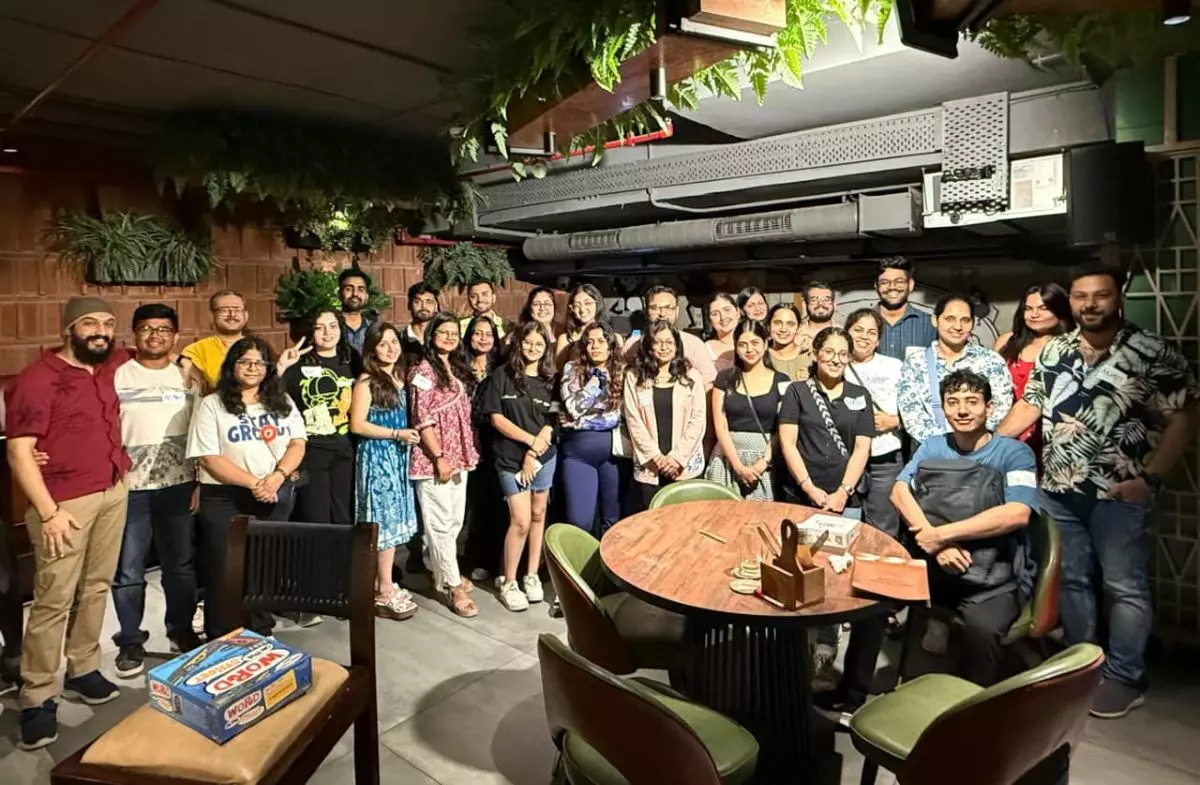
The community of board game lovers in Chandigarh formed by Akshit Shrivastava after one of their games sessions. Photo: By special arrangement
Move over God of War Ragnarok, Final Fantasy, Helldivers and Grand Theft Auto. Across India, groups of urban professionals are stepping away from playstations, laptops, mobile screens and even the latest OTT series on smart televisions — for a digital disconnect — towards tables stacked with colourful tiles, miniature figurines and strategy cards to form communities and organise themed meet-ups of board games lovers.
And if that brought to mind an image of UNO, Snakes & Ladders and Ludo, think again. From racing trains across Europe in Ticket to Ride, to dodging chaos in Exploding Kittens and sweating over numbers in Take 5, the board game universe is edgy and evolving.
https://www.instagram.com/reel/DUp_BbniTh2/?igsh=MWxoNGYxdG5zbjRlZg%3D%3D
Also read: Why the rise of AI-powered spiritual leaders has raised questions of trust, authority and copyright
“I never enjoyed the usual conversations about politics or the stock market when meeting friends or cousins. I wanted to be involved in something more fun and interactive,” says Omar Ali Khan, 38, a Bengaluru-based technical program manager, who admits to having been obsessed with board games for as long as he can remember.
What started as family game nights for Khan grew into Playparty.in — a community of like-minded players — and a personal collection of over 300 games stacked neatly in closets and IKEA containers. The community experiments with everything from deduction games that involve cracking codes or defusing bombs collaboratively, all on boards of course, to lighter social strategy titles like Othello. Other group favourites include theatrical experiences such as Blood on the Clocktower, where a cloaked storyteller guides players through dramatic rounds of suspicion and elimination.
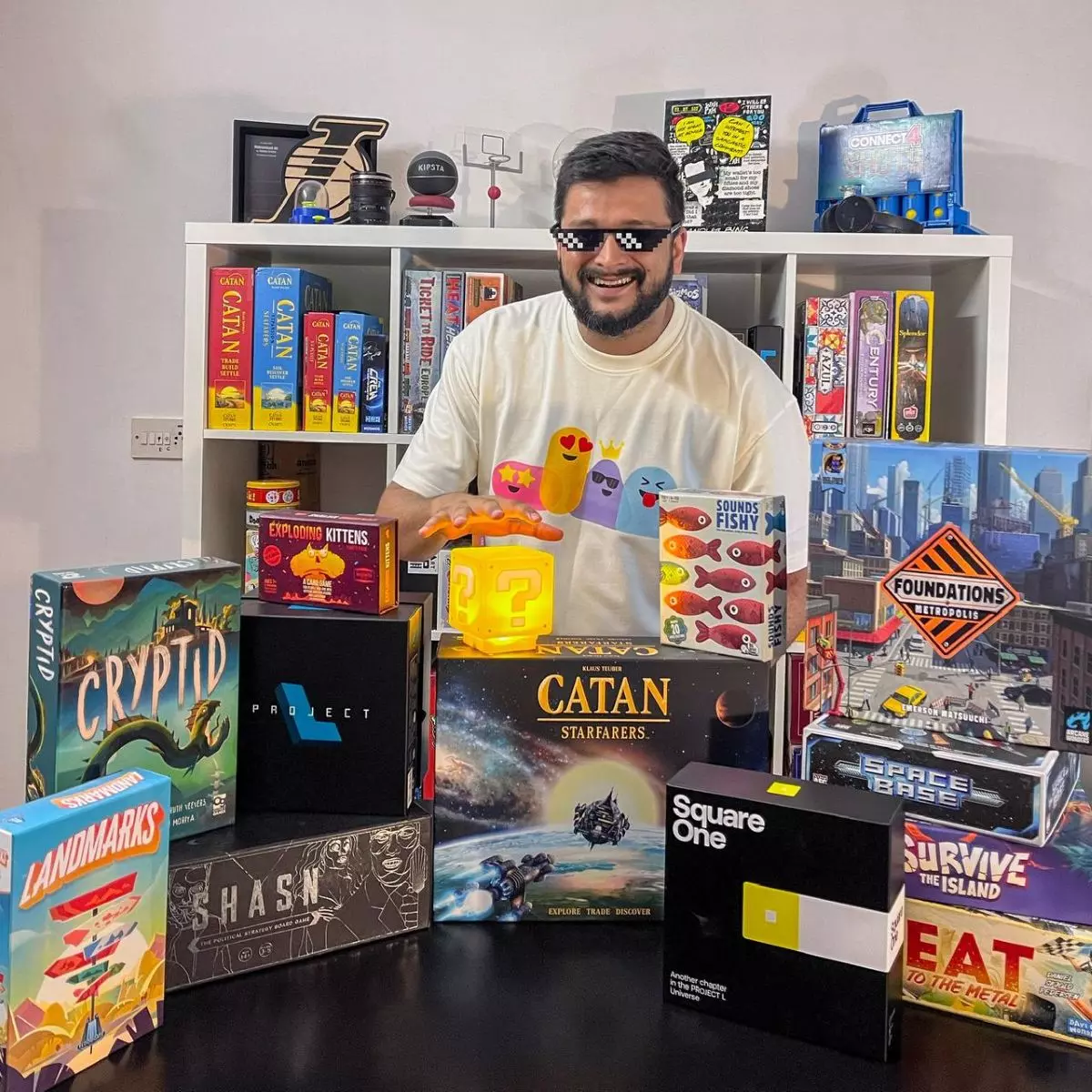
Playparty.in founder Omar Ali Khan with his collection of board games. Photo: By special arrangement
For Khan now, the magic of game nights lies in accessibility. “The most common thing people ask is, ‘What if I don’t understand?’ That’s the fear we try to remove. It’s about introducing games that aren’t too difficult and letting people learn as they play.”
He often hosts four-player sessions at home where participants sign up for a table, choose a game — sometimes entirely new — and immerse themselves for hours. “If I had the chance, I’d play every day,” he laughs. He also watches playthroughs online to learn rules, often setting up multiple monitors to follow complex mechanics.
Logistically, it’s no mean feat. For venues to host bigger players groups, he scouts cafés carefully — checking elevators and storage access — because transporting 50–60 kilograms of games across the city is part of the job. Yet the biggest reward? “When I’m hosting, I don’t even know where my phone is!” he says.
The players are everywhere.
For Rohan Chowdhury, a 26-year-old Mumbai-based creative marketer, the gateway came through his former manager, who introduced him to games like Ticket to Ride and Terraforming Mars. Soon, targeted ads fed his curiosity, and he began buying titles of his own.
That creative impulse eventually led to Flamigos — the name of the gaming community was inspired by Navi Mumbai’s flamingos and the Spanish word ‘amigos’. What began as a small circle now has over 350 members on WhatsApp and hosts at least three events per month. “We started with one event, but when 30–35 people began showing up, we had to scale up,” he recalls. Today, they collaborate with cafés — often choosing Saturday afternoons when spaces are quieter — and see a minimum of 20 attendees per session. Nearly 90 per cent are first-timers.
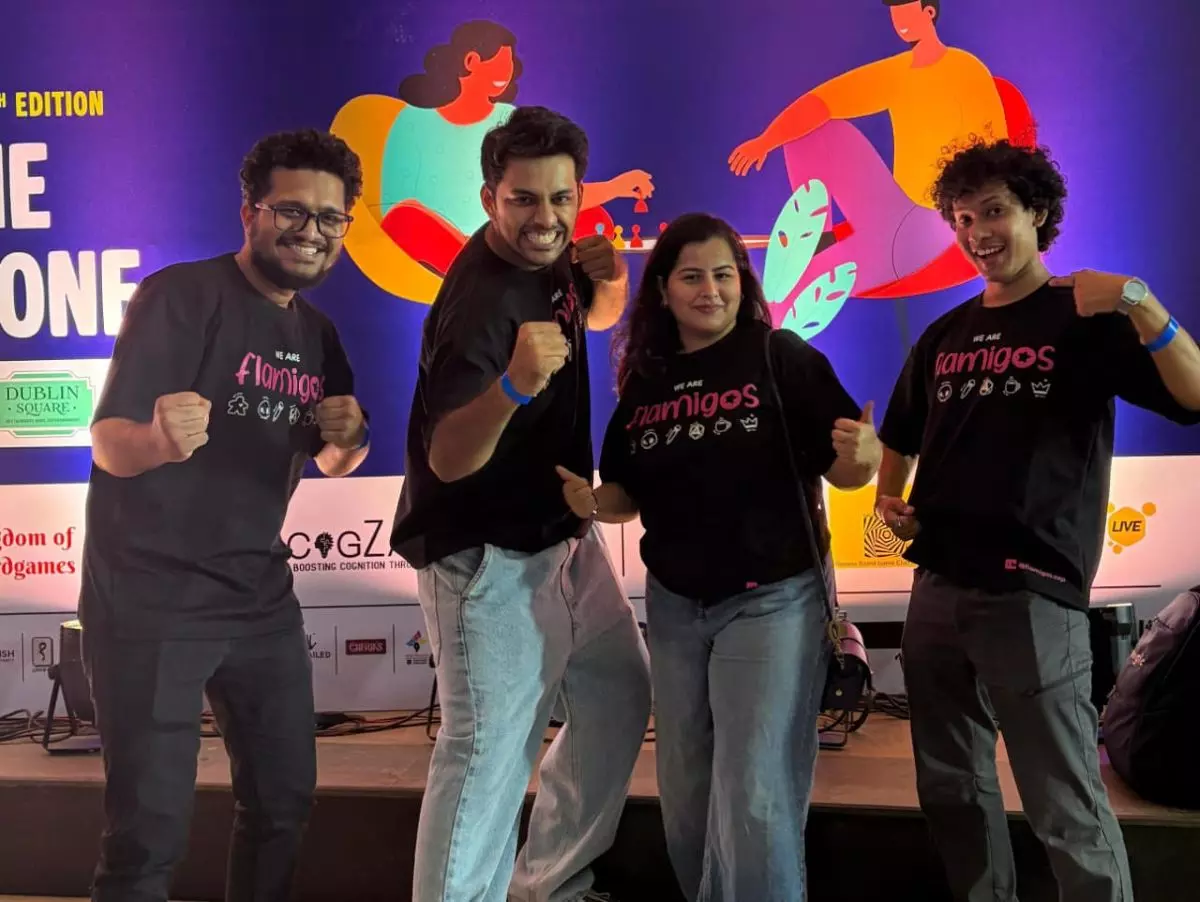
Rohan Chowdhury (extreme right), co-founder of the Navi Mumbai-based community Flamigos, with his teammates. Photo: By special arrangement
Flamigos categorises tables based on experience levels so that newcomers don’t feel overwhelmed. Six to seven tables might run simultaneously — some with light ice-breaker games, others with heavier two-player strategy formats. “People come stressed from work,” Rohan adds. “We see games as ice-breakers, not tasks.”
A particularly exciting trend, Rohan notes, is the growth of India-made games. He points to Chai Garam, where players run competing tea stalls. “The relatability makes people instantly connect,” he observes. “There’s something powerful about seeing our own culture reflected in gameplay.”
Also read: How artists are collaborating with local communities to bring about change in urban India
While most of the communities charge a participation rate at their events — Omar, for example, charges Rs 100 per hour — the growing interest in board games has fuelled full-fledged entrepreneurships.
When former ‘Teach for India’ fellows Sweekruthi Kaveripatnam and Avikant Bhardwaj saw the positive impact of board games on their students, they decided to create a community for all game-lovers. “In most cities, entertainment options are limited to eating out or watching movies. We wanted to provide an alternative that could help people digitally disconnect,” explains Kaveripatnam.
The idea led to the launch of Now Boarding, a café dedicated to board games, in Bengaluru in 2022, which now has two branches across the city. Visitors can access its extensive game library for Rs 100 per hour, while in-house “game masters” guide players through the rules and help them get started.
While the role-playing game Catan and strategy ones like Splendor, Azul and Ticket to Ride are the regular crowd favourites, Kaveripatnam highlights that there is a growing interest in complex titles among urban professionals. “So, we host open tables every evening for people who want to explore these heavier [complex] games but may not have access to them or a group to play with,” she says. “The fact that we’ve been able to source games like Speakeasy [a role-playing game, where players become mobster bosses managing their own empires] and Ark Nova [where players plan and design a modern, scientifically-managed zoon], and that there are plenty of takers for them, shows that the community is slowly but steadily growing.”
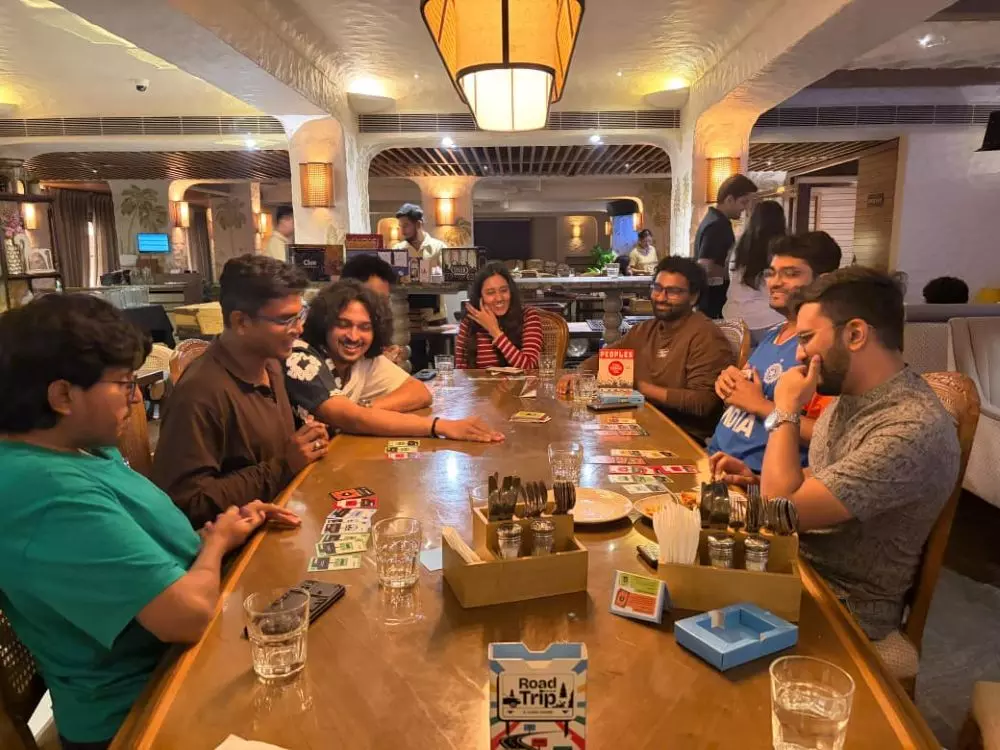
A gaming session organised by Flamigos. Photo: By special arrangement
Interestingly, the children’s section of the much-loved Bengaluru arts and culture festival BLR Hubba (titled Makkala Hubba), too, had several interesting cultural board games. Some of these, such as Elli Eke Enu, a large, interactive floor puzzle where people of all age groups learnt about the city’s neighbourhoods; and Cook & Keep, a life-sized board game focused on Karnataka’s culinary heritage, were a huge hit among the crowd, say the organisers.
For Bhawna Jaimini, the curator of Makkala Hubba, board games are a creative way to bring families together. “A simple game like Ludo can be played by a person of any age group,” she explains and adds, “When we began commissioning the Makkala Hubba programme last year, we put out an open call for ideas. Many popular games are Western, so we encouraged designers to think of indigenous themes. Instead of Shakespeare, we chose to draw inspiration from Girish Karnad and also transform something as complex as the map of Bengaluru into a fun, interactive game.”
The diversity doesn’t stop at strategy cards. Across communities, role-playing games such as Dungeons & Dragons are drawing players who want immersive storytelling. Deduction-based forensic games simulate solving murder cases with medical reports and suspect analysis. Some sessions resemble live theatre more than casual play.
Sinduja Krishnakumar and Subhashree Madhavan, founders of the Chennai-based Pawga, a pet yoga experience, recently came out with the novel concept of hosting board games with shelter puppies. “The idea is simple; people play board games as puppies run around them. These puppies are up for adoption, and a portion of the ticket proceeds also goes towards an animal welfare shelter,” says Krishnakumar.
Personally, the duo loves the camaraderie that board games bring. “We wanted to experiment with combining that with the joy of interacting with puppies. Today, people want novel things to do and meet others organically. They want to build on their hobbies and stay offline in a world where everything and everyone is too online,” Madhavan elaborates.
Also read: When less becomes more: Why India's Gen Z is redefining consumption, opting for 'minimalism'
Rushil Vashisht, a mental health therapist at the digital wellness platform ‘coto’, believes the rise of board games signals something deeper. “Strategy and problem-solving games stimulate the brain, improve focus and encourage flexible thinking,” she explains. “But beyond cognition, their real power lies in connection.”
In her counselling practice, she has seen how shared activities strengthen communication and reduce stress. “Board games bring people back to the same table — literally. They create space for laughter, healthy competition, teamwork and meaningful conversations.”
Emotionally, they foster patience, resilience and the ability to handle both winning and losing gracefully — skills that translate directly into daily life. “The growing popularity among urban professionals reflects a lifestyle shift,” Vashisht points out. “People are craving mindful leisure and authentic connection. Choosing a board game night over another scroll session signals a conscious move toward balance and community.”
In a culture that’s become obsessed with speed and endless notifications, these board game sessions help one slow down. You wait for your turn. You watch people’s faces. You negotiate, you lose, you try again. Around the table, strangers become teammates, colleagues turn into collaborators, and friends see new sides of each other. In the end, you forget who won the game but remember the memories of several joyful, uninterrupted hours offline.