Why revival of Kerala's inland waterways raises hopes of transportation ease, business growth
The inauguration of the Akkulam–Chettuva waterway signals the operationalisation of an inland corridor that the Kerala government is projecting as an alternative transport spine, running parallel to some of the state’s most congested road networks.

PK Moidunnikkutty, a native of Akalad in Kerala’s Thrissur district, is nearing 100. He now lives in Kochi with his son’s family. Age has confined him to bed. A breathing apparatus that his son brought him from Malaysia helps him draw breath. His memory is patchy. There are long stretches of darkness, and then brief periods of clarity. In those moments of lucidity, he recalls and talks...
PK Moidunnikkutty, a native of Akalad in Kerala’s Thrissur district, is nearing 100. He now lives in Kochi with his son’s family. Age has confined him to bed. A breathing apparatus that his son brought him from Malaysia helps him draw breath. His memory is patchy. There are long stretches of darkness, and then brief periods of clarity. In those moments of lucidity, he recalls and talks about his years as a boatman.
In the late 1960s and 1970s, Moidunnikkutty was among the many cargo boat operators who ferried goods between Ponnani and Kochi through Kerala’s inland waterways. He worked on pole boats, manually navigating the canal network that once functioned as a major trade route across central Kerala. The Canolly Canal (a 19th-century west coast canal built under British administration to connect the backwaters of north Kerala and facilitate inland cargo movement between Kozhikode and Kochi) interconnected the backwaters and carried rice, coconut, coir and other bulk goods during what he remembers as a busy period for inland navigation in the state.
“There were no engines in my early years. Boats were moved using long poles and oars, depending on the depth and current [of the water]. The work demanded physical endurance and familiarity with the canals’ seasonal changes. Goods were loaded and unloaded manually. Trips could take days, depending on cargo and water conditions,” says the old man.
By the late 1970s, road transport began to dominate. Lorries became faster and more reliable. Canal maintenance declined, silt accumulated and navigation reduced. Many boatmen left the trade as work thinned out, he remembers.
Today, Moidunnikkutty is among the rare surviving boatmen from that period who actively ferried goods during what he recalls as the peak years of Kerala’s inland navigation. When discussions about canal restoration appear on television today, his family says he sometimes responds, recalling the routes he once travelled.
Also read: Why Kerala seeing a shrink in its marine fish catch has cultural implications beyond business
With the commissioning of the Akkulam–Chettuva waterway in 2018 — a 280-km stretch connecting Akkulam in Thiruvananthapuram district to Chettuva in Thrissur district — to reopen long-silted stretches for navigation, Kerala is now attempting to restore, in institutional form, a system that boatmen like Moidunnikkutty once sustained through manual labour and local knowledge.
What was earlier an organic trade network linking Ponnani, Kochi and inland market towns is now being rebuilt as a planned transport corridor under the National Waterway-3 (also known as the West Coast Canal) project — with dredgers replacing pole boats, engineered embankments replacing mud banks, and scheduled services replacing tide-based movement.
On 26 February 2026, when the first official boats moved through the Akkulam–Chettuva waterway following its inauguration, it marked more than the completion of a canal restoration project. It signalled the operationalisation of an inland corridor that the Kerala government now projects as an alternative transport spine running parallel to some of the state’s most congested road networks.
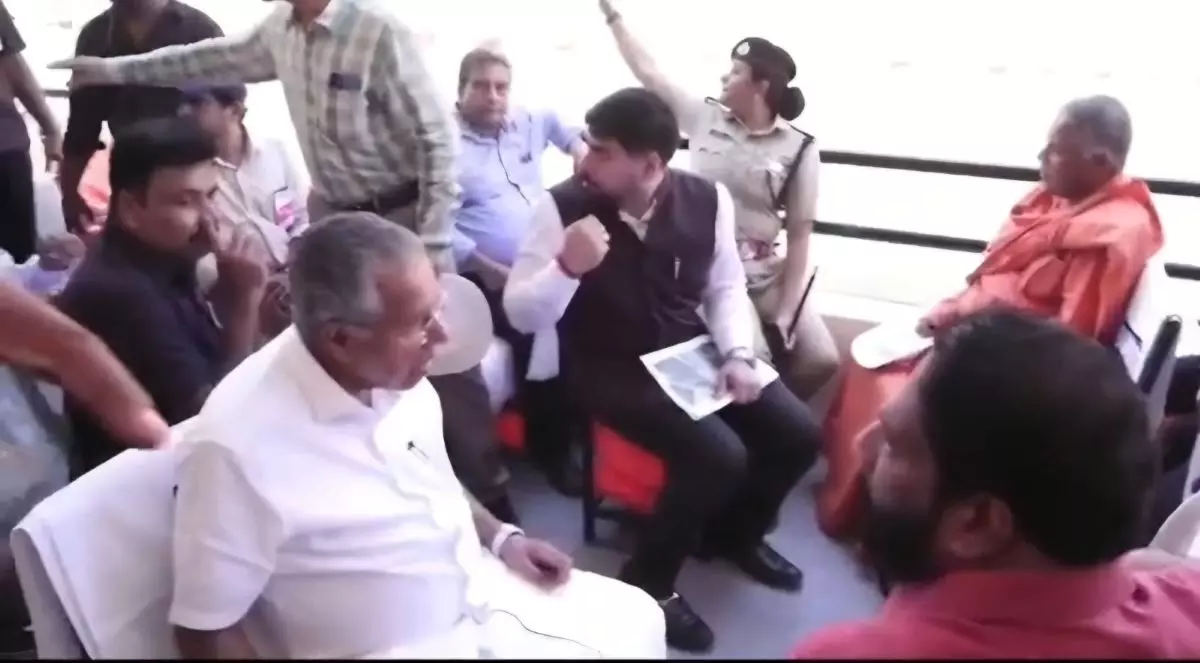
Kerala Chief Minister Pinarayi Vijayan on the inaugural boat. The Akkulam–Chettuva stretch is part of a larger plan to create an unbroken waterway from Kovalam in the south to Bekal in the north. Photo: By special arrangement
For now, the most visible impact may be in tourism. Visitor boats are expected to operate along the southern section of the Akkulam–Chettuva stretch, with particular attention on the renovated Varkala tunnel, drawing domestic travellers and weekend visitors. Commercial cargo movement may take time to scale up, but the immediate activity on the water is set to be tourism-driven, positioning the restored waterway as a recreational and experiential route before it evolves into a fuller transport corridor.
The tunnel renovation work has been carried out by Kerala Waterways Infrastructure Limited (KWIL), a joint venture of the state government and the Cochin International Airport Limited (CIAL). Cutting across southern and central Kerala through a chain of rivers, lakes and man-made canals, the waterway was formally commissioned after years of dredging, land acquisition, embankment strengthening and structural rehabilitation.
“In 2018, the state government launched the West Coast Canal project to develop an end-to-end inland navigation waterway. In 2021-22, the master plan of the project was drawn up and Rs 2556 crore sanctioned through KIIFB, the state’s infrastructure funding agency. The 616-km Kovalam-Bekal waterway [connecting Kovalam in Thiruvananthapuram district to Bekal in Kasaragod] is envisaged as a unique project that will set a model for the entire country on account of its upfront vision, said S Suhas, director, KWIL. “The waterway project is a milestone in Kerala’s inland waterways development, scaling up the state’s standing as a multi-modal logistic hub and boosting the state’s water-based tourism potential”, he added.
Officials describe the Akkulam–Chettuva stretch as the first operational phase of the larger plan to create an unbroken waterway from Kovalam in the south to Bekal in the north. Unlike isolated tourism boat circuits or heritage canal restorations, it is conceived as a continuous navigable route.
With the commissioning of phase one complete, passenger vessels can now theoretically travel across districts without interruption. The operational viability of this continuous route will determine whether inland navigation regains practical relevance in the state. Attention now shifts to a more substantive question, whether this revived inland corridor can alter how people and goods move across Kerala.
The 280-kilometre stretch integrates more than three dozen water bodies into a single navigable chain. Extensive dredging has been undertaken to ensure uniform draft, while canal widths were standardised in several segments. Retaining walls and bund reinforcements were added where erosion had weakened canal edges.
Also read: Why the revival of a festival last held about 270 years ago has public opinion divided in Kerala
“This has been a long-pending project. We have been hearing about it since the time of Rajiv Gandhi as Prime Minister, and even before that. Now at least this much has been completed. Hopefully, the banks will be properly reinforced with protective walls so that the waterway will last for a long time and transportation can finally become a reality,” said Reghunadha Pillai, 63, a local farmer, based in Kadinamkulam, Thiruvananthapuram, who has watched the project’s progress over the years.
Kerala’s geography, as a narrow strip between the Western Ghats and the Arabian Sea, leaves limited space for the expansion of highways and rail corridors. Road congestion has intensified in recent years, particularly along the north–south axis connecting Thiruvananthapuram, Kollam, Alappuzha and Thrissur.
The inland waterway offers a parallel route that bypasses much of this congestion. While water transport cannot match highway speeds, it offers consistency. Travel time by boat may be longer in absolute terms, but it is not subject to traffic gridlock.
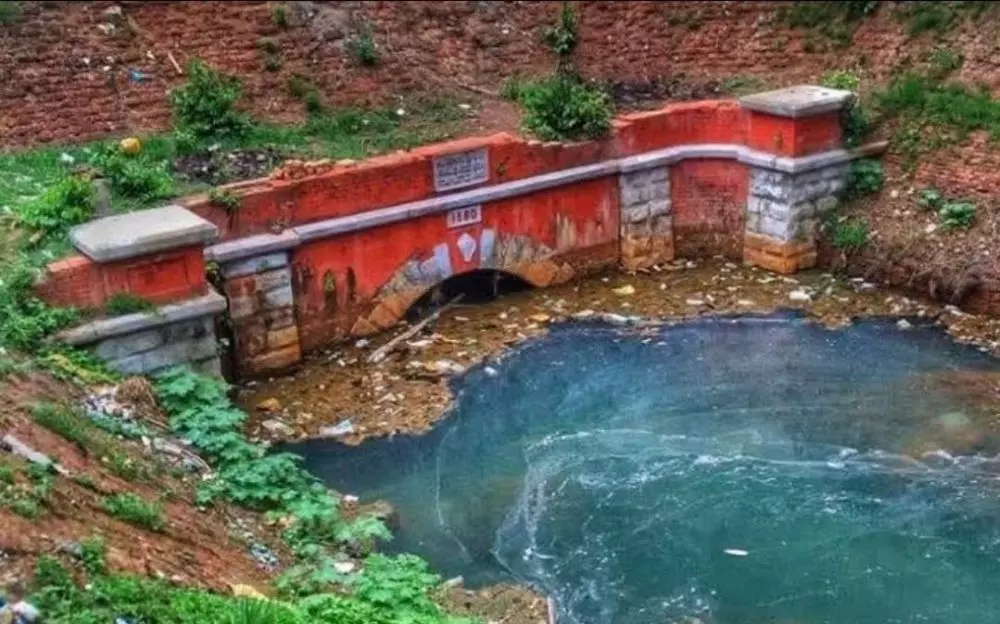
By the late 1970s, road transport began to dominate in Kerala. Canal maintenance declined, silt accumulated and navigation reduced. A 2019 image of the now-restored Varkala tunnel. Photo: Arun Kadakkal / Facebook
Transport planners argue that even a modest shift of passenger and cargo movement from road to water could ease pressure on arterial highways. The viability of this shift will depend on frequency, reliability and integration with other modes of transport.
“This canal once had regular water transport services from Vallakkadavu in Thiruvananthapuram towards the north. Boats used to pass through here consistently, and it was part of everyday movement for people and goods,” said Mohammed Hassan, a native of Varkala. “Now, with the restoration work completed, there is real possibility for structured services to return. There is talk that the Water Metro network could eventually be extended along this stretch. If that happens, it will connect coastal and urban centres in a more practical way.”
If properly maintained, Hassan believed, the waterway can serve more than just tourism. “It can become part of a larger transport network. At the same time, improved canal flow may help reduce waterlogging and flooding in nearby areas. And of course, tourism will grow. People are already curious about travelling through this stretch again,” he said.
Kerala already operates India’s only urban water-based metro system through the Kochi Water Metro under the Kochi Metro Rail Limited. That experiment demonstrated that structured, scheduled ferry services could become part of a city’s daily commute. The Akkulam–Chettuva corridor extends that logic beyond urban limits, testing whether water transport can function at an inter-district scale.
Following inauguration, authorities have indicated that passenger services will be introduced in phases. Initial operations are expected in segments with demonstrated demand, particularly those historically active in water ferry services.
Boat jetties have been under development or upgradation at multiple locations along the corridor. These will serve as boarding points for scheduled services. The government has not yet released a full timetable for end-to-end services, but transport officials indicate that connectivity between major population centres will be prioritised.
While passenger services attract immediate public attention, cargo movement represents the long-term economic rationale of the corridor.
“Cargo operations require additional infrastructure like loading terminals, storage facilities and reliable draft maintenance across seasons. These are to be implemented as per a master plan. Government has that vision, but we are not sure about the timeline,” said Stephan George, a Kuttanad-based boat driver.
If successful, even partial diversion of bulk cargo from highways could alter logistics economics in central Kerala.
Also read: How the Edam exhibition is giving ‘edam’, or space, to Kerala’s women artists
Tourism has been integrated into the waterway model as a complementary revenue stream. Select nodes along the corridor have been developed to attract visitors.
The most prominent of these is the renovated Chilakoor Tunnel at Varkala.
Completed in 1876 as a major engineering initiative of the Kingdom of Travancore, the tunnel near Varkala connected southern and northern waterways, overcoming the bottleneck in trade and passenger movement. Restored and made navigable, the tunnel now supports electric boat rides combined with an audio-visual installation on philosopher and social reformer, Sree Narayana Guru. Supporting facilities, including a jetty and public access areas, have been built to accommodate visitors.
“After decades, the Chilakkoor Tunnel in Varkala is reopening as a visible marker of Kerala’s waterway revival. The structure has been restored with an approach that combines heritage conservation and functional development. With electric boat services planned and a light-and-sound installation inside the tunnel, it is being positioned not only as an infrastructure asset but also as a public experience space that can attract visitors back to the waterway,” said Suhas.
But tourism integration extends beyond a single attraction. The corridor opens the possibility of structured long-distance boat cruises linking multiple districts. Operators are exploring themed journeys connecting beaches, backwaters, temple towns and heritage zones.
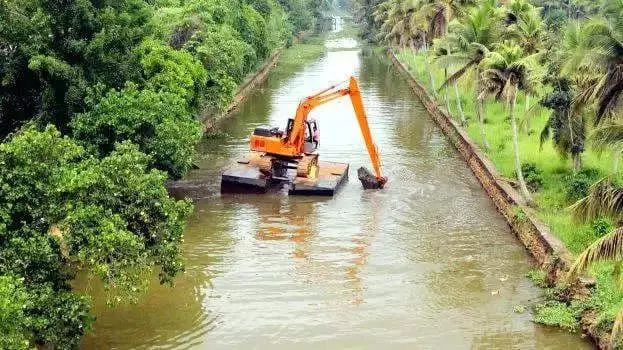
What was earlier an organic trade network is now being rebuilt as a planned transport corridor project, with dredgers replacing pole boats and scheduled services replacing tide-based movement. Photo: By special arrangement.
Unlike road tourism, which is often fragmented into short hops between destinations, water-based travel offers a linear experience. If managed effectively, it could encourage longer stays and multi-district itineraries.
Most of the tourists coming to the state are showing interest in water-based transport in Kerala, particularly the Water Metro services, apart from traditional houseboats.
“This is a completely new experience for us,” said Marcella Durham, 53, a dentist from France, whom The Federal met in Fort Kochi. “I have not seen this kind of first-class water transport anywhere else. The ride on the Water Metro was luxurious and well-managed. If it becomes possible to travel between districts by boat instead of trains or buses, that would be remarkable,” she said. Marcella and her husband, Dr Patric Durham, have been touring South Asia for the past 45 days and have been “blown away by the facilities seen at Kochi water metro”.
However, sustainability of the inland waterways project depends on maintenance. Kerala’s canals are prone to siltation and invasive aquatic vegetation. Without regular desilting and monitoring, navigability could deteriorate.
Aquatic vegetation such as African payal (Water fern) and water hyacinth pose a real threat to navigation and require regular intervention to keep channels clear. “If they are not removed periodically, they can spread quickly and choke the waterways,” cautioned Sidharth Venugopal, a marine biology student who has been part of canal-based study projects. He also pointed to the risk of solid waste being dumped from boats. “There needs to be strict regulations and penalties to prevent waste disposal into canals. Without enforcement, the gains from restoration can easily be reversed,” Venugopal added.
The commissioning of the corridor therefore, creates an ongoing administrative obligation. The long-term credibility of the project will rest on sustained upkeep rather than one-time restoration.
The project required land acquisition and relocation in several canal-side areas. In densely populated stretches, embankment widening and reinforcement necessitated the resettlement of families living along canal margins. According to the government sources, a total of 594 people were rehabilitated as part of the canal restoration efforts in the Varkala region alone.
Also read: How Kerala’s empowerment programmes are ensuring women's participation in grassroots politics
India has 111 declared National Waterways across 24 states, covering more than 20,000 kilometres. Yet only around 30 are fully operational, according to data shared by the inland navigation and shipping department. Development remains uneven, with cargo and passenger movement concentrated in a handful of states.
National Waterway-3, which runs along Kerala’s West Coast Canal, was among the earliest declared in 1993. With the commissioning of the Akkulam–Chettuva stretch, Kerala strengthens its position as one of the few states where declared waterways translate into functional routes.
Assam and West Bengal have extensive navigable stretches, particularly along the Brahmaputra and Hooghly systems. But Kerala now stands out for integrating both urban water transport and inter-district inland navigation.
Beyond direct transport benefits, the corridor could stimulate ancillary economic activity. Boat operations, maintenance services, hospitality ventures near jetties and waterfront development projects are likely to emerge along active segments.
Government agencies have identified parcels of land along the waterway for potential development under public-private partnership models. The viability of such projects will depend on sustained passenger and tourist flows.
If waterway traffic stabilises, canal-side economies could revive in areas that had seen declining activity after waterways fell into disuse.
It is something Susan Maliekkal, who runs a seafood eatery on the banks of the backwaters in Alappuzha, is hoping for.
“Right now, much of our business depends on tourist houseboats. We have to share a portion with boat operators and staff, as they bring the guests to us for lunch or tea. If government-run boats begin regular services, there could be a jetty here. That would mean more direct footfall for us and better business overall,” she said.
Commissioning marks the beginning of operations, not the end of work. Maintaining uniform draft across monsoon cycles, preventing encroachments and ensuring financial sustainability remain ongoing challenges.
There is also the question of behavioural change. For decades, Kerala’s mobility patterns have been road-centric. Encouraging commuters and cargo operators to shift to water transport will require reliability and economic incentives.
Integration with bus and rail networks will be essential. Without last-mile connectivity from jetties to town centres, the corridor risks remaining underutilised.
The success of the Akkulam–Chettuva corridor will ultimately be measured not by the scale of its inauguration but by daily usage patterns months and years from now. If not maintained or integrated effectively, it risks becoming a limited-use heritage navigation route. Moreover, the expansion plan to Bekal has a lot of hurdles to overcome.
“The first phase of the project stretches from Thiruvananthapuram to Thrissur district. It runs through the Parvathy Puthanar canal and the backwaters across Kollam, Alappuzha and Ernakulam, and connects to the Canoli Canal in Thrissur,” said KV Abdulkhader, former Guruvayoor MLA and Thrissur district secretary of the CPI(M). “Beyond Chettuva, especially within Thrissur district, substantial work remains. The canal has to be deepened, and several bridges need to be rebuilt with greater vertical clearance. That will take time and sustained investment. But the commissioning of Phase One has given the project significant momentum, and we intend to carry that forward,” he told The Federal.
For now, the commissioning marks a tangible shift in state infrastructure strategy. At a time when road expansion faces spatial and environmental constraints, Kerala has placed a renewed bet on its waterways.
The Akkulam–Chettuva stretch is operational. Whether it reshapes transportation and tourism across the state will depend on the consistency of services, maintenance discipline and user adoption in the years ahead.