- Home
- India
- World
- Premium
- THE FEDERAL SPECIAL
- Analysis
- States
- Perspective
- Videos
- Sports
- Education
- Entertainment
- Elections
- Features
- Health
- Business
- Series
- In memoriam: Sheikh Mujibur Rahman
- Bishnoi's Men
- NEET TANGLE
- Economy Series
- Earth Day
- Kashmir’s Frozen Turbulence
- India@75
- The legend of Ramjanmabhoomi
- Liberalisation@30
- How to tame a dragon
- Celebrating biodiversity
- Farm Matters
- 50 days of solitude
- Bringing Migrants Home
- Budget 2020
- Jharkhand Votes
- The Federal Investigates
- The Federal Impact
- Vanishing Sand
- Gandhi @ 150
- Andhra Today
- Field report
- Operation Gulmarg
- Pandemic @1 Mn in India
- The Federal Year-End
- The Zero Year
- Science
- Brand studio
- Newsletter
- Elections 2024
- Events

30 years on, why the arrack ban in Kerala continues to draw dissent
On April 1, 1996, just ahead of an upcoming assembly election, the then UDF government in Kerala, led by AK Antony, banned arrack in the state. 30 years later, Kerala’s relationship with alcohol has not diminished. Drinking has moved from informal, local spaces to structured outlets and private settings.

It was called charayam in Malayalam, known elsewhere as arrack. Distilled from fermented coconut palm sap, jaggery, or sugarcane molasses, it was brewed in rudimentary stills, often in backyards or hidden sheds, then funnelled into a tightly controlled but deeply informal retail network. It was typically sold in small 90 ml bottles known as podikkuppi (mini bottles), though regulars would...
It was called charayam in Malayalam, known elsewhere as arrack. Distilled from fermented coconut palm sap, jaggery, or sugarcane molasses, it was brewed in rudimentary stills, often in backyards or hidden sheds, then funnelled into a tightly controlled but deeply informal retail network. It was typically sold in small 90 ml bottles known as podikkuppi (mini bottles), though regulars would insist it was really “100 ml”. By the time it reached the glass, it carried the imprint of a local economy that thrived on volume and proximity.
Arrack shops were auctioned each year by the Excise Department through a public bidding process, with licenses for designated areas awarded to the highest bidder against a fixed base price. Existing license holders were often allowed to renew at higher fees, while remaining outlets were auctioned individually or in clusters to maximise revenue. Contractors, in turn, frequently sublet these licenses both legally and illegally, creating multiple layers of control.
Arrack shops were more than points of sale. They were gathering spaces where political arguments flared, deals were struck, and tempers often spilt into fights. The line between conversation and confrontation was thin.
It was also increasingly spoken of in negative terms, as a destroyer of families, with anti-liquor campaigns gathering force across the state, driven by women’s complaints and strong opposition from the church. It was an open secret that many operators used smuggled spirit to adulterate the product, raising serious concerns over quality and safety.
Amid this growing sentiment, the then United Democratic Front (UDF) government led by AK Antony banned arrack on April 1, 1996, just ahead of the Assembly elections.
Interestingly, the 30-year anniversary of the ban comes ahead of another assembly election in Kerala — scheduled to be held on April 9 in the state.
Also read: Why Kerala seeing a shrink in its marine fish catch has cultural implications beyond business
Janaki KR, now around seventy, lives a quiet retired life with her daughter’s family, including two school-going grandchildren, in a coastal village of Thrissur. She remembers the day the arrack shops shut not as a policy decision, but as the day her kitchen fire nearly went out.
She was in her early forties then. Her husband had left years earlier, leaving her to raise three children; the eldest a teenager and the youngest still in primary school. She found work at a nearby arrack shop, cooking for the men who gathered there each evening. What began as a means to survive slowly grew into something more.
“I started with cooking. Then I began selling fish and meat dishes brought from my house. As ‘touching’ [something to accompany the drinks] they were too good to resist for the daily customers,” she says. When the man who ran the shop died, she had to step in. She could not afford the original building, so she shifted the operation to a makeshift annex next to her house. A woman running an arrack outlet drew attention. Men came in numbers. Business grew, so did the talk.
“They mocked me and treated me like a whore. They even called my place ‘Janaki Mandir’. There were times when no women nearby would speak to me, because they saw me as the vice supplying liquor to their husbands and sons,” she says. “You know how people talk about a woman raising children alone, let alone selling liquor.”
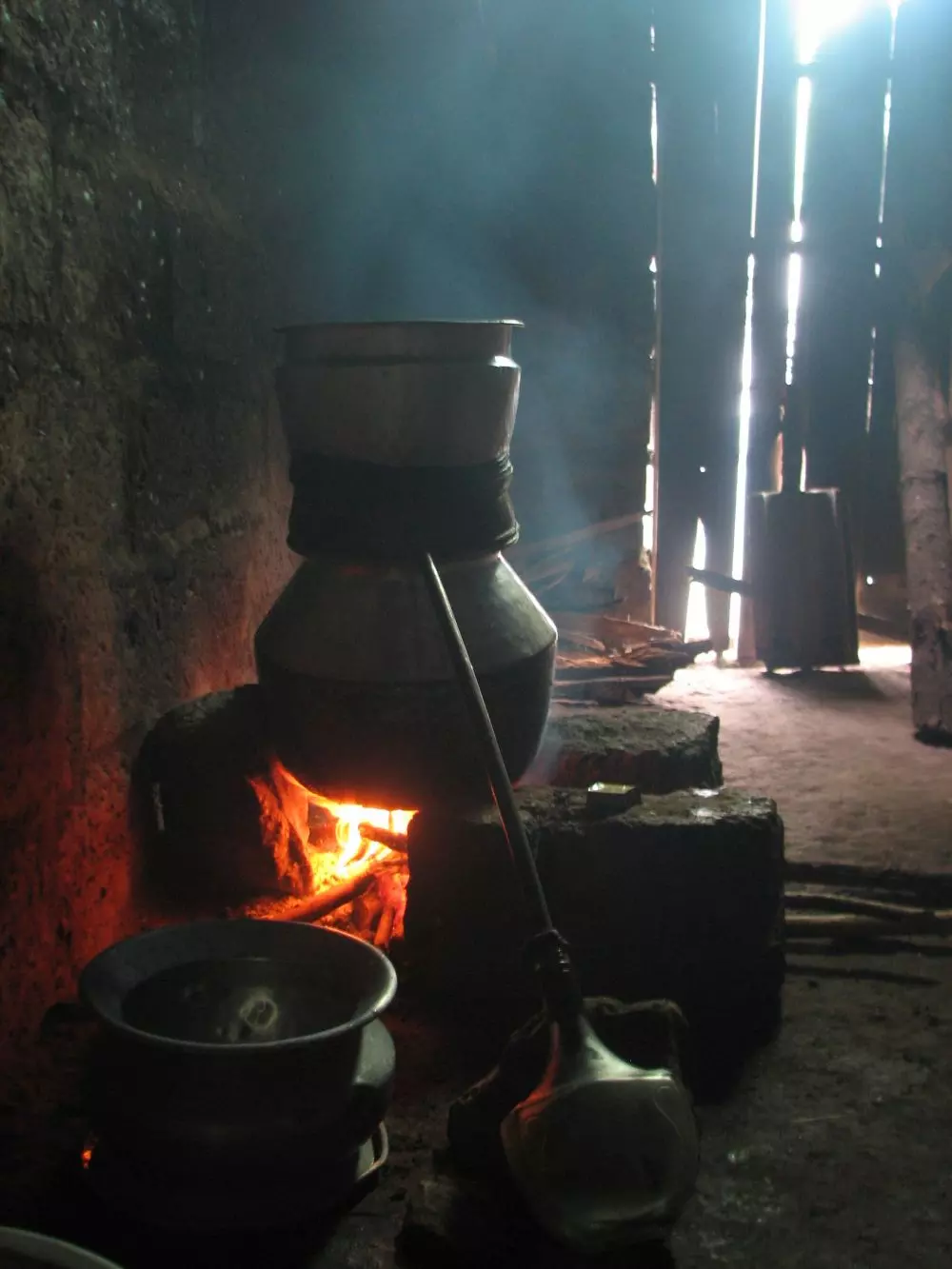
Arrack being distilled. Photo: Wikipedia
She did not stop.
“I sold arrack for three years on my own. Whatever I earned came from those days. Not just liquor, the food too. That is how I raised my children.” Her eldest son later went to the Gulf and settled there. One daughter became a teacher. The youngest, with whom she now lives, is a pharmacist who runs a medical shop.
She says she has no regrets.
Then came April 1, 1996.
“The ban was said to be for women. But as a woman, I lost my earnings,” she says. The three workers with her were unionised and later found some rehabilitation through welfare mechanisms. Janaki did not. She was treated as a contractor or vendor, even though the outlet legally belonged to someone else. She did not qualify for benefits.
She moved on, slowly. Started a small eatery. Built it up into a modest restaurant. Today, it is run by her nephew.
Her story is one among thousands that unfolded when Kerala banned arrack, the cheap, locally distilled spirit that had long been the drink of the working class.
The decision, taken under AK Antony, came after years of mounting pressure. Hooch tragedies had taken lives. Alcoholism was visible in everyday life. Women’s groups, church networks, and anti-liquor campaigners had turned the issue into a moral and political demand.
The ban was immediate. Arrack shops shut overnight across the state. There was no transition period, no structured rehabilitation for the thousands who depended on the trade.
“In fact, the decision of AK Antony to shut the shops did no good for society. We, the workers, lost our daily bread. What we got was barely Rs 30,000 as compensation, and even that included our provident fund (PF). We were all with the communist trade union then, and were promised either a reversal of the decision or proper rehabilitation. Nothing happened. After long legal battles, all we finally received was our own PF,” claims Madhavan Kakkungal, now 78.
The ban was celebrated in many quarters. The church and anti-liquor crusaders saw it as a victory, a long-awaited step to protect families and reduce alcohol abuse.
For the government, it was a defining decision.
Even last year, AK Antony stood by the ban. “This was the biggest decision I have taken as Chief Minister of Kerala. It was taken for the women of Kerala,” he said. He recalled that the Left Democratic Front led by EK Nayanar had come to power in 1996, promising to lift the ban, but could not. “I am still justified,” he said.
Critics point out, however, that the ban did not bring prohibition. It removed arrack, but left other forms of alcohol untouched. Indian-Made Foreign Liquor (IMFL) continued to be sold. Over time, its sales became more structured and centralised.
“It was a deeply flawed decision that reversed years of progress. Instead of solving the problem, it pushed consumption underground, leading to a rise in hooch tragedies and large-scale spirit smuggling,” alleges senior journalist and social commentator Sreejith Divakaran.
He adds: “The moral posturing around prohibition also rings hollow. Liquor distribution in the armed forces was already an established practice, and the irony is that AK Antony, who advocated such moral positions, also served as Defence Minister. Moreover, the ban opened the floodgates for substandard IMFL, often far inferior in quality to traditional arrack.”
Also read: Why, in coastal Karnataka, toddy tapping, once part of legends and ballads, has few takers today
The immediate impact of the ban was disruption.
Arrack had been cheap and accessible. Daily wage workers could afford it. Drinking was frequent and often public. With its disappearance, many shifted to IMFL, which was costlier. Drinking became less frequent for some, but often heavier when it did happen. Others reportedly turned to illicit brewing, which continued in hidden spaces despite enforcement.
“In those days, a labourer could get a mini bottle or two [of arrack] for just Rs 4–6. After the ban, spurious liquor began coming in plastic packets through smuggling. I was part of that trade for a while and even got caught by the excise,” recalls Madhavan.
He adds: “Then came IMFL, pushing costs up five or six times at first. Now look at it, we are paying almost three times the price as tax. It has only affected the common people. Did it end drinking or alcoholism? My answer is a clear no.”
That lived experience of the old arrack economy, both its ease and its undercurrents of corruption, is clear from the recollection of PR Janardhanan, a retired airman who once frequented those shops.
“In those days, arrack shops ran on a system everyone understood, but no one spoke about openly. Contractors, excise men, middlemen, there was always money flowing somewhere. Even raids, we knew, did not just happen on their own. But for us as drinkers, it was simple. With Rs5 or Rs 6, you could get a stiff drink, stand there, talk politics, argue, and go back to work. It was cheap and within reach”.
“After the ban, that changed completely. Drinking did not stop; it only became costlier and more hidden. The corruption did not end either, it just changed form,” claims Janardhanan, 65, a former airman.
The arrack trade had supported a wide network of workers. Shop staff, transporters, brewers, cooks. Many lost their livelihoods overnight. Some found alternative work. Some did not. A few were absorbed into other sectors through welfare boards. Many remained outside formal systems, their losses unrecorded.
The policy removed a local, decentralised economy and replaced it with a more controlled system.
Three decades later, Kerala’s relationship with alcohol has not diminished. It has changed shape. Consumption remains high. The state runs a tightly regulated retail system. Drinking has moved from informal, local spaces to structured outlets and private settings.
Policy shifts have continued.
In 2014, under then Chief Minister Oommen Chandy, the government shut 418 bars as part of a new liquor policy and imposed a cess on IMFL, adding another layer to the state’s control and revenue structure. The move soon led to allegations of large-scale bribery and corruption, with claims of payments for bar licences and exemptions surfacing. The controversy weakened the UDF government, which eventually lost power. In Kerala’s recent political history, two major crackdowns on liquor have come at a cost for the UDF. On both occasions, the Congress-led government appears to have miscalculated the political and social impact of liquor restrictions in the state.
The debate on the issue has also evolved further.
Interestingly, on the thirtieth anniversary of Kerala’s arrack ban, the spirit itself is making news again, far away from where it was outlawed. A Malayali entrepreneur has taken charayam to Europe, launching “Manavatty” Indian Arrack in Poland, with sales set to begin around April 1, 2026. Developed by Mithun Mohan and produced by London Baron Ltd, the brand has already won a bronze medal at the 2025 London Spirits Competition, with a taste described as smooth, light, and faintly peppery with balanced sweetness. The product is aimed largely at the Malayali diaspora in Poland, offering a sense of familiarity and nostalgia. The timing is striking. Exactly three decades after arrack was banned in Kerala, the same drink is being repackaged, regulated, and exported as a premium spirit. What was once a forbidden brew associated with social stigma is now being positioned as a global, marketable product, highlighting a shift in how it is perceived beyond Kerala’s borders.
In recent years, sections of the tourism industry have begun to question the long-standing ban on arrack. They point to Sri Lanka, where coconut arrack is marketed as a cultural product. Tourists buy it as a souvenir, a memory of their visit.
In Kerala, the argument goes, such a possibility has remained unexplored.
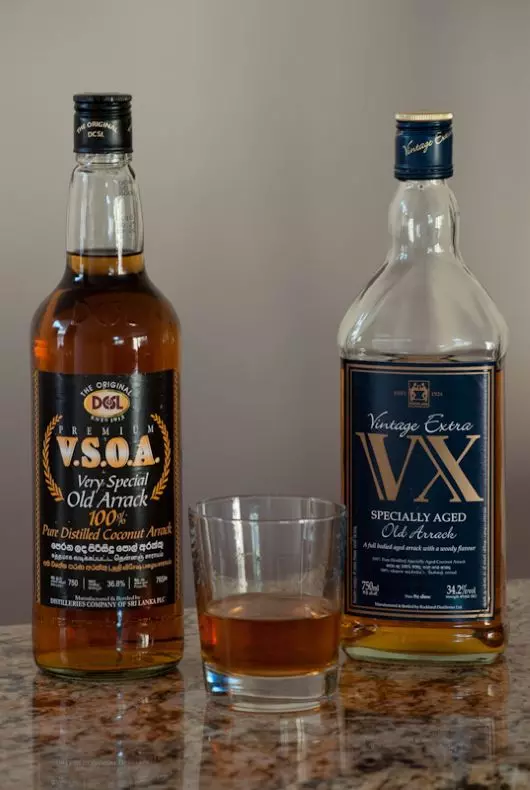
Representational image of Sri Lankan arrack. Photo: Wikipedia
Tourism voices, like MK Sivaprasad, a travel and tourism coordinator based in Alappuzha, speak of different categories of alcohol. Foreign-made foreign liquor benefits global producers. Indian-Made Foreign Liquor benefits manufacturers outside Kerala. A locally produced spirit, they argue, could support farmers, generate employment, and create a distinct identity.
The hesitation, they say, is political and social. The memory of arrack is tied to the reasons it was banned. Governments remain cautious about reopening that chapter.
Also read: Smell, stigma and supremacy: How 'food racism' shapes everyday life in India
Between those arguments and the lived experiences of people like Janaki lies the story of the ban. It is not a simple narrative of success or failure.
It is a story of a policy born out of social pressure, implemented with urgency, and lived through in uneven ways. It changed what people drank, where they drank, and how alcohol was sold. It reduced visibility but did not erase the habit. It created winners and left behind those who did not fit into its categories.
Janaki does not speak in those terms. For her, the ban is a moment when income stopped and life had to be rebuilt.
“I have no regrets about what I did,” she says of her years running the shop. “If I had listened to what people said, how would I have lived?”
The arrack shop is gone. The gossip has faded. The children she raised have moved on. She now lives a quiet life, yet speaks about those years without hesitation. “I became bold in those days. I learned to stand up to anyone face-to-face. That was the only way for me to survive,” she says, crediting that phase of her life for shaping her resilience.
What remains is the memory of a time when survival came from a trade that was later erased, and the quiet adjustment that followed when it was.