Why, in coastal Karnataka, toddy tapping, once part of legends and ballads, has few takers today
Sacred offering to traditional medicine and even fermenting agent for idlis, toddy has had many uses in Coastal Karnataka. But with social stigma attached to its making and sale in later years and spread of education among traditional toddy tappers, the availability of the spirit is now scarce.

Bhujanga Poojary was just 18 when he started toddy tapping — the process of collecting palm sap that is fermented and brewed into toddy, an alcoholic beverage. “I would collect 300 litres [of sap] a day,” recalls Poojary, his voice laced with both wistfulness and pride. Now 78, he has long since hung up his boots; or more accurately, the climbing belt which would once support him as he...
Bhujanga Poojary was just 18 when he started toddy tapping — the process of collecting palm sap that is fermented and brewed into toddy, an alcoholic beverage. “I would collect 300 litres [of sap] a day,” recalls Poojary, his voice laced with both wistfulness and pride. Now 78, he has long since hung up his boots; or more accurately, the climbing belt which would once support him as he hung from tall palm trees extracting the sap.
Till about three decades ago, the sight of a man, a sharp knife tied at his waist and a clay pot slung across his body, suspended from a climbing belt, as he scaled a tall palm tree, was common across coastal Karnataka and Tulunadu — spread across parts of Karnataka and Kerala and home to the ethnic Tulu-speaking community. Demanding a blend of sweat, skill and risk-taking, toddy tapping was an occupation that held a distinct place in Karnataka’s social and cultural history.
But as in other parts of the country, and even neighbouring nations where it was practised — such as Jharkhand and Sri Lanka, where too it is reportedly on the decline — toddy tapping, or moorthedarike as it is termed in Kannada, is today a dying craft in coastal Karnataka.
“At times now, there is no toddy available, no matter how much you are willing to pay for it,” says Shekhar Suvarna, the owner of a toddy shop in Bettampady village in Dakshina Kannada district.
The scarcity becomes an issue, because in coastal Karnataka culture, toddy has traditionally been much more than an alcoholic beverage — used as a sacred offering during worship rituals, as a medicinal tonic, an ingredient in palm jaggery and even as a fermenting agent while making idlis.
“ For rituals [now], people inform of their requirements in advance — at times making bookings even two days earlier — so we can inform the tappers,” says Suvarna. When it is not available, jaggery mixed with water is used as a substitute.
In Tulunadu culture, spirits (Daivas) are as much revered as the gods and toddy is an essential part of spirit worship. It is not merely a drink, but a sacred offering.
“During rituals such as the invocation of spirits like Koti-Chennayya, Panjurli, Jumadi, and Babbuswami, offering toddy along with meat is a traditional practice,” explains Prajwal Rai, a resident of Puttur and a self-proclaimed Daiva worshipper. “The person offering toddy must maintain strict purity and discipline. The first sap collected is considered sacred and offered at the shrine.”
Also read: Smell, stigma and supremacy: How 'food racism' shapes everyday life in India
The practice of toddy tapping itself was deeply intertwined with nature worship. The sap had to be collected without harming the tree and only at the right time ( or muhurta). Even today, before climbing a tree for the first time, toddy tappers place their knife, belt, and tools before the local deities and pray.
It’s a demanding task, one that is not only physically taxing but that demands grit and risk taking. And thus, before climbing the tree, toddy tappers bow to the tree in reverence, preparing themselves mentally for the challenge ahead.
The practice finds mention in the paddanas, or local oral ballads, some of which describe toddy tapping in detail. Back then, toddy tappers were village protectors and Ayurvedic healers, the physical strength they gained from climbing trees making them experts in martial arts. The ballads dwell on the tool of their trade and the agility of the toddy tappers, as proof of their extraordinary physical prowess.
The drink itself was not looked upon as a mere intoxicant. Village elders would use it in traditional medicine.
“Fresh toddy tapped before sunrise cools the body. It was considered a remedy for people with excessive body heat and gastric problems. Since it contains natural enzymes, it was used to improve digestion. Traditional healers even advised patients with kidney stones to consume pure toddy,” says Narnappa Saliyan, a folk healer from Marakoor village. “Today, because pure toddy is rarely available, this practice has faded.”
Palm jaggery, rich in iron and minerals, was commonly used in the postnatal diet for new mothers, and toddy was a key ingredient in the making of the jaggery.
“Postnatal diet is not just food — it rejuvenates the body. Ole bella [palm jaggery] is essential for this. Making one block requires about 10 litres of toddy. With toddy becoming scarce, even this medicinal diet is disappearing,” says 83-year-old Meenakshi K of Puttur.
Also read: Why in Tamil Nadu, Pongal celebrations unite Hindus and Muslims in common 'thanksgiving’
It was the Billava ethnic community of coastal Karnataka (also known as Eediga in some parts) that was traditionally involved in toddy tapping.
“The Billavas were traditionally known as Baidyers — folk physicians. Toddy was required to prepare herbal medicines. That was its primary purpose,” reiterates Ullas Kotyan, general secretary of the Gejjegiri Punyakshetra Trust, a religious body. “Over time, owing to oppression by upper castes, this medical practice became restricted and many from the community adopted toddy tapping as a livelihood, which eventually became labelled as their caste occupation,” he claimed.
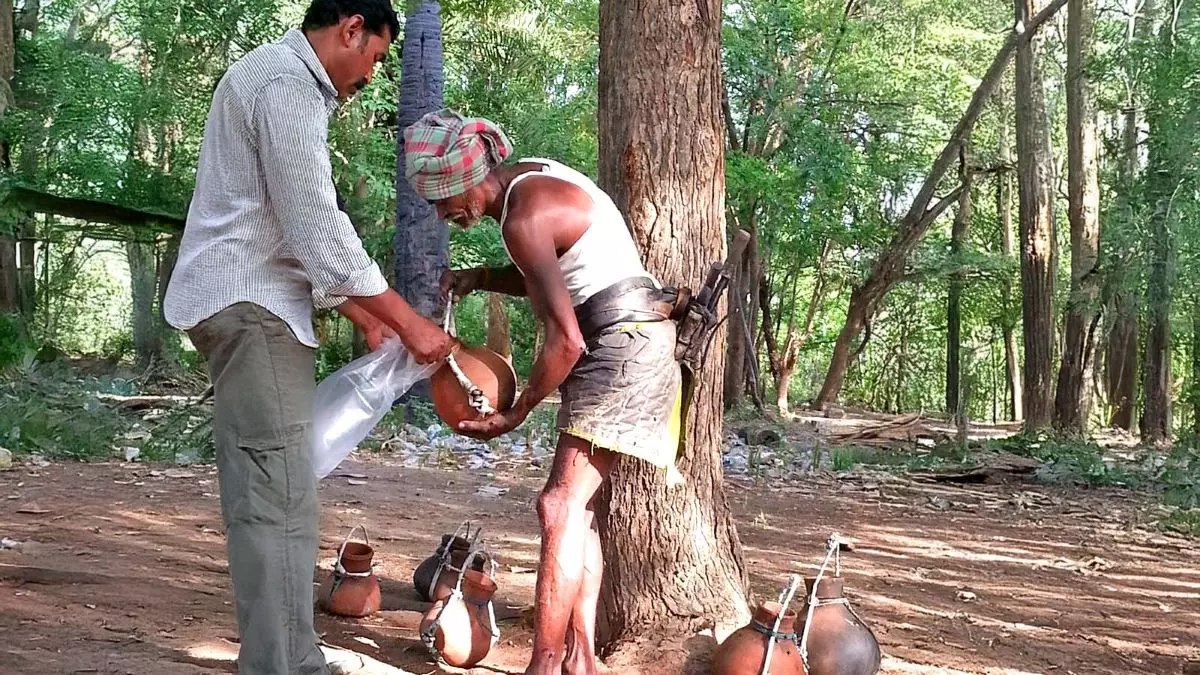
Those from the traditional toddy tapping communities say there has been a steady decline in numbers since the ‘90s. There are many reasons for this, such as better education and other livelihood options. Representative image. Wikimedia Commons
Over the years, a once-sacred occupation became increasingly stigmatised.
“Men climbed trees, while women from the community sold or stored toddy. Women working at toddy outlets were often subjected to physical and mental abuse. Society viewed women involved in alcohol-related trades with disrespect, making them vulnerable to harassment,” Kotyan added.
In the decades following Independence, The Karnataka Toddy Workers’ Welfare Fund Act, 1981 was passed, “to provide for the constitution of a fund to promote the welfare of toddy workers in the State of Karnataka”.
But in 1989–90, Chief Minister Veerendra Patil imposed a ban on toddy sales to protect poor families from alcoholism. Following widespread protests, however, coastal districts like undivided Dakshina Kannada were exempted.
Interestingly, this was not the first time there had been a curb on toddy trade in the state. In 1939, inspired by Mahatma Gandhi’s calls for liquor prohibition, villagers in and around Chitradurga district’s Turunavuru village had started cutting down palm trees to stop the production of toddy. The Wadiyar king imposed a rogue tax as the Eachalu Marada Chaluvali (Toddy Tree Movement) had resulted in revenue loss, but the villagers refused to pay the tax.
The state ban of 1989-90, however, severely impacted the toddy tappers.
When Sarekoppa Bangarappa became Chief Minister (he served from 1990 to 1992), he introduced cooperative societies, allowing local tappers to control auctions instead of big contractors. This ensured profits reached workers directly.
But the heyday of toddy tapping was gone. And those from the traditional toddy tapping communities say there has been a steady decline in numbers since the ‘90s.
Also read: Globally recognised, why Kolkata’s kathi rolls continue to rule over the city’s heart
There were many reasons for this.
The land reforms brought in by former chief minister Devraj Urs in the 1970s played a key role, with its “land to tillers” approach. Prior to the reforms, toddy tappers had extracted sap from palm trees on land belonging to the landlords. The land reforms gave land ownership to many from the Billava and Eediga communities, helping them to shift to farming, say those in the know. The growth of the beedi industry also drew some traditional toddy tappers. Beedi rolling was safer, home-based, and provided social security benefits like PF and medical aid—unlike toddy tapping, which remained unorganised, say those who have seen the change take place.
As incomes improved, people from the community started investing in educating their children.
Agrees Sanjeeva Suvarna, a retired headmaster, who is from the traditional community of toddy tappers, “We studied and found other jobs because toddy tapping was seen as an occupation of the uneducated and linked to alcohol.”
Adds Ganesh (identified by first name only), a bank employee, born in a traditional toddy tappers’ family, “Though we take pride in our caste occupation, it’s hard to continue it. Educated Billava women don’t want to marry toddy tappers.”
The risk involved in climbing trees and extracting sap also made many, like 80-year-old Giriyappa Poojary, reluctant to let their children follow in their footsteps.
According to Taranath Gatti Kapikad, president of the Tulu Sahitya Academy, a long time observer of the community, there are today only about 2,000–3,000 people from the Billava community remaining in toddy tapping out of a population of nearly one million spread across undivided Dakshina Kannada (comprising the present day districts of Dakshin Kannada and Udupi in Karnataka and Kasaragod in Kerala).
Meanwhile, those still hung on to the romance and historic importance of the job, like Bhujanga, rue its slow decline. “I made 25 paise a litre when I started. Today, one can get as much as Rs 150 per litre. But there are no toddy tappers; our tradition is dying,” he says.
(With inputs from Rajesh Shetty)