- Home
- India
- World
- Premium
- THE FEDERAL SPECIAL
- Analysis
- States
- Perspective
- Videos
- Sports
- Education
- Entertainment
- Elections
- Features
- Health
- Business
- Series
- In memoriam: Sheikh Mujibur Rahman
- Bishnoi's Men
- NEET TANGLE
- Economy Series
- Earth Day
- Kashmir’s Frozen Turbulence
- India@75
- The legend of Ramjanmabhoomi
- Liberalisation@30
- How to tame a dragon
- Celebrating biodiversity
- Farm Matters
- 50 days of solitude
- Bringing Migrants Home
- Budget 2020
- Jharkhand Votes
- The Federal Investigates
- The Federal Impact
- Vanishing Sand
- Gandhi @ 150
- Andhra Today
- Field report
- Operation Gulmarg
- Pandemic @1 Mn in India
- The Federal Year-End
- The Zero Year
- Science
- Brand studio
- Newsletter
- Events

Why ‘coming alive’ of its first commercial prototype fast breeder reactor is a nuclear milestone for India
A breeder reactor creates more fuel than it consumes; one can wrap a nuclear reactor with a non-fissile 'blanket' of material that can be transmuted into nuclear fuel. In Kalpakkam's 500-megawatt prototype fast breeder reactor, which achieved criticality on April 6, uranium-238, ordinarily not usable as fuel, serves as this blanket.

About sixty kilometres from the Tamil Nadu capital Chennai, at Kalpakkam, India's first commercial 500-megawatt prototype fast breeder reactor (PFBR) achieved 'criticality' on April 6. A major milestone in India's three-stage nuclear power quest, this event marks the successful completion of the programme's second phase.'Criticality', a keyword in the lexicon of atomic engineers, is...
About sixty kilometres from the Tamil Nadu capital Chennai, at Kalpakkam, India's first commercial 500-megawatt prototype fast breeder reactor (PFBR) achieved 'criticality' on April 6. A major milestone in India's three-stage nuclear power quest, this event marks the successful completion of the programme's second phase.
'Criticality', a keyword in the lexicon of atomic engineers, is quite different from our everyday usage of the word. In the medical lexicon, it implies danger: a patient balanced on life's fragile edge for the next 24 to 48 hours. Yet inside a reactor vessel, this word signals the reactor coming alive. It is the precise instant when neutrons cascade in an unbroken chain, the atomic heart begins to beat on its own, and the machine awakens without any further nudge from outside.
Consider a single straw. Light its tip, and it catches fire. However, the flame dies out quickly. Now take a bundle of straws, twist them tight, and set them ablaze. The fire now sustains itself. It burns steadily until nothing but ash remains. Exactly the same process takes place in a wood stove. First comes a small spark. Then, some paper or some inflammable material is fed to the growing flame. Only then are the logs arranged to get the fire growing. A continuous, self-sustaining fire takes hold.
Nuclear reactors behave no differently. Their fuel rods must be arranged in a specific geometry, a particular pre-designed configuration. Only then does a self-sustaining chain reaction begin and sustain. That, in essence, is criticality.
The road to this triumph began on March 4, 2024, when core loading commenced. The long, cylindrical fuel rods were inserted into the reactor vessel one by one. Like stacking firewood in a kiln to extract maximum heat from minimum fuel, the nuclear fuel rods have to be arranged in a precise, pre-determined pattern. At each stage, you pause, watch if the system is working well, and then add more rods.
On April 6, the work concluded successfully.
Inside the reactor, without any external trigger, a continuous nuclear reaction had spontaneously established itself. The reactor went ‘critical’.
Also read: How the failure of a satellite’s atomic clock has put India’s national security at risk
A historic and monumental scientific, technological, and construction achievement for the Indian nuclear establishment, this feat was carried out by BHAVINI – the Bharatiya Nabhikiya Vidyut Nigam Limited, a public sector enterprise under India's Department of Atomic Energy – with the participation of more than 200 private companies.
What comes next? Not overnight racing to full commercial power. The reactor will instead run in careful test mode for the next several months. Every valve, pump, and heat exchanger will be scrutinised as closely as a newborn's heartbeat. Only after thorough verification of every component and their integrated functioning will full-scale energy production and fuel breeding commence.
Across the globe today, only Russia operates a commercial fast breeder reactor. Once Kalpakkam's unit settles into routine service, it will stand as the world's second. Earlier, the United States, the United Kingdom, and France had all built experimental fast breeder reactors, but none operate today. Only China and Japan are advancing with test breeder reactors.
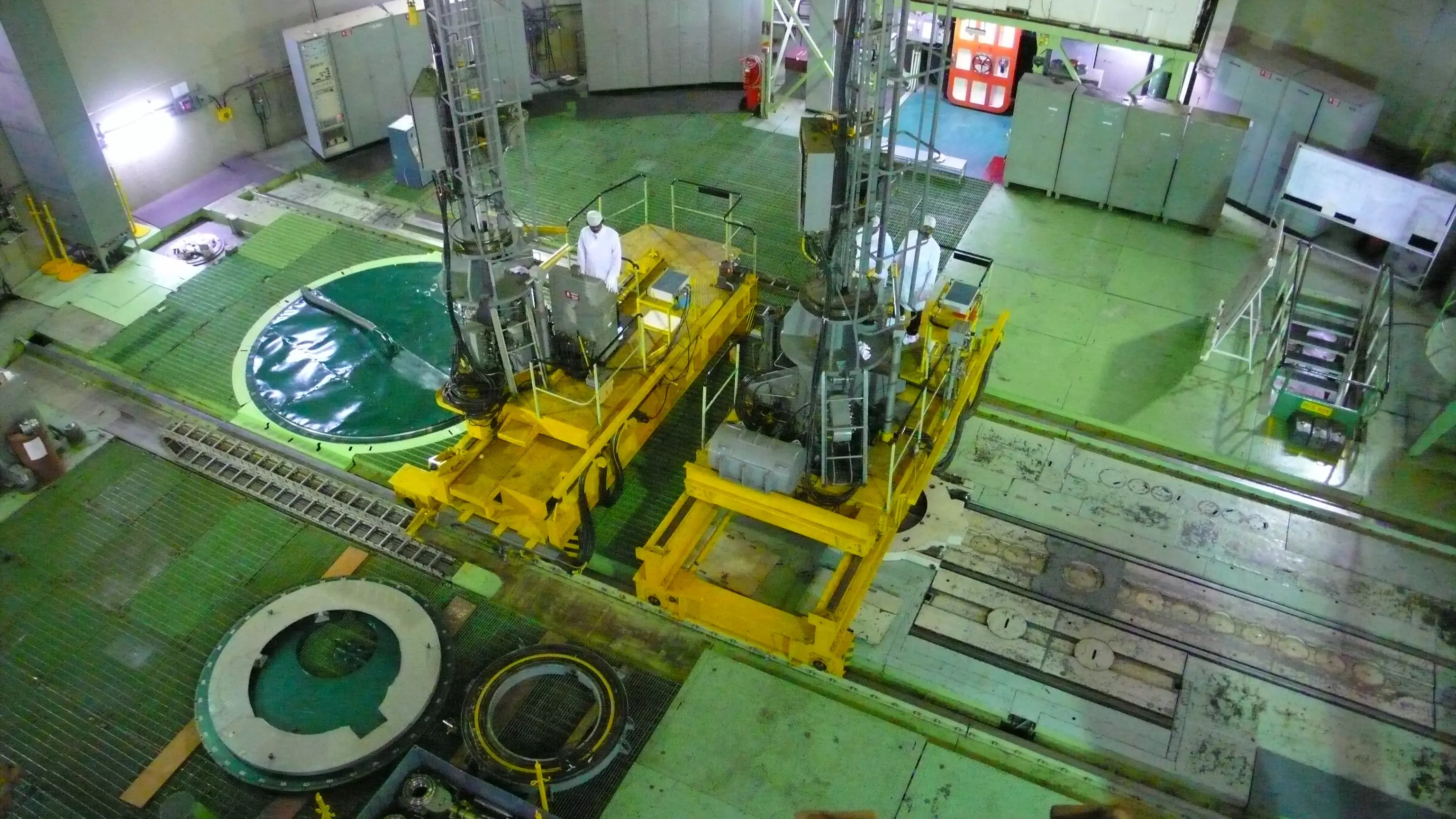
File photo of a fast breeder test reactor at Kalpakkam. Photo: Wikipedia/Petr Pavlicek / IAEA
To understand what makes this reactor special, one must first grasp something about nuclear fuel. Like the wide varieties of brinjal — purple, white, green — atomic elements too come in different isotopic forms. Naturally occurring uranium, for instance, is a mixture of uranium-234, uranium-235, and uranium-238. Each of them has the same number of protons in its nucleus, but they differ by the number of neutrons.
Among these, uranium-235 is naturally radioactive; it spontaneously decays, spitting out an alpha particle and transforming into thorium-231. Shoot a fresh neutron at the nucleus of such a radioactive isotope, at just the right speed, and the nucleus splits apart. Energy is released. This is the key to harnessing nuclear energy through fission.
Only three isotopes serve as nuclear fuel: uranium-235, plutonium-239, and uranium-233. A limited menu, this, but one that powers the entire nuclear industry.
Now, what exactly is a "breeder" reactor? At the heart of the breeder reactor lies an elegant alchemy. Conventional power stations consume coal and spit out ash; a conventional nuclear reactor generates nuclear waste. By contrast, a breeder reactor, true to its name, creates more fuel than it consumes — they 'breed'; hence the name.
How does this happen? A green, wet branch will not burn; it is useless as firewood. But place that green wood in the heat of a stove and it transforms into firewood. Similarly, certain non-radioactive isotopes can be converted into radioactive ones in breeder reactors. Just as one covers a tea pot to retain its heat in winter, one can wrap a nuclear reactor with a non-fissile 'blanket' of material that can be transmuted into nuclear fuel.
In Kalpakkam's PFBR, uranium-238 , ordinarily not usable as fuel, serves as this blanket. Bombarded by 'fast' neutrons released from the reactor core, uranium-238 metamorphoses into plutonium-239, a potent nuclear fuel. At full capacity, the PFBR reactor will produce about 140 to 150 kilograms of plutonium-239 annually. In the future, India's vast reserves of thorium-232 will be used as a blanket to convert it into uranium-233, another usable fuel.
Why "fast" breeder then? The first stage of India's three-stage nuclear power programme is pressurised heavy water reactors (PHWRs). In this design, at Kalpakkam, Kudankulam (Tamil Nadu) and other places, the neutrons released during fission are deliberately slowed down using moderators. Not so in a 'fast breeder reactor'.
Here, the primary fuel is a mixture of plutonium-239, plutonium-240, plutonium-241, and uranium-238. Of this, only plutonium 239 is a fuel; but like the air we breathe, which has oxygen and more, the fuel mixture is often a mixture of fissile and non-fissile isotopes. When fission occurs, these materials release neutrons travelling at enormous speeds; unmoderated, hence the name "fast". These fast neutrons slam into the uranium-238 blanket wrapped around the core. Absorbed by the uranium-238 nuclei, the energy from the neutrons transforms it into plutonium-239. New fuel is literally born inside the reactor while electricity is being generated. A remarkable two-for-one deal.
Also read: A life in orbit: How serendipity played a role in catapulting Sunita Williams to space
This matters immensely for India. The country has very little uranium, and its quality is poor; the fissile uranium-235 content is low. Thus, India imports nuclear fuel. Thorium, however, lies in lavish abundance along the southern beaches of Kerala and Kanyakumari, locked within the black sands. India possesses the world's largest reserves of thorium. Homi Bhabha, decades ago, foresaw this and crafted India's three-stage nuclear programme. Jawaharlal Nehru, with characteristic foresight, set it in motion. The logic was simple: turn thorium, that 'green, wet unburnable branch', into uranium-233 fuel, and achieve self-reliance. No more dependence on foreign suppliers.
The three-stage plan unfolds like this. In the first stage, 18 pressurised heavy-water reactors already operate across the country. They burn natural uranium, producing electricity and, as a valuable by-product, plutonium, the fuel needed for the next stage. The second stage, now officially underway at Kalpakkam PFBR, takes that plutonium, breeds still more of it in fast reactors, and soon will begin converting thorium into uranium-233 while generating power. Kalpakkam's test breeder has run for nearly fifty years, providing invaluable experience. Drawing on that experience, and incorporating enhanced safety measures developed after the devastating tsunami, the Atomic Energy Regulatory Board gave its approval. The commercial prototype is finally in operation.
Stage three will see reactors fuelled entirely by uranium-233, again with thorium blankets to breed even more fuel. Once we reach stage three, we can sustain energy production just with thorium; very little uranium or plutonium would be needed. A test reactor for this stage, KAMINI, has already been operating at Kalpakkam for several years. Indian nuclear scientists are already learning how to design and operate the third stage. The test reactor has already demonstrated parts of this thorium cycle at Kalpakkam, proving the concept in miniature.
This feat brings both joy and concern. Mastering such complex technology and bringing a commercial-scale breeder to life is indeed a great achievement. With this, the nation is closer to true self-reliance in atomic energy. Yet alongside the celebration, a quiet unease lingers, refusing to fade.
India has been a member of the International Atomic Energy Agency (IAEA) for a long time. But nuclear-weapon states like the United States have insisted on a discriminatory condition: that India, along with Iran, must accept full-scope safeguards while they themselves do not. In principle, India rejected this unequal international inspection regime until recently. Still, in a spirit of openness, Indian scientists have voluntarily published data and scientific papers from the test breeder's fifty years of operation from time to time. Through these publications, they have permitted indirect international scrutiny. This transparency, too, is cause for satisfaction.
But there are some serious worries that remain. As professor TR Govindarajan has explained in an article published in The Federal, questions also linger over the timing: criticality, it is now claimed, has been achieved nearly six months ahead of schedule.
Further, in 1994, under the aegis of the IAEA, all nuclear-energy-producing nations, including India, agreed to establish independent, autonomous, constitutionally protected atomic energy regulatory bodies. Canada and France, among others, have since created such independent regulators. Only an independent body can ensure true transparency and earn public trust. In India, the Atomic Energy Regulatory Board continues to function as an arm of the Department of Atomic Energy, the very agency it is meant to supervise.
Is it fair to place the watchdog under the same roof as the watched? The absence of a truly autonomous, constitutionally guaranteed overseer continues to trouble our conscience.