India’s PFBR reaches criticality: Milestone after years of delays and questions
From Bhabha’s three-stage vision to delays, global experience, and questions over timing and approvals, here’s a deep dive into India’s PFBR milestone

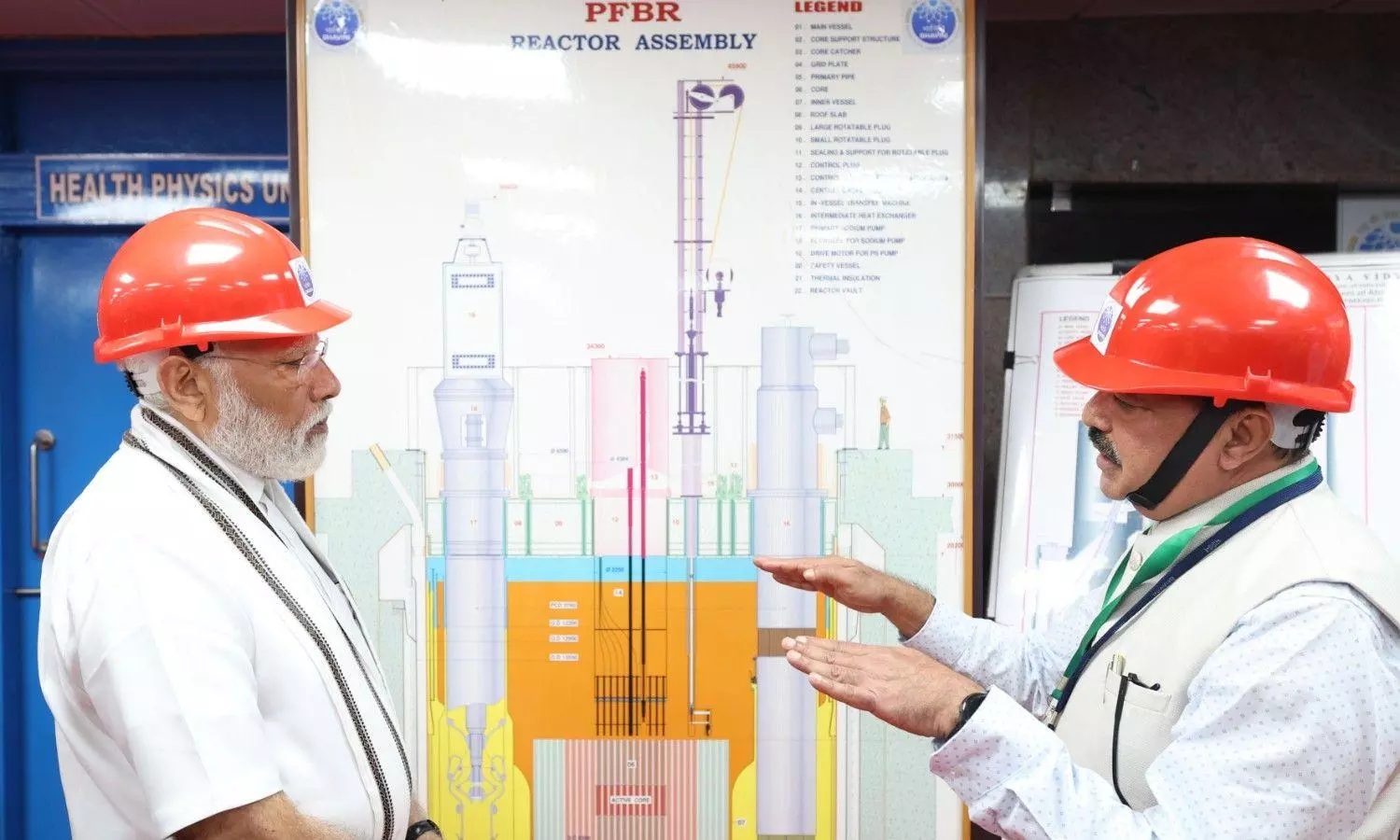
On April 7, Prime Minister Narendra Modi announced that the Prototype Fast Breeder Reactor (PFBR) at Kalpakkam had achieved criticality in a post on X. This is a pivotal moment for the Department of Atomic Energy. To assess the significance of this announcement, it is important to look back at the history of this development.
From vision to nuclear reality
Homi Bhabha, in the early 1960s, visualised a three-stage nuclear energy programme for India, taking into account the availability of resources such as thorium. The Atomic Energy Act was enacted in 1962 with this vision in mind. Though Bhabha and the Government of India declared that nuclear energy would be used only for peaceful purposes, it was not not clear whether they really kept it that way.
Also read | Kalpakkam Fast Breeder Reactor: Why it's controversial, why India chose it
In 1964, Bhabha even openly stated that India could conduct a nuclear test within a year. By 1974, India tested an atomic weapon at Pokhran, which led to sanctions against the programme in several ways. Canada, which had provided technology for the Pressurised Heavy Water Reactor (PHWR), withdrew from the programme.
The Nuclear Suppliers Group (NSG) was later formed, led by the United States, with the specific aim to stop uranium supply to India. However, thanks to the dedication of scientists and engineers in the Department of Atomic Energy (DAE), the reactor at Kalpakkam was completed and went critical by 1983, although heavy water shortages delayed the programme.
Indigenous build
This was the first indigenously built commercial reactor and raised hopes for further development. The DAE projected that by the turn of the millennium, 10 GW of capacity would be installed. However, this was followed by the second round of nuclear tests in 1998, which created further challenges. By 2010, the installed capacity was only about 4 GW, aided by two reactors with 2 GW capacity (Pressurised Water Reactors, or PWRs) supplied by Russia at Kudankulam.
Interestingly, in 1985, the Fast Breeder Test Reactor (FBTR) was built at Kalpakkam and soon became operational. It was intended for research purposes and to acquire knowledge in fast breeder technology. Its success later led to the programme to develop a 500 MW Prototype Fast Breeder Reactor (PFBR) under Bharatiya Nabhikiya Vidyut Nigam Limited (BHAVINI), which began in 2004.
Global journey of breeder reactors
A fast breeder reactor uses fast, unmoderated neutrons to generate more fuel than it consumes. These fast neutrons convert uranium-238 (U-238) into plutonium-239 (Pu-239), thereby producing more plutonium than the reactor initially started with.
Liquid sodium is used as a coolant because it does not slow down the neutrons, and the otherwise “waste” U-238 is also used to generate fuel. However, liquid sodium is highly reactive and dangerous, requiring an inert atmosphere and careful handling. Originally, the ability to reprocess spent fuel to obtain plutonium was a major motivation for developing fast breeder reactors (FBRs). This also helps reduce the challenge of finding geological storage for nuclear waste.
However, breeder reactors are more expensive, and while they were expected to become competitive in the long run, concerns over safety (due to the sodium coolant) and proliferation (due to plutonium availability) have persisted.
French pioneers
Globally, France was a leader in nuclear energy and developed reactors such as Rhapsodie and Phoénix to breed plutonium, operating them for several years. Until the 1980s, Phoénix had a strong operational record over decades.
However, unexplained transients led to a reduction in output to zero, raising serious safety concerns and eventually resulting in its shutdown. Later, Super Phoénix was also abandoned due to public opposition despite France being a country where public support for nuclear energy is relatively high. Japan, too, had a programme that ultimately failed. Russia, however, continues to operate fast breeder reactors commercially.
China has also progressed in this field, with two sodium-cooled reactors under construction following the successful operation of an experimental reactor. Given this history, it is clear that FBRs represent advanced, cutting-edge technology, and any achievement in this domain is worth celebrating.
PFBR timeline and setbacks
In India, the PFBR programme began in 2004 with the goal of achieving criticality by 2013-14. As has been the case with several DAE programmes, progress was significantly delayed here as well. Starting in 2013, there were repeated announcements that the PFBR would go critical the following year. However, that “next year” has only now been claimed to have arrived. The project faced teething problems related to fuel cycles, sodium coolant handling, and safety aspects.
Also read | Kalpakkam nuclear reactor: Expert views on concerns, delays
Two years ago, in March 2024, the Prime Minister visited Kalpakkam, and it was announced that he had initiated fuel loading in the FBR. This came as a surprise, as there had been no declared clearance from the Atomic Energy Regulatory Board (AERB) at the time. In fact, such clearance was granted only four months later, in September 2024. The earlier announcement may have been timed for political mileage, given that the parliamentary elections were held in May 2024.
AERB clearance and conditions
The clearance by the AERB was explicit. It was issued to initiate fuel loading in a phased manner, followed by measurements of neutron flux and other parameters, as well as the commissioning of the sodium coolant systems. The AERB order dated October 16, 2025, clearly refers to:
1. Permission for initial fuel loading into the core, the first approach to criticality, and low-power physics experiments (as per clearance issued on July 29, 2024).
2. Permission for alternate fuel handling due to certain issues, as per a letter issued in July 2025.
3. Vertical fuel loading and approach to criticality, dated August 11, 2025.
It also makes it clear that fuel loading and the approach to criticality must be carried out without any risk to workers, the public, or the environment. Further, it specifies that the consentee (BHAVINI) must obtain all necessary statutory permissions valid for fuel loading. Based on the above, clearance was granted for fuel loading, the initial approach to criticality, and low-power physics experiments, valid until December 2026.
Early criticality raises questions
One would have expected that, given the validity extending to the end of December 2026, the process would take time until then. In principle, once the fuel is loaded and operations begin, criticality should follow. However, criticality is now claimed to have been achieved six months earlier than anticipated, and it is not yet clear whether this will be sustained without any hiccups.
Watch | Myth breaking video: How useful is indigenous fast breeder reactor?
The timing of the announcement also raises questions about whether it is aligned with ongoing electoral developments in Tamil Nadu and Puducherry, possibly serving an image-building exercise.
There are also recent claims regarding an alternate thorium blanket fuel (ANEEL), reportedly promoted by a US-based private entity. This proposal has been associated with former AEC chairman Dr Anil Kakodkar, as the acronym coincides with his name.
However, it has been criticised by some BARC scientists in a Current Science article. This, too, may have influenced the timing of the announcements. Regardless of these speculations, the development remains significant and should be welcomed as an achievement of the scientific community within the Department of Atomic Energy.
------------------------------
Postscript comments
1. A correction: Prime Minister Visited Kalpakkam to 'initiate fuel loading' in March 2024 (Not April 2024). First clearance was given on July 29th 2024 (Not September 2024).
2. First criticality means the power level is kept at very low level (may be at kilowatt levels) and chain reaction is initiated. For this control rods are kept deeper so that heat is not produced but chain reaction is started.
3. Stability is monitored, without the coolant getting heated.
4. While first criticality is important, the next stages will test the heating of the coolant (liquid Sodium) and stability and safety validation are crucial.
5. Raising the power level to 500 MW which was the designed level is to be carefully watched.
6. Ajit Kumar Mohanty, Chairman, AEC and Secretary, DAE was present during the first criticality.
7. AERB Engineers will also be present during all the operations.