- Home
- India
- World
- Premium
- THE FEDERAL SPECIAL
- Analysis
- States
- Perspective
- Videos
- Sports
- Education
- Entertainment
- Elections
- Features
- Health
- Business
- Series
- In memoriam: Sheikh Mujibur Rahman
- Bishnoi's Men
- NEET TANGLE
- Economy Series
- Earth Day
- Kashmir’s Frozen Turbulence
- India@75
- The legend of Ramjanmabhoomi
- Liberalisation@30
- How to tame a dragon
- Celebrating biodiversity
- Farm Matters
- 50 days of solitude
- Bringing Migrants Home
- Budget 2020
- Jharkhand Votes
- The Federal Investigates
- The Federal Impact
- Vanishing Sand
- Gandhi @ 150
- Andhra Today
- Field report
- Operation Gulmarg
- Pandemic @1 Mn in India
- The Federal Year-End
- The Zero Year
- Science
- Brand studio
- Newsletter
- Events

Why the Indian palette is not just about bright, stereotypical colours, but a sense of who we are
From the mineral palette of the earliest artists and pigments that yielded luminous yellows and deep blues, to the growth of aniline dyes in the late 19th century and revival of organic colours in the 21st century, India's colour palette continues to evolve.

The past few days this week have seen India immerse itself in myriad hues, as the country celebrated Holi, or ‘the festival of colours’. The recent years have seen a growing discourse surrounding the use of ‘safe’ colours, with many returning to the use of organic gulaal (dry colours), or those derived from flowers, and moving away from the chemical dyes that had come to dominate...
The past few days this week have seen India immerse itself in myriad hues, as the country celebrated Holi, or ‘the festival of colours’. The recent years have seen a growing discourse surrounding the use of ‘safe’ colours, with many returning to the use of organic gulaal (dry colours), or those derived from flowers, and moving away from the chemical dyes that had come to dominate the markets in the past decades.
While the shift is propelled by a concern for skin-friendly colours, India’s long history of art and the use of colours have its roots in the use of natural mineral and plant-based dyes.
Indeed, modern India’s sensory overload with synthetic pinks, neon blues and Bollywood palettes feels far removed from the mineral palette of its earliest artists.
The story of colour on the subcontinent stretches back at least 30,000 years, to the cave paintings of the Bhimbetka rock shelters in Madhya Pradesh.
Prehistoric artists would have ground iron-rich stone into powder and mixed it with water and plant binders to create pigments. Rekha Rao, Bengaluru-based artist and co-founder of the KK Hebbar Art Foundation, notes, “They used wooden coal and soft red stones, which they powdered and mixed with some sort of gum and water to form a paste. Yellow was obtained from hartal stone and green was obtained from plants.” These were not decorative flourishes but tools of communication in ochre and charcoal as early painters recorded hunts, rituals, dances and animals, mapping their lives onto stone with colours drawn directly from the earth.
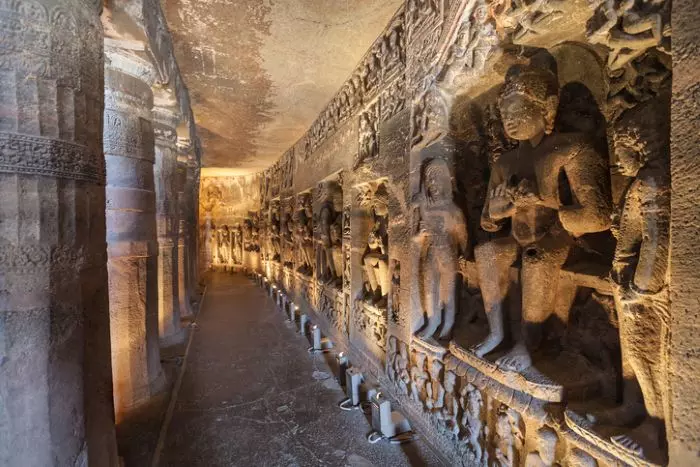
the Ajanta caves in Maharashtra, dating back from the 2nd century BCE to 6th century CE, elevated colour into acts of devotion. Here, pigments deepened in both palette and purpose. Photo: iStock
If the iron-rich reds bonded to stone in these sandstone shelters, the Ajanta caves in Maharashtra, dating back from the 2nd century BCE to 6th century CE, elevated colour into acts of devotion. Here, pigments deepened in both palette and purpose. One can see ochre reds, brown, lamp soot (for black), lapis lazuli (deep blue or ultramarine colour), kaolin (white clay) and more. Colour was no longer merely descriptive; it was sacred, deliberately sourced, traded (lapis lazuli was imported from Afghanistan) and prepared. “The cave paintings and murals done in natural colours have stood the test of time,” says Rao.
Also read: Why the cultural intermingling that formed the core of ‘Holi Milan’ appears to be losing its hue
From the prehistoric, muted earth tones, artists moved toward pigments that yielded luminous yellows and deep, saturated blues, developed through increasingly sophisticated techniques. Some of these mineral-based methods endure even today, preserved in traditional ateliers and workshops.
Goa-based art curator and historian Lina Vincent highlights the miniature painting traditions that travelled to the subcontinent from Persia and mingled with the existing manuscript painting processes. Largely making use of mineral colours, she notes, the ateliers functioned almost like ancient apothecaries. Specialists ground stones and minerals into fine powders, preparing pigments with meticulous care. Blues came from lapis lazuli, malachite yielded greens, cinnabar or vermilion produced rich reds, the striking and toxic orpiment created yellow. Artists also used white lead, gold and silver, even iridescent beetle wings, binding these materials with gum Arabic before applying them to paper. “The tradition is a rich source of study for the use of natural pigments,” says Vincent.
The American artist Waswo X Waswo, who runs Studio Karkhana in Udaipur and has long collaborated with miniature painters, argues that India’s traditional palette is far more complex than the hues most commonly associated with it. “Take Peori, commonly known as Indian Yellow,” he notes. The deep, luminous pigment was widely used in Mughal, Rajasthani and Pahari miniatures. “Or consider neel blue. The French artist Yves Klein effectively claimed a version of it as his own with International Klein Blue.” To Waswo, these are not just colours but inheritances, Indian pigments that “tickle and satiate the eye”.
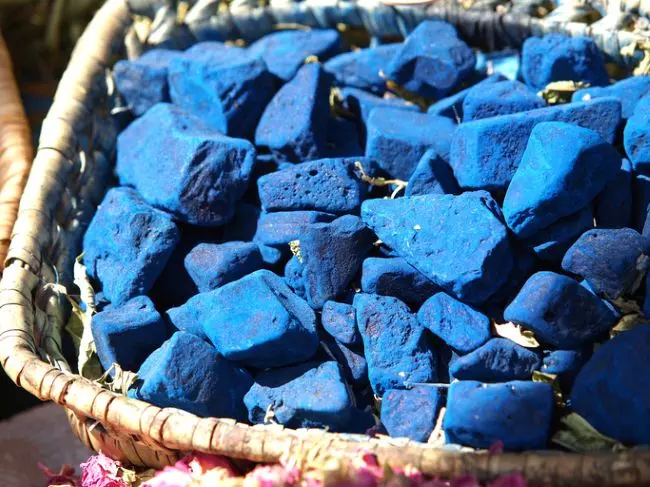
Indigo, carries a layered and conflicted history. Many regard it as not merely a pigment but a political archive. Photo: iStock
He is particularly animated about indigo. “It’s an absolute wonder of a colour, and I love it,” he says. “But sadly, it has become the stereotypical shade many outsiders and designers associate with India.”
Indigo, however, carries a layered and conflicted history. For visual and textile artist Shelly Jyoti, indigo is not merely a pigment but a political archive. Her practice draws on historical iconography within the wider cultural history of India. Central to her work is Mahatma Gandhi’s idea of swa, the notion of self and self-realisation that underpinned his philosophy of resistance. “My research into Gandhi’s idea of swa led me to the Champaran Movement,” Jyoti says, referring to the 1917 campaign in Bihar in which Gandhi urged farmers to resist cultivating indigo for British planters — an early act of civil disobedience that would shape India’s freedom struggle.
Her landmark series and exhibitions, including Ode to Neel Darpan, Indigo Narrative and Indigo: The Blue Gold, examine indigo’s long history from multiple vantage points; colonial trade in the 18th and 19th centuries, forced cultivation, migration and exploitation.
“One segment of my work looks at indigo as a commodity that seduced the world,” she says. Historical accounts show that Dutch traders carried indigo cakes from Machilipatnam back to Europe, where the dye astonished markets with a depth and fastness that surpassed European woad (a source of blue dye there) by over 60 per cent. Later, under British rule, Indian farmers were coerced into cultivating indigo for export, and in some cases, transported to other colonies to continue its production. “Indigo gives the whole perspective of Indian trade, migration and struggle,” she says. “Even its botanical name carries geography within it: Indigofera tinctoria derives from the Greek indikon that translates as a dye from India.”
Also read: How artists are collaborating with local communities to bring about change in urban India
Indian artistic traditions have long drawn colour from the land itself. Beyond caves and ateliers, natural pigments continue to decorate rural and indigenous practices across the country. “Walk into community spaces in different parts of rural India,” says Vincent, “and you will notice drawings on walls and floors that rely on the natural colours of mud and clay, the white of rice paste or lime, the dark shades of coal and soot, the vivid red of vermilion and the warm yellow of turmeric.”
Such practices, from floor designs to colourful murals, reflect what she describes as a symbiotic relationship between communities and their environments. “Culturally, materials become part of life,” she says, “whether for food, decoration, attire or architecture.”
For the artist Avinash Karn, born into a family of Madhubani painters and founder of Madhubani’s first art collective, Kacchi-Bharni, colour is inseparable from economy.
“In Mithila painting, economics shaped the palette,” he says. “Artists spent almost nothing on materials. Paper was often the only purchased item. Pigments, brushes and binders were prepared at home using what was locally available.” Malabar spinach berries yielded purple; beetroot, too costly, was rarely used. Butterfly pea flowers produced aparajita blue and their leaves a vegetal green. Marigolds released yellow, orange came from fresh or dried harshringar (parijaat) blossoms. Black was made from lamp soot, though occasionally bought. Strong natural reds were difficult to obtain, so crimson and pink were often derived from Holi powders.
Even the surface spoke of frugality. Cow dung mixed with water formed an earthy base coat and shells from pond oysters doubled as paint cups, adds Karn.
The artist resists choosing a single colour to represent Mithila painting. Instead, he points to combinations rooted in tradition: Prussian blue with vermilion red, or lemon yellow paired with pink.
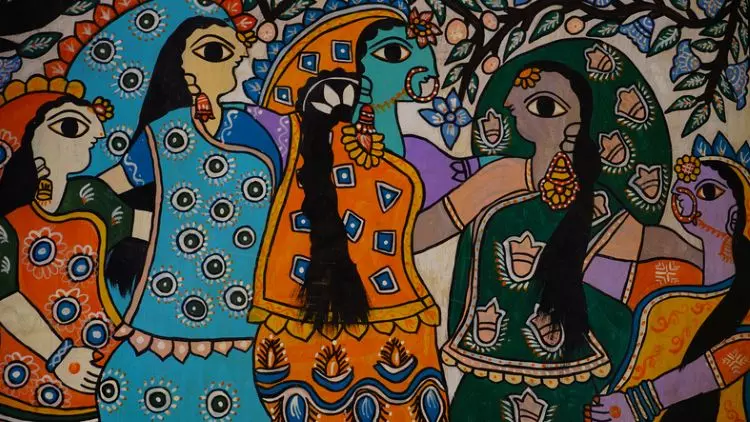
In Mithila paintings, pigments, brushes and binders were prepared at home using what was locally available.Butterfly pea flowers produced aparajita blue and their leaves a vegetal green. Marigolds released yellow... Photo: iStock
By the late 19th century, aniline dyes (the first synthetic colours) were imported from Germany, and later manufactured locally, had begun transforming India’s palette, say artists. Brighter and more stable than many natural pigments, they made vivid hues accessible to a wider public. Mass production democratised colour, but at a cost. These dyes often contained toxic chemicals, displacing centuries-old mineral and vegetal techniques.
In 1905, the iconic art supply store G. C. Laha opened in Kolkata, importing artist-grade paints and materials that would shape modern Indian art. Over the decades, stalwart artists such as Rabindranath Tagore, Abanindranath Tagore, Nandalal Bose, M. F. Husain, Satyajit Ray and Bikash Bhattacharjee are said to have purchased their paper, inks and brushes there.
Kolkata-based art curator and historian Jyotirmoy Bhattacharya recounts a story about master artist Raja Ravi Varma. When Varma ran out of paint midway through a work, he initially considered sourcing replacements from London, a process that would have taken weeks. Instead, a friend procured the required colours from G. C. Laha. In gratitude, Varma is said to have gifted the store a watercolour.
Also read: How the Edam exhibition is giving ‘edam’, or space, to Kerala’s women artists
Economics continued to shape artistic practice well into the 20th century. For post-Independence artists, imported materials were often the only option and they were costly. “These artists had little choice but to depend on imported brands like Winsor & Newton for their work,” Rekha says, recalling the generation of her father, master artist KK Hebbar. “Canvas, too, was imported, limited and expensive. Many artists turned to handmade paper or board instead.” The search for materials coincided with a search for identity. “Indian artists of that era struggled to find a language of their own,” she says. By the 1970s and ’80s, access had improved, even if choices remained limited. The Lalit Kala Akademi in New Delhi imported small quantities of oil paints for artists, Rekha adds. “Today,” she says, “the sky is the limit”.
Many of the works of the Bengal School of Art that flourished in the early 20th century, too, were made using imported colours, say artists and art historians, although some artists linked to that school, like Jamini Roy, are known to have made their own colours. “The kajini sihai, or black pigment, which was used for outlines and detailing, especially in folk and tribal painting traditions like the Kalighat paintings [a style which originated in the 19th century], was made by burning jackfruit leaves,” Bhattacharya explains, adding that in spite of the availability of synthetic colours, tradition dictated some of the natural colours now strongly associated with the region. The red alta, a bright red paste traditionally applied to women’s hands and feet, was made using lac resin. For Saraswati puja, yellow or green abeer (gulaal, Holi colours) is mixed with mica dust to decorate the goddess. Blue, produced from indigo or mineral pigments, was used in early Bengal paintings on canvas as well as lithographs.”
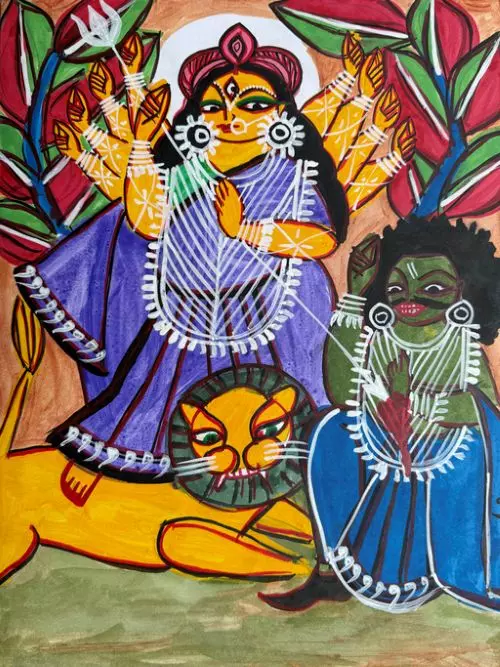
The black pigment, which was used for outlines and detailing, especially in folk and tribal painting traditions, like the Kalighat paintings, was made by burning jackfruit leaves. Photo: iStock
Now, in the 21st century, interest in organic dyes for textiles has seen a revival.
Prominent examples are Jyoti’s works with the Ajrakh artists or Juliette Ravel Roychowdhury, a French-born textile designer who works with natural dyes and pigments drawn from local fruits, flowers, soils, and barks and traditional indigo vats. “Juliette’s practice revives centuries-old Indian techniques, bridging historical craftsmanship with contemporary artistic expression,” says Vincent. “She recently showed her pathbreaking saree length artwork based on the 'abhisarika nayika' [the heroine going to meet her lover, one of the eight nayikas classified in the Sanskrit treatise Natya Shastra] characterisation, in Sitara Chowfla's curated show 'Threads though time: Textile art from Goa' as part of a group of artists presented at the Goa Open Arts Festival.”
As the Indian colour palette continues to evolve, the hues most closely associated with the country are changing. Avinash Karn notes that pop culture once drew inspiration from Varanasi’s wooden toys, and soon lorries and rickshaws were painted in the brightest yellows, blues, pinks, and reds, brightening the rural landscape. Today, he observes, minimalism has shifted the global taste, and colours once celebrated as joyful are sometimes seen as gaudy. Cue in pastel wedding ghagras and muted art palettes. “The psychology of colours is changing,” he says.
Yet some hues have grown bolder with mass popularity. Saffron, for instance, now appears in fashion and public imagery, from Indian PM Narendra Modi’s pocket square to Israeli PM’s wife Sara Netanyahu’s dress. “It’s interesting how saffron has changed its shade,” Vincent laughs. “The bright shade is almost unrecognisable from the saffron of miniature and Bengal School paintings. The natural saffron colour has changed its essence and become commodified.”
If there was one colour to link history to present-day India, or one that can be said to be representative of the country, what would it be? “Red,” say Rao and Bhattacharya, the latter adding that “I am instinctively drawn to it as it has originated from red earth.” Jyoti, on the other hand, declares it is indigo. “To me, it represents our history.”