- Home
- India
- World
- Premium
- THE FEDERAL SPECIAL
- Analysis
- States
- Perspective
- Videos
- Sports
- Education
- Entertainment
- Elections
- Features
- Health
- Business
- Series
- In memoriam: Sheikh Mujibur Rahman
- Bishnoi's Men
- NEET TANGLE
- Economy Series
- Earth Day
- Kashmir’s Frozen Turbulence
- India@75
- The legend of Ramjanmabhoomi
- Liberalisation@30
- How to tame a dragon
- Celebrating biodiversity
- Farm Matters
- 50 days of solitude
- Bringing Migrants Home
- Budget 2020
- Jharkhand Votes
- The Federal Investigates
- The Federal Impact
- Vanishing Sand
- Gandhi @ 150
- Andhra Today
- Field report
- Operation Gulmarg
- Pandemic @1 Mn in India
- The Federal Year-End
- The Zero Year
- Science
- Brand studio
- Newsletter
- Elections 2024
- Events

Why the cultural intermingling that formed the core of ‘Holi Milan’ appears to be losing its hue
For generations, Holi has been celebrated by people of all religions. If its colours reflected the shades of love of the Hindu deities Radha and Krishna, Sufi poets too wrote of the spirit of the day. Recently, however, the festival seems to be losing out to rising religious fundamentalism, say old timers.

“Jab Phagun rang jhamakte hon tab dekh baharein Holi ki/ aur daf ke shor khadakte hon tab dekh baharein Holi ki,” wrote 18th-century poet Nazeer Akbarabadi. Loosely translated, it means, “when Phagun [a month in the Hindu lunar calendar] are shining, behold the spring of Holi/and when the drums resonate, behold the spring of Holi”.For generations, the festival of Holi, heralding the...
“Jab Phagun rang jhamakte hon tab dekh baharein Holi ki/ aur daf ke shor khadakte hon tab dekh baharein Holi ki,” wrote 18th-century poet Nazeer Akbarabadi. Loosely translated, it means, “when Phagun [a month in the Hindu lunar calendar] are shining, behold the spring of Holi/and when the drums resonate, behold the spring of Holi”.
For generations, the festival of Holi, heralding the onset of spring, has been celebrated by Indians irrespective of their faith.
Like many other Indian festivals, the origins of Holi too are rooted in a legend — that of the burning of the demon Holika (celebrated as Holika Dahan the day before Holi) and the triumph of good over evil.
If the mischievous play of colours has been intertwined with the eternal love story of the Hindu deities Radha and Krishna, which found resonance in the traditional arts, music and literature of the country, Sufi poets too celebrated the spirit of the day in their writings. It was celebrated as 'Eid-E-Gulabi' during the reign of the Mughal emperors and Guru Gobind Singh built upon the idea of the festival, introducing a martial element in it as 'Hola Mohalla'. For centuries, it has been representative of India’s composite culture, its spirit of integration embodied in the legacy of 'Holi Milan'.
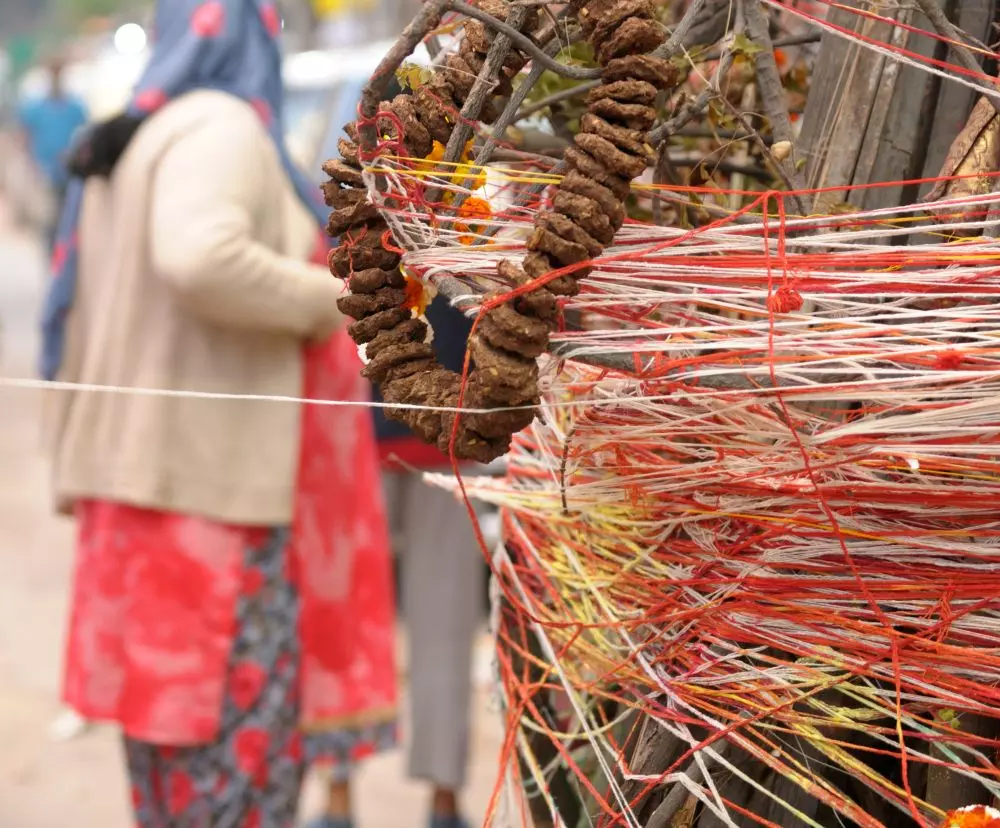
Like many other Indian festivals, the origins of Holi too are rooted in a legend — that of the burning of the demon Holika (celebrated as Holika Dahan the day before Holi) and the triumph of good over evil. Photo: Prerna Jain
“I spent some 15 years of my early life at Delhi’s Jawaharlal Nehru campus, and when I say I am spoilt by it, it’s no exaggeration,” says Ritambara Agrawal, an advertising professional and writer, whose father was a professor at the university.
Talking of a time approximately 15-20 years back, she adds: “Think of a safe space where 10-year-old girls can play Holi just about anywhere, without fear of misbehaviour or even the dreaded ‘pakka rang’ [colour which takes days to fade]. I remember our toli [group] of friends would walk all over the campus with our little packets of colours that we would share with anyone we met on the way; no fear of strangers. The hostel’s mess would not serve food that day (post-breakfast, if I remember correctly), so students had to manage their own lunch and dinner. Often, they would walk into faculty homes and be welcomed for a meal. It wasn’t just a ‘Holi Milan’ in the sense of all of us gathering in some open space and putting colours on each other, but opening our homes and hearts to one and all.”
Also read: How Gen Z is recolouring the Holi canvas, pushing for mindful celebrations
Over the years, old timers rue that spirit of Holi seems to have undergone a subtle shift. In a 2019 advertisement for a detergent, a young girl in a white T-shirt lets other children throw colours at her to ensure her friend remains clean for Namaz at a mosque. She is protecting her Muslim friend from the colours so he can go to prayers. The advertisement received mixed reactions, stirring unexpected controversy over something that had hoped to convey a message of communal harmony, innocence, and friendship.
“Growing up, Holi was always a part of our lives,” recalls author and historian Rana Safvi, 68, who continues to celebrate the festival. “We played Holi with our friends. I have always held the belief that there’s no ban on playing Holi for Muslims. In truth, Islam does not prohibit colour. The only requirement is practical: during wuzu [the act of washing and purifying the body before prayer] before namaz, water must reach the skin. If colour forms a barrier, it must be washed off. That is all. So, I wash away the Holi hues before I pray,” she explains.
The words of the 18th-century Punjabi mystic Bulleh Shah echo this spirit of the subcontinent’s syncretic inheritance, that delicate, resilient ‘Ganga-Jamuni tehzeeb’. “Hori khelun kah kar Bismillah/Naam Nabi ka ratan chadhi, Boond padi illallah/Rang rangeeli ohi khilave jo sakhi hove fana-fi-ullah/Hori khelun kah kar Bismillah,” he says. Which translates to “I will play Holi, saying Bismillah. Cast like a gem in the name of the Prophet, each drop falls with the beat of Allah, Allah. Only He may play with these colourful dyes, who has learnt to lose himself in Allah.”
Once celebrated in the writings of Nawab Wajid Ali Shah of Awadh and Mughal ruler Bahadur Shah Zafar, the interfaith character of Holi celebrations owed its origins, in a big measure, to the influence of the Sufi and Bhakti movements, which ensured perfect peace and harmony among the communities. The shift, a result of growing religious fundamentalism, is a recent phenomenon, say those who have been a part of interfaith celebrations for years.
Poet and author Satbir Chadha, who spent her childhood in Kumaon in the 1970s, recalls the “shared culture of the ‘Pahadis’, ‘Desh ke Log’ (as people of the plains were called), Muslims and several Sikh families that came in after Independence. Also, a spattering of Christians”.
“All communities were salient in their religious practices; what was common was the festivals, which were assiduously celebrated by all communities together. Holi, being the most boisterous festival, as also the most solemn among the Pahadis, was also celebrated together. The Pahadi women sang their traditional folk songs, and all of us children sang along. Over the years, the language and verses had become everyone’s. People respectfully applied a ‘Teeka’ of gulaal to each other’s foreheads; all kids and adults were equally anointed, regardless of religion or community,” she says.
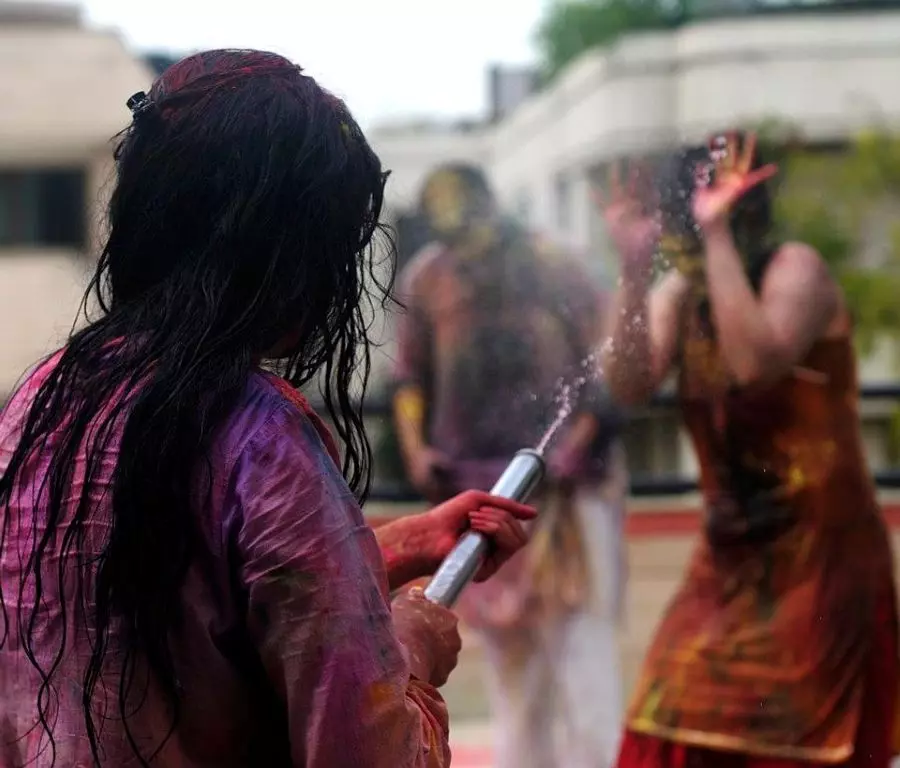
Over the years, old timers rue that spirit of Holi seems to have undergone a subtle shift, losing its integrated characted. Photo: Prerna Jain
Dwelling on those celebrations from the yesteryears, she recalls that while they would mostly play with dry colours, some teenagers would mix the colours in water and splash it on the others. “By mid-morning, we were all unrecognisable, our faces and clothes coloured and splashed, and I remember my mother jokingly telling my aunt, ‘They are all like one, we can’t tell our children from the others, who knows who they are playing with. I’ll only know when they come home that they’re my kids’. Everyone would join in and play Holi with the same vigour and ardour.”
Rueing that that culture of integrated celebration was now lost, Chadha adds, “Children are becoming conscious of being Hindu, Sikh, Muslim, or Christian. The thinking Indian needs to consciously make the effort to coalesce the communities as before. Happiness and grief are good catalysts, so what better time than festival season to begin amalgamating and consolidating our secular fabric?”
Also read: Why in Tamil Nadu, Pongal celebrations unite Hindus and Muslims in common 'thanksgiving’
Freelance writer and a ‘Dilliwala’, Ashok Mathur, too shares similar memories of integrated Holi celebrations in Shahjahanabad, or what is more commonly referred to as ‘Old Delhi’.
“When [Mughal ruler] Shahjahan made Delhi his new capital, shifting it from Agra, he brought various people from different communities and professions to settle here, who in turn brought with them motley cultural traditions, both tangible and intangible. Shahjahanabad became one of the biggest trading cities and trade thrives on festivities too. Come any festival, and the city drapes itself in that mood. Holi is one of the longest-celebrated festivals here. It starts on Basant Panchami and ends forty days thereafter, culminating with the symbolic Holika Dahan at street crossings and in the sprinkling of colours on each other the next day. Children throw colours and water from their chajjas [balconies], shouting “bura na mano Holi hai” [Don’t mind, it’s Holi] and believe me, no one minds, some even consider themselves lucky to be coloured.”
Talking about the demographic of the neighbourhood, Mathur adds, “There are areas with a prominent Muslim population, where Hindus are in the minority, but a Holi fire [Holika Dahan] burning there, with equal fervour, music and dance. Mashaq walas or “bhishtis” [water carriers], who are predominantly from the muslim community would gather at big crossings. Hindus would pay them a sadka [an amount to ward off the evil eye], and they’d empty their mashaq [leather bags of water] at the crossing where Holika Dahan would take place. While it is a practice to ward off the evil eye, it also cleans the place where people gather for a puja.”
Over the years, however, a big section of these old residents from both communities has moved out of the area for various reasons, both within and beyond their control, says the writer. “Traces and remnants of [the old] culture still line, Shahjahanabadis or the residents of the ‘old city’ continue to practice their multicultural life, but not in the manner of the past or with that outward display,” claims Mathur.
![Old Delhi residents talk of children throwing colours and water from their chajjas [balconies], shouting “bura na mano Holi hai” [Don’t mind, it’s Holi]. Photo: Prerna Jain](https://thefederal.com/h-upload/2026/03/04/600683-holi6.webp "Old Delhi residents talk of children throwing colours and water from their chajjas [balconies], shouting “bura na mano Holi hai” [Don’t mind, it’s Holi]. Photo: Prerna Jain")
Old Delhi residents talk of children throwing colours and water from their chajjas [balconies], shouting “bura na mano Holi hai” [Don’t mind, it’s Holi]. Photo: Prerna Jain
His memories and observations are shared by Sadia Aleem, a journalist and former resident of ‘Old Delhi’, who continues to live in the national capital.
“My home, Haveli Hisamuddin Haider in Ballimaran, was not far from [landmarks like] Turkman Gate or Jama Masjid and a short walk from the fragrant chaos of Sitaram Bazaar. [As a child] I still remember my best friend Nidhi and I would fill balloons with coloured water and wait on terraces to mischievously target unsuspecting passersby. ‘Bura na mano, Holi hai!’ we would shout, bursting into giggles,” recalls Aleem, now in her forties.
She adds: “Distinctions would be blurred into shared delight; faces shone red and green and gold, and everyone looked equally absurd and equally beautiful. In the courtyard near Sitaram Bazaar, the Aggarwal aunties would send over plates of gujiyas [Holi-special dessert], their sweetness lingering long after the colours had faded from skin.”
Today, she says, the streets are still there, but feel narrower.
“The conversations have become more cautious. Where once doors were left ajar, now some are bolted. Every era has its shadows. Yet something tender has thinned; a certain ease of trust, a certain instinct to see oneself in the other. When the heart begins to turn away, it is almost like losing a limb you never knew you relied on. And yet, I refuse to despair. I believe the essential Delhi remains the Delhi of shared sweets, shared grief and shared celebration,” insists Aleem.
Also read: Smell, stigma and supremacy: How 'food racism' shapes everyday life in India
Not everyone is equally optimistic, though.
Award-winning author Madhulika Liddle is worried that her choice not to play Holi might be given a religious colour.
“I am a Christian and I have never actually played Holi. But that has little to do with my religion and more to do with my almost OCD-like [obsessive compulsive disorder] dread of dirt and messiness. When I was a child, my father was the only one in our family who would go out to play Holi. He was a police officer and celebrating with the jawans was an important way of bonding with them. I used to shudder when Papa came home soaked in colours and dirt (sic),” says Liddle.
She adds: “Our neighbours and friends would come, and respecting our wishes, would only leave a tiny dab of gulal on my parents’ cheeks, no more. Now, even admitting that one doesn’t want to play Holi, one [fears] facing immediate suspicion. It’s as if saying no to Holi is in some way a disrespect to Hinduism itself.”
One of the most popular Sufi writings on Holi is the lines by the saint Shah Niyaz Ahmad (1742-1834), who wrote “Holi hoye rahi hai Ahmad Jiyo ke dwaar/ Hazrat Ali ka rang bano hai Hassan Hussain khilaar.” Which means, “Holi is being played at the doorstep of our beloved Ahmad. Hazrat Ali has become the colour and Hasan and Husain the players”.
It is the ‘pakka rang’ (strong hue) of such inclusive celebrations that remains the core principle of ‘Holi Milan’.