- Home
- India
- World
- Premium
- THE FEDERAL SPECIAL
- Analysis
- States
- Perspective
- Videos
- Sports
- Education
- Entertainment
- Elections
- Features
- Health
- Business
- Series
- In memoriam: Sheikh Mujibur Rahman
- Bishnoi's Men
- NEET TANGLE
- Economy Series
- Earth Day
- Kashmir’s Frozen Turbulence
- India@75
- The legend of Ramjanmabhoomi
- Liberalisation@30
- How to tame a dragon
- Celebrating biodiversity
- Farm Matters
- 50 days of solitude
- Bringing Migrants Home
- Budget 2020
- Jharkhand Votes
- The Federal Investigates
- The Federal Impact
- Vanishing Sand
- Gandhi @ 150
- Andhra Today
- Field report
- Operation Gulmarg
- Pandemic @1 Mn in India
- The Federal Year-End
- The Zero Year
- Science
- Brand studio
- Newsletter
- Events

Why in Tamil Nadu, Pongal celebrations unite Hindus and Muslims in common 'thanksgiving’
The harvest festival has been celebrated by members of both communities with equal fervour for generations. Writers, filmmakers and sociologists feel Pongal cuts across religious lines as the festival is linked to nature and not the worship of any particular deity.

Documentary filmmaker Kombai Anwar’s family has been celebrating Pongal, Tamil Nadu's harvest festival, for close to a century now. “My mother, who is in her eighties, told me that she remembers how Pongal was celebrated with grandeur. We have a record of celebrating Pongal for at least 100 years now. The tradition still continues in our family,” says Anwar, who has been known to...
Documentary filmmaker Kombai Anwar’s family has been celebrating Pongal, Tamil Nadu's harvest festival, for close to a century now. “My mother, who is in her eighties, told me that she remembers how Pongal was celebrated with grandeur. We have a record of celebrating Pongal for at least 100 years now. The tradition still continues in our family,” says Anwar, who has been known to document the state’s communal harmony and the bond shared by Muslims and those from other religions.
The family serves up a big vegetarian lunch, including 16 different dishes. The meal is served on a banana leaf. “In my childhood, we would collect all the vegetables for the feast from our farm. Now we buy them from the market,” Anwar adds.
For generations, Pongal, which starts on Wednesday (January 14) this year, has been celebrated by both Hindus and Muslims in Tamil Nadu with equal fervour. The festival, which marks the beginning of the Tamil month of 'Thai', sees people cooking and sharing 'Pongal', a sweet dish made of raw rice. Traditionally celebrated over four days — referred to as Bhogi (the last day of the previous month, meant for cleaning and preparations), Thai Pongal (the beginning of Thai, the main day), Mattu Pongal (the day when farm animals, especially bullocks, are dressed up and reverred) and Kaanum Pongal (when people go out to enjoy) — most Muslim families celebrate Pongal on the first day of Thai. Some cook Pongal ahead of sunrise, while others prepare the meal at noon.
Also read: How a groundnut festival to appease a bull became a part of Bengaluru's cultural calendar
Thirty-three-year-old Sayeera Banu of Madurai is among hundreds of Muslim women in the state who draw special kolams — decorative patterns drawn on the floor using rice flour — in front of their houses for Pongal. She takes extra care to draw cows on the sides of her kolams to represent the importance of farm animals that are revered as part of the festival.
“My family has been celebrating Pongal for several years now. I invite my Hindu friends too for the meal. We cook Pongal in the morning and a non-vegetarian meal for lunch. Our prayers are done as usual and we cook Pongal at sunrise. The morning chill and the hot Pongal make a good combination that spreads happiness, hope and gratitude,” says Banu.
Writers, filmmakers and sociologists feel the festival cuts across religious lines as it is linked to nature and not the worship of any particular deity.
“In Tamil Nadu, Pongal is celebrated as a thanksgiving festival, where we respect nature, farmers and farm animals. We thank the farmers and farm animals who toil on the lands and the nature that gives us food,” says writer A Jeevakumar. “Cooking Pongal and sharing it with relatives and neighbours is the main part of the celebration. Muslims adapted the Tamil culture of celebrating Pongal as it is not tied to any spiritual identities.”
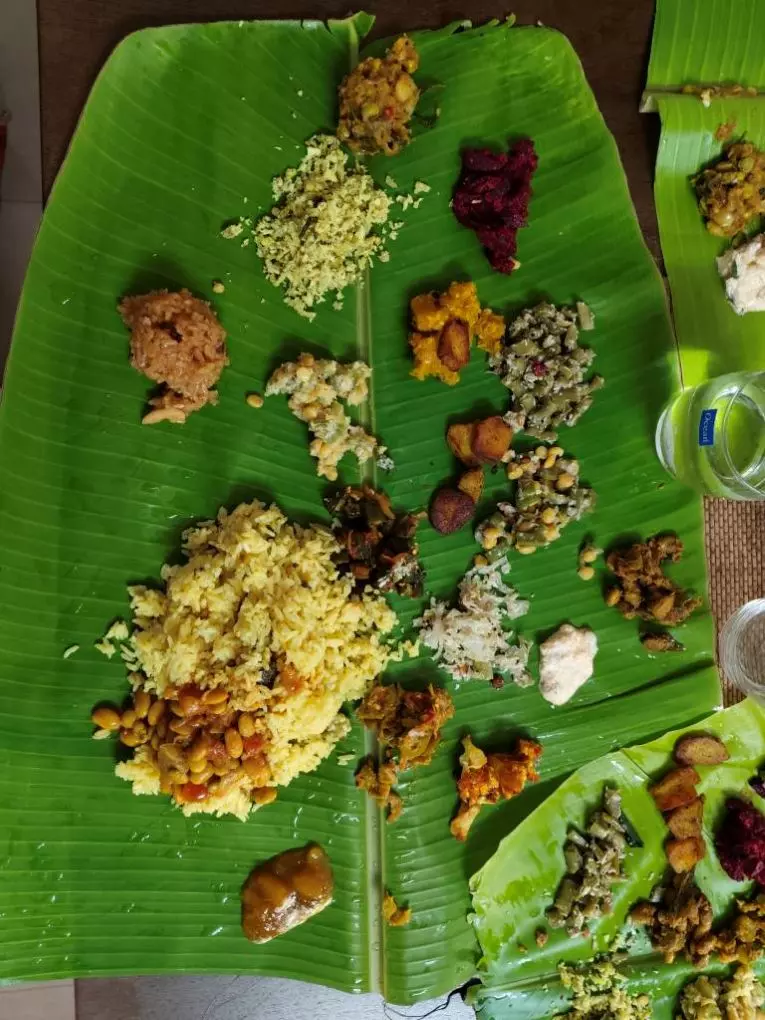
The Pongal meal served on a banana leaf at the Kombai Anwar familys celebration of the festival. Photo: By special arrangement
For sociologist R Elango, Pongal celebration is an example of how a cultural festival could bind people together and enrich the social fabric of a diverse society.
“There are some extremist groups among both Hindus and Muslims. But the majority of Hindus and Muslims believe that Pongal is a common festival. This belief creates an inclusive society and it passes the values of communal harmony to future generations,” says Elango.
He adds: “Tamil society has always been inclusive right from the Sangam age [3rd century BCE to 3rd century CE, known for its rich cultural and literary traditions]. As Pongal celebration is more about thanksgiving to nature, it connects all faiths. Tamil society always adapts and remains inclusive.”
Elango further points out how in many villages across Tamil Nadu, during Jallikattu (a traditional bull taming sport organised during the Pongal period), Muslims too would bring their bulls to participate in the game. “Pongal Jallikattu has deep roots in agriculture, collective labour and thanksgiving. So, it’s evident that the festival remains inclusive.”
Also read: How the popularisation of Dakla music led to its traditional folk artistes being sidelined
Seventy-seven-year-old A Amanulla still remembers the grand Pongal celebration in his hometown, Mannargudi — a delta region known as the ‘rice bowl of Tamil Nadu’. His grandfather, Mohammed Ismail Ghani, would take him to their six-acre paddy fields during harvest time and the first paddy harvest would be saved for Pongal day, he recalls.
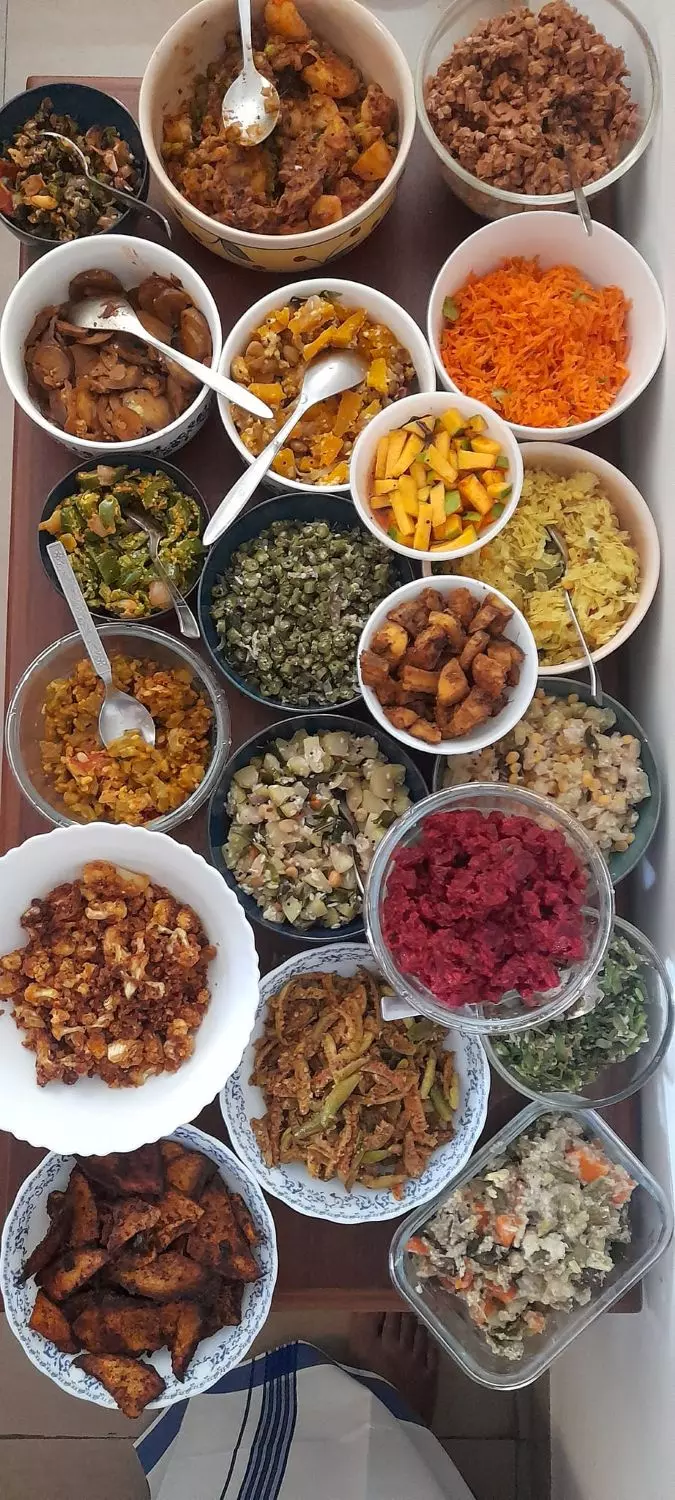
The all-vegetarian feast, which includes 16 different types of vegetable preparations, at the Kombai Anwar family's Pongal celebration. Photo: By special arrangement
On the threshing floor, even as the harvested paddy was being beaten, the grains gathered and measured, the very first sack of rice would reach his house. The women of the household would measure out the required quantity, pound it in a mortar to make hand-pounded rice, which would be used to cook paachoru (sweetened white rice cooked with coconut milk).
“One portion of the first harvested paddy would be kept in the courtyard of the house. It was meant for sparrows and birds, to offer them fresh grains. The other portion would be used to cook paachoru or ‘putharasi’ — a meal cooked with new rice on Pongal day. The aroma of fresh rice would fill the house. As soon as the rice was cooked, we would divide it into three portions. One to be given to the nearby mosque, the second to be distributed to relatives and friends and the third to be shared by family members,” Amanulla explains, describing the Pongal-day ritual that would be followed in his family.
Amanulla also remembers that cows and bulls on the family farm would be washed and decorated for Mattu Pongal (the second day of Pongal celebration, dedicated to paying respect to cattle). “We would bathe our cows, paint their horns and garland them. Cows and bulls would not be used for any work on that day. It was a holiday for them,” he adds.
Though he shifted to Chennai two decades ago and now resides in an apartment, the 77-year-old joins a local community initiative to celebrate Pongal. “Our Facebook friends will gather on January 15 in a community park for Pongal celebrations this year. We will share Pongal and sweet memories,” he says.
Meanwhile, S Ibrahim has invited his friends G Mohana Priya and L Satish for lunch on Pongal day. The three are undergraduate students of economics at a private college in Thanjavur. Speaking to The Federal about how Pongal celebration connects people from different religions, Mohan Priya says, “Religion doesn’t hold any place in Pongal celebration. All of our neighbours, including Muslims, cook Pongal early in the morning. The coming together to celebrate adds happiness and flavour to the festival. We feel connected more during this festival.”
Sangam-era poems and recent archaeological excavations both confirm that maritime trade links existed in the past between Tamil Nadu and West Asia, including Arabia, says Anwar. Around the same time that Islam began to spread in the Arabian desert in the 7th century, it reached Tamil Nadu through traders. “Supported by the prevailing social environment here, the missionary work of Sufi saints (known as Iraiyanesargal), and the patronage of Tamil rulers, Islam took root in Tamil Nadu,” the documentary filmmaker explains. “It is significant that Islam spread as a strong religion in North India around 500 years later. There, wars and military invasions played a major role [in its spread], whereas here, in the southern part of India, particularly in Tamil Nadu, trade-based relationships fostered a far more harmonious connection.”
Which perhaps is another reason why, as Tamil Nadu celebrates Pongal this year, Anwar’s family and scores of other Muslims in the state will again be a part of the festivities, to thank nature for its bounty.