How Gen Z is recolouring the Holi canvas, pushing for mindful celebrations
Gone are the days of licensing inappropriate behaviour with the excuse of 'bura na mano Holi hai'. For a generation that spends extensive periods of time in the virtual world, this high-physical-contact festival comes with the caveat of consent, respecting boundaries and ensuring sustainability.

In the 1933 film Darr, starring Shah Rukh Khan and Juhi Chawla in lead roles, one of the scenes shows Chawla’s character celebrating the ‘festival of colours’, Holi, with her family and fiancé. Actor Anupam Kher, who played Chawla’s brother in the film, bursts into a song, which begins with the words “Jo ji mein aaye aaj karlo, chaho jise in baahon mein bhar lo… [Follow...
In the 1933 film Darr, starring Shah Rukh Khan and Juhi Chawla in lead roles, one of the scenes shows Chawla’s character celebrating the ‘festival of colours’, Holi, with her family and fiancé. Actor Anupam Kher, who played Chawla’s brother in the film, bursts into a song, which begins with the words “Jo ji mein aaye aaj karlo, chaho jise in baahon mein bhar lo… [Follow your heart today, take whoever you want to in your arms]”. The festival sequence also shows Khan, playing an obsessed stalker who has made Chawla’s life a living hell, disguised as a dhol player, breaching the security of Chawla’s home celebration to wish her a ‘Happy Holi’; in the process, ruining the festival for her and leaving her badly shaken.
Darr was not an exception. What begins as a kind of subtle rebellious disregard of conventions when faced by an ex in ‘Rang Barse’, Amitabh Bachchan’s iconic Holi song from the 1981 cult film Silsila, ends in not only leaving his then wife and his former girlfriend’s husband in visible discomfort, but even causes his lady-love moments of unease.
There are numerous such examples in Bollywood — from ‘Aa re ja re hat natkhat’ in the 1959 Navrang to ‘Aaj na chodenge…’ in the 1970 Kati Patang — of consent and personal choice being negated in the garb of festive fun, of force being downplayed as mischief and harmless teasing, or worse, tradition.
And, in the case of Holi, it’s the real inspiring the reel. For decades, ‘bura na mano Holi hai [don’t mind it’s Holi]’ has often been used to excuse groping, grabbing and other such licentious, lascivious and inappropriate behaviour.
But the times, ‘they are a-changin’, and for a generation that spends extensive periods of time in the virtual world, a high-physical-contact festival like Holi now comes with the caveat of respecting personal boundaries and being mindful of personal safety and comfort.
“I make it a point to ask for consent before putting colour on anyone, and I expect the same [from others],” says Jatin Khosla, a 24-year-old sociology student from Mumbai. “The old excuse ‘bura na maano Holi hai’ doesn’t justify crossing boundaries anymore.”
Khosla is not alone.
For many young people today, Holi is not just about vibrant colours and high energy, but about creating a space where everyone feels comfortable, respected, and included. Gen Z is not simply following trends — they are reshaping them, bringing their own perspectives on mindful celebration, environmental impact, and what it truly means to honour tradition in a modern world.
Some of the changes in the celebration have been cosmetic.
“From a deeply community-driven festival, involving neighbourhood celebrations with families and friends, where we would wear old clothes that you didn’t mind being ruined by colours, to large-format, ticketed events, I have seen Holi celebrations undergo a shift,” admits Ankur Talwaar, a 40-year-old public relations professional based in Delhi. Even home Holi parties have undergone a change. “Past celebrations were organic and spontaneous. Now Holi feels more planned and aesthetic. People prefer organic colours, coordinated outfits, curated playlists, and intimate gatherings over chaotic colour play,” Jain adds.
Some among the Gen Z — those born between the late 1990s and early 2010s — enjoy the scaled-up celebration. Tanishka (identified by first name only), a college student in Delhi, loves the DJ music and poolside celebrations.
Others, like fellow Delhi resident and BBA student Arshiya Jain, believe in digital solitude. “Personally, I don’t like playing Holi. I don’t even prefer stepping out that day. If someone I know applies colour, I don’t refuse, but I never initiate it myself. I would rather spend the day on Instagram or studying online,” she explains.
By and large, however, the generation believes in mindful celebration, on its own terms.
Also read: Why the rise of AI-powered spiritual leaders has raised questions of trust, authority and copyright
As first-year bachelor of law student Rutva Rai, also a Delhi resident, puts it, her generation is not against celebration, but the “chaos” and “hooliganism” that often characterises Holi. Agrees Koyal Yada, a student of class 10 at a school in the national capital, “I am not comfortable playing Holi with strangers. My circle is limited to friends and family.”
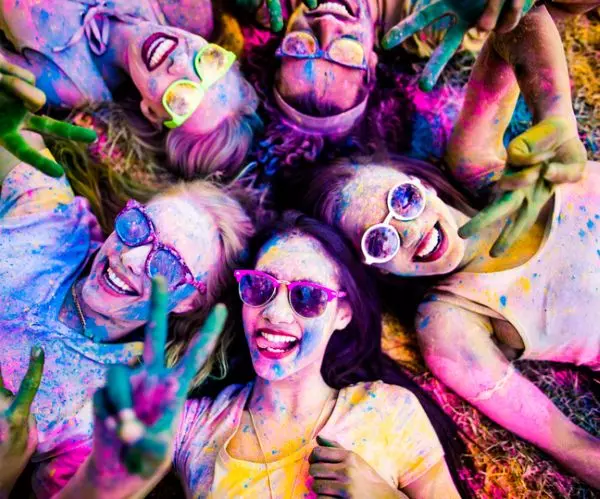
The shift goes beyond setting boundaries to ensuring sustainable practices and being socially responsible. Many are beginning to question how to preserve the spirit of Holi while reducing its unintended impact on health and the environment. Photo: iStock
The shift goes beyond choosing personal comfort and setting boundaries to ensuring sustainable practices and being socially responsible. Many are beginning to question how to preserve the spirit of Holi while reducing its unintended impact on health and the environment.
“A sustainable Holi goes beyond simply choosing organic colours,” says Sania Jain, a 26-year-old law student from Mumbai. “It’s about the larger choices we make — carpooling [to go to the party] or using public transport to get around, supporting local vendors and small businesses, cooking at home instead of over-ordering, and choosing gifts that are plastic-free. Sustainability isn’t a single action; it’s a mindset that shapes the entire celebration.”
For some it means cutting out on excessive use of water — and therefore the use of buckets, hoses, water pistol and balloons — and playing with dry colour instead.
Alcohol-free Holi celebrations are steadily gaining popularity among this group. For many young people today, sobriety is not restrictive — it is intentional. “Choosing to celebrate without alcohol allows gatherings to feel more inclusive across age groups and reduces the risk of unsafe situations [such as drunk driving or alcohol-induced misbehaviour]. For us, being fully present — not intoxicated — is what truly elevates a celebration,” adds Sania.
Also read: In India, why being vocal about relationships is not easy for adolescents in love
Event planners, too, are increasingly being careful of such preferences, curating celebrations keeping today’s woke crowd in mind. “Safety is our highest priority, with special emphasis on overall crowd management and women’s security. We undertake extensive pre-event planning to ensure smooth operations on the event day,” says a spokesperson for Lunaastar, an event management company, which also organises Holi parties.
He adds: “Our security framework includes multiple entry and exit gates for controlled crowd movement, thorough security checks at entry points, deployment of trained male and female security personnel, well-planned venue infrastructure to avoid overcrowding and dedicated monitoring and supervision teams throughout the event. Additionally, we ensure that only skin-safe, high-quality colours are permitted within the venue to maintain hygiene and guest well-being. Our objective is to create a secure, enjoyable, and responsibly managed celebration for everyone attending.”
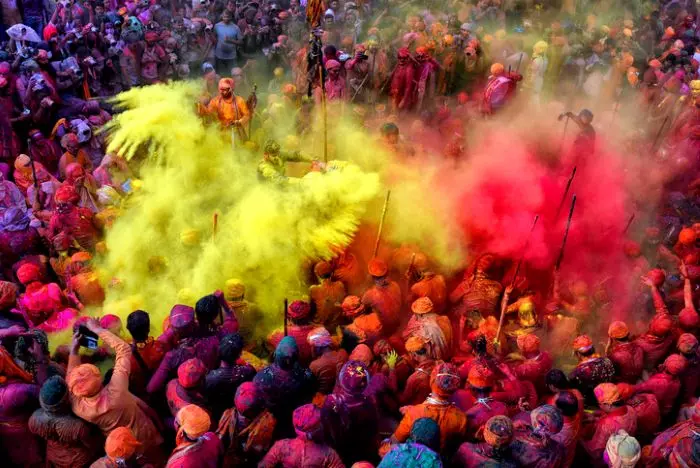
Event planners, too, are increasingly being careful of youth preferences, curating celebrations keeping today’s woke crowd in mind. Photo: iStock
Even people in traditional Holi hubs, known for their massive, crowded celebrations, are becoming conscious of the shift in popular mindsets.
Thirty-year-old Vrindavan resident, Raadhika Khetarpal, a culture entrepreneur, concedes that she understands why “people say Vrindavan’s Holi is intense. It is emotional, immersive, and far from curated, yet it remains one of the most photographed celebrations. The ten days of Holi in Braj are an expression of lived devotion unfolding with the blessings of Radha and Krishna. That’s the soul of Braj ki Holi. But yes, not to miss that it’s super crowded and such spaces can feel overwhelming, especially when visitors unfamiliar with the traditions step in”. She adds: “But Vrindavan’s core emotion is not chaos — it is bhaav, pure devotional feeling.”
Meanwhile, the millennials, who have spent years adjusting to the fervour of “bura na mano holi hai”, are now taking a leaf out of the book of the next generation to celebrate in a quieter, more mindful way.
“Road safety is a serious concern. Intoxicated driving, throwing colours or balloons at strangers, and loud nuisance create unnecessary risk. Also, consent is important; celebration should never come at the cost of someone’s comfort or boundaries,” says Talwaar.
As in the past many years, he will be celebrating the festival with his ‘gang’. “It feels safer, more organised, and one has better control over how the day unfolds. It’s also less chaotic and more about bonding, enjoying conversations, and celebrating in a comfortable space.”
And over thandai — that quintessential Holi beverage of chilled milk and dry fruits — if someone does burst into a ‘Rang Barse’, or that Darr hit, ‘Ang se ang lagana’, there will be no discomfort, as no unfamiliar faces will be hiding under the layers of colour.
(With inputs from Abhishek Rawat)