Why a 7-year-old’s prayer to Shiva has a lesson on restraint and accountability for adults
Back from a road trip through Gujarat with her son, a mother writes of the beauty she encounters, of people travelling for miles for faith and the omnipresent signs of human abuse of environment. “What's the point of entering a clean temple after dirtying the earth that leads to it?” she asks.

This winter, I travelled through Gujarat with my seven-year-old son, tracing long stretches of India’s western coastline along the Saurashtra peninsula. The plan was not pilgrimage but proximity to the sea — ports, beaches, small towns, highways running parallel to salt pans and fishing villages. Saurashtra was not a destination so much as a passage, one coastal edge flowing into...
This winter, I travelled through Gujarat with my seven-year-old son, tracing long stretches of India’s western coastline along the Saurashtra peninsula. The plan was not pilgrimage but proximity to the sea — ports, beaches, small towns, highways running parallel to salt pans and fishing villages. Saurashtra was not a destination so much as a passage, one coastal edge flowing into another.
The stretches between cities were long and open, but the cities themselves were anything but sparse. Streets spilt outward — crowded, alive, chaotic, where faith and commerce flowed together. The sea brought salt-laced wind and human presence felt more insistent.
It was only when we reached Dwarka, a town part of the ‘Char Dham’ Hindu pilgrimage circuit — four spots at four corners of the country, the other three being Badrinath in Uttarakhand, Puri in Odisha and Rameswaram in Tamil Nadu — that the conversation turned inward. Somewhere near the Dwarkadhish temple, dedicated to the Hindu deity Krishna, my husband began explaining the Hindu trinity to our son: Brahma, the creator, Vishnu, the preserver and Shiva, the destroyer.
As these stories often do, they invited questions. Why does Shiva destroy? Who decides when destruction is necessary? And then the question that has hovered over centuries of belief: who is Vishnu’s tenth avatar?
Kalki, said my husband, the one who has not yet come.
Outside the Dwarkadhish Temple, we stopped for tea at a small stall just beyond the main entrance. The chaiwala moved with the ease of repetition — boiling, pouring, stirring — his day measured not by clocks but by crowds. He told us he serves tea till one in the morning and starts again by five-thirty. Pilgrims never really stop, he said. Gods may rest; cities do not.
As he handed us our cups, he spoke almost casually. “Bahut log aate hain [Many people come],” he said. Then, after a pause, he added, “Par kisi ne kabhi nahi poocha ki mandir band hone ke baad, sadak kaun saaf karta hai? [No one has ever asked who cleans the streets after the city sleeps].”
The question lingered, unanswered, like the cups drying beside him.
Also read: Why Delhi moms across economic and social groups are losing out to a common fear
A day after Prime Minister Narendra Modi’s visit to Somnath earlier this month, we reached the temple town ourselves. Somnath is not merely a site of faith; it is a civilisational memory. Rebuilt repeatedly after destruction, it does not promise permanence. It accepts cycles. Hindu philosophy does not deny collapse — it contextualises it. Creation, preservation, dissolution — srishti, sthiti, pralaya — are not events but rhythms.
As we walked along the temple complex by the Arabian Sea, I asked my son what he had prayed for. He answered without drama. “Dear Shiva, please don’t destroy the Earth. Don’t be angry.”
That prayer refused to leave me.
That evening, by the sea, he asked me, “Are we evil? Do we also have a Bhasmasura [a demon, who according to Hindu beliefs could burn anyone who touched his head to ashes] inside us — for being so bad to God’s earth?” After a pause, he added, “If no one cares, how will God fulfil our wishes?”
I didn’t have an answer ready.

The beaches were spotless, but the parking lots told another story: plastic bottles, food wrappers, disposable cups scattered around blue and green dustbins that remained conspicuously empty. Water sports thrived offshore. Photo: Namrata Yadav
A few months ago, I had taken my son to Ganga’s Curse, a storytelling session. Since then, Hindu mythology has unfolded in his mind as a kind of multiverse. What fascinates him most is how gods are tied to animals and nature. Ganpati matters because “elephants are Mamma’s favourite”. Hanuman ji matters because, as he tells me simply, he loves monkeys. Gods, for him, are living presences, not mere abstractions.
In Hindu thought, Shiva does not destroy out of rage. He destroys when imbalance becomes unbearable — when preservation itself becomes violence. Destruction is not cruelty; it is correction. Shiva arrives when humans refuse to correct themselves.
Climate change, then, does not feel like a scientific abstraction or a policy failure. It feels like a moral one.
Also read: Why Delhi moms fear their children are becoming collateral damage to the city's smog apathy
Our road trip had been, in part, an attempt to escape, even if for a few days, Delhi’s toxic air — air so thick in winter that children learn the meaning of air quality index (AQI) before they learn the names of trees. Gujarat felt better, yes, but unevenly so. Around Dwarka, near salt factories and the stretch towards Beyt Dwarka, the air thickened again. The sea breeze offered momentary relief, compensating, once more, for human excess.
The beaches themselves were spotless, proudly carrying Blue Flag status; an international award for beaches, marinas and sustainable tourism boats that meet environmental criteria, among others.
The parking lots told another story, however: plastic bottles, food wrappers, disposable cups scattered around blue and green dustbins that remained conspicuously empty — not for lack of infrastructure, but for lack of use. Water sports thrived offshore, engines cutting through waters considered sacred. One wonders where the fuel, oil, and residue eventually settle, certainly not into abstraction.
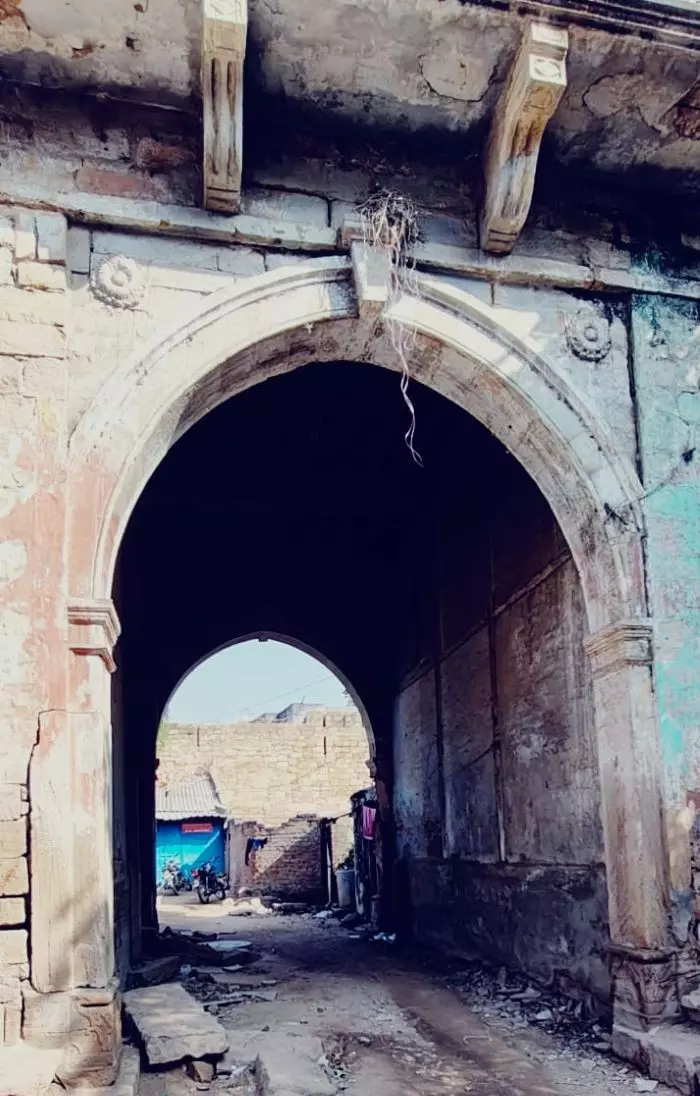
Bylanes of Surendranagar. Gujarat, like much of India, is a sensory explosion. Turn a corner and history announces itself without ceremony; on walls, in street alignments, in arches that still remember hands and tools. Photo: Namrata Yadav
And yet, despite everything, it was all so beautiful.
This is the part often lost when we speak only in the language of crisis. Gujarat, like much of India, is a sensory explosion. Turn a corner and history announces itself without ceremony; on walls, in street alignments, in arches that still remember hands and tools. Beauty is not curated here; it is scattered. You walk through it, often without pause.
There is so much we have been left — to see, to marvel at, to wonder over, to learn from. And yet the question intrudes: when we inherit so much layered beauty, what exactly are we preparing to pass on? Memory — or multi-level parking?
Also read: Nearly six months after flash floods wreaked havoc in Dharali, why locals are yet to move on
Across towns and highways, faith appeared everywhere. People travelled for miles, many walking barefoot through streets, feet navigating plastic-strewn roads, oil marks, and pan-stained pavements with devotion. The sight was humbling and unsettling at once.
What is the point of entering a clean temple after dirtying the earth that leads to it?
How does pollution become spiritual merely by crossing a threshold?
I am nobody to question faith. But I am everybody to ask: which god supports dirtying the Earth to the point of destruction?
In Hindu thought, nature is not separate from the divine. Shiva lives in forests and mountains, smeared with ash. Vishnu rests on cosmic waters. Ganga, herself a Hindu deity, descends to earth through the matted hair of Lord Shiva. Vayu is breath. Agni is fire. Prithvi is ground. These are not metaphors; they are sacred presences.
And yet, we behave as though nature is expendable, external, endlessly forgiving.
At the heart of the Champaner–Pavagadh UNESCO heritage site stands the Jami Masjid — an architectural confluence of Hindu, Jain and early Islamic traditions. The space is calm, almost austere. The stone is clean. The courtyard uncluttered. Walking through it feels like entering history that has been allowed to breathe.
A local guide walked with us, pointing out the architecture and explaining how the site grew in significance over centuries. But then, almost in the middle of explaining a carving, he said quietly: “Log yahan zyada nahin aate — log mandir ke liye zyada aate hain. Isliye upar parking bana rahe hain. [Fewer people come to see sites like the mosque; more come for the temple at the hilltop. That’s why multi-level parking is being built].”
Not far from the mosque rises the Pavagadh Hill, crowned by the Kalika Mata temple. Pilgrims climb barefoot up the narrow hill road, while diesel taxis idle along the incline, engines humming. Faith spills outward — urgent, embodied — yet the hill itself is being carved away to make space for multi-level parking.
When belief requires the removal of the mountain that holds it, one has to ask: what exactly is being preserved?
My son declared the historical ‘Atak Gate’ his favourite part of Champaner. He stood at the zig-zag entrance, imagining soldiers struggling to enter, horses slowing down, battles unfolding. Then he noticed the scribbles on the walls — names scratched into stone that had survived centuries. “Why do people write on something so beautiful?” he asked.
Again, I had no answer.
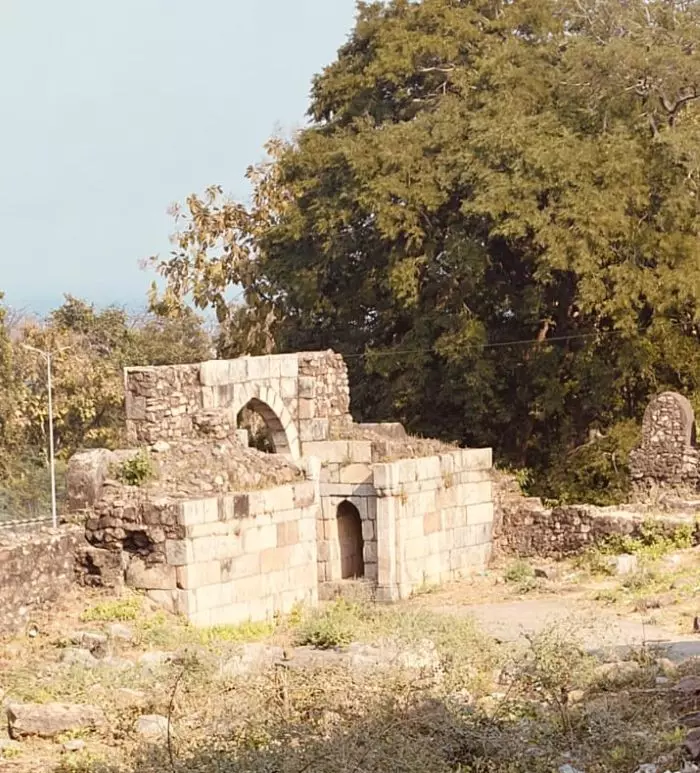
My son declared the historical ‘Atak Gate’ his favourite part of Champaner. Then he noticed the scribbles on the walls — names scratched into stone. “Why do people write on something so beautiful?” he asked. Photo: Namrata Yadav
Then we arrived at Sasan Gir national park.
The roads leading into the forest are immaculate, almost startling in their order. Before every safari, eco-guides repeat the rules — patiently, almost ritually: no single-use plastic, no littering, no loud noise, no disturbance. Conservation here is not assumed; it is enforced through memory.
All the guides belong to Sasan village, living just outside the forest boundary, in quiet alignment with it. They work in unison with the forest, its animals, and the Maldhari pastoral tribes who have lived here for generations, sharing space with lions while tending their livestock. There is no romance in this coexistence, only practice.
In Gir, our eco-guides, Vinod Bhai and Aniket Bhai, became our eyes and ears in the forest. Not just escorts through terrain, but men shaped by it. We spent hours with them, stopping often, learning to slow down. Vinod Bhai explained why the saal tree grows differently here than in northern forests, how soil, water, and grazing patterns shape resilience itself. Aniket Bhai taught my son how to birdwatch without chasing. Rukna seekho pehle. Learn to pause first.
Despite being keepers of animals themselves, the Maldharis understand something modern conservation still struggles to teach: coexistence without entitlement. “Jungle unka ghar hai. Hum unke ghar mein hain. [The jungle belongs to them, the animals. We are in their home],” one guide tells us quietly, not as a slogan but as fact.
And yet, even here, care shows its cracks.
Inside the forest, tourists crane their necks, cameras poised, hungry for proof — a selfie with the lion becomes a quiet obsession. The guides remain alert, restrained, almost protective, not of spectacle, but of space. Conservation does not collapse through ignorance. It erodes through casual entitlement.
That erosion became visible suddenly. A tourist vehicle slowed ahead of us. A plastic bottle flew out and landed near the track.
Vinod Bhai asked the man to stop, warning him of a fine. The man laughed. “Parchi dikhao [Show me the receipt]’.”
Later, Vinod Bhai spoke with quite diffidence. “Jab hum bolte hain, log bolte hain ‘parchi dikhao’. Hum kya karein? [When we ask people to follow rules, they question our authority. What can we do?]”. People don’t come here to experience the forest, he said, not the air, not the silence, not its people. “Bas sher ke saath selfie [Just a selfie with the lion].”
Also read: How residents of Udhampur’s Tirshi village have lived since losing homes in September landslide
From Surendranagar to Porbandar to Bhavnagar, my son walked long stretches of city streets. He tiptoed instinctively, dodging spit, plastic wrappers, oil stains, like navigating a video game or a field of landmines.
Walking through Porbandar and Rajkot, past Kaba Gandhi No Delo, the irony sharpened. We remove our shoes before entering homes, shops, even banks. We respect interiors. And yet our streets — the most shared spaces we have — are treated as disposable. Gandhi taught that cleanliness begins with the self but extends to the community; caring for shared spaces is as much moral discipline as caring for one’s own home. Are streets not shared homes? Is public space not moral space?
At Bhavnagar, my son had asked again, this time pointing at a wall stained red.“Why do people spit so much?” “Why do adults do things they tell children not to do?” As a parent, I realised what unsettled me most wasn’t the question itself, but the honesty behind it. Children notice the gap long before adults are willing to name it.
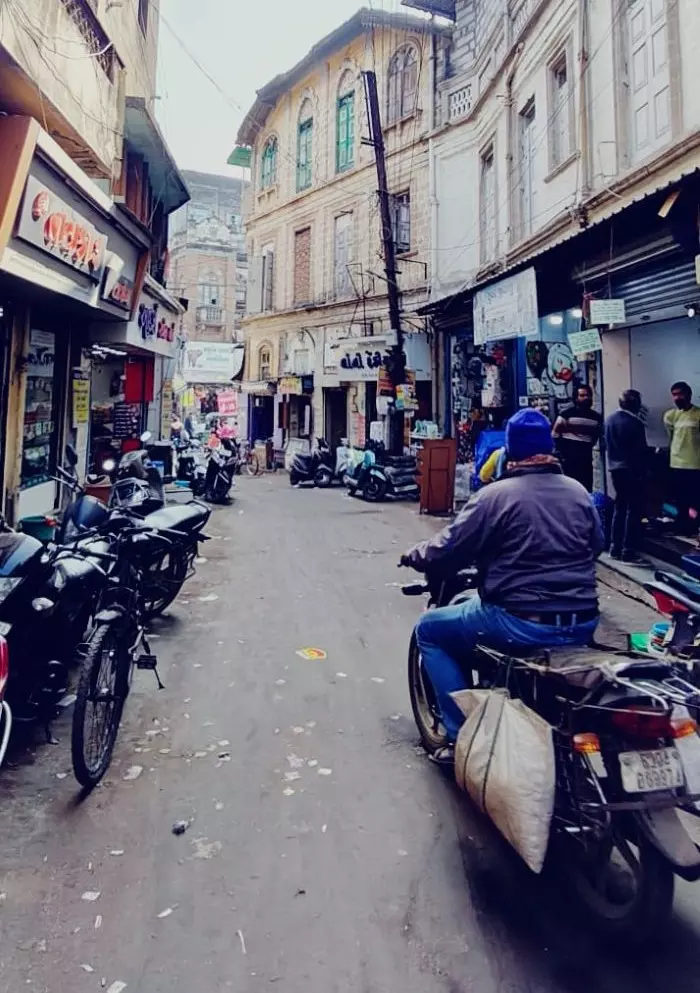
Market lanes, Bhavnagar. From Surendranagar to Porbandar to Bhavnagar, my son tiptoed through the city streets, dodging spit, plastic wrappers, oil stains, like navigating a video game or a field of landmines. Photo: Namrata Yadav
Across faiths, the message converges. In Islam, humans are khalifa — guardians, not owners. In Christianity, creation is entrusted, not consumed. In Buddhism, harm to nature is harm to self. No religion grants moral permission to destroy and then pray.
The Isha Upanishad says, “Īśāvāsyam idaṁ sarvaṁ yat kiñca jagatyāṁ jagat. [All that exists in this universe is enveloped by the divine].”
Cleanliness is not symbolic — it is ethical. A clean temple beside a polluted street is not devotion; it is denial.
Children already understand what adults resist acknowledging. A seven-year-old knows that if the Earth collapses, nothing survives — not gods, not governments, not growth. My son’s prayer was not for success or protection. It was for restraint.
Perhaps the tenth avatar will not arrive on a white horse. Perhaps Kalki looks like a child asking adults to stop. And perhaps Shiva does not need appeasement, only accountability. Because the Earth does not need saving from gods. It needs saving from us.