- Home
- India
- World
- Premium
- THE FEDERAL SPECIAL
- Analysis
- States
- Perspective
- Videos
- Sports
- Education
- Entertainment
- Elections
- Features
- Health
- Business
- Series
- In memoriam: Sheikh Mujibur Rahman
- Bishnoi's Men
- NEET TANGLE
- Economy Series
- Earth Day
- Kashmir’s Frozen Turbulence
- India@75
- The legend of Ramjanmabhoomi
- Liberalisation@30
- How to tame a dragon
- Celebrating biodiversity
- Farm Matters
- 50 days of solitude
- Bringing Migrants Home
- Budget 2020
- Jharkhand Votes
- The Federal Investigates
- The Federal Impact
- Vanishing Sand
- Gandhi @ 150
- Andhra Today
- Field report
- Operation Gulmarg
- Pandemic @1 Mn in India
- The Federal Year-End
- The Zero Year
- Science
- Brand studio
- Newsletter
- Elections 2024
- Events

How residents of Udhampur’s Tirshi village have lived since losing homes in September landslide
While Udhampur was among the worst-hit districts in the deluge that hit J&K in Aug, in Tirshi, a single neighbourhood lost 103 houses in the landslides that followed in Sept. With the onset of winter, displaced families desperately await financial assistance from govt to rebuild their lives.

Travelling from Shiv Nagar, in Jammu and Kashmir’s Udhampur, to Kainthgali village in the same district — a distance of approximately 18-20 kilometres — a little signboard on the left of the road directs commuters to the Tirshi Panchayat Ghar to the right.Unfortunately, while the signage still exists, neither the panchayat ghar nor much of the village of Tirshi could survive the...
Travelling from Shiv Nagar, in Jammu and Kashmir’s Udhampur, to Kainthgali village in the same district — a distance of approximately 18-20 kilometres — a little signboard on the left of the road directs commuters to the Tirshi Panchayat Ghar to the right.
Unfortunately, while the signage still exists, neither the panchayat ghar nor much of the village of Tirshi could survive the heavy rainfall which lashed across Jammu and Kashmir in August-September, bringing in its wake floods and landslides.
“Ever since, we have been living in these tents” — provided by the district administration as temporary relief measures — said 35-year-old Dev Raj, who used to work as a driver before the calamity hit, but has been forced to accept odd jobs as labour in nearby villages since, apprehensive of leaving his family alone at the tent for long durations of time.
“I cannot work in Udhampur or Jammu towns, exposing my family members living in these flimsy tents to the risk of getting attacked by wild animals,” he said. Tirshi has a history of people being attacked by boars, leopards, and other wild animals.
Whereas earlier Dev claimed to have earned Rs 22,000 a month as a driver, he said he now made only Rs 500-700 a day, even when he did manage to get work. The reduced earnings have hit the family — which includes him, his wife and three children — hard, as he claimed to have already lost their house and 28 kanals and four marlas (approximately 3.5 acres of agricultural land) owned by the family, in the deluge and landslide.
Recalling the events of September 1, when the land started sinking in Tirshi following the past few days of incessant rain, Raj said the family was inside their tin-roofed house when they heard screams from people uphill, where a landslide in 2022 had caused part of the ground to cave in, damaging four houses. Sensing imminent threat to the downhill settlement, Raj and his neighbours moved their families, cattle and what belongings they could to a safer area in Tirshi, when there was a momentary respite from the rains.
“But as the rains continued to batter down for the next few days, many of the houses were damaged and agricultural land washed away. While the women, children and elderly spent September 1-3 [the period when houses and land in Tirshi were lost] at the homes of relatives in the nearby villages of Door, Gandala and Kiramchi, the men of the village spent three nights in the open, guarding their cattle and other belongings,” recalled Raj.
He added: “As news of the calamity in Jammu and Udhampur spread on social media, social sector workers started coming to the villages from September 3, offering cooked meals, quilts and clothes. Officials from the district administration arrived in Tirshi on September 4, taking stock of the damage and setting up tents for those who had lost their homes. While a few tents were put up in the village itself, some were set up 500 metres away, in Door.” According to Surinder Kumar, the village patwari (revenue official), the district administration provided 10 tents at Tirshi and seven in Door, accommodating as many as 17 families.
The rest of the affected families from the village have either taken refuge in the houses of relatives in nearby villages or are living in rented properties in Udhampur town or the capital city of Jammu, say locals.
Also read: Why Hurricane Melissa is a wake-up call on how a warming climate can intensify natural disasters
Over three months later, Raj’s family and a handful of others from the affected areas continue to live in the tents, even as the onset of winter has seen nighttime temperatures plummet to as low as three to four degrees Celsius here.
“We lay as many rolls of bedding as we can on the ground and cover ourselves with thick quilts, but the bone-chilling cold still continues to seep through the ground. It is very difficult to endure. The health of children and the elderly is at greater risk, since they are more vulnerable,” said Raj.
Replying to a question raised by the Bharatiya Janata Party (BJP) legislator from the Ramnagar Assembly Constituency (in Udhampur district), Dr Sunil Bhardwaj, in a session of the Jammu and Kashmir Legislative Assembly in October, the Union Territory (UT) government stated that according to a joint survey conducted by the revenue, agriculture, horticulture and animal husbandry departments, the heavy rains and flash floods in Udhampur district damaged a total of 9,471 houses, either fully, severely, or partially. Besides, 14,443.57 hectares of agricultural land were also affected in the town, with 2,123 livestock also reported to have perished.
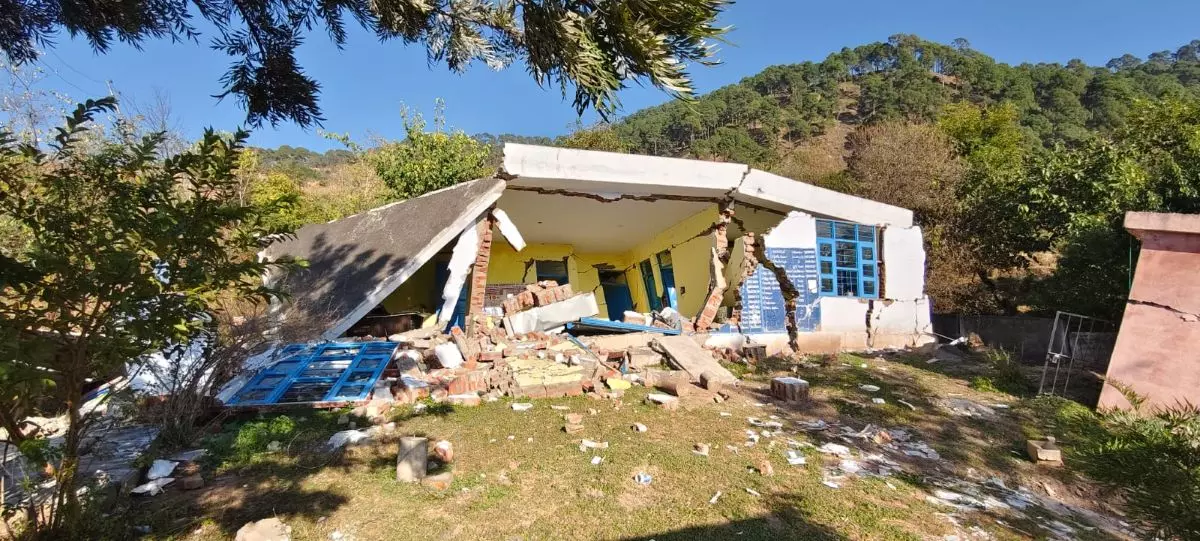
The Tirshi panchayat ghar, damaged in the landslide. Photo: Bivek Mathur
Udhampur and Jammu were among the worst-hit in the UT in the August-September deluge, with Udhampur reportedly witnessing a record rainfall of 629.4 mm on August 27— almost equivalent to Delhi’s entire monsoon rains. This left a trail of destruction across the district, with loss of lives and extensive damage to public and private property. According to revenue officials, some 700–800 kanals of state land (approximately 100 acres), approximately 350 kanals of private land (about 44 acres) and 250 kanals of forest land (31 acres) were affected in the disaster at Tirshi, with 103 houses also damaged — either fully or partially.
While other villages of Udhampur also suffered damages, in Tirshi, the severity of the impact was probably intensified by the localised nature of the impact — all 103 houses damaged in the rains were from a single neighbourhood, claim locals, identified as the “main market area” of Tirshi.
The J&K government, while responding to the question raised in assembly, had stated that an amount of Rs 16.50 crore had been sanctioned in favour of the affected families in the UT for damage to houses and property, under the norms of the state and national disaster response funds (SDRF/NDRF). Relief assistance in the form of tents, tarpaulins and dry ration had also been extended, it stated. Tirshi residents alleged, however, that they are yet to receive any monetary support from the authorities.
Under SDRF norms, Rs 1,30,000 is provided for fully/severely damaged houses, Rs 6,500 is given for the partially damaged pucca house, and Rs 4,000 is paid for the partially damaged kutcha house.
But the alleged delayed disbursal of funds has made it difficult for the victims to attempt any effort at rebuilding their lives, claimed those from Tirshi The Federal spoke to.
Sixty-year-old Bal Krishan, who retired as a forest guard in September, has been living in a single-room forest department quarter in Sailan Tallab area of Udhampur town, provided to him by his senior officers on humanitarian grounds, since his house in Tirshi was damaged in the rains. The quarter is shared by his wife, a married son, two other sons who are yet to be married, his daughter-in-law and two grandchildren.
“I was provided this quarter after I discussed my plight with the senior officers. They assured me accommodation for a limited period of time. I don’t know when we will have to vacate this,” he fretted.
Despite the relief of having a roof over their heads, however temporary, the family was struggling to make do in the restricted space.
“It is very difficult for seven to eight people to live in a single-room quarter,” Krishan admits. Having lost around 35 kanals (4.375 acres) of agricultural land owned by them in the village, he added, “we have to purchase everything from the market here”, which is a drain on their already limited resources.
According to him, the administration had yet to provide any financial assistance to them.
His plight was shared by 35-year-old Raj Kumar, a carpenter by profession, who has been living with his wife and young son in a single-room rented accommodation since the Tirshi disaster, while some members of his family have been staying at the house of a relative in Door.
“I cannot afford to rent a house for everyone on my meagre income, so until we receive any financial assistance from the administration, we have to make do like this,” he said.
Both Krishan and Kumar claimed J&K Lieutenant Governor Manoj Sinha had assured the affected families of providing fabricated residential structures for rehabilitation, but “land for it was yet to be identified”.
Also read: Punjab floods: How Ravi’s fury, embankment collapse brought calamity to farmers
Meanwhile, the plight of those in the tents was worse, as they got little protection from the extreme cold.
According to 31-year-old Satya Devi, whose husband, Madan Lal, worked as a labourer, some 70–80 individuals, including elderly citizens and school-going children, were currently living in the tents.
“Only we know what we have endured. When strong winds coupled with heavy rain [in the days following September 3] rip through our shelters and leave our children and elders crying in fear, all we feel is helplessness and humiliation,” she said.
According to Satya Devi, stronger and more durable tents were provided by the administration in the last week of October, which brought some respite, but now, with the onset of winter, the tent-dwellers are back to battling the elements.
“We have no beds in these tents and have to sleep on the ground. The cold seeps up from the ground, making the ailing and children vulnerable. Sometimes, we have to wake up in the middle of the night to give them hot water bottles and extra quilts,” she said.
Satya added: “If the administration truly believes these tents are fit for living, we challenge the officers to spend just one night here with us—along with their children and elderly parents. Only then will they truly understand our pain.”
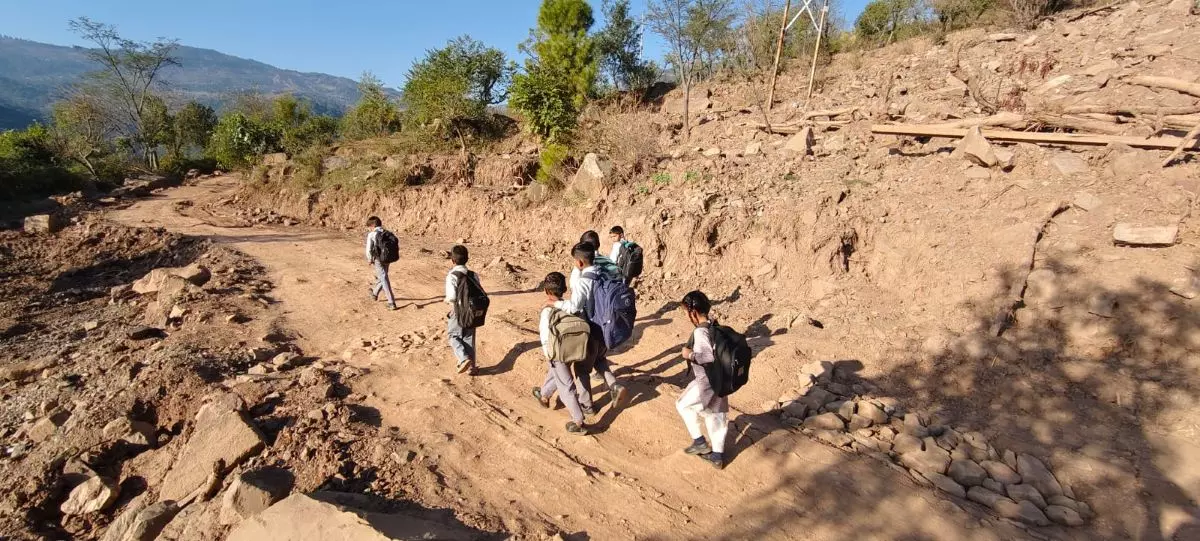
Children make their way to school through a deserted part of Tirshi, following the landslide. Photo: Bivek Mathur
Apart from having to battle the vagaries of weather, there are other issues to living in the tent.
While the administration has provided a temporary electricity connection to the tent dwellers, sanitary conditions remained poor, with those living at the Tirshi tents having to relieve themselves in the open; those at the Door tents meanwhile, were using the toilets at the nearby government school.
Acknowledging that the tents provided earlier were not strong enough to withstand strong winds, patwari Kumar pointed out that the administration has now provided the affected families with a third set of strong and durable tents.
He added: “The owners of the private land and damaged houses will be compensated under the SDRF norms by the district administration under three slabs—‘fully damaged/severely damaged house’, ‘partially damaged pucca house’, and ‘partially damaged kutcha house’.”
Meanwhile, district development commissioner, Saloni Rai, had told The Federal in November that the Tirshi residents would receive aid within days. “Those affected in districts such as Basantgarh, Latti, Dudu, Panchairi, and Moungri, among other areas, were given priority, as those regions get colder,” she said.
The Federal had also reached MLA Pawan Gupta, who represents the Udhampur (West) constituency in assembly for comment, but received no response. The article will be updated if a response is received.
Also read: How encroachment turns Yamuna floods into Delhi’s cycle of displacement
With compensation yet to reach, many of the poorest families in the tents claimed they have had to sell off their cattle to make ends meet.
Gullan Devi, 76, who claimed to be suffering from a heart ailment, was among those from Tirshi who had been accommodated in tents at Door. According to her, she and several other families who were in deep financial crisis owing to the loss of homes and lands, had to distress sell their cattle to meet their needs.
“Like my late husband, Kishan Ram, my son, Balbir, is also a labourer. I am a heart patient who needs regular medication. Who would have paid for these expenses if I had not sold my cattle? I had to,” says Gullan, who has been living in the tent with her son, daughter-in-law and an unmarried daughter.
According to her, the family has sold around four to five milch cattle, including cows, buffaloes, and goats. Usually, a buffalo is sold for Rs 50,000–1,00,000, while a cow is sold for Rs 30,000–1,00,000 and goats and sheep for Rs 7,000–25,000. However, owing to distress selling, they have now let go of buffaloes for Rs 30,000–40,000, cows for Rs 10,000–30,000, and sheep and goats for just Rs 3,000–5,000, claimed locals.
With no end in sight to their plight and the excruciating cold adding to their predicament, another elderly tent dweller voiced the collective anxiety of the Tirshi residents made homeless by the natural disaster — “without the promised financial help from the government, we will possibly die in these tents” — a reflection perhaps on the uncertainty over the duration of their stay in the tents, as well as their inability to reclaim their lives without administrative support.