- Home
- India
- World
- Premium
- THE FEDERAL SPECIAL
- Analysis
- States
- Perspective
- Videos
- Sports
- Education
- Entertainment
- Elections
- Features
- Health
- Business
- Series
- In memoriam: Sheikh Mujibur Rahman
- Bishnoi's Men
- NEET TANGLE
- Economy Series
- Earth Day
- Kashmir’s Frozen Turbulence
- India@75
- The legend of Ramjanmabhoomi
- Liberalisation@30
- How to tame a dragon
- Celebrating biodiversity
- Farm Matters
- 50 days of solitude
- Bringing Migrants Home
- Budget 2020
- Jharkhand Votes
- The Federal Investigates
- The Federal Impact
- Vanishing Sand
- Gandhi @ 150
- Andhra Today
- Field report
- Operation Gulmarg
- Pandemic @1 Mn in India
- The Federal Year-End
- The Zero Year
- Science
- Brand studio
- Newsletter
- Elections 2024
- Events

Why Delhi moms across economic and social groups are losing out to a common fear
In the national capital, ecological grief — mourning for a future we fear we are losing — is manifesting itself as pollution anxiety. And mothers are bearing the brunt of it. A nameless, faceless sorrow, it is heightened by the burden of daily choices to protect kids from an invisible adversary.

In New Delhi’s Rajouri Garden, Deepti Sethi, mother of a nine-year-old, sits in a room where the air purifier has become a permanent fixture since the city’s air quality index (AQI) started dipping around October, guilt gnawing at her. “I don’t sleep properly through winter [associated for the past many years with worsening air quality in the national capital],” she says....
In New Delhi’s Rajouri Garden, Deepti Sethi, mother of a nine-year-old, sits in a room where the air purifier has become a permanent fixture since the city’s air quality index (AQI) started dipping around October, guilt gnawing at her. “I don’t sleep properly through winter [associated for the past many years with worsening air quality in the national capital],” she says. “Especially in November [when the changing weather and air pattern, seasonal crop burning in neighbouring states and cracker-bursting during festivals and weddings create a spike in Delhi’s air pollution], my nights are spent checking AQI numbers and calculating the next day: should I send him to school or keep him home, put him on the bus or drive him myself? The stress of deciding is exhausting. I am constantly anxious about the long-term consequences.”
Deepti talks of chronic sleeplessness, mental fatigue and constant hyper-vigilance. The weight rarely lifts. “When he comes back with a cough or headache, I immediately think — ‘did I make the wrong decision today? Did I hurt him by sending him to school?’ Nobody asks what it takes to live like this. We’re just expected to cope,” she laments.
What Deepti is experiencing is what environmental researchers and activists have started describing as “pollution anxiety”, brought on by living three months every year under the blanket of heavy grey fog that usually begins to settle on the national capital sometime around October-November. Not a formal psychiatric diagnosis yet, it is a term rooted in lived experience and closely linked to concepts such as air-pollution stress, toxic stress, eco-distress, and environmental distress.
“Our social systems place women as primary caregivers, which means they bear the daily responsibility of managing the consequences of environmental collapse — from toxic air to unsafe water,” explains Dr. Fawzia Tarannum, a sustainability consultant. “When systems fail, the cost is paid inside homes and it is mothers who absorb that impact first. Policy must begin to see Delhi’s mothers not as passive beneficiaries of schemes, but as equal partners in environmental solutions — because they already carry the lived expertise of this crisis.”
Climate anxiety — the persistent helplessness born of living amid environmental collapse — is often imagined as something that belongs to activists, scientists, or children marching with cardboard placards. But in Delhi, the mental-health cost of ecological destruction is quietly making itself manifest at homes, at bus stops, in classrooms and in hospital waiting rooms. Psychologists describe this burden as ecological grief — a quiet, chronic mourning for the futures we fear we are losing. Nested within this is climate anxiety. And for many Delhi mother’s, “pollution anxiety” — the daily emotional grind of constant vigilance, the endless weighing of choices: whether to send a child to school, when to let them play outside, whether it is safe to open a window, all under the looming uncertainty of long-term health impact. It is the mental exhaustion of carrying the responsibility of protecting your child’s future without any control over what impacts it, of fighting an invisible threat with absolutely no power to stop it.
Also read: Why Delhi moms fear their children are becoming collateral damage to the city's smog apathy
Pollution anxiety doesn’t arrive with drama, doesn’t announce itself. It leeches into the body and our lives quietly — when the AQI app becomes the first thing one checks in the mornings, when a child coughs in the afternoon and when the burning in the throat in the evening makes one hyper-aware of the poison being inhaled. These aren’t moments; they are cumulative scars, layered until breathing itself feels like endurance.
Clinical and public-health research already recognises the overlapping conditions, including eco-anxiety and ecological grief. A 2017 report by the American Psychological Association and the US-based not-for-profit organisation ecoAmerica documented how climate-related environmental threats are linked to heightened anxiety, chronic stress, grief, loss of identity, and helplessness, particularly among vulnerable communities. More recently, a 2024 systematic review in the open-access, peer-reviewed journal BMC Psychiatry found that individuals reporting eco-anxiety showed significantly higher levels of psychological distress, anxiety symptoms, depression, and chronic stress.
In Delhi, this burden settles unevenly. The middle and upper-middle-class mothers rely on air purifiers, masks, sealed windows, and altered routines — temporary band-aids offering fleeting relief but little escape from the guilt and helplessness. For mothers on daily wages, there are no such buffers. Every day becomes an agonising calculation: earn today or care for a sick child; buy food or buy medicine; step into polluted streets or lose income entirely. There is no room for emotional processing, only endurance. Across these unequal realities runs the same invisible thread: responsibility without power. Pollution anxiety names the emotional toll — the constant vigilance, the compulsive risk-calculation, and deep exhaustion of trying to protect children from a threat no mother can outrun.
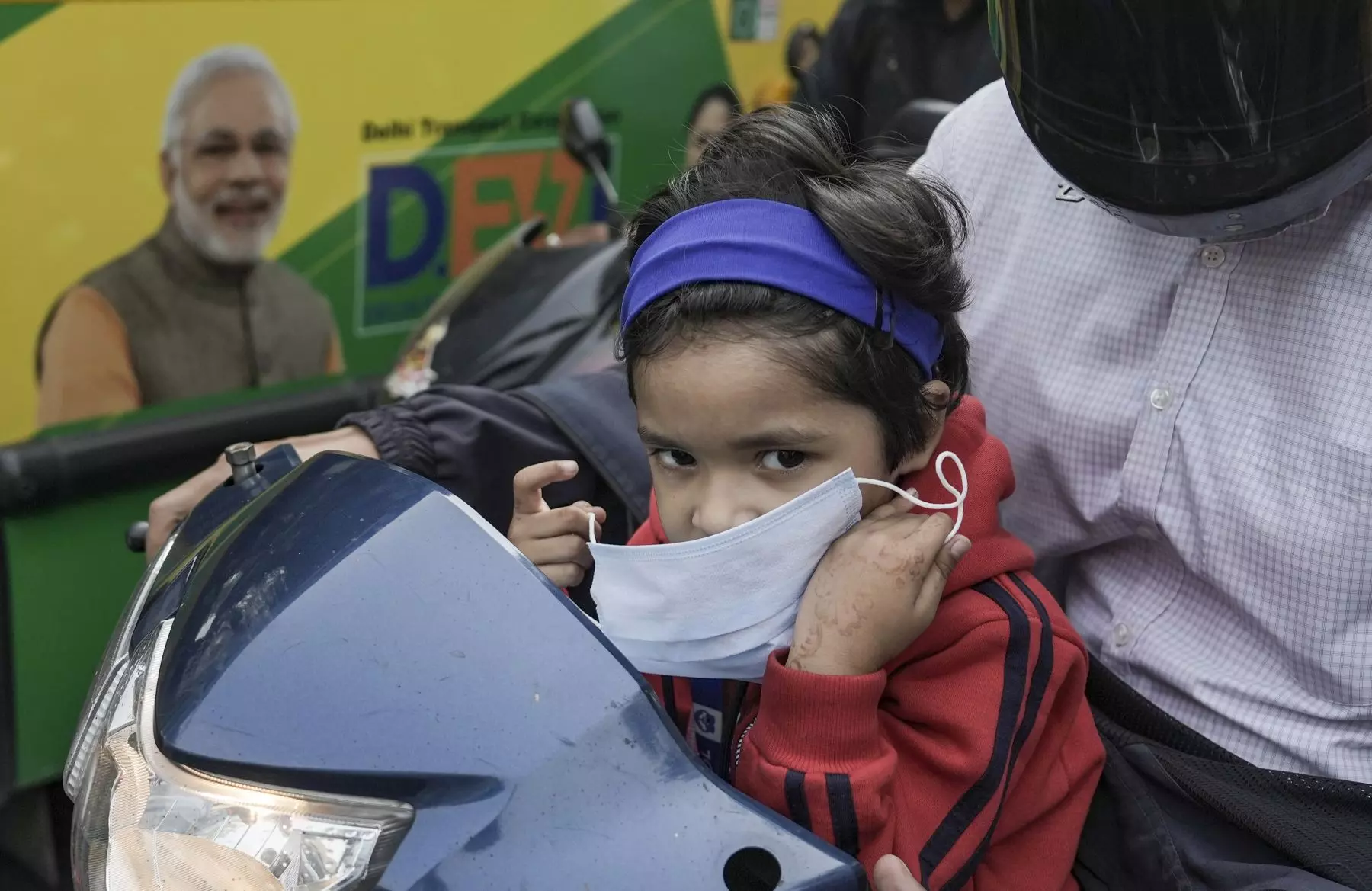
Mothers are showing the strain of protecting children without the means to truly protect them, carrying fear and guilt alongside their physical exhaustion. File Photo
Sunita (identified by first name only), earns a living ferrying bricks at a construction site. Constant monitoring of her children, mounting a vigil against the impact of air pollution on the kids, is a luxury she can’t afford. She shrugs when asked about her children falling sick: “Kya kare? Kamayenge nahi tho baccho ko kya khilayenge? [What do I do? If I don’t earn, what will I feed the children?]”
Meanwhile in a South Delhi residence, a mother who does not wish to be named, lives with thalassemia minor — a blood disorder that already compromises oxygen levels, making Delhi’s air an added, daily physical and psychological strain. “Since the AQI worsened [earlier in the year], the headaches never really go away,” she says. “There’s the constant sniffles, the coughs, even when we mask up.” Her home stays sealed against the smog. Air purifiers run day and night. She drives her sons to school to spare them increased exposure to the spike in PM2.5 (particulate matter with a diameter of 2.5 micrometres or less, a threat to air quality). Yet protection itself has become a source of emotional exhaustion.
“I feel like I’m failing my kids even when I’m doing everything I can,” she says. “I want to be part of the solution, not the problem.” The strain shows up not only in vigilance, but in persistent self-doubt and emotional isolation. “Sometimes I wonder if I’m overthinking — if I’m going crazy,” she admits. “Everyone seems to have normalised this, and I feel so alone.”
Also read: How this TN man has boosted community interest in mangroves, made crab-fattening a means to empower
Gayatri (identified by first name only) lives in Masoodpur and works as a house help, earning ₹12,000 a month. A migrant from Madhya Pradesh, who moved to Delhi hoping to secure better schooling for her two children, she wakes most mornings to the sharp smell of burning plastic and rubber in the air. Her children fall sick repeatedly — coughing, feverish, vomiting — and her younger child has been diagnosed with rickets. Each doctor’s visit and round of medicines pushes the family closer to the edge. Her husband drives an autorickshaw on daily wages, but even pooling their earnings barely covers food, rent, school fees, and treatment. “I feel tired and weak all the time now,” she says. “But if we don’t keep working, then how will we ever move ahead?”
The emotional weight runs deeper than physical fatigue. “Kabhi lagta hai sab chhod chhaad ke gaon chali jaaun,” she says. “Par kaise? Bachchon ka kya hoga? (I sometimes feel like running away, but how? What will happen to the kids?),” she questions.
Oddly, going to work becomes her only emotional release. “Madame meri baat sunti hain… dil halka ho jaata hai (Madame listens to me. Talking to her lightens my burden),” she says. At home, there is no space to speak — only the relentless circle of cooking, cleaning, worrying, and enduring. “Hawa bhi kharab hai, paani bhi kharab hai,” she says softly. “Bas bachchon ke liye yahan par hain. (The air is bad, the water is bad. I am only here because of the children’s future)”
For Gayatri, pollution anxiety is not something she can name — it is simply life: the constant strain of protecting children without the means to truly protect them, carrying fear and guilt alongside physical exhaustion, and learning to endure what she cannot change.
What Gayatri lives is not accidental – it is how our systems are structured.
Pollution grief doesn’t just corrode mood; it corrodes the mathematics of survival — every rupee becomes a choice between today’s food or tomorrow’s medicine. And as mothers watch their children struggle, grief becomes two-fold: enduring their own physical pain and mental exhaustion, while witnessing the very future they dream for their children being eaten away by the air they breathe.
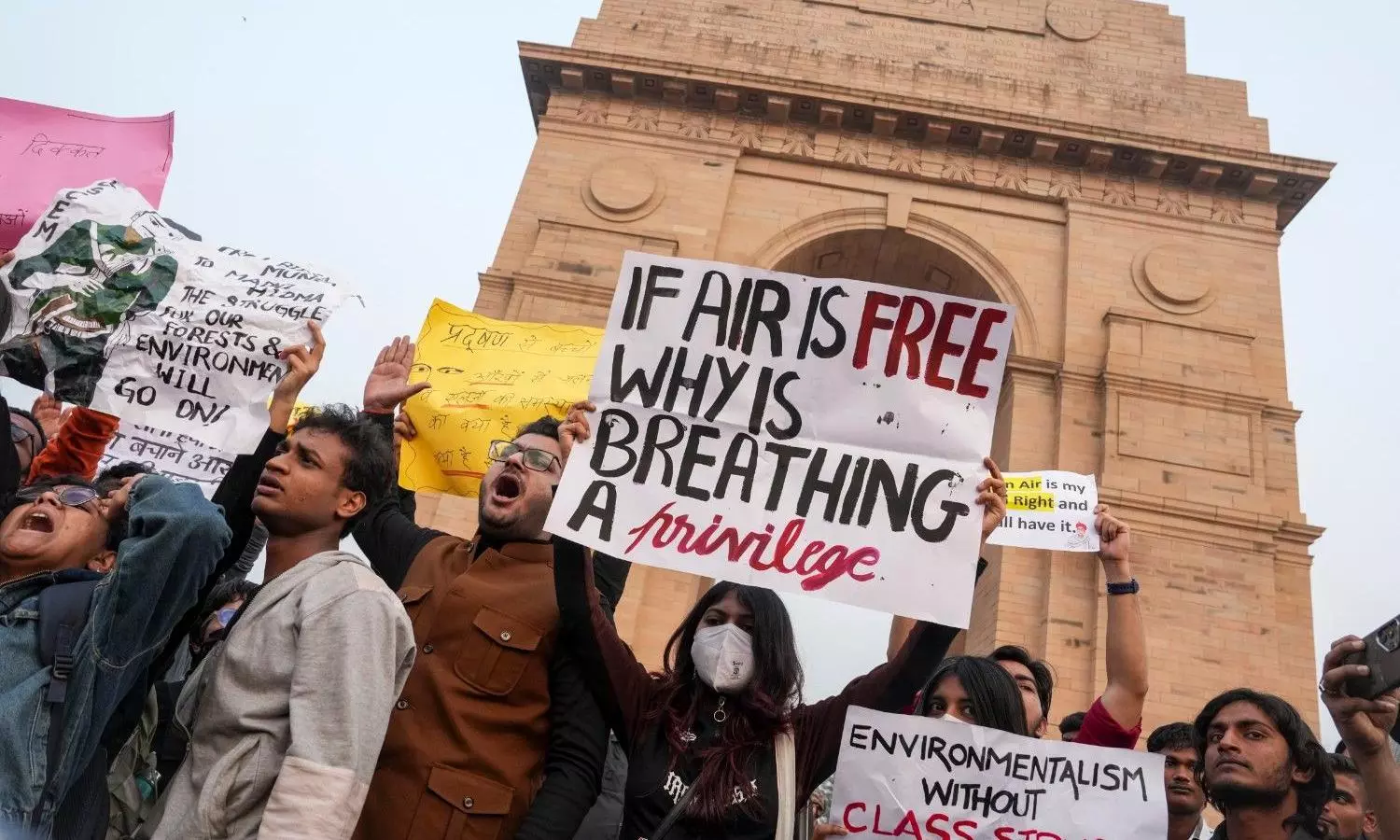
As mothers watch their children struggle, grief becomes two-fold, enduring their own physical pain and mental exhaustion, while witnessing the very future they dream for their children being eaten away by the air they breathe. File photo
Psychotherapist Nayamat Bawa explains it as an “anticipatory fear combined with grief for what is already being lost”.
She adds: “Guilt, denial, anger, and despair spill into everyday moments, even something as small as a child not listening. Mothers carry the constant emotional labour of making impossible choices day after day. Over time, this feeds directly into maternal ecological grief — a deep, often unnamed and unacknowledged mourning. Nothing about this childhood is normal; living with constant fear has become normalised for today’s children.”
This emotional burden manifests in a range of symptoms: sleep disturbances, chronic tension, fatigue, irritability, heightened anxiety, hyperawareness of environmental threats, avoidance and a persistent sense of helplessness, says Bawa.
“Because these stresses are relentless and beyond their control, many mothers gradually normalise the fear, suppress their emotions, and absorb the weight silently. Seeking help or support is still something we as a society struggle with. Layering on top of the daily stresses the additional burden of pollution — the invisible, persistent threat to their children’s health — makes this emotional load all the more complex and layered, particularly for economically vulnerable mothers,” she adds.
Also read: Why Hurricane Melissa is a wake-up call on how a warming climate can intensify natural disasters
But just because this heavy fear is unnamed doesn’t mean it isn’t real.
Bawa continues, “Pollution is a lived reality. We need to create spaces where these experiences can be named, explored, and shared. Acknowledging and talking about these feelings is a first step toward addressing eco-anxiety and maternal ecological grief. Many mothers now ask themselves whether they should bring a child into a world where they will grow up facing urban pollution trauma.”
Call it a climate crisis. Call it an air crisis. At its core, it is a mother’s crisis.