- Home
- India
- World
- Premium
- THE FEDERAL SPECIAL
- Analysis
- States
- Perspective
- Videos
- Sports
- Education
- Entertainment
- Elections
- Features
- Health
- Business
- Series
- In memoriam: Sheikh Mujibur Rahman
- Bishnoi's Men
- NEET TANGLE
- Economy Series
- Earth Day
- Kashmir’s Frozen Turbulence
- India@75
- The legend of Ramjanmabhoomi
- Liberalisation@30
- How to tame a dragon
- Celebrating biodiversity
- Farm Matters
- 50 days of solitude
- Bringing Migrants Home
- Budget 2020
- Jharkhand Votes
- The Federal Investigates
- The Federal Impact
- Vanishing Sand
- Gandhi @ 150
- Andhra Today
- Field report
- Operation Gulmarg
- Pandemic @1 Mn in India
- The Federal Year-End
- The Zero Year
- Science
- Brand studio
- Newsletter
- Elections 2024
- Events

Nearly six months after flash floods wreaked havoc in Dharali, why locals are yet to move on
The Aug 5 flash floods claimed an estimated 77 lives in Uttarakhand's Dharali, but families have been unable to dig out the bodies and conduct last rites for the deceased. Loss of assets and livelihood are other challenges. Meanwhile, experts warn against the cost of unregulated human activities.

A little over six years old, Atiksh Panwar, wears a near-perpetual forlorn look on his small face. Too young to really know the meaning of death, he has still rarely been his former self since August 5, 2025. That was the day Atiksh lost every member of his immediate family in the flash floods that hit Dharali, Uttarakhand — father Mukesh (40), mother Vijeta (34) and brother Anik (3) —...
A little over six years old, Atiksh Panwar, wears a near-perpetual forlorn look on his small face. Too young to really know the meaning of death, he has still rarely been his former self since August 5, 2025. That was the day Atiksh lost every member of his immediate family in the flash floods that hit Dharali, Uttarakhand — father Mukesh (40), mother Vijeta (34) and brother Anik (3) — says Dinesh Bhatt, a local social activist, narrating the boy’s tragic story to The Federal.
Atiksh survived because he had been living with his grandmother Ujla Devi at the time, in the small town of Gyansu, near Uttarkashi, to attend school there. But even that refuge was soon to be snatched from him. Ujla Devi passed away months later, on October 27, leaving the boy in the care of an uncle, Bhatt added.
What makes matters worse, perhaps, is that he never got a chance to bid adieu to his family. While the significance of last rite rituals might be lost on someone as young as him, the performance of it would probably have given a kind of tangibility to loss and, eventually, closure, Bhatt says.
But like all those who lost their lives in the August 2025 flash floods in Dharali, Atiksh’s family remains buried under the frost-hardened ground.
As per reports, it was a series of flash floods over a period of hours that had wreaked havoc in Dharali that day. Triggered by intense rainfall, the sudden deluge in Dharali and Harsil villages of Uttarkashi district, caused houses, roads and bridges to be swept off; loss of human lives. An assessment of the damage by the Indian Space Research Organisation (ISRO) and National Remote Sensing Centre (NRSC), using high-resolution satellite images, showed sediment and debris deposits in Dharali, “at the confluence of the Kheer Gad and Bhagirathi River” in the area.
According to field surveys by the Dehradun-based Wadia Institute of Himalayan Geology and other experts, the volume of glacial debris left by the flash floods in its wake measured 360 million cubic metres, weighed around 250,000 tonnes.
“The state doesn't have the equipment to remove such volumes of debris. Even if we did rope in some global agency at a huge cost to do it, where and how would we dispose of the debris?" questioned an official of the Uttarakhand State Disaster Management Authority.
And so nearly six months later, there is no closure for those who lost their dear ones in the disaster that unfolded in Dharali that day.
Also read: How residents of Udhampur’s Tirshi village have lived since losing homes in September landslide
According to official estimates, the flash floods in August claimed 77 lives — seven locals and 70 migrant workers from Nepal and Bihar, employed in the hotels, restaurants, and apple orchards of Dharali. Many Dharali residents claim, however, that the “real” count of casualties could be more than double the official figure, as several tourists and migrant workers were allegedly not accounted for.
“How can you gauge the extent of loss when there is no register maintained by the authorities to track visitors or migrant workers to the area? There were many unlisted daily wage workers [who could have lost their lives that day]," claims Umesh Panwar, 53, a local farmer-cum-businessman.
The 53-year-old adds that his family lost two apple orchards with eco-tourism huts and two houses, including a 150-year-old ancestral home, in the flash floods, all located near the banks of the Kheer Ganga, a tributary of the Ganga, referred to as Bhagirathi here.
“Besides the asset loss, I have lost earnings to the tune of Rs 25 lakh per year. Our family was totally dependent on this business. I don’t know what to do now,” adds Panwar.
The family survived the calamity since all members were away from Dharali that day, for various reasons.
The vast expanse of debris brought in by the floods that remains spread across Dharali is a chilling reminder of the scale of the calamity. Every step brings the uneasy consciousness of the possibility that one may be stepping over a body lying buried under the rubble.
For the locals, every glance is a reminder of loss, of what used to be and is now missing.
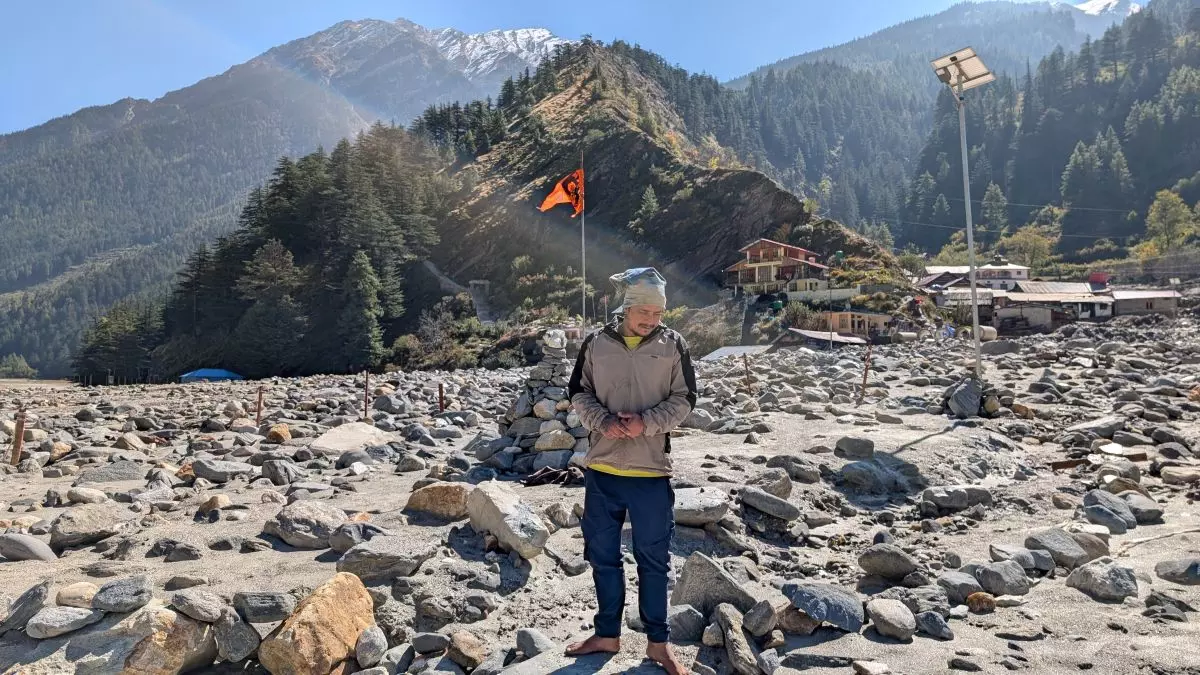
Amit Negi, one of the priests at Dharali's Kalp Kedar temple stands at the spot where the temple used to be before the flash floods. Photo: Manan Kumar
“That flag atop a pole there in the middle of the heap of stones was our famous Kalp Kedar temple,” says 25-year-old Amit Negi, pointing to what used to be the location of a 20-foot-tall temple. “It was our main village temple and more than two centuries old. The Archaeological Survey of India, with the help of radar, pinpointed the place where the temple lies buried. We have put these stones and a flag to mark the area,” adds Negi, who used to be a priest at the temple.
His elder brother, who ran a grocery store at the Dharali market, was killed in the flash floods. “We live a kilometre up there on the mountain. On that day, my brother had gone down to the Dharali market along with three of his friends for work. They were inside a shop when all of a sudden the floods came. They must have had only seconds to escape. Locals who witnessed the horrific event from a distance later told us that my brother could not make it,” says Amit.
Of course, no body was recovered.
Amit too witnessed the calamity unfold from afar, from a fair in Mukaba village, which he was attending at the time the floods hit Dharali. Located on a height across the Bhagirathi, it was from where most of the live videos of the calamity, which went viral on social media, were taken. “I saw it from there. It was terrible, unstoppable,” recalls Amit
Adds Vinit Panwar, Amit’s neighbour, “People were whistling from Mukhba [to alert those in Dharali], but people didn’t take note as a local dance is performed at the fair that is accompanied by whistling.” About 32 years old, Vinit works as a trek guide. His family owned a three storeyed hotel in Dharali, with two shops on the ground floor that were lost in the flash floods.
“The ravaged plains that you see now were a bustling market. There were at least 150 hotels and homestays to accommodate about 5,000 tourists. Besides, there were hundreds of shops and a big parking space. But the flood took away everything. The total loss is immeasurable," he says.
Also read: Why Delhi moms fear their children are becoming collateral damage to the city's smog apathy
A close look at the area speaks volumes about the Himalayan fault lines, climate change, and the cost of unregulated human activity.
According to the environmental think tank, Centre for Science and Environment (CSE), India experienced extreme weather events on 99 per cent of days in the first nine months of 2025. Extreme weather events killed 4,064 people and affected 9.47 million hectares of cropped area, showed CSE data released in November 2025.
“The northwest—which includes Punjab and the Himalayan states of Himachal Pradesh and Uttarakhand, among others that made headlines for their devastating monsoon events—also saw the highest number of deaths: 1,342, followed by 1,093 in central India,” the report stated.
The Federal visited the office of the district commissioner, Uttarkashi, Prashant Kumar Arya, to understand the government's perspective about the ecological disasters unfolding in the area, but was told he was busy. The Federal has also reached out to the Uttarakhand State Disaster Management Authority for its findings on the Dharali disaster and ways to prevent such calamities in future.
About 8,016 square kilometres of the vast mountainous region from the Chang La Pass near the China border to Dharasu near Mussoorie is under the jurisdiction of the Uttarkashi administration.
Dharali, which is a part of the Uttarkashi district, is the main and one of the last stopovers for pilgrims and tourists on the way to Gangotri, revered as the origin of the holy Ganga river, making it a hub of hotels.
Environmental experts working in the region, however, are vocal against unregulated construction and commercial growth in the area because of its delicate ecology.
"Studies by several scientists have proved that the impacts of climate change in the Himalayas are much more severe than anywhere in the world. All the glaciers are receding fast, leaving loose material called moraine. The events of continuous or torrential rainfall in the higher reaches have increased and have become a new normal. Excessive rains in the higher reaches bring down tonnes of moraine with tremendous velocity that causes damage,” explained SP Sati, professor of environmental science at the VCSG Uttarakhand University of Horticulture and Forestry. Sati, who specialises in Himalayan Geology and disasters, cited the example of the 2013 Kedarnath flash floods, where excessive rainfall mobilised massive glacial moraine downward, causing severe flooding in the double stream and claiming many lives.
“Earthquakes, floods, avalanches are natural phenomena that occur because of several reasons like geology, seismic movements and climate change impact etc. It is the humans that make them disasters and give them the name of natural disasters,” he added.
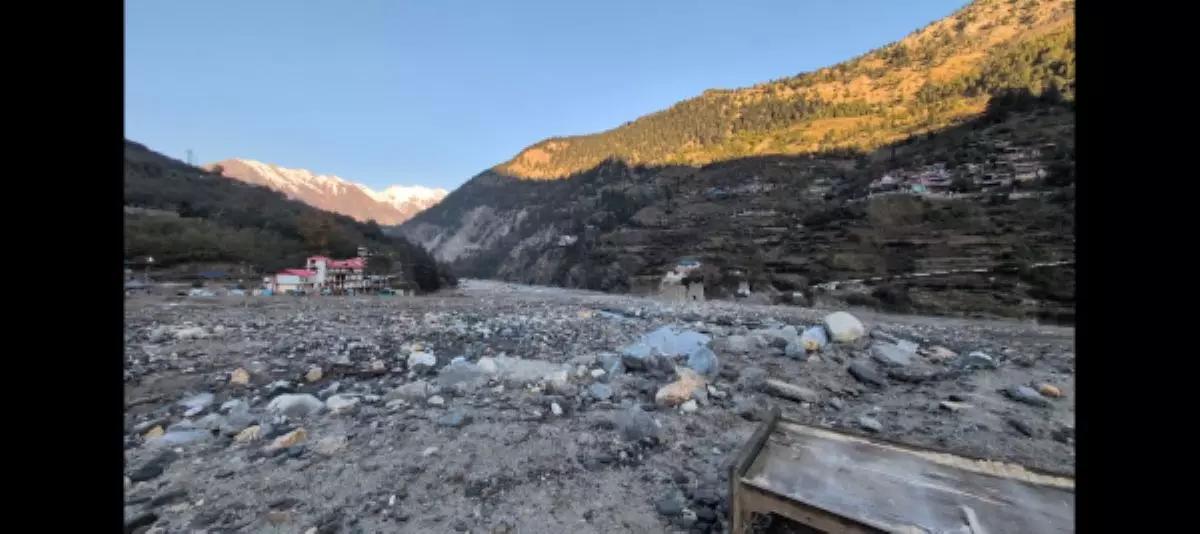
Debris left behind by the flash floods. Photo: Manan Kumar
According to Sati, “planning and installation of big projects or unplanned habitations in the higher reaches should be stopped” if human beings wanted to curb life threatening natural calamities. “Dharali is a perfect example. Hundreds of hotels and restaurants were built on the floodplains of Kheer Ganga that originate from the glacial region. Prolonged rainfall made the moraines move with rapid velocity with a cascading effect on the downstream, and we witnessed this tragedy,” he explained.
Also read: How a group of villagers in Kerala grew a forest to curb riverbank soil erosion
Sati’s views are echoed by Dr. Ravi Chopra, former director of the People's Science Institute, Dehradun, a noted environmental scientist/ activist. Chopra, who had headed two Supreme Court-directed committees to investigate the impacts of hydropower dams in Uttarakhand and to monitor the construction of the Char Dham Pariyojna (Scheme), told The Federal, “Himalayan rocks look hard, but they are weak because they are disjointed and have fractures. We may not feel it, but the entire region receives swarms of micro earthquakes. This movement of rocks and earth in this region makes the slopes more vulnerable. On top of the mountain are glaciers that have been receding. They have left behind a lot of moraines, rocks, and boulders. So, there's a lot of destructive material waiting to be moved.”
Warming, due to climate change, results in rainfall in the higher Himalayas.
“The combination of water, melting ice, and snow becomes a deadly combination. And this is what happened in Dharali. Within minutes, a devastating avalanche came plunging 2000 meters, carrying thousands of tons of sediments with deadly velocity. It used the path of Kheer Ganga and submerged everything in a pile of about 30-40 feet of mud, rocks, and boulders,” Chopra added.
The expert claimed that a committee appointed by the Supreme Court and headed by him had recommended against the widening of the roads in the area, but alleged their suggestions had been brushed aside by the government as it was keen to increase traffic to the Gangotri shrine for revenue.
“People saw an opportunity to build hotels in the valley surrounding the mountain slope. The only saving grace was the last line of defence, the cedar (deodar) forest, which, according to popular folklore, belongs to Lord Bhairavnath, the guardian of the deity in the Gangotri Temple. The cedar trees have deep roots that hold the earth. It stopped at least some devastation,” Chopra explained.
As a safeguard against future disasters, Chopra advises against following the current economic model in the region.
“Regions like Uttarakhand cannot have an economic model similar to that of the plains - monstrous buildings, big factories, and super wide roads. Development should be done keeping in mind the geological, environmental, and climate change concerns,” he warned.
Back in Dharali, meanwhile, the wait has started for another tourism boom.
“We want our temple to be excavated. It is the temple of our ‘Gram Devta’ [village deity]. Once it is established, the footfall of tourists and pilgrims will start increasing again and we will be able to build our hotels and shops,” says Amit.
Agrees Vinit, “We also want commensurate compensation and interest-free loans for rebuilding. The pro rata compensation of Rs 5 lakh paid by the government is nothing.”
“Here? It is a dangerous zone. The disaster may happen again, resulting in a greater tragedy. Scientists have warned about it,” says a traveller who had stopped by to listen to the conversation.
Interrupting his advice in the middle, Amit says, “Disasters don’t happen often. This was a coincidence.”