- Home
- India
- World
- Premium
- THE FEDERAL SPECIAL
- Analysis
- States
- Perspective
- Videos
- Sports
- Education
- Entertainment
- Elections
- Features
- Health
- Business
- Series
- In memoriam: Sheikh Mujibur Rahman
- Bishnoi's Men
- NEET TANGLE
- Economy Series
- Earth Day
- Kashmir’s Frozen Turbulence
- India@75
- The legend of Ramjanmabhoomi
- Liberalisation@30
- How to tame a dragon
- Celebrating biodiversity
- Farm Matters
- 50 days of solitude
- Bringing Migrants Home
- Budget 2020
- Jharkhand Votes
- The Federal Investigates
- The Federal Impact
- Vanishing Sand
- Gandhi @ 150
- Andhra Today
- Field report
- Operation Gulmarg
- Pandemic @1 Mn in India
- The Federal Year-End
- The Zero Year
- Science
- Brand studio
- Newsletter
- Elections 2024
- Events

How ‘baithakis’ — intimate gatherings over conversation, culture and cuisine — are making a comeback
The word ‘baithak’ or ‘baithakkhana’ — literally meaning a room for guests to be received — evolved to include the conversations or exchange of ideas, at times casual, often nuanced — on poetry, politics or society — carried out within its walls. Now, such ‘baithakis’ are being revived to bring together small groups of like-minded people for a curated experience.

In 1918, the Seths, a family of jewellers based in Jaipur, Rajasthan, brought back a radio set from Kolkata (then Calcutta). The purchase was made specifically to stay abreast of the news relating to the First World War. But alas, that was not to be. For Jaipur had no electricity at the time, and it wasn’t until 1926 that the family would be able to use the radio — a wooden set that now...
In 1918, the Seths, a family of jewellers based in Jaipur, Rajasthan, brought back a radio set from Kolkata (then Calcutta). The purchase was made specifically to stay abreast of the news relating to the First World War. But alas, that was not to be. For Jaipur had no electricity at the time, and it wasn’t until 1926 that the family would be able to use the radio — a wooden set that now sits mute at the Seth’s 289-year-old, beautifully frescoed ancestral haveli (mansion) in Jaipur’s Johri Bazaar.
“Back when it was bought, it wasn’t enough to have the money to be able to buy a radio. A licence was needed to legally possess one,” claimed Vikram Seth, a fourth-generation jeweller, restorer, boutique hotelier and the keeper of the haveli’s legacy, to an audience that had gathered at the family home on a Sunday morning in December last year to hear about the anecdotes of this old family.
The setting at the Seth haveli was informal, the gathering intimate, the conversation free-flowing; reminiscent of the ‘baithakis’ of yore.
The word ‘baithak’ or ‘baithakkhana’ — literally meaning a hall, drawing room or parlour for guests to be received — reportedly originated in Hindi or Urdu. It also refers to the sitting posture. Beyond the space, the word evolved to encapsulate in its meaning the conversations or exchange of ideas, at times casual, often cultural or nuanced, carried out within its walls, over cups of tea or plates of food.
You find its mention in literature and films referencing the 19th and 20th centuries — rooms with floor cushions, elegant runners or carpets and low tables, or the ones with a marked Western influence, furnished with Victorian furniture, ornate chandeliers, gilt-framed mirrors. There were also the more spartan spaces of the Swadeshi era; ‘baithakkhanas’ with low wooden divans, bamboo mats, traditional Indian floor art, etc.
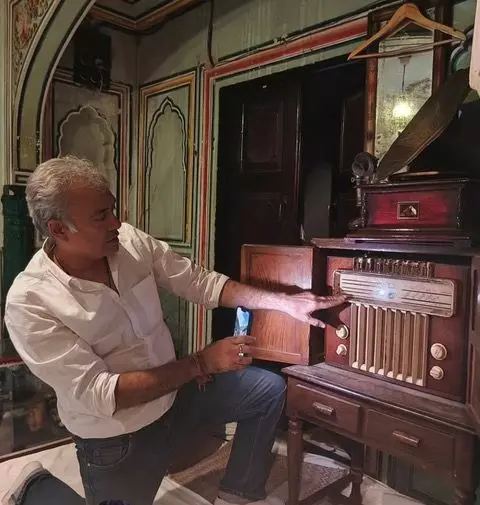
The 1918 radio at the Seth haveli. Photo: By special arrangement
Real life must have had more modest spaces of the middle classes too, where the talks had been about mundane household and family affairs and the daily struggle of managing expenses, but what’s survived in public memory and pop culture are the baithakkhanas of the elite and intelligentsia, where poetry, prose, music and discussions on society and politics dominated.
It is said at the baithakkhana of the Tagore residence in Kolkata’s Jorasanko, Nobel Laureate Rabindranath would often present the first readings of his writings.
Now, such ‘baithakis’ are being revived by families or event organisers, where small groups of like-minded people are coming together in an intimate setting for a curated experience. From music soirees to poetry and book readings, curated menu tastings to sneak peeks into family traditions and histories — as the one at the Seth haveli — these new-age baithakis are for those looking for an immersive cultural experience, held at family living rooms, gardens or kitchen tables.
Also read: Why an upcoming nine-hour-long Kannada play has a lesson to offer on the current geopolitical crisis
“We believe in a baithaki, lived experience should forefront as the ‘hero’, always reminding us that the richest wisdom isn’t always found in books, it can be drawn from real, unfiltered stories,” says Swati Vashishtha, a journalist, cultural advisor and one of the co-founders of Baithaki, Jaipur.
For them, these events are intertwined around ‘human libraries’, the repositories of memories, thoughts and experiences.
Vashishtha adds: “At Baithaki-Human Library Reimagined, we honour voices that have wandered, weathered, witnessed; stories etched on skin, humming in laughter, sparkling in eyes or stitched softly in silence. Baithaki sessions are a tapestry of journeys and experiences, both ordinary and rare.”
According to her, the idea of Baithaki came to the organisers during a conversation one evening.
"We have compiled a list we keep adding to, keeping in mind the theme ‘Stories of Jaipur’,” says Vashishtha, adding, “The focus is on lesser-known people; we want to listen to new stories and lesser-known perspectives. We explore our potential living books by initiating conversations on the theme with them. If they show promise, we do a round of meetings with them, listen to their stories, look at documents, artefacts and old objects and photographs [in their collection] that are relevant to their stories. We are all sticklers for research and we enjoy the process [preparing] for each session as much as the session itself, if not more.”
Having held more than four to five baithakis in 2025 (including the one at the Seth residence), about the response, Vashishtha says, “It's working surprisingly well! It is very reassuring to see requests from friends and complete strangers to join the sessions. We cap the number [of attendees at each event] to about 15-16, so we always have pending lists of guests as well.”
The organiser adds: “One unique thing about Baithaki Jaipur is that we also put in a lot of effort into identifying participants for each Baithaki. We like to align the interests of the invitees and the subject to try and make sure it is a deeply engaged audience each time.”
The trend has been picking up in other cities, too, the national capital included. There were reports of musical 'baithaks’ held in Delhi even during the pandemic years, when lockdowns and the fear of contagion made big events impossible.
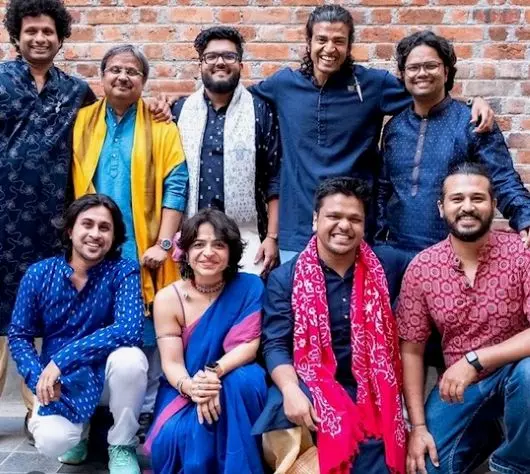
The Marham team. Photo: By special arranagement
Marham (literally meaning a healing salve), a Bengaluru-based musical-poetic ensemble that blends soulful poetry, storytelling and music in its events, to explore themes of love, nostalgia and other human emotions, offer intimate, live baithakis, featuring original poetry paired with curated melodies, often highlighting Sufi philosophies and emotional, personal narratives. The group has held such intimate events across cities like Delhi, Bengaluru, Mumbai and Kolkata.
“We started in June 2025. I have been writing poetry since childhood and the musicians who are part of the team have been in this field for more than 15 years. Our music and poetry are focused on emotional healing, human vulnerabilities and our respective internal journeys. The performances are often curated as a linear progression through human emotions: moving from memory and longing to hope and, eventually, silence,” explains Divya Batra, a contemporary poet and one of the co-founders and the force behind Marham.
Unlike traditional high-energy concerts, these sessions are essentially designed for reflection. Batra says she often speaks to the audience about the "zakhm" (the wound) that inspired a specific piece before reciting the "Marham" (the cure). The poetry often revolves around themes of sukun (tranquillity) and sohbat (companionship), she adds.
Also read: Why in Tamil Nadu, elections are busy, happy times for look-alikes of actors-turned-politicians
Then there are food-centric ‘baithakis’ or supper clubs, which function as much as social clubs as places for lunches or dinners. Here the food is not just for consumption, but an outing for reflective conversations and thinking.
People come as strangers and leave as friends, with the events taking place in settings like private homes, art galleries, rooftops or even repurposed garages. What attendees find relaxing, they say, is discovering new flavours while enjoying great conversations with others, without the pressures of a formal setting as in a fine-dining restaurant.
The immersive dining experiences could also include performances, storytelling, or thematic decor.
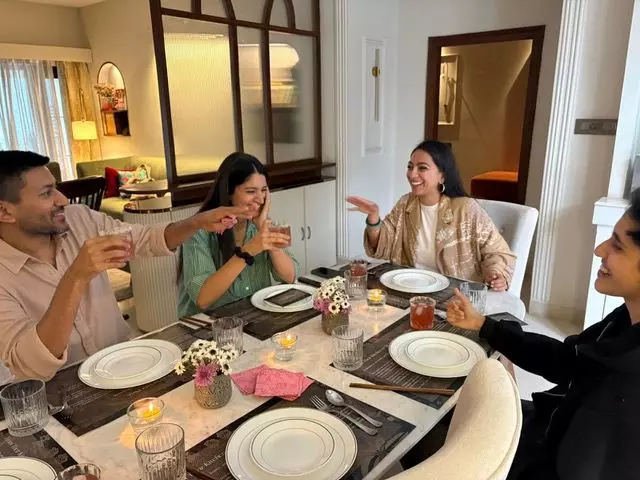
Guests at the Ode 101 supper club in Jaipur. Photo: By special arrangement
“It is like democratising fine dining, where you get high-quality food in a casual living room without the stuffy dress codes of elite hotels. They can be called ‘Cultural Diplomacy’ clubs too, when immigrant chefs cook authentic recipes from their heritage, creating a space for true cultural exchange. These can well serve as low-barrier entry points for young chefs, as they allow them to build a brand without the lakhs of rupees needed to open brick-and-mortar restaurants,” explains Seema Sethi, who runs the Ode 101 supper club in Jaipur.
For Sethi, the supper club is a deeply personal tribute to her mother and the home she grew up in. “101 was our house number — a place where I watched my mother cook with immense passion and love. In that house, hospitality had no boundaries; everyone, from guests to our apartment helpers, was fed with love. Ode 101 is like carrying forward that legacy,” she says.
Herself a chef, Sethi says, since 2015 she had been catering primarily to tourists, giving them an insight into the local cuisine, when the Covid pandemic of 2020 — and the resultant lockdown and lingering impact on travel and tourism — forced a pivot.
“I decided to open my home to everyone, introducing Gujarati and Burmese cuisines alongside my traditional roots. I began sharing my journey on Instagram and hosted everything from strangers' meets and jamming sessions to open-air cinemas. Every gathering is a "slow living" ritual where storytelling and food foster genuine connection. The exclusivity is one of the strongest factors attracting people to supper clubs, as there is no structured menu. It's crafted for that particular evening only. The experience is personal, seasonal, and unique,” she explains, adding, “A supper club is about being transported away from the everyday... it's about connection, not just consumption”.
Of course, such curated experiences are not free, at least not always. While the Baithaki Jaipur does not charge for attendance, the Marham events are ticketed — Rs 309 to 599, depending on the city — and Ode 101 charges Rs 2000 per head for a meal and the experience (foreigners pay Rs 3500 per head, but that includes the experience of visiting a farm market, sourcing the ingredients and watching the meal being cooked).
Also read: How communities of urban Indians are ditching the screen to bond over board games
The popularity of the ‘baithaki’ concept can be gauged from the fact that cafes and restaurants in Kolkata have been named 'Bithaki' or 'Baithakkhana'.
Meanwhile, at the Seth residence, Vikram Seth had moved on from the radio to another family heirloom, holding the audience captive by his stories of an old picnic box, with a layer of insulation and a chamber at the bottom where pieces of burning coal were put to keep the food warm. Also on display was a spear-topped walking stick, “used to ward off foxes” during walks of the haveli grounds.
For Nemali Singh, a professor of nutrition and first-time ‘baithak’ attendee, the experience was both spell-binding and eye-opening. “I learnt so much about the culture of Jaipur; the event has stayed with me,” she tells The Federal.