- Home
- India
- World
- Premium
- THE FEDERAL SPECIAL
- Analysis
- States
- Perspective
- Videos
- Sports
- Education
- Entertainment
- Elections
- Features
- Health
- Business
- Series
- In memoriam: Sheikh Mujibur Rahman
- Bishnoi's Men
- NEET TANGLE
- Economy Series
- Earth Day
- Kashmir’s Frozen Turbulence
- India@75
- The legend of Ramjanmabhoomi
- Liberalisation@30
- How to tame a dragon
- Celebrating biodiversity
- Farm Matters
- 50 days of solitude
- Bringing Migrants Home
- Budget 2020
- Jharkhand Votes
- The Federal Investigates
- The Federal Impact
- Vanishing Sand
- Gandhi @ 150
- Andhra Today
- Field report
- Operation Gulmarg
- Pandemic @1 Mn in India
- The Federal Year-End
- The Zero Year
- Science
- Brand studio
- Newsletter
- Elections 2024
- Events

Why an upcoming nine-hour-long Kannada play has a lesson to offer on the current geopolitical crisis
Based on a 12th-century Kannada literary tradition, Vachana Kalyana looks back at a genre which, according to experts, preached the avoidance of conflict and pursuit of power, as well as the rejection of ritualistic practices and social inequality. Directed by C Basavalingaiah, the production is supported by the Karnataka government.

As the US-Iran war, which has drawn Israel to the side of America, continues to create ripple effects across the world — especially in terms of an escalating fuel crisis — in Karnataka, a stage is being readied for a production that looks back at a literary tradition which, according to experts, had preached the avoidance of conflict and pursuit of power. Titled Vachana Kalyana (or...
As the US-Iran war, which has drawn Israel to the side of America, continues to create ripple effects across the world — especially in terms of an escalating fuel crisis — in Karnataka, a stage is being readied for a production that looks back at a literary tradition which, according to experts, had preached the avoidance of conflict and pursuit of power. Titled Vachana Kalyana (or a celebration of Vachana), the nine-hour-long play is the brainchild of C Basavalingaiah, former director of the Bengaluru centre of the National School of Drama (NSD), former head of Rangayana, a Mysuru-based theatre institute and former assistant director of the NSD Regional Resource Centre in Bengaluru.
Dating back to the 12th century, Vachanas are a form of Kannada literature characterised by their philosophical or spiritual themes, or addressing of social issues, rejection of ritualistic practices and social inequality, and are often associated with the leaders and reformers of what came to be identified as the Lingayat sect (worshippers of a formless universal consciousness identified as the Ishtalinga, known for their opposition to the caste system and push for social equality). Often equated with what are known as maxims in English — ‘a short statement of general rule, principle or rule for behaviour’ — the word Vachanas literally means “that which is said”. The writers are known as Sharanakaraas, and among the most notable of Vachana composers are Basavanna, Akka Mahadevi, Allama Prabhu, Siddarama, Madivala Machidevaiah, and Akka Nagalambik — all Lingayat philosophers and reformers. The Anubhava Mantapa (Temple of experiences), established by Basavanna at the present Basavakalyan (city and municipal council in Bidar district), is widely regarded as the first spiritual parliament and pioneering democratic institution in India. It facilitated open egalitarian debate on social, religious and political issues, allowing participation from genders and castes.
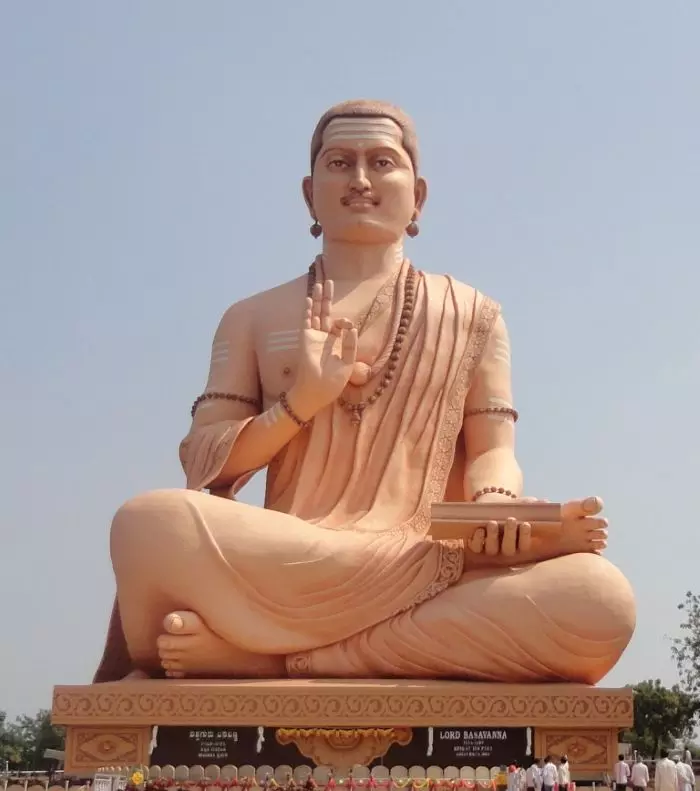
A statue of Basavanna at Basavakalyan. Photo: Wikipedia
“Basavanna, the 12th-century Vachana poet and philosopher, in his verse Sakala Jeevatmarige lesane bayasuva Koodalasangamadeva (Let welfare happen to all living beings, O Kudalasangangama Lord), rejected the idea that power or wealth gained through such means [violence, wars] has any lasting value. His refusal to seek royal patronage further underscores his resistance to systems built on violence and exploitation,” observes Dr Basavaraja Sadara, noted writer, literary critic and an authority on Vachana literature.
He adds: “Vachanas offer a powerful ethical response to a society shaped by violence, hierarchy and political conflict. These brief, intense poetic verses reflect a deep unease with the values that sustained warfare and royal power. The Sharana Vachanas present a subtle, but profound critique of war-oriented culture, through their emphasis on compassion, equality, and inner transformation.”
Sadara’s thoughts are shared by scholar-writer L Basavaraju, who in his work Vachana Chandrika, wrote of Vachanas offering an “alternative vision of society that stands in sharp contrast to the violence and power struggle of their historical context. Specific Vachanas preserved in their original Kannada further illuminate the ethical stance, where the rejection of violence and affirmation of compassion emerge as central spiritual social principles”.
Also read: Why restoring Kannada classic Samskara would help preserve a landmark in Indian cinema
While the Congress government in Karnataka led by Chief Minister Siddaramaiah has announced plans to establish a Vachana University in Basavakalyan, allotting 25 acres of land for the project, now, Basavalingaiah’s long-from stage production is the latest celebration of the philosophy of Vachanas in an increasingly turbulent global reality.
“Basavanna’s message of universal brotherhood is the hallmark of Vachana Kalyana,” says Basavalingaiah, popularly known in the theatre world as Basu, who first started working on this idea in 2015. The plan then had been for the Bengaluru Centre of NSD to stage Vachana Kalyana, with the support of the Karnataka government’s Department of Kannada and Culture and the Department of Information and Public Relations. An expert committee, formed to oversee production, had been headed by professor MM Kalburgi, a scholar of Vachana literature, who was killed by unidentified assailants in August that year.
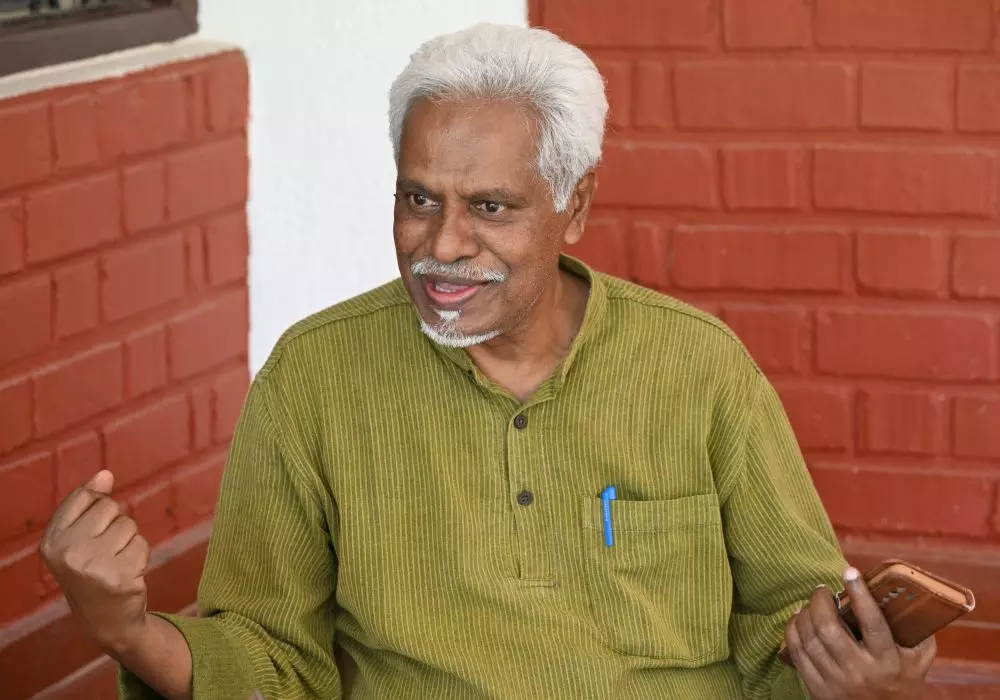
C Basavalingaiah, the director of Vachana Kalyana. Photo: K Bhagya Prakash
It took two years for writer KY Narayanaswamy to complete the script for the play.
“Narayanaswamy and I sat together and discussed for months before the commencement of rehearsals. We wanted Vachana Kalyana, a unique experiment to capture the imagination of the audience by highlighting the Sharana cultural movement’s social and political relevance. We titled the play as Vachana Kalyana, as it narrates the history of the Kalachuri Dynasty, headed by King Bijjala, whose capital was Kalyana, now in the Bidar district. There was a social upheaval during the reign of King Bijjala, in whose court Basavanna was finance minister. The idea was to chronicle the history and social movement that Kalyana witnessed during the time of Vachanakaras,” explains Basavalingaiah.
By the time the two were ready to start production, there had been a change of political dispensation in the state (The Bharatiya Janata Party had come to power in Karnataka in 2019, following the collapse of the Congress-Janata Dal (Secular) government formed after the assembly elections of 2018). The Covid pandemic, which broke out in 2019-20, acted as a further deterrent.
“However, we continued to work on the different aspects of the play, even during the pandemic and with Congress returning to power in 2023, we resolved to resume our attempts to stage the play with the support of the government,” Basavalingaiah added.
Being produced with the support of the state government’s Department of Kannada and Culture, the plan is for the first edition of Vachana Kalyana to be staged at a 20-acre space in Kala Grama, Bengaluru University — a cultural space maintained by the Department of Kannada and Culture.
While Narayanaswamy, who has 20 plays to his credit, has already completed the writing of Vachana Kalyana, “noted film and theatre art director Shashidhar Adapa is designing the stage, and the lighting is being done by Nanda Kishore. Pramod Shiggaon will take charge of costumes and tabla maestro Ustad Faiyaz, with the support of Hindustani classical music vocalist of Jaipur Gharana Dr Jayadevi Jangamashetty, will compose music for the play” Basavalingaiah told The Federal.
The cast will have 70-plus actors, the director added.
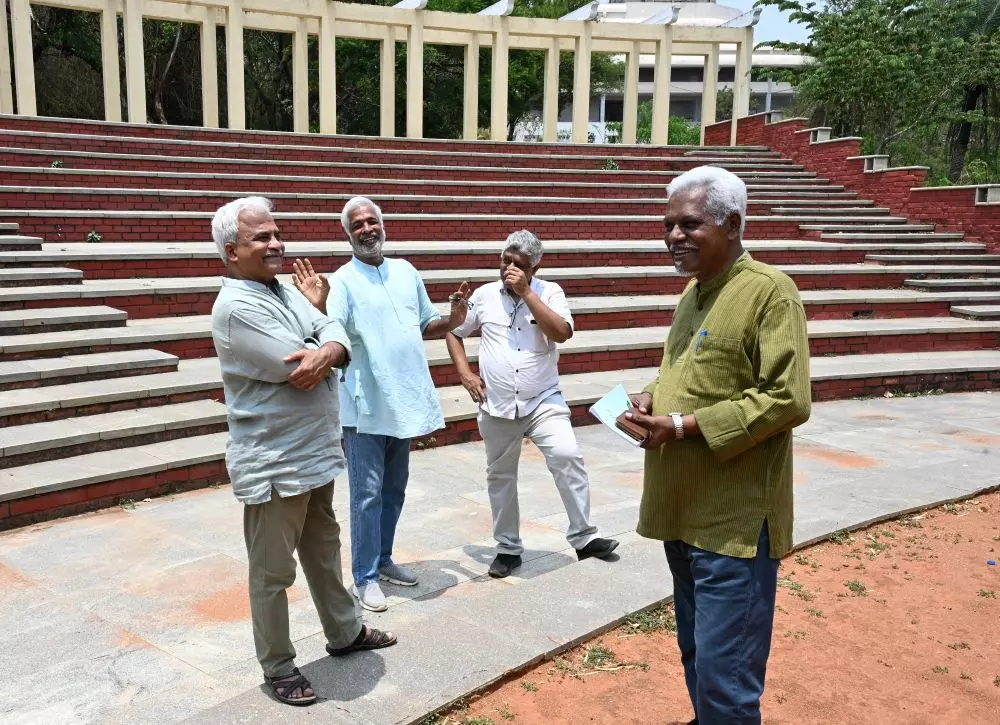
The techinical and production unit of Vachana Kalyana at the location for the play. Photo: K Bhagya Prakash
On March 21, the Department of Kannada and Culture put out an advertisement inviting applications from eligible artistes for the nine-hour play, fixing the age limit of artistes from 18 years to 40 years. Eligibility criteria include experience in theatre, with training in theatre institutes in Karnataka. Artistes have been assured of a decent monthly honorarium for three months, with a residential facility during the preparation for the play. “We have received hundreds of applications and the selection process of artistes is almost completed,” Basavalingaiah told The Federal.
The Department of Kannada and Culture has also formed an expert committee to oversee the production of Basava Kalyana, headed by renowned theatre personality K Marulasiddappa. Basavalingaiah, Narayanaswamy, professor OL Nagabhushanaswamy, professor SG Siddaramaiah, renowned music composer Hamsalekha, renowned Kannada researcher, writer, activist, and thinker Meenakshi Bali, writers Ramjan Darga and Ka Ta Chikkanna, Karnataka Nataka Academy chairman KV Nagarajamurthy, art director Shashidhara Adapa and writer-scholar Veena Sharma Bhoosanurumath, are the others in the committee.
“Since Vachana Kalyana blends the depiction of history and myths from the 12th century society, experts panel is taking all aspects of the period into consideration. We are looking at the play from a research and analysis perspective, based on literary and historical materials collected by scholars. Full creative freedom has been accorded to Basavalingaiah,” Bali told The Federal.
Also read: Why ongoing Kannada Sahitya Parishat row reflects a deeper decline in century-old institution
Neither the form nor the content is new, however. Nor is the controversy surrounding Vachana and one of its foremost creators, Basavanna.
Over the years, more than 30 plays have been written on Vachana Kalyana or Kalyana Kranti (Revolution).
Celebrated Kannada playwright P Lankesh explored the 12th-century social revolution by Basavanna in his play Sankranthi, focusing on the challenges, conflicts, and potential collapse of an established order during this period of intense social reform. The play was published in 1971 and considered to be one of the authentic plays on Vachana Kalyana.
The subject of Mahachaitra, by noted poet HS Shivaprakash, is Basavanna; the play faced protests for allegedly portraying Basavanna in a distorted manner. Tale-Danda (The Beheading), written by renowned playwright Girish Karnad in 1993, is also based on the Sharana movement.
In the mid-1990s, noted scholar PV Narayan’s work on Basavanna, Dharmakarana, became highly controversial, leading to the banning and confiscation of his book. Critics, particularly from religious groups, alleged that the book distorted history, made derogatory references to Basavanna and presented allegedly incorrect facts about his life.
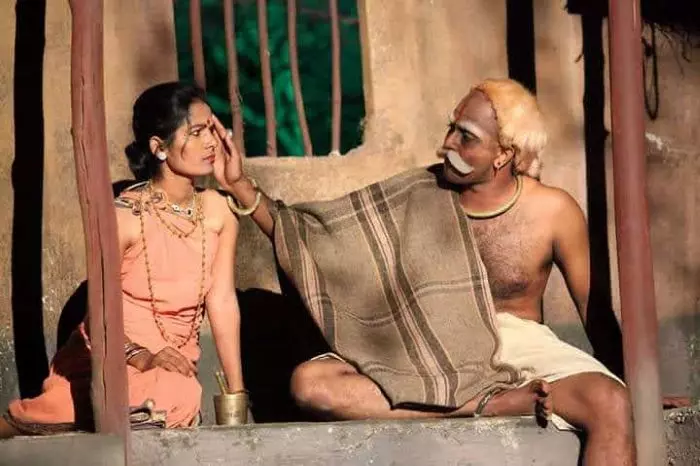
Basavalingaiah 2010 directorial Malegalalli Madumagalu, regarded as the first night-long play (8pm - 6am) in modern Kannada theatre. Photo: By special arrangement
Admitting that in modern Karnataka, Basavanna’s legacy has turned into a contested subject, Basavalingaiah says, “it is a challenge to adapt Vachanas for theatrical visuals. Each interpretation raises a sensitive question: who owns Basavanna’s legacy? The Vachana movement was not just a moment in history; it became a living legacy. Over centuries, it shaped the identity of the Lingayat community and came to symbolise resistance against social inequality.
The controversy has intensified in recent times with books such as Prajna Pravah’s Vachana Darshana, attempting to reinterpret Vachanas within a broader Hindu philosophical framework. Critics have argued that such readings diluted the movement’s radical anti-caste stance. Kalburgi had been one of those who argued that Lingayatism is a distinct 12th-century religion, not a sub-sect of Hinduism.
However, Basavalingaiah asserts that, “Expert scholars committee has not been formed fearing possible controversy over the interpretation of Vachanas” and that enough artistic freedom has been given.
Of course, Basavalingaiah is no novice to the form of long-form theatre.
In 2010, Basavalingaiah directed what is regarded as the first night-long play (8pm - 6am) in modern Kannada theatre — Jnanapith recipient Kuvempu’s Malegalalli Madumagalu. The nine-hour-long play was enacted in four different open-air theatres involving 150 artists.
In 2020, noted filmmaker, actor and theatre practitioner, Prakash Belawadi, adapted Parva, a 696-page novel by SL Bhyrappa for the stage. “The biggest artistic liberty I took was in locating different time-spaces in the novel, often together on the stage; even using characters to link two time-spaces. For me, Parva is experimental in the sense that we used many narrative devices to remain committed to the novel’s purpose.”
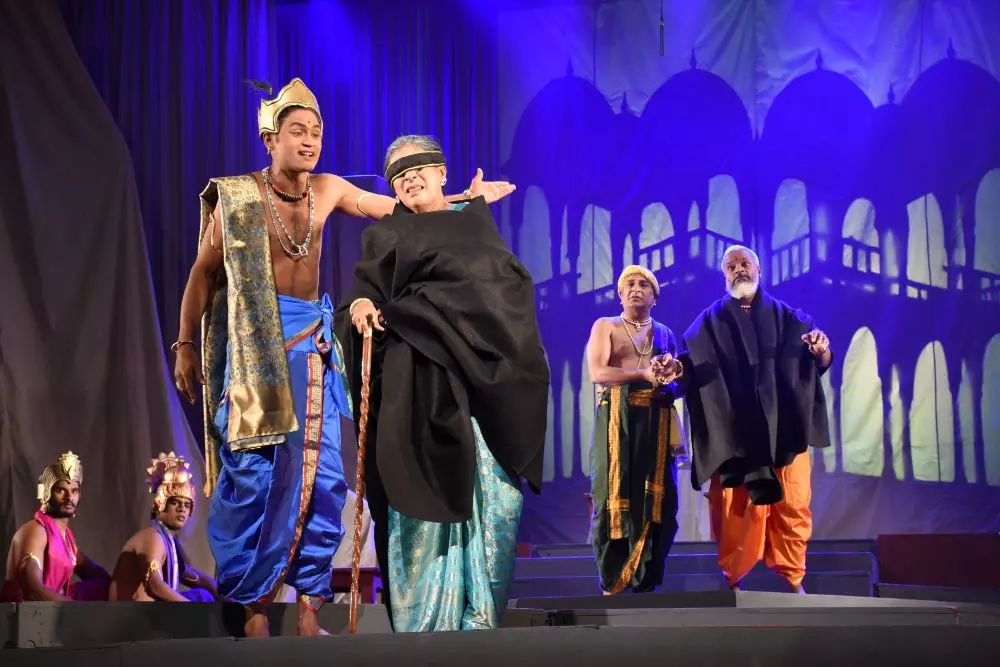
A scene from Parva. Photo: By special arrangement
Interestingly, Parva is a modern retelling of the epic Mahabharata and in modern theatre, American director Peter Brook’s English adaptation of the Sanskrit epic is acknowledged to be among the most iconic long-form productions, spanning nine hours.
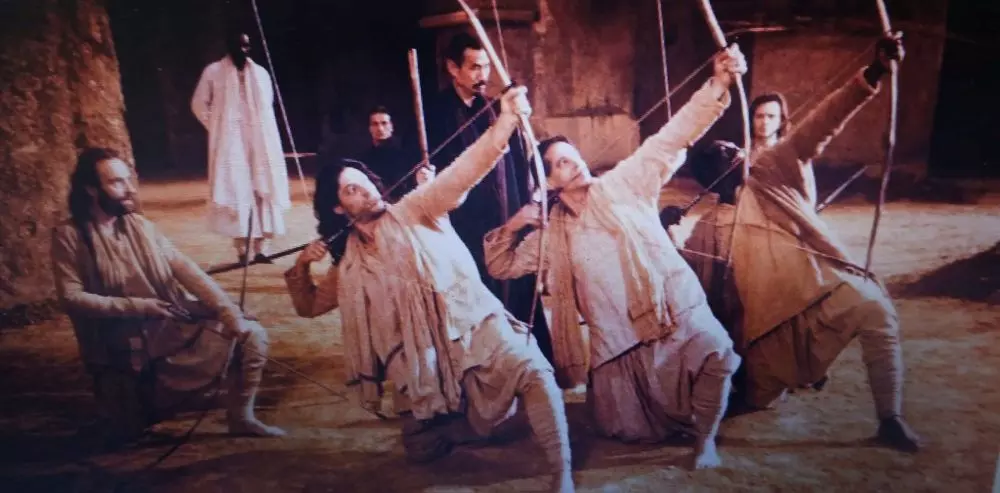
Peter Brook's Mahabharata. Photo: By special arranagement
When it comes to Vachana Kalyana, playwright Narayanaswamy admits the project was not without “challenges”. “The narrative has to include all aspects, including the disruption witnessed in the religious, social and lyrical space at that time,” he says.
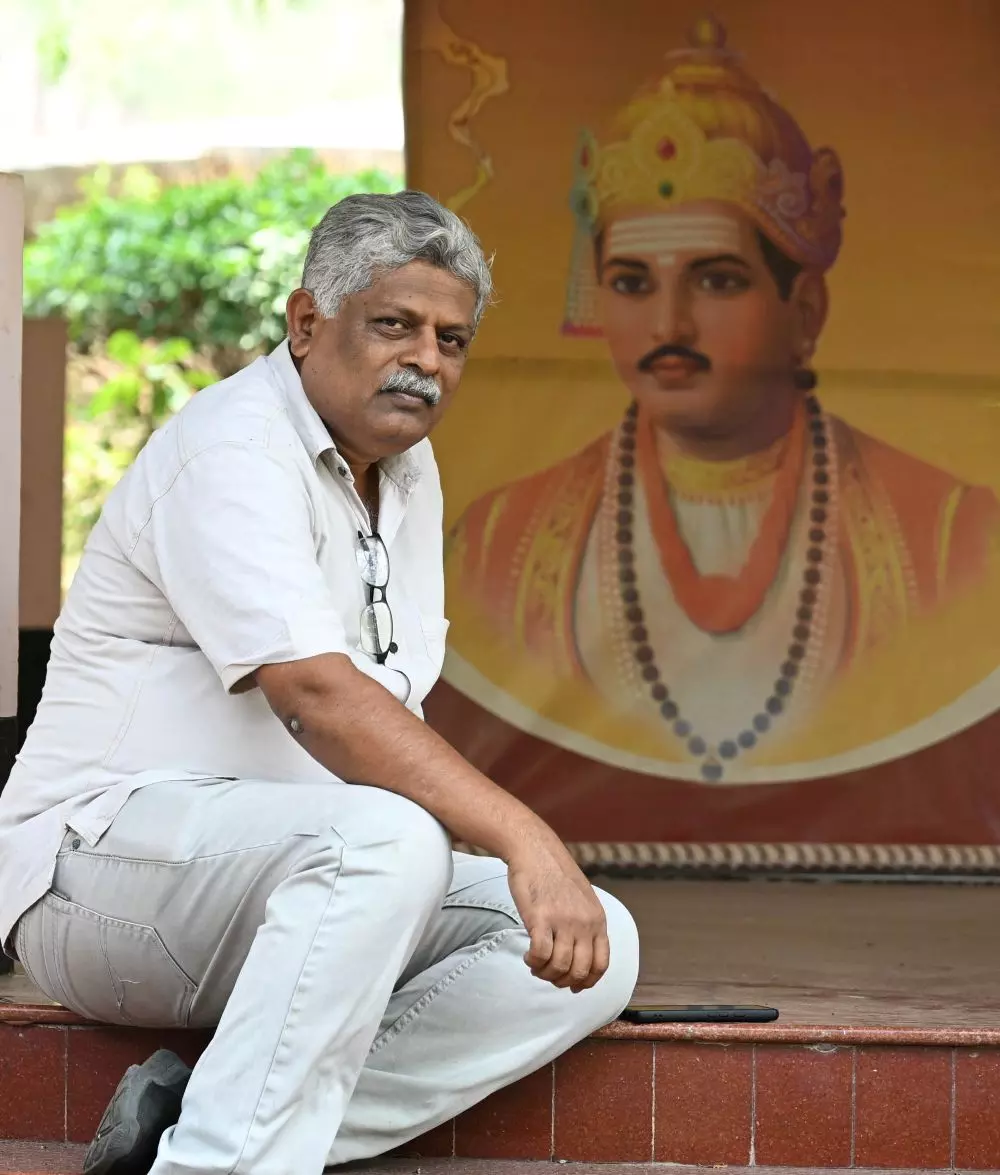
Playwright KY Narayanaswamy. Photo: K Bhagya Prakash
The fact that the play was first written a decade ago, further complicated matters.
“In this context, I was forced to rewrite the play. Unfortunately, things which were non-controversial turned controversial after 2017. However, the experts committee of scholars extended complete artistic freedom, but with a rider. The play should not make one person as the protagonist of the play. It should be the play of the lower class of society, which believed in Kayakave Kailasa (Work is Worship). The play should focus on the transition period of the Kalyana movement, where the social reforms of Sharanas were opposed by the Vedic tradition community. I was expected to handle this transition with utmost care, as it is an epic of the common man in the 12th century,” the playwright explains.
Narayanaswamy adds: “There is no social movement that could be treated as a parallel of the Vachana movement in India or anywhere in the world. When you talk about civilizations in Greece or Rome, it was usually the elite class that used the medium of poetry and literature for social commentary and to give expression to their thoughts. But in Vachana Kalyana, the movement itself gained momentum against the caste rigidity and against all the ills plaguing society during that time. The importance of the movement lies in the fact that people from across society contributed to it.”
Also read: Why the death of a bird in his rehearsal space made theatre personality Prasanna give up direction
It is an ambitious project for the government, too.
“The technical and the text teams are working overnight to structure a play that represents 12th-century Karnataka,” Manjunatha Swamy, director, Department of Kannada and Culture, told The Federal.
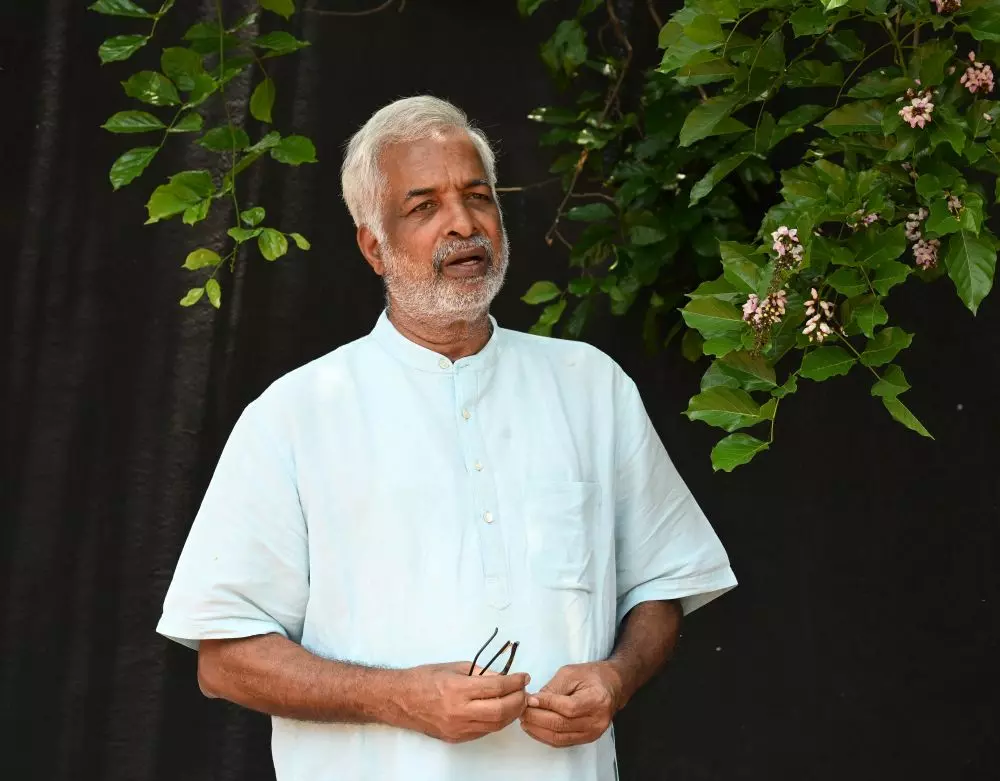
Film and theatre art director Shashidhar Adapa. Photo: K Bhagya Prakash
On March 31, the technical and production team, including Basavalingaiah, Narayanaswamy, Adapa, Nanda Kishore and Shiggaon, met and finalised the locations for the stages and the seating arrangement.
According to sources, while in 2015 the estimated cost of production had been Rs 1.30 crore, the budget has now reached Rs 2.40 crore.
No one in the team wants any compromise on quality.
“I will make use of modern technology to facilitate the soul of the play to reach the audience. As it is a dawn-to-dusk open-air theatre play, challenges are many; I have started planning lighting design to meet the expectations of both the director and the audience,” says Nanda Kishore.
Adds Adapa: “The audience will have their own expectations. Keeping this in mind, along with Basavalingaiah’s vision and the playwright’s intentions, I have started sketching stage design, making best use of ambience.” The stage designer was busy taking photographs of the location to help in his work. He is also planning to visit Basavana Bagewadi, claimed to be the birthplace of Basava and study the Basaveshwara temple constructed during the rule of the Chalukyas (who ruled between the 6th and 12th centuries).
“The plan is to stage the technical show at the end of October, and the audience can watch the longish play from November 2,” says Basavalingaiah.
For the director, the staging will be the culmination of a decade-long dream.
“Ivanaarava, Ivanaarava? Nendenisadirayya, Iva Nammava, Iva Nammava Iva Namma Nendenisayya Koodalasangamadeva. Nimma Maneya Maganenisayya [Let them not think of me as a stranger! Who is he? Instead, say He is ours! O Lord Koodasangama, Let them see me as your own dear son],” recites Basavalingaiah, quoting Basavanna’s Vachana, adding “The idea [of Vachana Kalyana] is to spread the message of ‘Sarva Janangada Shantiya Tota’ [Let all the world experience peace],”.