- Home
- India
- World
- Premium
- THE FEDERAL SPECIAL
- Analysis
- States
- Perspective
- Videos
- Sports
- Education
- Entertainment
- Elections
- Features
- Health
- Business
- Series
- In memoriam: Sheikh Mujibur Rahman
- Bishnoi's Men
- NEET TANGLE
- Economy Series
- Earth Day
- Kashmir’s Frozen Turbulence
- India@75
- The legend of Ramjanmabhoomi
- Liberalisation@30
- How to tame a dragon
- Celebrating biodiversity
- Farm Matters
- 50 days of solitude
- Bringing Migrants Home
- Budget 2020
- Jharkhand Votes
- The Federal Investigates
- The Federal Impact
- Vanishing Sand
- Gandhi @ 150
- Andhra Today
- Field report
- Operation Gulmarg
- Pandemic @1 Mn in India
- The Federal Year-End
- The Zero Year
- Science
- Brand studio
- Newsletter
- Elections 2024
- Events

How India’s trailblazing skier Aanchal Thakur is preparing for the 2026 Winter Olympics
From Manali’s raw slopes to the precision tracks of France's Tignes, 29-year-old Aanchal is translating grit into global ambition. After becoming the first Indian to win a medal at a major international alpine skiing competition in 2018, she now has her sights set on an Olympic experience.

“The entire competition is just one minute, just a 200-meter sprint. It's for this one minute that we dedicate so many years of our life to practice — only for sixty seconds,” emphasises Aanchal Thakur, pausing to let the weight of that statement sink in. “Every fraction matters,” she adds, “Because when you win medals, there isn't a difference of seconds, it's fractions of...
“The entire competition is just one minute, just a 200-meter sprint. It's for this one minute that we dedicate so many years of our life to practice — only for sixty seconds,” emphasises Aanchal Thakur, pausing to let the weight of that statement sink in. “Every fraction matters,” she adds, “Because when you win medals, there isn't a difference of seconds, it's fractions of a second.”
In January 2018, Aanchal made history by winning bronze at the Alpine Ejder 3200 Cup in Turkey — the first Indian to win a medal at a major international alpine skiing competition. Now, the 29-year-old trailblazing skier is preparing for the Milano Cortina 2026 Winter Olympics, which begins in Italy in the coming February.
The pressure is immense. Thakur's official race season has already begun on December 9, with the qualification deadline for the Olympics being January 18, 2026. She must accumulate sufficient Federation of International Skiing (FIS) points across international competitions in Austria, Italy, Switzerland, France, Serbia, Bosnia, and Turkey to make it to the Olympics. If qualified, her giant slalom event will occur around February 15, 2026.
Aanchal is realistic about the challenge — she's competed in five World Championships alongside her idol, American skiing legend Mikaela Shiffrin, who has won over 100 World Cups. “She's fire”, notes Thakur, as she interacts with The Federal at the Club Med resort in France’s Tignes. Aanchal practices at Tignes, one of Europe's most respected high-altitude training hubs, every December.
Also read: Mumbai to small-town nets, how World Cup win is redrawing the map of women’s cricket in India
Born on August 28, 1996, in Burua, a small village five km north of Manali, Aanchal's story didn't begin in a five-star ski resort or a European academy. It began where snow wasn't a luxury, but simply a way of life; where seven-to-eight-feet of snow accumulation would take it to the level of raised balconies and where children would jump directly from their homes into the white expanse below.
Her father, Roshan Lal Thakur, has been skiing for 48 years and paragliding since 1991. A former national-level athlete who later moved to coaching and served as secretary general of the national skiing federation — Ski and Snowboard India — for eight years from 2010 to 2018, Roshan introduced both his children to the sport early. Her brother, 31-year-old Himanshu Thakur, is also an international alpine skier who had competed at the 2014 Winter Olympics in Sochi, Russia. In an interview with a media outlet earlier this year, Aanchal spoke about her brother, saying he had guided her all along.
At five years old, Aanchal clipped into her first pair of skis — wooden ones crafted by her brother because the family couldn't afford professional equipment. “We used to climb for hours with those heavy skis on our shoulders just to ski for a minute,” she recalls. There were no chairlifts, no heated lodges. Just climb, descend, repeat.
Those early years were defined by resourcefulness and relentless competition among village friends. Aanchal remembers building snow jumps on village roads, much to the annoyance of elders who would scold them for making the paths too slippery.
“We would compete about who could make the highest jump,” she recalls. At six or seven years old, she and her friends had no fear of pain or broken bones, no proper technique for jumps. “We just went for it. In actual jumps, you're supposed to tuck in, but we would just throw ourselves like that.” They even managed to fit four people on a single pair of skis, jumping together before inevitably tumbling after landing.
When Aanchal finally got her first professional ski set at the age of seven, the entire village took notice. “Everyone in the village was saying, 'Oh, you got original skis!' Then everyone would use them one by one. Everyone wanted to take them!”
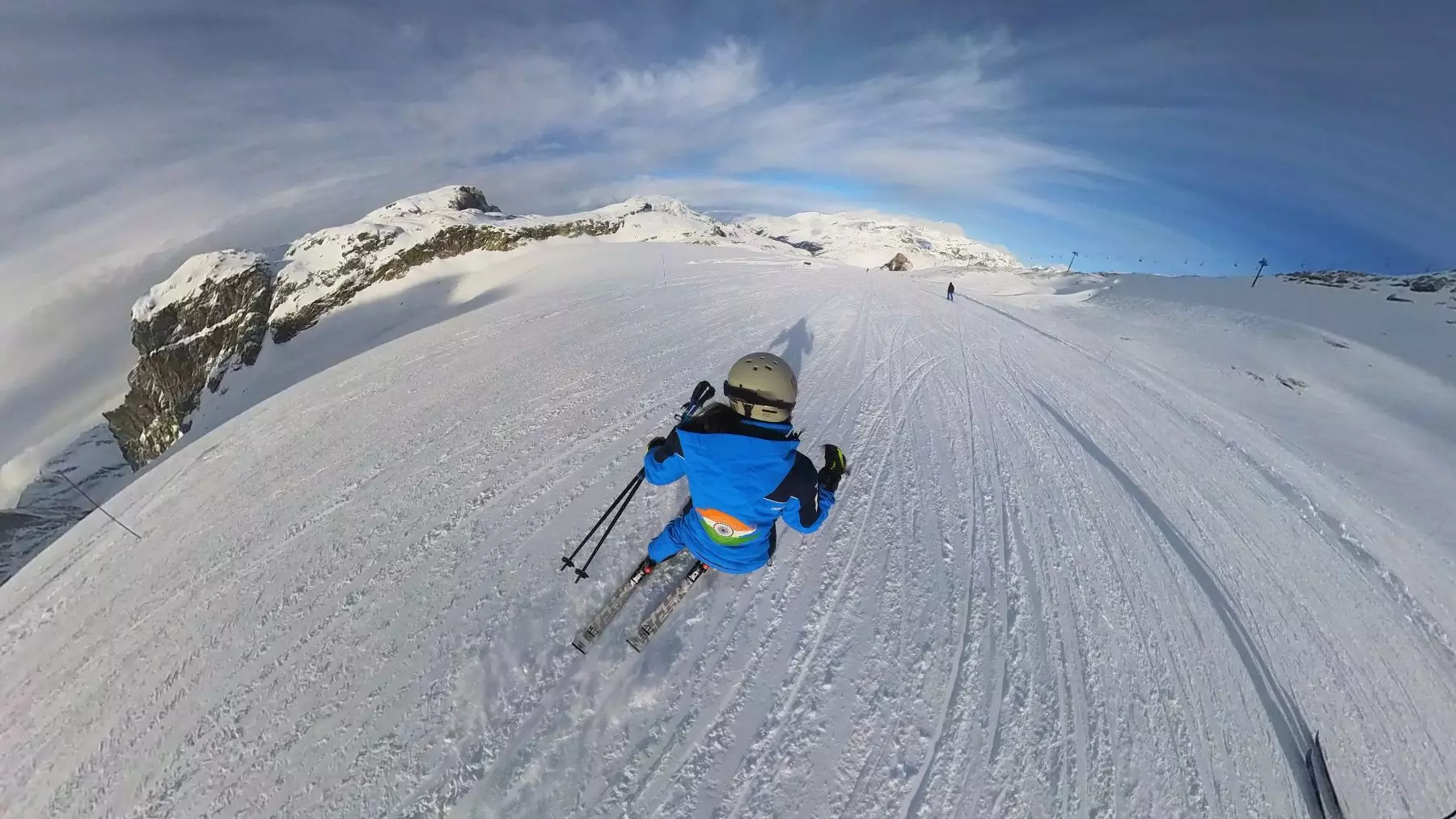
Tignes offers something beyond infrastructure, it offers inspiration, says the athlete. Photo: Veidehi Gite
With proper equipment, the family began making regular trips to Solang Valley — in Himachal Pradesh, at a distance of seven to eight kilometres from their home, which is known as a hub for skiing and other winter sports activities.
But during heavy snowfall, vehicles couldn't operate. “We would wake up at five in the morning and walk to Solang. It took two hours. Our skis would be on our shoulders and on one shoulder, we also carried our pair of jute shoes.”
Even at Solang, there were no lifts. If she wanted to ski, she had to climb up with skis on her shoulder, managing at most two to three runs per day.
The silver lining was the journey home — the downward slope meant she could ski all the way back, using her equipment as transportation.
Also read: How traditional archery has evolved into a modern, competitive sport in Ladakh
Roshan Lal is candid about the infrastructure gap that continues to challenge Indian skiers. “It's not challenging to ski in India; it is available for everybody. But if you want to be at an international standard, then we don't have that kind of infrastructure; the trails and other facilities for that level of training. We have to come to Europe to train here so that we can compete at the international level,” he explains.
According to the veteran skier, while India has natural slopes, it lacks the groomed, road-like surfaces essential for international competition. “In India, it's almost like we are skiing on the raw mountains. That is another kind of skiing. But to achieve the international standard, we have to ski here.”
The financial burden of that can be crushing. “Right now, I am paying for everything [for Aanchal],” Roshan Lal claims. “Every day, her expenses come to about 300 Euros. If I accompany her, then that goes up to 500-600 Euros a day.”
He adds: “Equipment alone costs between five to ten lakh rupees and lasts only one season under heavy usage. The International Federation of Skiing regularly changes specifications, forcing athletes to purchase new gear to remain eligible for competitions. Despite approaching numerous sponsors and even meeting with [former] Union Sports Minister Anurag Thakur, meaningful government support never materialised. Everybody says it will happen. But nothing happens.”
The Federal has reached the secretary (sports), Union Ministry of Youth Affairs and Sports, for comment. The article will be updated if a response is received.
Also read: How Kerala’s empowerment programmes are ensuring women's participation in grassroots politics
The difference between skiing in a place like Tignes and in India is staggering, she says. “When we train in India, we can do up to five runs in a day, but in Europe, it's easy to get in at least 20 in a single day.”
In alpine skiing, where muscle memory and micro-adjustments determine success, volume matters enormously. Tignes offers something beyond infrastructure, it offers inspiration, she says. “It's very wide. It's literally like a bowl. And there are slopes on all four sides. You go to one place, from the top you go to another mountain, and you can see another valley from the top,” she adds.
Aanchal’s first international exposure came at the age of thirteen, competing at the Asian Children's Championships in Lebanon. The experience was both inspiring and devastating, she recalls.
“When I went there, I was astonished. I was shocked and also a bit demoralised that we were so far behind them. I wondered how many years it would take for us to reach their level,” reminisces Aanchal.
The Lebanese skiers, according to her, carved with precision on groomed slopes while Indians trained on off-piste powder (off-trail areas with powder snow), climbing step-by-step to compact snow for competitions. “When I saw them [the Lebanese skiers], I felt like, 'When will we ever be able to do this?'”
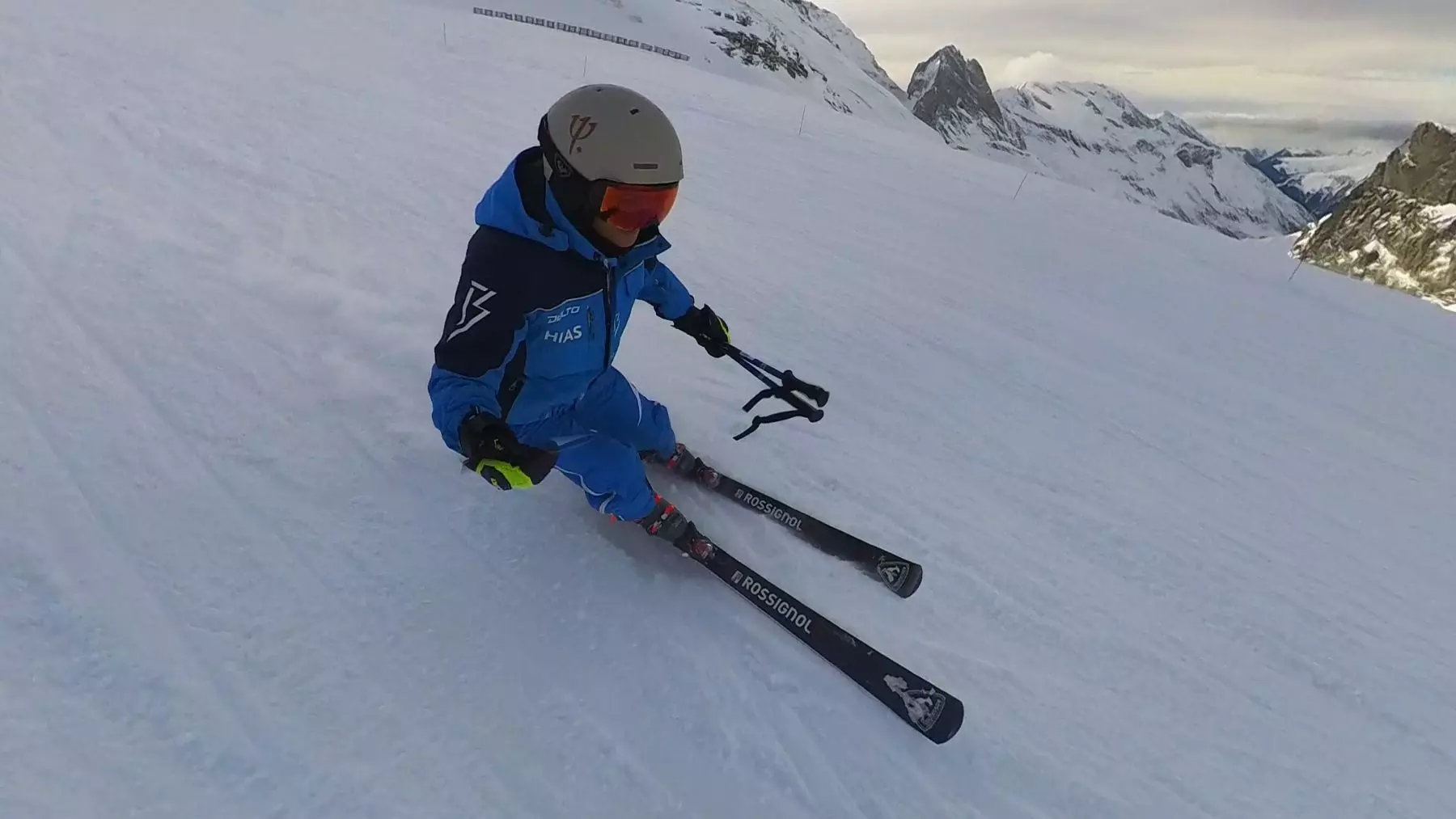
“When we train in India, we can do up to five runs in a day, but in Europe, it's easy to get in at least 20 in a single day, says Aanchal. Photo: Veidehi Gite
In 2012, she participated in the Winter Youth Olympics in Austria.
But it was the 2018 bronze medal in Turkey that changed everything. “The medal became a turning point for me and winter sports in India. I saw pride in my parents' eyes,” says Thakur.
But more significantly, it shifted national perception, she claims. “Till the time I won a medal, nobody, except for the couple of skiing pockets in the hill states of Himachal and Jammu and Kashmir, was aware that the country has professional skiers. The medal changed people's perspective, especially in the plains and now they consider us as sportspersons.” Enrolment at the government ski institute in Manali went up, she adds.
At the time, then Himachal Pradesh chief minister, Jai Ram Thakur, had reportedly announced a cash award of Rs 5 lakh for the skier.
Aanchal added to the 2018 bronze medal in Turkey with bronze and silver medals at the Jamaica Ski Federation’s national championships in 2021 and the UAE Alpine Slalom Championships, held in Dubai in 2022, respectively.
Also read: Why Delhi moms across economic and social groups are losing out to a common fear
Yet, Aanchal acknowledges that there have been obstacles. Relatives have, on occasion, questioned why so much money was being spent on her when there was already an Olympian brother in the family. Despite having a supportive husband and in-laws, close acquaintances often express disapproval about her time away training, she says.
She remains undeterred, though, drawing strength from her father's strong-headedness. “I have never liked the word 'achieved'. I don't want to think that way. I don't ever want to stop,” Aanchal asserts, “People who thought there was no scope for skiing are now coming back. That is the biggest happiness for me.”
The 29-year-old has launched Aanchal Snow Sports in Manali, teaching skiing courses in winter and organising hiking and trekking expeditions. Parents from South India, Gujarat and even Dubai seek her guidance for their children's professional skiing futures, she says.
According to one of the parents, Muskan Singh, whose children Rajyavardhan and Rudraeini, aged 12 and 9 years respectively, have been attending Aanchal's academy, the guidance goes beyond skiing techniques. "She builds confidence, discipline, and a genuine love for the sport," says Muskan.
To Aanchal, this represents transformation, from a time when friends abandoned skiing because Indian parents saw no future in the sport. And knowing she played a part in bringing about that change is what keeps her going.