From genocide to grime, the fading story of Hyderabad’s Rohingyas | Ground Report
As a Telangana HC petition seeks their deportation and right-wing groups target them politically, Hyderabad's nearly 7,000 Rohingya refugees struggle to survive

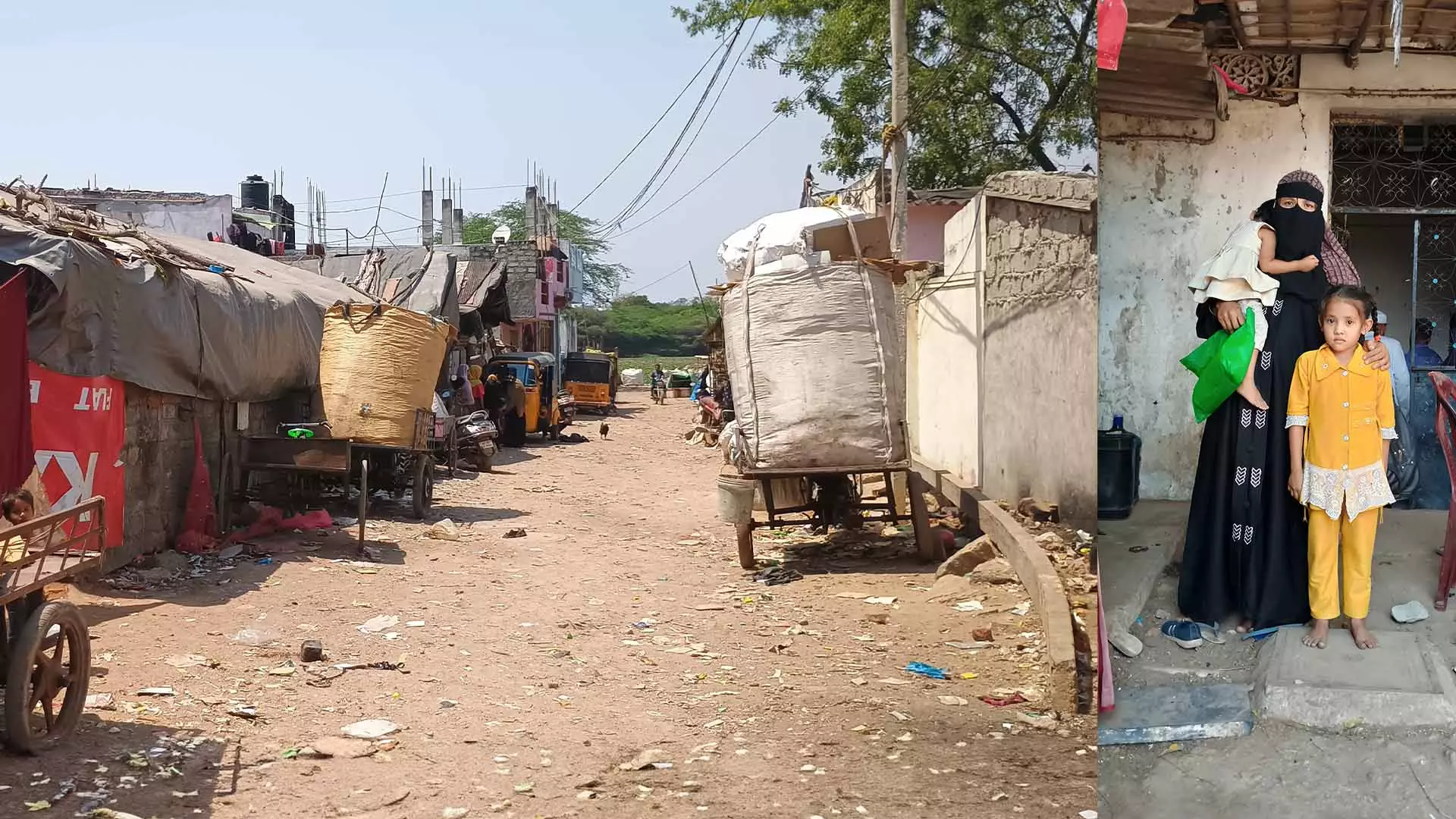
A view of the Rohingya colony (left) in Balapur, Hyderabad, and a woman with her child who has a serious heart ailment, for which the family is being asked to shell out Rs 8 lakh. Photos: G Ram Mohan
Noor Mohammad wasn't able to send a penny to his mother in Bangladesh this Ramadan, something which makes him emotional, since he used to remit Rs 5,000 to his family every year during the festival.
The 42-year-old ragpicker and occasional construction worker — one of nearly 6,900 Rohingya refugees living in Hyderabad, where they are mostly settled in around 30 camps in the Balapur suburb — says finding work has become harder than ever.
Also read: Jammu’s Rohingyas, who once defeated death, struggle for dignity, rights I Ground Report
Facing harassment with little relief has been another part of his ordeal. His 18-year-old son was recently beaten up by a few people; the police complaint went nowhere. On top of it, they are often asked to produce papers.
“All I have is my UNHCR (UN High Commissioner for Refugees) card,” he said, wondering what else he needs to procure a peddling cycle to carry scrap.
Earning Rs 300-500 on a good day, Noor has to shell out Rs 3,250 a month for a tarpaulin-roofed shelter, which shows the kind of hardships he encounters.
'It wasn't this strict when we came'
Life turned no better for Rizwana, a divorcee and a mother of three who came to Hyderabad in 2012. She once worked at a local hospital but gave it up after police began discouraging her and her family from being out at night.
Members of a Rohingya family engage in rag-picking activities at a colony for the community in the Balapur area of Hyderabad, Telangana. Photo: G Ram Mohan
Among the 100 to 150 out of nearly 7,000 who have some formal education, Rizwana earns Rs 12,000 a month and is currently studying for her intermediate exams to improve her prospects of bagging a better job. But the dreams seem to drift away as she struggles to make ends meet with her salary amidst the rising prices.
The woman’s quest for a better life, both in terms of finances and freedom, has met an uncertain future. As someone who fled her country as a school student because of the genocide and lost contact with her family for a few years, Rizwana had thought that after reaching Hyderabad, things would take a turn for the better. “When we first came, it wasn't this strict,” she said now, nearly a decade-and-a-half since her arrival.
Also read: Hundreds of Bangladeshis stopped at Hakimpur trying to cross border; is SIR the reason?
What ails these people more is that they do not readily possess the skills or resources to survive in an urban environment. Having worked as farmers back home, they mostly manage to find jobs at construction sites or earn a living as rag-pickers or vegetable sellers. The unorganised nature of their work and the growing social surveillance in India increasingly make their survival tougher.
The walls closing in on Hyderabad's Rohingyas
♦ Trump's funding cuts entirely halt crucial UNHCR aid
♦ Aadhaar mandate blocks access to Indian government hospitals
♦ Anti-infiltrator rhetoric criminalises well-documented community
♦ Daily wages of ₹300-500 barely cover rent and food
♦ Police restrictions make nighttime work nearly impossible
Mohammad Ismail, who is in his late 60s, is among those who consider themselves fortunate to have lived. The man, who came to Hyderabad with some others from his village in Myanmar, lost as many as 25 relatives in the genocide, and there is no question of returning to the place, which people like him compared with Gaza.
But given the growing challenges in the place they thought to be their new home, is the future assured?
Recalling Indian hospitality
Amin Mohammed is a septuagenarian who recalled how harmonious things were when he first came to India. He said he was given food by a Hindu woman near a temple as he was foraging. Despite the growing uncertainty, Mohammed still believes the local people are good, and recalled how they went to other cities or states in India, such as Mumbai, Delhi, Bengaluru and Gujarat, to search for work before restrictions set in.
The UNHCR works with the refugees with the help of agencies such as MARI (Modern Architects of Rural India) and COVA (Confederation of Voluntary Associations). But even the UN agency’s aid, which is key for around 100 vulnerable people such as single women, the elderly, orphans, and cancer patients, among others, has come to a halt, thanks to the United States' Donald Trump administration slashing funding for the international agency.
Also read: Varanasi police begin week-long verification drive for illegal immigrants
Rules in India have also become more challenging as access to government hospitals — previously available — ended when Aadhaar became mandatory for treatment.
The drying up of aides and growing inaccessibility to emergency services have compounded problems for people like Rashida, mother of two sons, one of whom is differently abled. The boy needs medicines worth Rs 5,000 a month, and doctors at Hyderabad’s Niloufer Hospital have said that a brain scan is required. The family is in dire straits. “I hardly manage to earn Rs 9,000 per month,” said Rasheed's husband, Mohammad Khan, who works as a labourer at construction sites.
Rashida with her husband Mohammad Khan, and their two sons, one of whom is differently abled. The couple is facing a tough time with his medical treatment. Photo: G Ram Mohan
For Rashida, such a turn of events in life is more than heartbreaking since she belongs to a family which had five acres of land in Myanmar, which has now been occupied. Despite its endless agony, the family doesn’t forget to express its gratitude for the local people who either lend it funds for the boy’s expenses or employ Khan, irrespective of his religious or national identities.
Thirty-five-year-old Safoora Khatoon is another from the community to have found herself at the receiving end. The single mother of a girl, who has a serious heart ailment, was asked for Rs 8 lakh for her treatment. Fifty-eight-year-old Kadir Hussain, who fled Myanmar after his father was killed before his eyes, also said that they could avail treatment for free till last year.
Also read: After SC stance, UP launches drive against Bangladeshi, Rohingya infiltrators
These stories moved an academic, who told this website on the condition of anonymity about what one could expect from governments that deny basic amenities to its citizens. “Can we expect them to be considerate towards refugees?”
The anti-Muslim narrative
The problems for the Rohingyas in Hyderabad have not been much different from the hunting down of alleged “ghoospethiyas” (infiltrators) in many other parts of the country. The community's troubles have sharpened since advocate K Karuna Sagar recently approached the Telangana High Court seeking the identification, verification and detention of undocumented Bangladeshi nationals and Rohingya Muslims in the state capital.
While Karuna Sagar insisted his concern is purely legal and has no links to Islamophobia, the timing, just ahead of the Great Hyderabad Municipal Corporation elections, has not gone unnoticed. The former, though, dismissed such speculations. Despite Telangana not being ruled by the Bharatiya Janata Party (BJP), the narrative has not been different.
The petition also followed the police’s refusal to permit a 'Dharma Rakshana Sabha' to be held by the local Bhagyanagar Ganesh Utsav Samithi in Balapur. The permission was given after Karuna Sagar’s legal representative L Ravichander, told the court that no provocative speeches would be made. But subsequent speeches made did not make any distinction between local Muslims, Bangladeshis and those from Myanmar.
Rohingyas are well-documented
The concerns over the Rohingyas allegedly posing a security threat have also emerged despite the fact that proper documents have been maintained on them with rigorous checking.
Balapur Police Station Sub-Inspector M Naveen Kumar said the community is well-documented and has UNHRC cards, with biometrics collected every six months. In four years, he recalled only two serious crimes — both within the community. "They are wary of trouble. They fear deportation," he told The Federal.
Also read: Rohingya refugees caught in AAP-BJP political blame game
“They have assimilated here. Any decision about them has to be taken by the central government, and the police have no role in it. Our duty is to see that they don’t venture out into faraway places,” he said, suggesting that the police question anyone found late in the night on the roads. “This is for their own safety from possible trouble with locals.”
Reports indicate a pregnant woman in her twenties died during childbirth when the ‘Dharma Rakshana Sabha’ was being held. The woman’s family is said to have been dissuaded from venturing despite her intense labour pain. She died eventually at a hospital as her condition worsened, though her baby survived.
'They are here for basic survival'
Dr Mazher Hussain, executive director of COVA, told The Federal that Hyderabad is home to not just the Rohingyas but refugees from 12 countries. Those from six nations have already returned, he said. “They are not here for economic gain but basic survival,” he added.
As it was evident when The Federal spoke with many of the Rohingyas who have taken shelter in Hyderabad, the nostalgia hasn't faded, and the wish that they could return to their troubled homeland someday persists, despite the dangers.
Most Rohingyas fled military persecution in Myanmar in 2011, and in subsequent waves, the worst being the 2015-16 genocide, when around 4,000 came to India.
Activists who have worked for their welfare say when they came around 2010, they were hardly 50 to 60 and eked out a living by doing daily labour. Initially, they had a lot of sympathy. People offered jobs, monetary help and food to them. But when their numbers rose to around 6,000, it led to resentment among local people over pressure on local resources. Besides Balapur, they are also settled in Baba Nagar and Shaheen Nagar areas of Hyderabad.
As their numbers increased, the police began to keep an eye on them, which also left the local people angry as they did not appreciate the law-keepers intruding into their lives.
The scale of generosity has shrunk. As an activist said, while the donors’ numbers are limited, they also shift priorities to different causes over time as fatigue sets in. It is because of these challenges that many Rohingyas have left the Indian shores for Bangladesh, and their numbers have fallen by more than 1,000 in Hyderabad.
(Names of some of the Rohingya refugees have been changed on request)
(This article was originally published in The Federal Telangana.)