Hundreds of Bangladeshis stopped at Hakimpur trying to cross border; is SIR the reason?
Many Bangladeshis, including Rohingyas, detained at border post; many cite fear of SIR in Bengal for leaving India; others call reverse migration not 'unusual'

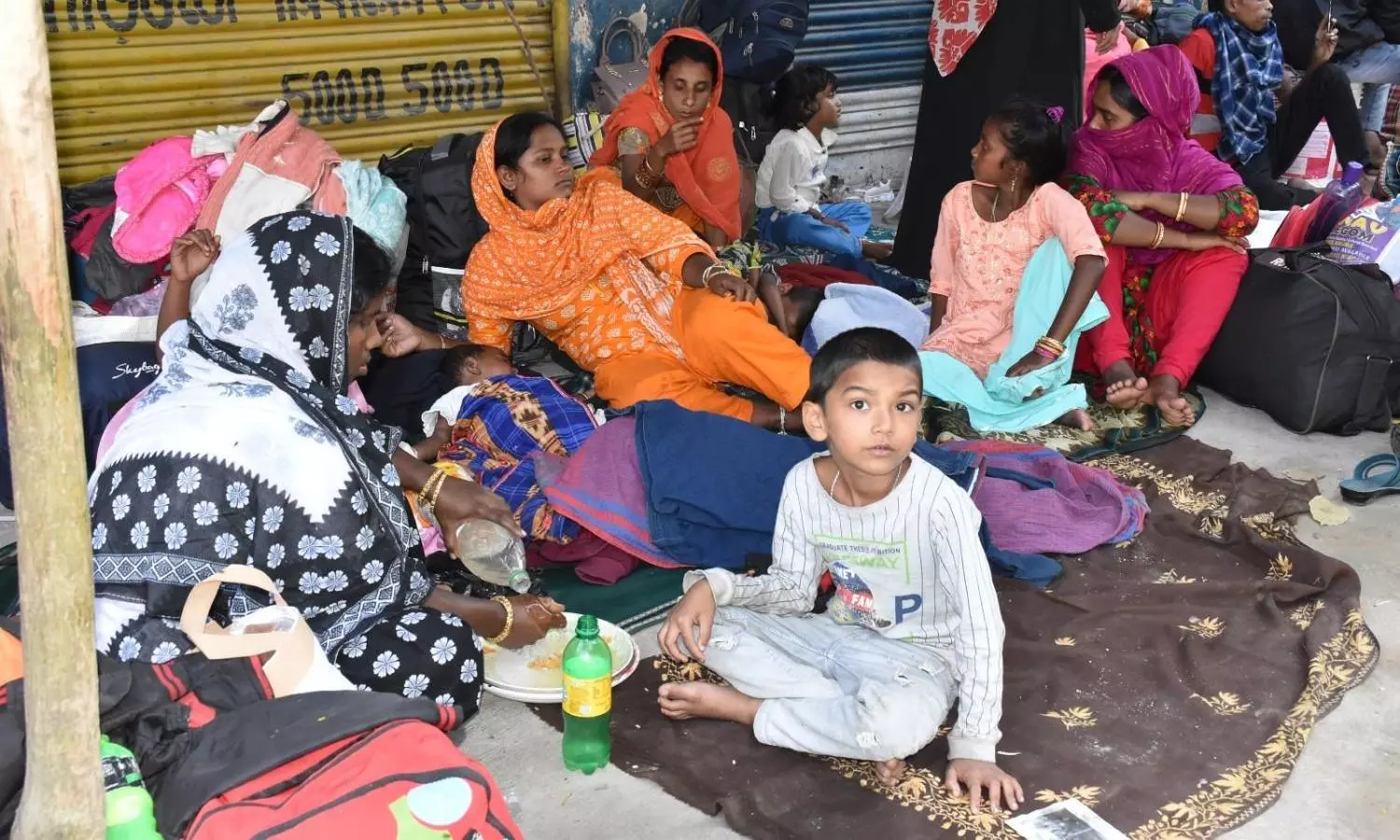
Since Sunday, November 16, the BSF has intercepted a few hundred Bangladeshi nationals at the Hakimpur check post near Swarupnagar in North 24 Parganas in West Bengal, as they attempted to cross back into Bangladesh.
The number of stranded individuals at Hakimpur, however, had "swelled to about 500" by Wednesday (November 19).
Largest batch
According to the officials, personnel of the force’s 143rd battalion had “detected the movement while monitoring a riverine stretch of the border” and detained the group, which had arrived in phases over the past three days.
The BSF described them as "the largest single batch of suspected undocumented Bangladeshi nationals intercepted this year".
Many of the Bangladeshi nationals and Rohingyas said they were leaving to avoid legal complications because of the statewide Special Intensive Review (SIR) of the electoral roll in Bengal
Among those detained were several Rohingyas as well. Most of the detainees admitted to the media that they had entered India “illegally” and had been living in areas around Kolkata such as Birati, Madhyamgram, Rajarhat, New Town and Salt Lake, where they worked as domestic helps, daily labourers or construction workers.
Fear of SIR
Notably, this journey back to Bangladesh appears to have begun since the SIR exercise began over the past month. The BSF has arrested in phases more than 90 Bangladeshi nationals and Rohingyas who were attempting to cross back through the same border.
Also Read: Why residents of former Bangladeshi enclaves are losing sleep over ongoing SIR in West Bengal
Many of the Bangladeshi nationals and Rohingyas said they were leaving to avoid legal complications because of the statewide Special Intensive Review (SIR) of the electoral roll in Bengal.
A female detainee, Taklima Khatun told The Federal, "I was staying in a rented house for more than a decade and working as domestic help. I have no documents. Now I want to return to Satkhira (which is just across the border in Bangladesh)."
Avoiding scrutiny
Another group stated they came to India driven by hunger or fear during political unrest in Bangladesh.
"We came to Dankuni two years ago for work…through a broker. Now with all this SIR strictness, we have to return home. My husband, my little daughter, and I have been waiting for two days. The BSF has taken our Bangladeshi papers," said another woman Rubina Bibi.
Sixty-year-old Abbas Ali shared, "Before Covid, I came to New Town through a broker. I worked as a mason. My wife worked as a domestic help. Our children are at home in Satkhira, Bangladesh. Then we suddenly heard that all documents will be checked. So, we decided to return. I have no Indian documents. I only have Bangladeshi ones."
Another detainee Samina Khatun told The Federal, "The BSF told us they will help us cross the Sonai river (that delineates the India-Bangladesh border in Hakimpur). Then we will go to our home in Khulna."
Migration not unusual
Kirity Roy, secretary of Banglar Manabadhikar Suraksha Mancha (MASUM), a West Bengal-based human rights group that documents state atrocities along the India-Bangladesh border, found nothing "unusual" about the movements of migrants at the Bengal border.
“Migration of people from either side of the border is not unusual, it has been happening for years. But the numbers are certainly not in lakhs or crores, as some sections try to claim,” said Roy.
"This time it has drawn attention because hundreds of people tried to cross the border at the same time, and unlike earlier, they did not do it clandestinely as they usually do," he said.
Roy, however, acknowledged that fear induced by the SIR could be one of the factors behind the sudden rush to cross the border.
Bithari-Hakimpur Gram Panchayat president Jesmina Parvin Sardar told The Federal over phone that there had been a steady trickle of people voluntarily turning themselves in before the BSF, ever since the government decided around June this year to "push back" illegal migrants without going through the legal process.
Pushback policy
A senior BSF official of the 143rd battalion confirmed this recent trend of people surrendering to the BSF ever since the "pushback" started. He said initially only a few people were approaching the BSF seeking to be pushed back.
Also Read: SIR in Bengal: How BJP is planning to leverage CAA to reassure refugees
"But the numbers started rising after the SIR was launched earlier this month," the official said. "It was then that we suddenly received instructions from the higher-ups to arrest those attempting to cross the border rather than push them back. During that period, we arrested more than 90 people over the course of a week or so."
The rationale behind the recent rush to cross the border via the pushback route became apparent as it gives migrants an opportunity to return to their homeland without being arrested or having to pay hefty amounts to touts. Photo: Jayanta shaw
The arrests suddenly choked the flow of reverse migration, prompting the BSF to revert to its earlier approach of pushing back migrants without going through the legal procedures that follow an arrest.
Soon after the "pushback" resumed, undocumented individuals once again began taking the so-called pushback route to return to Bangladesh. The BSF official noted that many of the Rohingyas who surrendered during this period were even carrying refugee identity cards issued by the UNHCR.
Chance to return
The rationale behind the recent rush to cross the border via the pushback route became apparent from the comments of some of the detainees.
"This has given us a rare opportunity to return to our homeland without being arrested or having to pay hefty amounts to touts," said Mehedi Hasan Ahmed, a 23-year-old visually impaired man.
He had come to India illegally with his parents twenty years ago for eye treatment and had never had the chance to return until now.
False narrative
The reverse migration, however, has fuelled social media narratives claiming that "lakhs of illegal Bangladeshis and Rohingyas are fleeing due to the SIR."
Police and BSF officials, in contrast, confirmed that only a few hundred individuals attempted to cross through this single border post, with no similar gatherings reported elsewhere along the Bengal frontier to suggest a large-scale exodus.
Also Read: West Bengal 'SIR deaths' spark political storm: TMC, BJP trade charges
“It is unfortunate that a false narrative is being circulated on social media and some television channels to support the state BJP’s claim that the SIR exercise is needed to purge millions of alleged illegal voters. In reality, only a small fraction of those leaving are doing so because of the SIR, and most of the roughly 500 detained individuals do not even possess Indian voter cards,” said Ranjit Sur, a senior member of the Association for the Protection of Democratic Rights (APDR).
BSF begins repatriation process
The BSF has set up tarpaulin shelters near the Hakimpur check-point, and is processing documents before repatriation.
Officials confirmed that they are “checking Bangladeshi documents” and, when found, “seizing any Indian documents” like Aadhaar or voter ID obtained through illegal means.
The detainees are being “repatriated” in a batch of 80 people at a time after collecting and uploading their biometric data in the home ministry’s Foreigners Identification Portal (FIP).