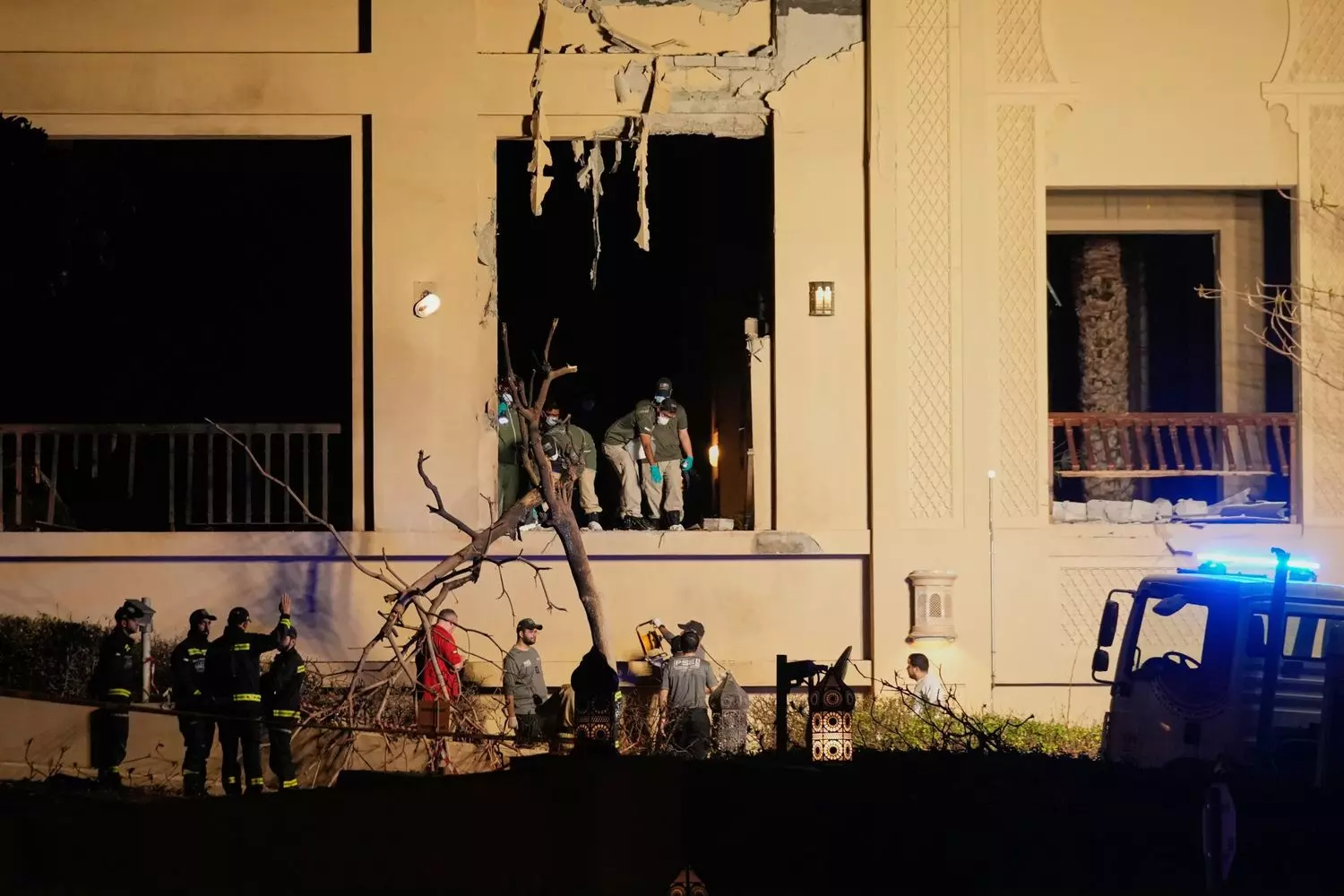
Rescue workers comb through the wreckage at Fairmont The Palm, Dubai, as smoke settles over one of the city's most iconic addresses. A photo taken on Saturday. (AP/PTI)
When missiles fall in the Gulf, why Kerala holds its breath
The US-Israel offensive on Iran is not distant geopolitics for Kerala; it hits home — economically, socially and psychologically

For many in Kerala, the Gulf is not abroad, but an extension of home. That is why developments in West Asia resonate so deeply here. The war may be fought elsewhere, but its echoes are heard in Kerala’s courtyards, banks and even marketplaces.
When reports emerged of a coordinated United States–Israel military offensive on Iran, followed by retaliatory strikes and security alerts across parts of the Gulf Cooperation Council region, the reaction in Kerala was immediate and visceral. This was not treated as a distant geopolitical risk but as a personal risk.
Pinarayi blasts 'rogue nations' US-Israel
That urgency found political articulation quickly. Chief Minister Pinarayi Vijayan became one of the first state leaders in the country to publicly condemn what he described as US–Israeli aggression. In a strongly worded response delivered at the Wayanad rehabilitation house handover ceremony, he questioned both the legality and the morality of the offensive.
This crisis has been precipitated by the reckless actions of American imperialism, with Israel standing alongside it. These two rogue nations together are responsible for what is unfolding now
“Our concern is that lakhs of our brothers and sisters are living in the Gulf countries, and today they find themselves in a deeply insecure situation. This crisis has been precipitated by the reckless actions of American imperialism, with Israel standing alongside it. These two rogue nations together are responsible for what is unfolding now. I have written to the Prime Minister seeking urgent intervention. At this moment, we must collectively register our strong opposition to such actions. A country has gone to the extent of assassinating the individual it regards as its supreme leader, killing him in his own home along with members of his family. How many such acts of aggression have we witnessed? What justification is being offered to the world? These are matters of global concern, and we must be prepared to condemn them without ambiguity.” Pinarayi Vijayan said.
Also Read: By striking Iran, Trump and Netanyahu make a mockery of global order
His statement, unusually direct for a state leader on an international conflict, reflects the depth of Kerala’s material and emotional stakes in the region.
Why Gulf matters for Keralites?
Kerala’s post-1970s social transformation is inseparable from Gulf migration. Lakhs of Malayalis work across Saudi Arabia, the United Arab Emirates, Qatar, Oman, Kuwait and Bahrain. They are employed in construction, oil and gas, healthcare, retail, logistics, hospitality and domestic services. Remittances sent back home have underwritten household consumption, private education, real estate growth and banking deposits across districts from Kasaragod to Thiruvananthapuram.
Panic all across the state
When tensions escalate in West Asia, that entire architecture feels fragile. On the day retaliatory reports began circulating, people across Kerala were, in effect, hitting the panic button. Social media timelines were flooded with anxious messages. WhatsApp groups of families with relatives in Dubai, Doha or Dammam lit up with questions. Airline websites were checked repeatedly. Parents waited for calls.
Also Read: Why did Iran bomb its neighbours? Do Dubai, Abu Dhabi have US military bases?
In many newsrooms across the state, the first reflex was not to consult foreign policy experts but to reach out to friends and contacts in the Middle East.
'GCC countries were pre-warned'
“As of now, everything seems to be okay. We had prior information and warnings from the government. Offices are not functioning. Schools are closed. As journalists, we had to work, but for others, the situation is like that. It seems Iran had pre-warned the GCC countries, and that’s how they could minimise the casualties,” a Doha-based journalist working with an international television network told this correspondent.
It is not an exaggeration to say that a war in the Gulf is also a war against Kerala. Though Kerala is not a military target, its people, economy and social structure are deeply intertwined with that region
That ground-level account captures the peculiar duality of such crises. On one hand, there is visible disruption. Schools shut. Offices closed. Heightened security. On the other, a managed attempt by Gulf governments to prevent panic and limit casualties. For Malayali families back home, however, nuance offers little comfort. The uncertainty alone is enough to unsettle.
“In the Middle East, Iran is not seen purely through direct regional hostility. The positions of several countries are shaped by their strategic alliances with the United States, and that is why American military bases in these nations have become primary targets,'' says Saji Markose, a Bahrain-based professional, from Kerala.
'Civilians need not worry for time being'
“Iran has limited avenues for retaliation and cannot strike the US mainland. As indicated earlier, its response has focused on US military installations operating in the region, not on civilian areas. For now, civilians in these countries need not panic. At the same time, the conflict must not be prolonged. A drawn-out war would only deepen provocation and widen the consequences. The only hope is that it ends quickly”, added Markose.
Where it hurts for Kerala
Apart from the immediate panic and fear, the economic implications of the conflict are layered and potentially severe.
If military escalation disrupts oil installations, port operations or business activity in the GCC, employment contracts may be suspended or terminated
Kerala has historically received a significant share of India’s total remittance inflows. In several years, remittances into the state have rivalled or exceeded its own revenue receipts. Entire local economies, especially in northern districts, are structured around Gulf income.
“If military escalation disrupts oil installations, port operations or business activity in the GCC, employment contracts may be suspended or terminated. Even temporary delays in salary payments can ripple through Kerala’s financial system. Bank deposits could slow. Loan repayments might falter. Consumer spending may contract,” Abdul Lathif from Malappuram district, who works in the banking sector with the Government of Qatar, told The Federal.
Return migration looming?
There is also the spectre of return migration. Kerala has confronted this scenario before during the 1990–91 Gulf crisis, when large numbers of expatriates were evacuated. Reintegration is rarely smooth. Skills acquired abroad do not always align with local labour market needs. Incomes fall. Debt burdens become heavier. Families accustomed to Gulf remittance levels struggle to recalibrate.
Should the present conflict deepen and compel large- scale repatriation, the state’s labour market and welfare systems would face renewed strain. Many households have structured their financial lives around the assumption of stable Gulf earnings. Housing loans, educational commitments and family expenses are often tied to that monthly transfer from abroad.
'Gulf migration has reshaped Kerala's landscape'
Beyond the balance sheets lies a sociocultural dimension. Gulf migration has reshaped Kerala’s landscape. Remittance-funded homes, schools, hospitals and religious institutions stand as visible markers of this transnational link. The so-called Gulf Malayali identity is not peripheral but central to the state’s contemporary self- image.
“It is not an exaggeration to say that a war in the Gulf is also a war against Kerala. Though Kerala is not a military target, its people, economy and social structure are deeply intertwined with that region. Even if bombs fall there, their shockwaves reach here in the form of reduced remittances, rising fuel prices, job insecurity, family anxieties and shattered dreams, scorching Kerala in indirect but real ways,” says social scientist and political commentator Dr T T Sreekumar.
'Peace in the Gulf is peace for Kerala'
“This is the reality of globalisation: wars no longer remain confined to maps. They spread through supply chains, migration networks, emotional bonds and economic structures. Kerala’s history of close engagement with the Gulf is a powerful example of this interconnectedness. Therefore, peace in the Gulf is peace for Kerala; war there becomes a lived and unsettling reality here,” he wrote on Facebook .
For now, reports from the ground in parts of the GCC suggest controlled disruption rather than chaos.
The aviation sector too faces vulnerability. Kerala’s airports at Kochi, Kozhikode, Kannur and Thiruvananthapuram handle some of the highest volumes of Gulf-bound traffic in India. Airspace restrictions, flight cancellations or security advisories would disrupt both passenger travel and cargo flows.
For now, reports from the ground in parts of the GCC suggest controlled disruption rather than chaos. Governments appear to be taking precautionary measures. Yet the very fact that schools close and offices suspend operations is enough to send waves of anxiety across Kerala.
The US–Israel offensive on Iran and the retaliatory tremors affect remittance flows, fuel prices, job security and family stability.
That is why the chief minister’s intervention was not merely ideological positioning. It was also reflective of an electorate whose lives are entwined with the Gulf.