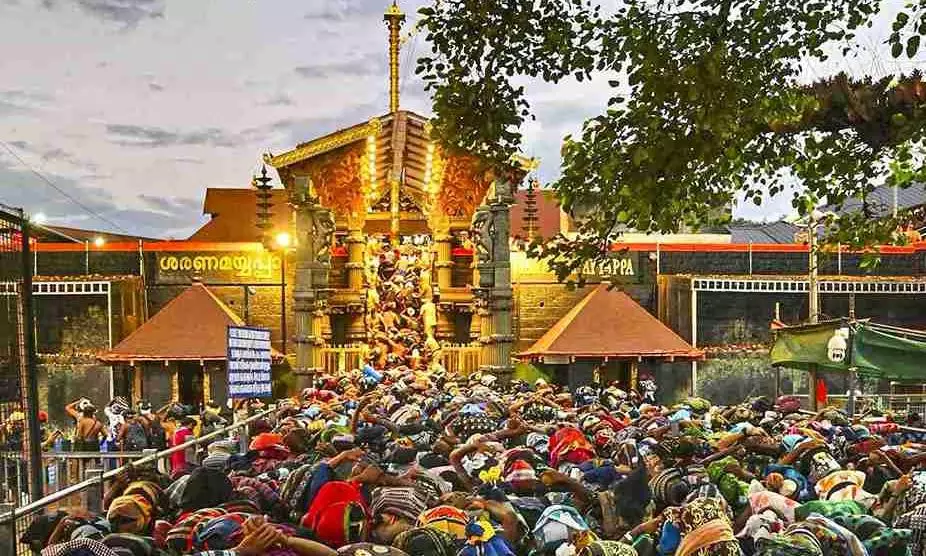
Sabarimala: Kerala govt cites ‘2007 stance’ to seek scholar panel for review of rituals
In legal submission to SC, LDF govt emphasises that judicial review of long-standing religious practices must involve 'eminent' voices

The Kerala government has told the Supreme Court that any judicial review of long-standing religious practices must follow wide consultation with religious scholars and social reformers, a position that appears to reaffirm rather than reverse its earlier stance on the contentious question of women’s entry into the state-based Sabarimala shrine.
In its written submission filed before the court in the pending review proceedings linked to the Sabarimala verdict, the state said that when courts examine religious practices that have existed for generations and are tied to the beliefs and values of devotees, the process must involve consultation with experts from within the faith and voices from social reform movements.
Also read: Sabarimala tantri arrest sparks Congress-CPM clash over gold case: 'Deliberately trapped'
The submission (see image below), filed on behalf of the state government, stresses that an informed decision must come after assessing such opinions.
'Judicial review must be after wide consultation'
“For and on behalf of the State of Kerala, any judicial review into any religious practice followed for so many years connected with the belief and values accepted by the people must be after wide consultation with and after soliciting views of eminent religious scholars and reputed social reformers of that religion,” the written submission stated.
The government further said that the court may consider the views of such scholars and reformers before arriving at a final decision, recalling earlier discussions on the issue of women’s entry to the Sabarimala temple.
The submission also referred to the state’s position expressed in 2007, when it had suggested that the court could appoint a commission of eminent scholars with authentic knowledge in Hinduism, along with reputed and uncorrupt social reformers, to examine whether women of all ages should be allowed to enter the temple and worship.
The emphasis on consultation with scholars and reformers has become the centre of political debate in Kerala in recent days, with opposition parties accusing the government of diluting its earlier stand on the entry of women of all age groups to Sabarimala.
Also read: Sabarimala case in SC: What is Kerala govt's stand now
However, the state government and the ruling party insist that there has been no shift in their position.
State Devaswoms Minister VN Vasavan said the government continues to hold the same view it had expressed earlier in court. “Decisions related to temple entry should be taken by an expert committee that includes scholars well-versed in matters of temple customs and rituals. The government had informed the Supreme Court of this position through an affidavit in 2007. The government has always adopted a stand that safeguards the interests of devotees,” he said.
According to the minister, the present submission only reiterates what had already been communicated to the court earlier.
Govt hasn't changed position: Minister
“It cannot be said that the government has changed its position on the entry of young women into Sabarimala. This was already conveyed to the Supreme Court in 2007,” he said.
The review proceedings in the Supreme Court arise from the landmark 2018 verdict, which held that the exclusion of women between the ages of 10 and 50 from the Sabarimala temple was unconstitutional. The court had struck down Rule 3(b) of the Kerala Hindu Places of Public Worship (Authorisation of Entry) Rules, 1965, holding that it violated the fundamental right of women to practise religion.
The present written submission does not directly argue for or against the entry of women of a particular age group. Instead, it focuses on broader constitutional questions that the Supreme Court has framed for consideration while examining the review petitions.
Scope of Article 25
Among the issues the court is examining are the scope of the right to freedom of religion under Article 25 of the Constitution, the relationship between the rights of individuals and those of religious denominations, and the extent to which courts can review religious practices.
The state submission notes that the article guarantees freedom of conscience and the right to profess, practise and propagate religion, while also making the right subject to restrictions based on public order, morality, health and other constitutional provisions.
Also read: PM Modi vows action on Sabarimala gold loss if BJP forms govt in Kerala
It also discusses the interplay between articles 25 and 26, which deal with individual religious freedom and the rights of religious denominations to manage their affairs.
The submission also emphasises that when courts examine whether a particular practice is an essential part of religion, the test should be whether the community that follows the religion genuinely regards it as integral to its beliefs.
“What constitutes the essential part of a religion has to be primarily ascertained with reference to the doctrines of the religion itself,” the submission states, adding that the court must consider whether a belief is genuinely and conscientiously held as part of the practice of religion.
The government also points out that judicial review in matters of faith should not be guided by whether a practice appears reasonable or appealing to sentiment.
Instead, the court should determine whether it forms part of the religious belief of the community.
The submission also noted that public interest litigation allows citizens to approach courts in matters of public injury or the enforcement of constitutional rights. At the same time, it suggested that a person who does not belong to a particular religious group may not normally have sufficient interest to challenge its practices, except in cases involving grave human rights violations.
Also read: Kerala politics on the boil as Sabarimala case explodes; arrested priest in hospital
The state’s ruling Communist Party of India (Marxist) also maintained that the government’s legal stand remains unchanged. The party’s state secretary, M V Govindan, said the current proceedings before the Supreme Court do not directly revolve around the question of whether women should be allowed entry to Sabarimala.
'Answering seven specific questions'
“The question before the Supreme Court is not whether women should be allowed entry or not. It is about answering seven specific questions,” he said.
Govindan also pointed out that the issues raised by the court concern broader constitutional principles affecting multiple religions and not just Sabarimala.
“Among those seven questions, there is no question asking whether women’s entry should be allowed or not. What the court is undertaking is a constitutional examination. It concerns all religious denominations,” he said.
Opposition UDF cites poll compulsions for ruling front
However, the opposition United Democratic Front believes the government is attempting to shield itself from the anger of devotees ahead of the upcoming Assembly elections.
“Now that the Assembly election is approaching, the chief minister and the party are gripped by the fear of losing power. It is at this moment that the concerns of devotees and the protection of faith and customs have suddenly come to their minds. Everyone in Kerala knows that this realisation after 10 years has come only with the election in sight and with the intention of securing votes,” said senior Congress leader and MLA Ramesh Chennithala.
Also read: Kerala's U-turn: TDB to tell SC it wants Sabarimala's traditions restored
The written submission by the state, therefore, appears to frame the government’s position within a wider constitutional context rather than taking a fresh stand on the immediate issue of women’s entry. By referring back to its earlier affidavits and reiterating the need for consultation with scholars and reformers, the state has sought to argue that its present stance is consistent with what it had stated before the court nearly two decades ago.
Whether that explanation will settle the political debate in Kerala remains to be seen. For now, the state government maintains that there has been no change in its position, even as the constitutional questions surrounding the Sabarimala case continue to await final resolution in the Supreme Court.