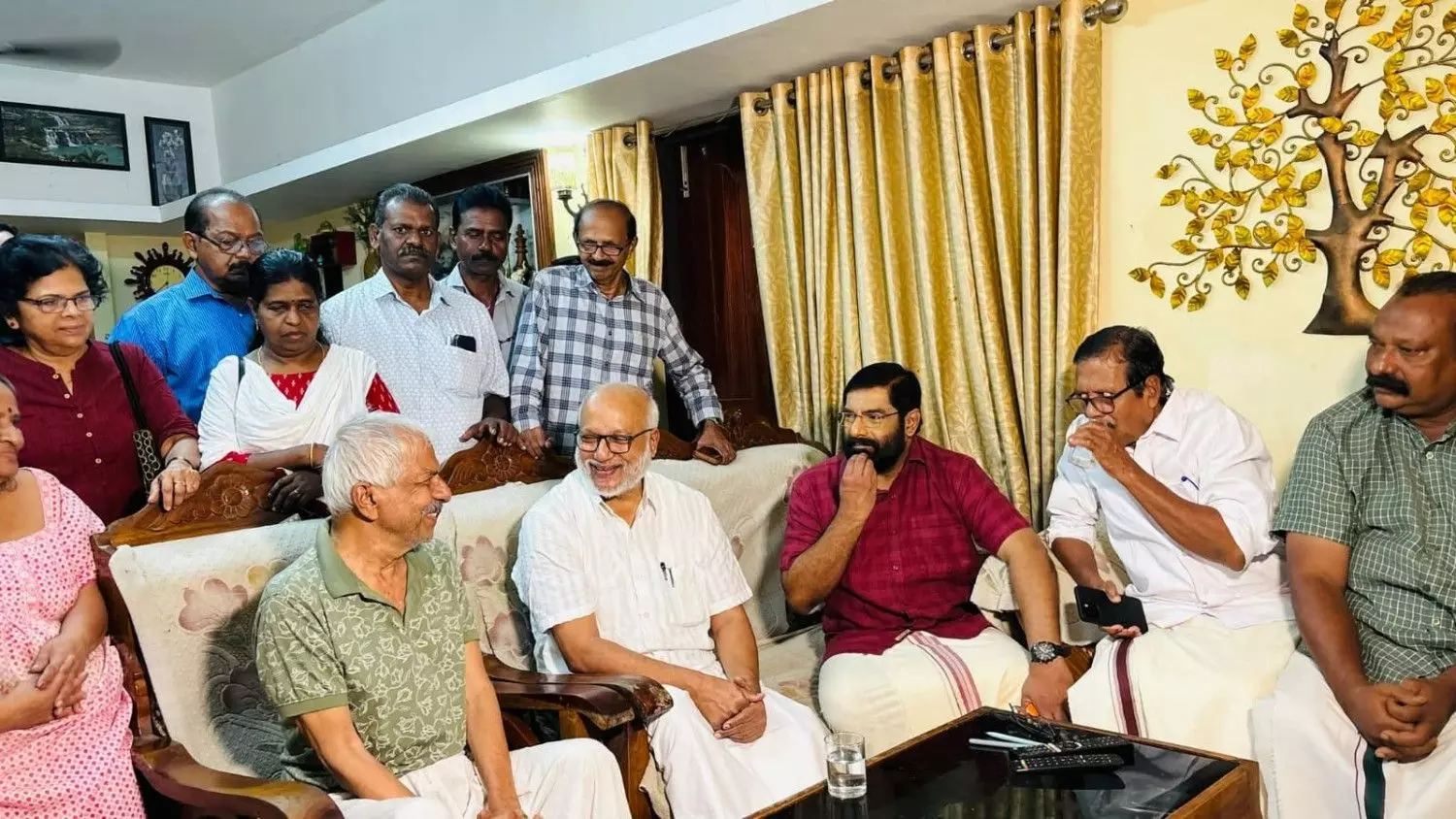
General Secretary of CPI(M), MA Baby (4th right), and others interact with members of a family during the party's ‘Griha Samparkam’ house-to-house outreach campaign.
CPI(M) launches house-to-house campaign to reconnect with voters
During its ‘Griha Samparkam’ outreach programme, CPI(M) leaders have been told not to argue with people, not to interrupt them, and to respond patiently even to harsh criticism.

VM Prakashan, 61, a CPI(M) branch secretary in Thrissur district, once prided himself on knowing every voter in his booth and most in the neighbouring ones. For decades, his calculations on election day rarely went wrong. “We could predict our vote share with minimum error,” he recalls. “That confidence is gone now.”
His final realisation came in the 2024 Lok Sabha election. In his own ward, BJP candidate Suresh Gopi took the lead. The UDF came second. CPI(M) slipped to third. What shocked Prakashan most was that the party’s internal assessment had shown a comfortable lead of 176 votes. “We had no idea what was happening on the ground,” he admits.
Also read: Battle for Kerala Congress: Why every ruling front wants a slice of the party
Prakashan speaks with unusual candour about why. “I should admit that we have lost our connect with the new generation. Even though we have SFI units, Generation Z voters are strangers to us. So are flat dwellers. Many residents’ associations do not allow local politicians to enter. This is not just our problem. The Congress also faces it.”
House-to-house outreach campaign
It is this growing disconnect between party structures and everyday voters that has driven the CPI(M) to launch its ‘Griha Samparkam’ house-to-house outreach campaign. From senior leaders to grassroots workers, party cadres are visiting homes across Kerala until January 25, ahead of the LDF campaign marches led by MV Govindan, Binoy Viswam and Jose K Mani, which will begin on February 1 in three regions of the state covering all Assembly constituencies
Behind the public image of leaders knocking on doors lies a carefully drafted internal code of conduct. The party leadership has issued detailed instructions to ensure that the outreach does not appear arrogant, defensive or confrontational.
Standard responses to sensitive questions
Anticipating sensitive questions, the CPI(M) has also prepared its leaders with standard responses on controversial issues, including Sabarimala. According to an internal circular issued for the house visit campaign, leaders are instructed to explain that when the Sabarimala case reached the High Court, the government itself took the position that a special police team under court supervision would be the best way to ensure a fair investigation. The court, the party note says, not only supervised the process but also selected the team members and reviewed the progress of the probe. The High Court, the circular reminds cadres, has observed that the investigation is proceeding in the right direction.
Also read: Kerala Congress (M) rules out UDF return, stays with LDF
The party leadership believes that such prepared responses are essential to counter what it sees as politically motivated narratives built around emotive issues. Leaders are told not to sound defensive but confident, factual and calm while responding.
Opposition’s charge
At the same time, the CPI(M) is keen to draw a clear distinction between its political outreach and the government’s own door-to-door exercise, the Rs 20 crore participatory New Kerala Initiative survey. The government programme, officials say, is meant to collect public feedback on development priorities, welfare delivery and future planning, and to help shape Kerala’s roadmap towards 2031.
CPI(M) leaders during the party's ‘Griha Samparkam’ programme.
However, this distinction has not convinced the Opposition. The house visit campaign comes amid sustained allegations by the UDF that government programmes and funds are being subtly used to support the ruling party's campaigning. The Opposition argues that when government-sponsored surveys and party-led door-knocking happen in parallel, the boundary between governance and politics becomes blurred for ordinary citizens.
CPI(M) leaders reject this charge, insisting that the party campaign is entirely organisational and funded by the party, while the government initiative is administrative in nature. Yet even within the party, there is an acknowledgement that perception matters as much as intent in an election year.
‘People not angry, but distant’
For many cadres, the campaign is also an exercise in humility. The detailed behavioural guidelines, the prepared political explanations, and the emphasis on listening rather than lecturing signal a party that knows it is no longer speaking from a position of unquestioned dominance.
Also read: Kerala Cong (M) staying in LDF won't affect UDF: Muslim League's Kunhalikutty
As Prakashan reflects after another day of visits, “People are not angry. But they are distant. That is more dangerous.”
The CPI(M) hopes that through thousands of such quiet conversations across Kerala, that distance can be reduced. Whether it will translate into votes remains uncertain. But for the party that once built its strength on intimate neighbourhood connections, ‘Griha Samparkam’ is less about winning arguments and more about rediscovering its lost closeness with the people it claims to represent.
No arguments with people
Leaders have been told not to argue with people, not to interrupt them, and to respond patiently even to harsh criticism. They are instructed to enter houses in small teams, preferably with someone known to the family. Sitting inside the house and talking calmly is encouraged over standing at the gate. Respect must be shown to the head of the household, while making sure every member is heard. Conversations should be shaped by an understanding of the family’s background.
The party suggests beginning discussions with the recent local body election results. In areas where the party suffered defeats, leaders are asked to openly ask why it happened. In politically active households, the broader election atmosphere can be discussed. People should be encouraged to express their opinions about the party, and leaders must listen without interruption. Criticism is not to be resisted but welcomed.
The instructions go further. Leaders are urged to reopen dialogue with former comrades who drifted away from the party, and to maintain continuous contact with such households. They are also asked to clearly explain that criticism of communal organisations is not hatred towards any religion. Opposition to the RSS, the Jamaat-e-Islami or the Muslim League, the party says, must be explained as political opposition, not religious hostility. Leaders are warned to be alert to hate campaigns by extremist groups and to counter them carefully and responsibly.
Party says response is encouraging
While the Opposition continues to accuse the CPI(M) of masking political campaigning as governance outreach, party leaders insist the response on the ground has been encouraging.
Also read: Sabarimala gold loss probe: SIT arrests chief priest in fresh case
“People are welcoming us,” says KV Abdulkhader, CPI(M) Thrissur district secretary and former three-time MLA from Guruvayur. “They mainly raise neighbourhood issues, and of course politics also comes up. The misinformation campaign by the UDF and its affiliates about a non-existent CPM-BJP deal, the PM SHRI controversy and the Sabarimala issue is discussed everywhere. Overall, it seems we are able to politically convince many of them.”
Meeting 83 families on first day
In Palakkad, former MP Krishnadas NN echoes the same optimism. “On the first day alone, we met 83 families. It is very positive. People are talking openly,” he says.
For leaders like Prakashan, ‘Griha Samparkam’ is not merely a political exercise. It is an admission of loss. Loss of familiarity, loss of instinct, loss of everyday presence in people’s lives. “Earlier, people waited for us to come,” he says. “Now we are learning how to knock again.”
In Kerala’s tightly fought political landscape, where margins are thin and loyalties are shifting, the CPI(M) knows that ideology alone no longer guarantees votes. The party is now betting on conversation, humility and patient listening to recover what it once took for granted: the confidence of the ordinary voter.