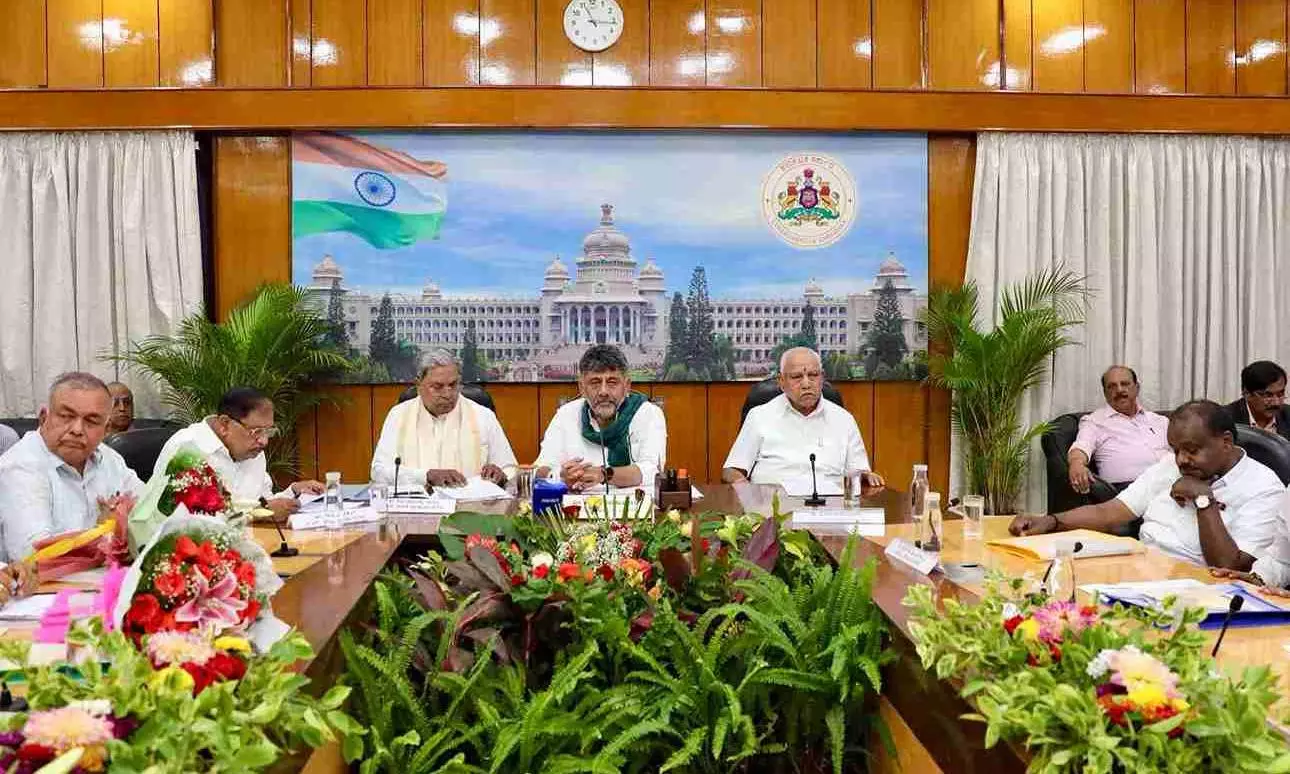
United on Cauvery: Shivakumar scores a win as all Karnataka parties back Mekedatu
In a major political success for Shivakumar, meeting attendees unanimously declare that Mekedatu project is the only long-term solution to Cauvery dispute

In a rare show of political unity, Karnataka’s all-party meeting on the Cauvery water dispute concluded that the Mekedatu balancing reservoir project was the only permanent solution to the long-running water-sharing conflict with Tamil Nadu.
The meeting, chaired by Chief Minister DK Shivakumar, also turned out to be a political success for him, with leaders across party lines extending their support to his efforts. The meeting also noted a positive development—recent rainfall leading to an increase in inflows into the state’s major reservoirs. Although the inflow remains below normal due to the rainfall deficit, it has provided some relief amid the drought situation.
Mekedatu only solution
Former chief ministers, Union ministers, senior leaders from the Congress, BJP and JD(S), and legal experts agreed that temporary distress-sharing formulas cannot permanently solve the Cauvery dispute. The leaders said the Mekedatu balancing reservoir would allow Karnataka to store excess water whenever the Kabini and Krishna Raja Sagar (KRS) reservoirs are full, instead of letting it flow downstream. This stored water could later be released during dry periods.
Also read: Cauvery water row: Shivakumar urges Karnataka farmers to drop Aug 13 protest; Vijay defers visit
They also said that during years of monsoon deficiency, the planned Mekedatu reservoir would make it easier for Karnataka to supply Tamil Nadu’s allocated share of water while protecting the state’s own drinking water and irrigation needs. Hence, the meeting unanimously declared that the Mekedatu project was the only long-term solution to the Cauvery dispute.
All political parties urged the state government to immediately rectify the technical shortcomings in the Detailed Project Report (DPR) and obtain the Centre’s approval at the earliest.
Major political success for Shivakumar
The meeting was also seen as a significant political achievement for Shivakumar, who has been leading Karnataka’s campaign for the Mekedatu project for several years.
Senior BJP leader and former chief minister BS Yediyurappa, Union minister and JD(S) leader HD Kumaraswamy, along with leaders from other political parties, former chief minister Siddaramaiah, central ministers V Somanna, Shobha Karandlaje, and others appreciated Shivakumar for convening the all-party meeting.
Also read: Can Karnataka build Mekedatu without Tamil Nadu's nod? What expert says
They assured him of their support in protecting Karnataka’s interests in the Cauvery dispute and offered suggestions on how the state should balance its legal battle with political engagement with Tamil Nadu. The meeting projected a united Karnataka, with both the ruling and Opposition parties standing together on the Cauvery issue.
Karnataka faces severe drought
Speaking after the meeting, Shivakumar said Karnataka had received 30–35 per cent below-normal rainfall this year, creating severe drought conditions. Tamil Nadu had demanded 9 TMC (thousand million cubic feet) of water, while the Cauvery Water Regulation Committee (CWRC) and the Cauvery Water Management Authority (CWMA) directed Karnataka to release 3,500 cusecs of water every day.
“Recent rains have increased inflows into the Kabini, KRS, Hemavathi and Harangi reservoirs to a combined 68,314 cusecs. According to the existing schedule, Karnataka should have released 40 TMC of water to Tamil Nadu by this stage. However, due to the poor monsoon, the state has released only 3.6 TMC so far—2.9 TMC in June and 0.7 TMC in July, including water released for the safety of the Kabini reservoir,” he said.
The government made it clear that it would not sacrifice the interests of farmers in the Cauvery basin, he added.
Drinking water gets top priority
The all-party meeting decided that 40 TMC of water should be reserved in Karnataka’s reservoirs exclusively for drinking water needs. The available water will first be used for drinking purposes and to fill lakes and tanks.
Also read: 'Keep Mekedatu separate, focus on Cauvery share now': Expert on upcoming Vijay-DKS talks
The government has also advised farmers not to take up fresh sowing until further directions are issued. By the end of August, rainfall and crop damage reports will be collected from all taluks, after which drought-hit taluks will be officially notified following Cabinet approval and the Centre’s guidelines.
Legal battle and dialogue with Tamil Nadu
The Karnataka government has decided to challenge the CWMA’s directions in the Supreme Court. It will engage senior legal experts and seek advice from water experts to prepare a scientific distress-sharing formula.
At the same time, the government said it was willing to resolve the issue through dialogue with Tamil Nadu Chief Minister C Joseph Vijay. Due to the current tension over the Cauvery issue, Vijay has postponed his proposed visit to Karnataka at the request of the state government. Discussions between the two leaders are expected once the situation improves.
The government also appealed to organisations to withdraw the proposed Karnataka bandh on August 13, saying there was no need for protests as the state itself is fighting the legal battle on behalf of Karnataka’s farmers. “We are witnessing deficit rainfall. We have requested farmers to be patient till we give them guidelines,” he said.
Also read: TN will turn into desert if Karnataka builds Mekedatu Dam: Vijay govt in Assembly
He said the CWMA and the CWRC had directed Karnataka to release 3,500 cusecs of water to Tamil Nadu. “Our dams were not full and there was no rain. Today, there has been some rain and the situation has become slightly better. Kabini is now full. Karnataka had received only about 35 per cent of its normal rainfall so far this year.
Positive sign
Shivakumar said Karnataka had released around 19.9 TMC of water in June last year, compared with only about 2.30 TMC this year. In July last year, the state released around 31 TMC, whereas this year only around 3.6 TMC had been released. “Against the expected release of nearly 40 TMC by July, we have been able to release only around 3.6 TMC because of the severe shortage,” he said.
He said Karnataka had initially refrained from releasing water from its reservoirs, but improved inflows and the need to ensure dam safety had compelled the government to release a limited quantity downstream after maintaining safe reservoir levels.
Also read: Karnataka’s Mekedatu project does not require consent from other states: Centre
He said inflows into reservoirs had improved in recent days, with around 24,000 cusecs entering the reservoirs, including nearly 22,000 cusecs flowing into the KRS reservoir. However, rainfall had reduced slightly since Saturday (August 1) afternoon, while the Kabini reservoir was receiving around 11,000 cusecs of inflows.