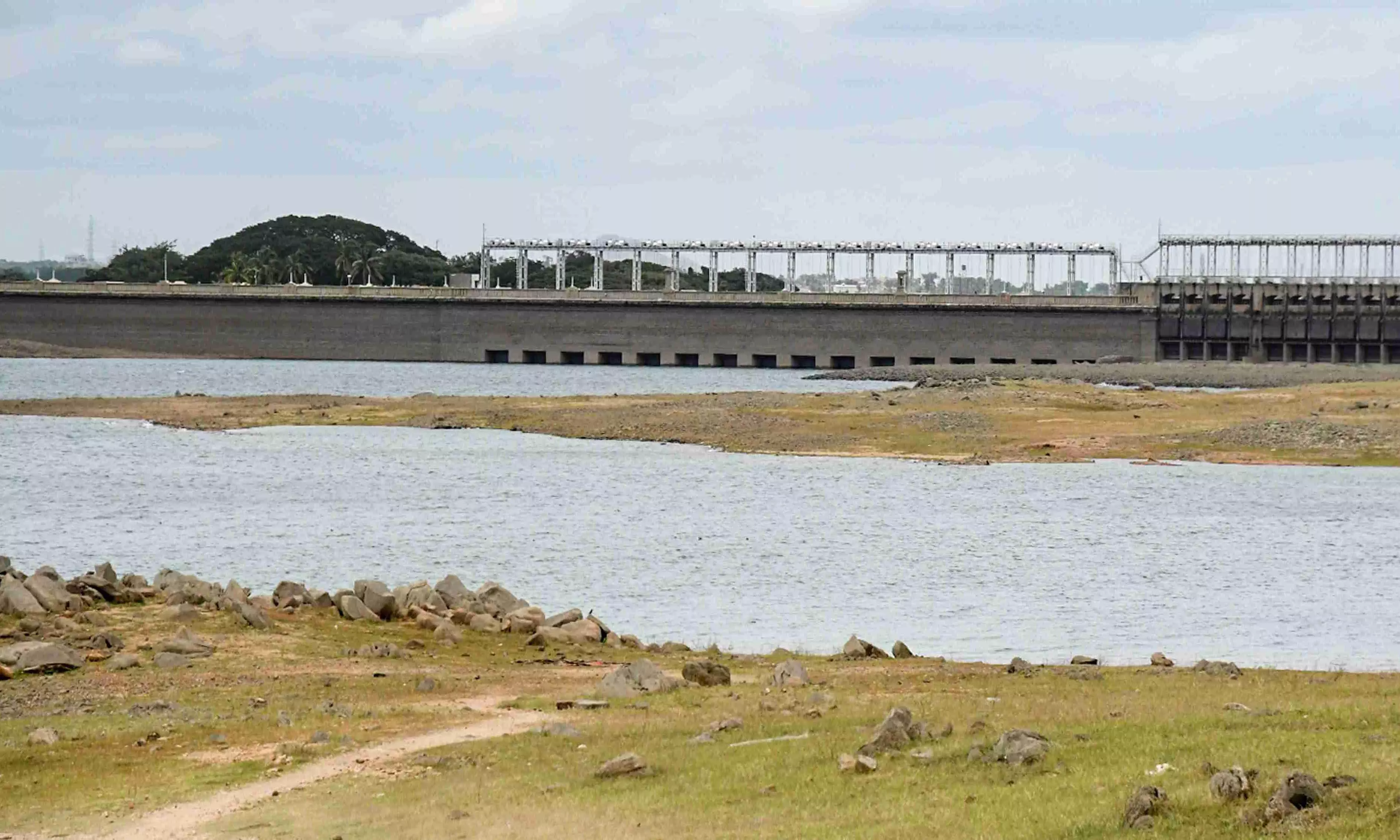
Historically, major reservoirs such as the Krishnaraja Sagar (KRS) Dam and the Kabini Dam were constructed after obtaining the approval of the Madras government under the 1924 agreement. A view of the Krishnaraja Sagar (KRS) reservoir in Mandya district, Karnataka. Photo: PTI
Can Karnataka build Mekedatu without Tamil Nadu's nod? What expert says
Senior journalist Ramakrishnan says the Centre's reply has skipped part of the Cauvery Tribunal award while ignoring Karnataka's duty to release water downstream

Union Jal Shakti Minister Raj Bhushan Choudhary's recent assertion that Karnataka does not require the consent of Tamil Nadu, Kerala or Puducherry to build the proposed Mekedatu reservoir has reignited the decades-old Cauvery dispute. While the statement has been welcomed in Karnataka, some experts argue that the legal position is far more nuanced than the minister's interpretation suggests.
Speaking to The Federal, senior journalist T Ramakrishnan, who has tracked the Cauvery dispute for decades, said the Union minister's remarks rely only on one part of the Cauvery Water Disputes Tribunal (CWDT) award while overlooking the conditions that govern Karnataka's right to undertake new projects.
Also read: Cauvery row flares up: Shivakumar urges Vijay to defer Bengaluru visit; Karnataka bandh on Aug 13
"The minister has taken only one interpretation of the legal position with a limited view of the factual and legal issues. He is relying on Clause 13 of the Tribunal's final award. However, the latter part clearly says Karnataka can construct projects only 'in a manner not inconsistent with the order of the Tribunal'," Ramakrishnan said.
Clause 13 of Tribunal’s award
According to Ramakrishnan, the Tribunal does recognise Karnataka's right to build reservoirs and utilise its allocated share of Cauvery waters. However, that right is conditional and cannot override the state's obligations under the Tribunal award.
One of the most important conditions, he said, is Karnataka's obligation to ensure the annual release of 177.25 thousand million cubic feet (TMC ft) of water to Tamil Nadu at Biligundlu, the interstate border point.
"The permission to construct a dam anywhere within Karnataka does not free the state from complying with the Tribunal's directions. It must first honour every obligation imposed under the award. Therefore, it would be incorrect to read the award as giving Karnataka unrestricted freedom to proceed with the Mekedatu project," he said.
Ramakrishnan also pointed to Clause 11 of the Tribunal award, which states that upper riparian states should not take any action that affects scheduled water deliveries to lower riparian states.
Also read: 'Keep Mekedatu separate, focus on Cauvery share now': Expert on upcoming Vijay-DKS talks
"Karnataka and Kerala are the upper riparian states. The Tribunal clearly says they should not take any action that affects scheduled deliveries downstream. That qualification is crucial while interpreting the legality of Mekedatu," he said.
What did the Supreme Court say?
The expert also addressed the argument that the 2018 Supreme Court judgment gave Karnataka greater freedom to pursue the project.
According to him, the Supreme Court did not rewrite the Tribunal award but only modified certain allocations after hearing appeals from the basin states.
"The judgment substantially reiterates the Tribunal's conclusions. It dealt only with specific grievances against the 2007 final award. Except for modifying certain water allocations, the legal framework laid down by the Tribunal continues to remain valid," he explained.
How the consent issue evolved
The debate over whether Karnataka requires Tamil Nadu's consent is rooted in the 1924 agreement between the erstwhile Mysore State and the Madras Presidency.
That agreement required Mysore to obtain Madras' approval before constructing certain reservoirs. Karnataka has long argued that the provision was unfair because the Madras Presidency did not require Mysore's consent for projects within its own territory. "The consent clause gradually became one of Karnataka's biggest political grievances," Ramakrishnan said.
The Tribunal later superseded both the 1892 and 1924 agreements, with Clause 3 of its final award stating that the earlier agreements would no longer govern the Cauvery system.
"However, merely because those agreements have been superseded does not mean every underlying principle disappears. Similarly, the first part of Clause 13 cannot be interpreted as granting Karnataka absolute freedom to utilise Cauvery waters in any manner it chooses," he added.
Historical disputes over dams
Historically, major reservoirs such as the Krishnaraja Sagar (KRS) Dam and the Kabini Dam were constructed after obtaining the approval of the Madras government under the 1924 agreement.
The dispute sharpened during the tenure of former Karnataka Chief Minister D Devaraj Urs, who argued that Karnataka no longer needed Tamil Nadu's approval for new projects.
When Karnataka proposed dams including Hemavathi, Harangi, Lakshmana Tirtha, Arkavathi and Suvarnavathy, Tamil Nadu objected, arguing that the reservoirs would affect downstream flows.
At the time, the Planning Commission reportedly maintained that Karnataka should obtain Tamil Nadu's concurrence before Central funding could be sanctioned. However, Devaraj Urs is said to have informed the Centre that Karnataka would proceed even without Central financial assistance.
"That consent clause became the foundation of much of the later political debate. Today the agreements may have been superseded, but Karnataka still cannot ignore the broader obligations imposed under the Tribunal award," Ramakrishnan said.
Why Karnataka wants Mekedatu
Located around 100 km from Bengaluru and about five kilometres upstream of the Tamil Nadu border, the proposed Mekedatu reservoir is central to Karnataka's long-term water planning.
According to Karnataka, the project would primarily serve two purposes: meeting Bengaluru's growing drinking water demand and functioning as a balancing reservoir to regulate river flows.
Also read: Can't release Cauvery water to TN, says Karnataka; plans to appeal
At present, Karnataka has the KRS and Kabini reservoirs upstream but no major storage structure before the river enters Tamil Nadu. "Karnataka argues that a balancing reservoir would help regulate excess floodwaters before they enter Tamil Nadu, thereby reducing flood risks downstream," Ramakrishnan said.
Tamil Nadu's trust deficit
Tamil Nadu, however, remains unconvinced by those arguments.
According to Ramakrishnan, the state's opposition is driven less by the stated objectives of the project and more by concerns over future water releases.
"The real issue is not a water deficit but a trust deficit," he said.
Tamil Nadu has consistently argued that during years of poor rainfall, Karnataka tends to retain as much water as possible while reducing releases downstream. This has led the state to repeatedly demand a formal distress-sharing formula, under which shortages would be shared proportionately by all basin states during drought years.
"But Karnataka has often maintained that it cannot spare even a drop of water during such periods," he noted.
Ramakrishnan also rejected Karnataka's argument that Mekedatu would significantly benefit Tamil Nadu through better flood control.
"Floods in the Cauvery are not new. Tamil Nadu has extensive experience in managing them and has developed systems for evacuation and disaster response. So while Karnataka presents flood regulation as a benefit, Tamil Nadu does not see that as sufficient reason to support the project," he said.
With political rhetoric around Mekedatu intensifying once again, Ramakrishnan said any interpretation of the Tribunal award must be read in its entirety rather than in isolation. "The award gives Karnataka certain rights, but those rights are inseparable from the responsibilities and conditions laid down by the Tribunal," he said.