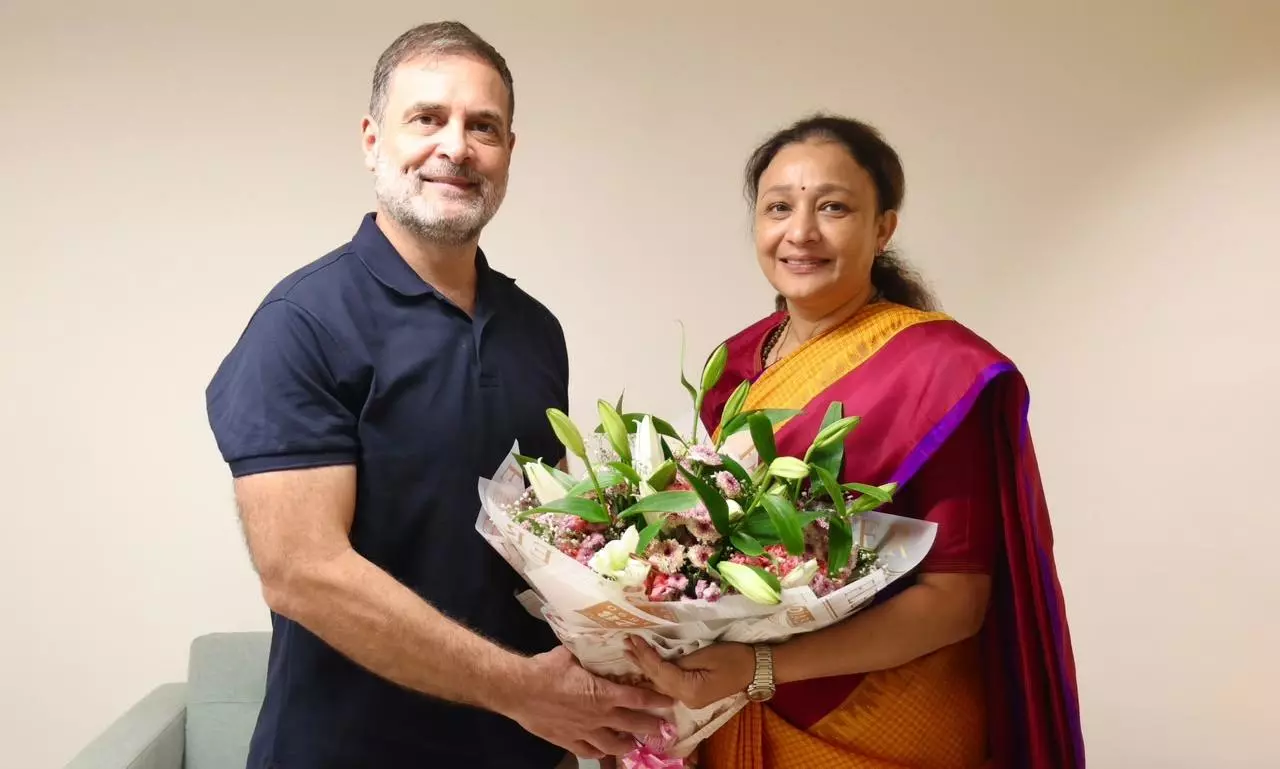
Political observers have expressed their reservations over the appointment of Aradhana Mishra as the Brahmin face for the Congress. File photo of Congress leader Rahul Gandhi (left) and UPCC president Aradhana Mishra. Photo: X//@aradhanam7000
Congress's Brahmin gambit in UP: Tactical move or tokenism?
The party hopes to tap into reported Brahmin discontent with the BJP while rebuilding its organisational base ahead of the 2027 polls

Last week, the Indian National Congress (INC) appointed three-time Rampur Khas MLA Aradhana Misra as chief of the Uttar Pradesh Congress Committee (UPCC), putting a Brahmin leader at the centre of its efforts to revive the party's dwindling fortunes in the state where it was reduced to just two seats in the last Assembly elections.
The rejig also brought Saharanpur MP Imran Masood in as deputy chief and elevated Devendra Nishad, from the extremely backward fishing community, and Dalit leader Alok Prasad as senior vice-presidents.
The overhaul signals Congress’ attempt to stitch together a wider social coalition. But its decision to put a Brahmin face at the helm has, in particular, put the party’s strategy to win back the community ahead of the 2027 Assembly elections under scrutiny.
‘Brahmin card may not work’
Political analysts and psephologists see the move as a renewed attempt to tap into reported discontent among Brahmins, some of whom are said to be increasingly uneasy about giving Chief Minister Yogi Adityanath another term.
But whether that discontent can be converted into votes for Congress is another question.
Also read: Congress resets Punjab and UP leaderships, but factional challenges persist
Speaking to The Federal, political observers and veteran journalists said that while installing a Brahmin at the helm of the UPCC may be a tactical move, it is unlikely by itself to reclaim a community whose political influence far exceeds its numbers. More importantly, they point to Congress’ diminishing presence at the grassroots and booth levels as a far bigger obstacle.
“A party with a threadbare grassroots network and no stable state leadership cannot hope to achieve much with such tokenism. Just a Brahmin face is insufficient to convince even a small fraction of Brahmins to switch their current loyalties that rest safely with the BJP,” Lucknow-based veteran journalist JP Shukla told The Federal.
Congress’ once stronghold
Brahmins were once inextricably woven into the political fabric of the Congress. The party even gave the first six Brahmin chief ministers to Uttar Pradesh, including Govind Vallabh Pant, Sucheta Kripalani, Kamlapati Tripathi, Hemvati Nandan Bahuguna, ND Tiwari and Shripati Misra.
The era of Mandal-Kamandal politics, however, upended that social contract. While the Mandal movement created caste-based parties like Samajwadi Party (SP) and Bahujan Samaj Party (BSP), Mandir politics laid the foundation for the emergence of the BJP juggernaut that eventually became the safe home of the upper-caste Hindus.
Congress, caught between the two, increasingly ceased to be the party upper-caste voters believed represented them politically. As a result, Brahmins moved lock, stock and barrel to the BJP. From then on, Congress has been in terminal decline in Uttar Pradesh.
Also read: Mayawati takes nephew Akash Anand back into BSP, re-appoints him national convenor
“The Mandal-Kamandal churn was a challenge Congress failed to answer. BSP took its Dalit base, SP captured OBCs and Muslims, while even some upper castes moved to SP. BJP, however, was the biggest beneficiary and eventually consolidated the upper-caste votes,” said Lucknow-based political commentator Ratan Mani Lal.
Failed experiments
This is not the first time the party has attempted such a recalibration. Its efforts to woo Brahmins ahead of the 2017 and 2022 Assembly elections failed to halt its precarious decline in the state.
In 2017, the grand old party betted on the Brahmin credentials of former Delhi chief minister Sheila Dikshit and made her its chief ministerial candidate in the state.
Dikshit, the daughter-in-law of veteran Brahmin leader Uma Shankar Dikshit, was expected to give the party a foothold among the community. Congress also planned Brahmin samagams across the state.
The gambit, however, went nowhere. The party soon abandoned the strategy and allied with the Samajwadi Party. Congress won only seven seats with 6.2 per cent of the vote. CSDS-Lokniti data showed 83 per cent of Brahmins backed the BJP alliance, against just 1 per cent for Congress.
Priyanka’s push
Five years later, Congress tried again. Jitin Prasada led its Brahmin outreach through Brahmin Chetna Yatras, amid growing discontent among sections of the community with Yogi Adityanath’s government.
But Prasada whose political career as such was on steep decline soon switched to BJP.
Thereafter, Priyanka Gandhi was parachuted to Uttar Pradesh. With her, the Congress attempted to combine the Brahmin outreach along with women empowerment pitch. The result, however, was devastating.
Congress was reduced to two seats and 2.3 per cent of the vote, with Aradhana Misra among the two winners. According to the CSDS-Lokniti data, the BJP alliance’s Brahmin support actually rose to 89 per cent in 2022 from 83 per cent in 2017 despite the resentment with the Yogi government.
Also read: Why UP BJP is banking on ‘sangathan shilpi’ Sunil Bansal for 2027 election
Congress again attracted just 1 per cent. Of the 52 Brahmin MLAs elected to the Assembly, 46 came from the BJP-led alliance, five from the SP-led alliance and just one from Congress.
Why Brahmins matter in polls?
Brahmins have always enjoyed the vantage point in the social and political architecture, most notably in the Hindi heartland. Electorally, they represent only 12 per cent of the total voters in the state.
Their significance does not come from the electoral strength but the social dominance they continue to enjoy. The community is estimated to influence electoral outcomes in roughly 100 of the state’s 403 Assembly constituencies, particularly across central and eastern Uttar Pradesh.
Their sway is best illustrated by the BSP’s 2007 victory, its only majority on its own that ended a 15-year period of political instability and coalition governments in the state. The BSP managed this feat by getting Brahmins under its fold.
Bahujan politics
Mayawati replaced Kanshi Ram’s “Tilak, Tarazu aur Talwar” slogan and recast it to forge a larger social coalition with Brahmins under its fold. While Mayawati and Satish Chandra Misra projected the formidable Dalit-Brahmin social contract, Naseemuddin Siddiqui helped draw Muslims in. It was an alliance that would have seemed improbable in the post-Mandal-Kamandal era.
“The ongoing clamour to become the voice of the Brahmins shows the diminishing returns of focusing solely on the Bahujan politics — Dalits, OBCs and minorites. To win in the Hindi heartland means getting Brahmins on your side,” pointed out political science professor at Babasaheb Bhimrao Ambedkar University Shashi Kant Pandey.
Also read: What Mayawati’s succession drama means for BSP’s future and Dalit politics
Reiterating Pandey’s arguments, Ratan Mani Lal noted that Brahmins are the cementing force in the elections, without which no party can hope to form a majority government. “It is widely said that when a single Brahmin goes out to vote, he brings along at least 4-5 more voters from across castes,” Lal added.
Discontent is not defection
Political analysts suggest the reshuffle attempts to capitalise on perceived upper-caste (Brahmin, Rajput, Tyagi) alienation over ticket distributions and administrative dynamics under the ruling BJP.
Sections of Brahmins have complained about inadequate political representation and what they perceive as the growing dominance of Thakurs in the Adityanath government. A meeting of BJP Brahmin legislators in Lucknow in December 2025 brought some of those concerns into public view.
“Brahmins are angry with the Yogi government as we are not getting proper representation. But Congress does not strike confidence as it keeps changing its leadership. Right when Ajay Rai was emerging, they’ve parachuted somebody who is seen as a symbol of Congress’ dynastic politics rather than Brahmin face,” said national president of Akhil Bhartiya Brahmin Mahsabha Pandit Rajendra Nath Tripathi.
But analysts caution that discontent with the BJP does not automatically translate into support for Congress.
“Aradhana Misra has no real connect with the masses. And we doubt that Brahmins would gravitate towards Congress because of this decision alone,” pointed out another political commentator Anand Vardhan.
A larger social coalition
Even as political observers have expressed reservations over the appointment of Aradhana Misra as the Brahmin face for the party, some contest that the move may still give the party a good footing in seat-sharing negotiations with the Samajwadi Party.
“If we look at this development in the larger context, then it appears that bringing in Aradhana Misra serves more than one purpose. Besides being the Brahmin face, she and her father Pramod Tiwari have good relations with SP and that could help smoothen the seat-sharing talks,” Vardhan argued.
Also read: Is Congress's UP expansion plan a threat to its SP alliance in 2027 polls?
Congress, meanwhile, says that the party’s recent rejig is to forge a large social coalition and double down on the brewing discontent across caste lines against the ruling BJP party in the state. Besides, it believes that Aradhana Misra was one of the two party candidates that could still hold the fort while much of the party’s candidates suffered discouraging losses in 2017 and 2022.
‘Congress stands for each and everyone regardless of their caste and religion. That philosophy was exercised while overhauling the state unit. Aradhana Misra has been appointed on her merit and we are hopeful that she’ll be able to hold the social coalition very effectively,” Congress spokesperson Akhilesh Pratap Singh told The Federal.
Singh further noted that the Congress’ outreach is trying to channel brewing resentment among different sections of society, including Brahmins, into political dividends in the ensuing assembly elections.