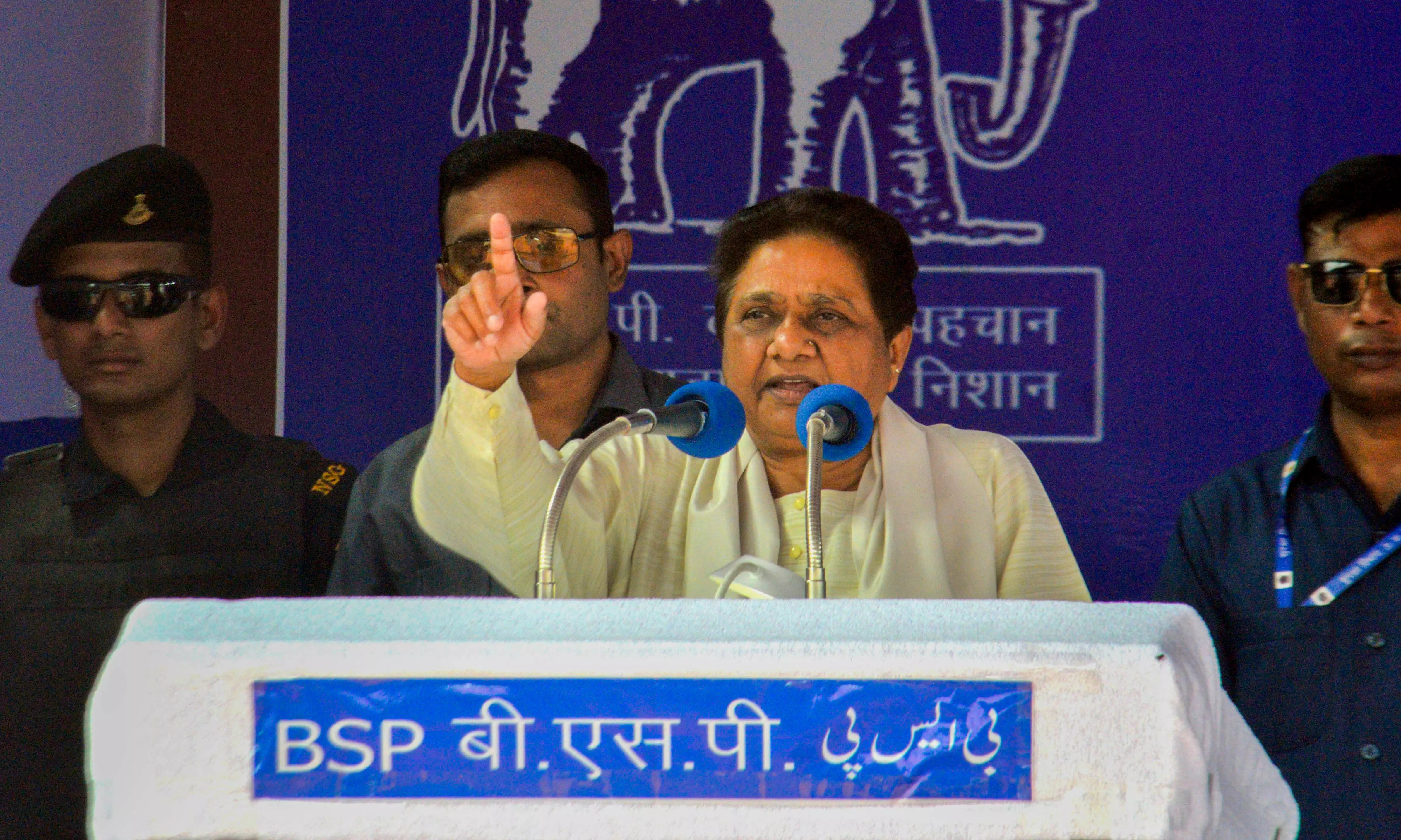
What Mayawati’s succession drama means for BSP’s future and Dalit politics
Akash Anand’s apology has revived questions over his return as Mayawati’s BSP faces a succession crisis, organisational decline and an eroding Dalit base

Just when it seemed the succession saga at the Bahujan Samaj Party (BSP) had been largely settled, a recent Twitter post by beleaguered Akash Anand, seeking forgiveness from party chief Mayawati, has fuelled fresh speculation about his return to the party.
For the past few weeks, a musical chair of succession has been playing out among Mayawati’s nephews — Akash Anand and Ishan Anand — and niece Deepika Anand. Mayawati first ruled out political roles for both her nephews, only to appoint Ishan Anand to a key organisational position days later. Akash, once projected as her successor, was expelled yet again on September 10. Now, his public apology has fuelled fresh speculation about his return.
BSP’s existential crisis grows
These twists and turns and leadership flip-flops, choreographed by Mayawati herself, are more than a succession saga. Instead, they are the culmination of the party’s years-long precipitous decline and its transformation from an ideologically driven grassroots social movement into a family-centric enterprise under Mayawati.
Also read | UP: BSP reshuffle signals Mayawati’s return to Dalit–Muslim formula ahead of 2027 polls
As the BSP heads into the elections with no sitting MLA or Lok Sabha MP, the prolonged succession drama has cast fresh uncertainty over the party’s future. Political observers and former BSP workers told The Federal that the party, already facing a serious crisis, appears increasingly bereft of a clear political vision and effective leadership.
“BSP has been in turbulent decline for more than a decade now. The recent family drama has only acted as the last nail in its coffin, as the party stares at a frightening existential crisis. The party that rose against feudalism is now reduced to a private limited company that revolves only around Mayawati and nobody else. The BSP cadre and voters are seemingly disgruntled with all this,” Prof Sashi Kant Pandey, a political science professor at Babasaheb Bhimrao Ambedkar University in Lucknow, told The Federal.
From movement to machine
The family-centric succession debate sits uneasily with the BSP’s founding philosophy, which stood staunchly opposed to feudalism and dynastic politics.
A few years before the Mandal protests reshaped Uttar Pradesh politics along caste lines, Kanshi Ram emerged as a defining force in Dalit politics. He turned Ambedkarite mobilisation into an electoral force.
On Ambedkar’s birth anniversary in 1984, he founded the BSP to unite Dalits, marginalised communities and religious minorities under the banner of the Bahujan (the majority). From cycling through villages to building an army of grassroots workers, Kanshi Ram painstakingly converted social mobilisation into the political machinery that would dominate Dalit politics in the Hindi heartland.
“His strategy really paid off, although it was still a far cry from the core ideas of Bhimrao Ambedkar. Soon the party became the kingmaker. But his protégé Mayawati wanted to be the king herself, and so it happened,” pointed out retired IPS officer and Dalit thinker SR Dharapuri.
“But that came with a price. Under Mayawati, BSP became a political machine that survived on huge cash and political flip-flops rather than an ideology-based social movement,” he added.
From electoral high to decline
By the early 2000s, BSP and Mulayam Singh Yadav’s Samajwadi Party (SP) had become the two dominant political forces in the state. In 2007, Mayawati sprang a surprise, with the BSP winning 206 of Uttar Pradesh’s 403 Assembly seats and 30.43% of the vote to form a majority government on its own. In the 2009 Lok Sabha election, it won 20 of the state’s 80 seats with more than 27% of the vote.
Also read | Mayawati quells ‘rumours’ about her health, questions Akash Anand’s role
The year 2009 was the tipping point. The four-time Chief Minister of Uttar Pradesh, Mayawati, began eyeing the high office in New Delhi. Regional and national newspapers across the country were flooded with imagery of an elephant, with Mayawati sitting atop it, charging towards Parliament.
But the national breakthrough never came.
The electoral slide began in 2012, when the BSP fell to 80 seats despite retaining 25.95% of the vote. It won 19 seats in 2017 and just one in 2022, as its vote share fell to 22.23% and 12.88%, respectively. In 2024, the party drew a blank in Uttar Pradesh, with its vote share falling to about 9.4%.
“Mayawati’s political rise was followed by a dramatic collapse that is still continuing. A large section of her voters, especially Muslims and non-Jatavs, became disillusioned with her style of politics and the gradual but strategic erasure of the party’s leadership that had a good command over the electorate. This eventually contracted the party’s footprint at a time when BJP and SP were expanding their social coalitions,” Ravi Kant Chandan, a Dalit thinker and professor at Lucknow University, told The Federal.
Power centralised, party weakened
Mayawati’s fall and the BSP’s decline are inextricably intertwined. As the party became more and more about Mayawati herself, the Dalit agenda was brushed under the carpet and organisational erosion became increasingly apparent.
Mayawati had said in her 2008 autobiography that her successor would not be from her family. Yet her brother Anand Kumar was subsequently given a prominent organisational role, while his children entered the party’s succession conversation.
According to Ravi Kant, this eventually weakened the party’s second line. “Senior leaders who rose through the organisation were either expelled or left, depriving the BSP of leaders with independent political networks,” he said.
The BSP gradually moved from being a social movement-turned-political party to a more conventional election machine. “Politicians from outside the organisation were accommodated, often on the basis of their ability to fill the party’s coffers. The cadre increasingly became less central to the party’s functioning,” Pandey added.
The relationship between the party, its workers and its voters consequently became increasingly transactional. Cadre felt betrayed and voters eventually felt abandoned.
Also read | Mayawati ousts ‘double-minded’ nephew Akash Anand, says he is ‘completely freed’ from BSP
“We gave our life and soul to the party, but it never really bothered about its people. Gradually, the cadre began shifting to other parties, mainly the SP, while some went to the BJP,” said Parmeshwar Kumar Kannaujia, who shifted his loyalty to the Samajwadi Party before the 2014 Lok Sabha elections.
BSP’s core base under strain
Political observers prefer to describe the BSP’s present standing as an enigma. Its steep decline notwithstanding, they say a section of Jatav voters still rally behind her.
Dalits account for more than 21% of the electorate in Uttar Pradesh. Of that, over 54% are Jatav voters — Mayawati’s core voter base.
“And a significant chunk of that voter base is still supporting Mayawati. For them, her name is still enough. Until she’s alive and active in politics, that base will largely be with her. But after her, the party’s future looks weak,” argued Ravi Kant. “Thus, the BSP’s obituary would be premature,” he added.
Besides, there’s enormous political memory associated with her. For an older generation of Dalit voters, Mayawati’s rise represented more than an electoral victory. It was the arrival of a Dalit woman at the centre of power in Uttar Pradesh.
“We have no option but to vote for her. What she has done for us, no leader could have done. But we feel sad that she lost her track midway. Maybe she was misdirected, we don’t know. But other than the BSP, we cannot see any party as our political home,” says 59-year-old e-rickshaw driver Avadesh Gautam.
The younger voters, however, feel that party loyalty has reached a point of fatigue. They are beginning to look for other options.
“For the past 10 years, she has been absent from the political space and not raised our issues. Other parties like the SP and Congress are coming to us and wanting to work for us. So, we’ll vote for the party that can win and raise our issues,” noted 40-year-old Saroj Gautam from the Sammudinpur slum in Lucknow.
Dalit politics beyond Mayawati
While voters and political observers differ on Mayawati’s waning relevance in Dalit politics, they broadly agree that the BSP faces a bleak future, with little sign of revival.
“The party is basically leaderless and visionless. It has no concrete agenda like the SP, Congress or BJP, with their welfare schemes and populist measures. People are tired of voting for a face that is no longer the voice of Dalits,” said Dharapuri.
While the succession tussle has further weakened the BSP’s organisation, new players are eroding its traditional support. Chandrashekhar Azad and his Aazad Samaj Party (Kanshi Ram), for instance, are seeking to prise away sections of the BSP’s Dalit base.
Also read | Mayawati says BSP to contest Punjab Assembly elections alone, rules out alliance
Sustained ground mobilisation by the RSS and BJP, meanwhile, has helped the BJP expand its support among non-Jatav Dalits. The SP and Congress have also sought to consolidate backward-class, Dalit and minority voters, helping their alliance win 43 of Uttar Pradesh’s 80 Lok Sabha seats in 2024.
For a party already without a sitting MLA or Lok Sabha MP, these shifts make the road back to relevance even steeper.
“The Dalit political space is highly scattered. The rising middle class and educated youth among Dalits are looking for a party that can counter the BJP. The SP may become the biggest beneficiary,” Dharapuri contends.
For Ravi Kant, Dalits are increasingly gravitating towards Congress leader Rahul Gandhi. “And if Congress manages to strengthen its state leadership and cadre, Congress will be the new home for Dalits,” he asserted.