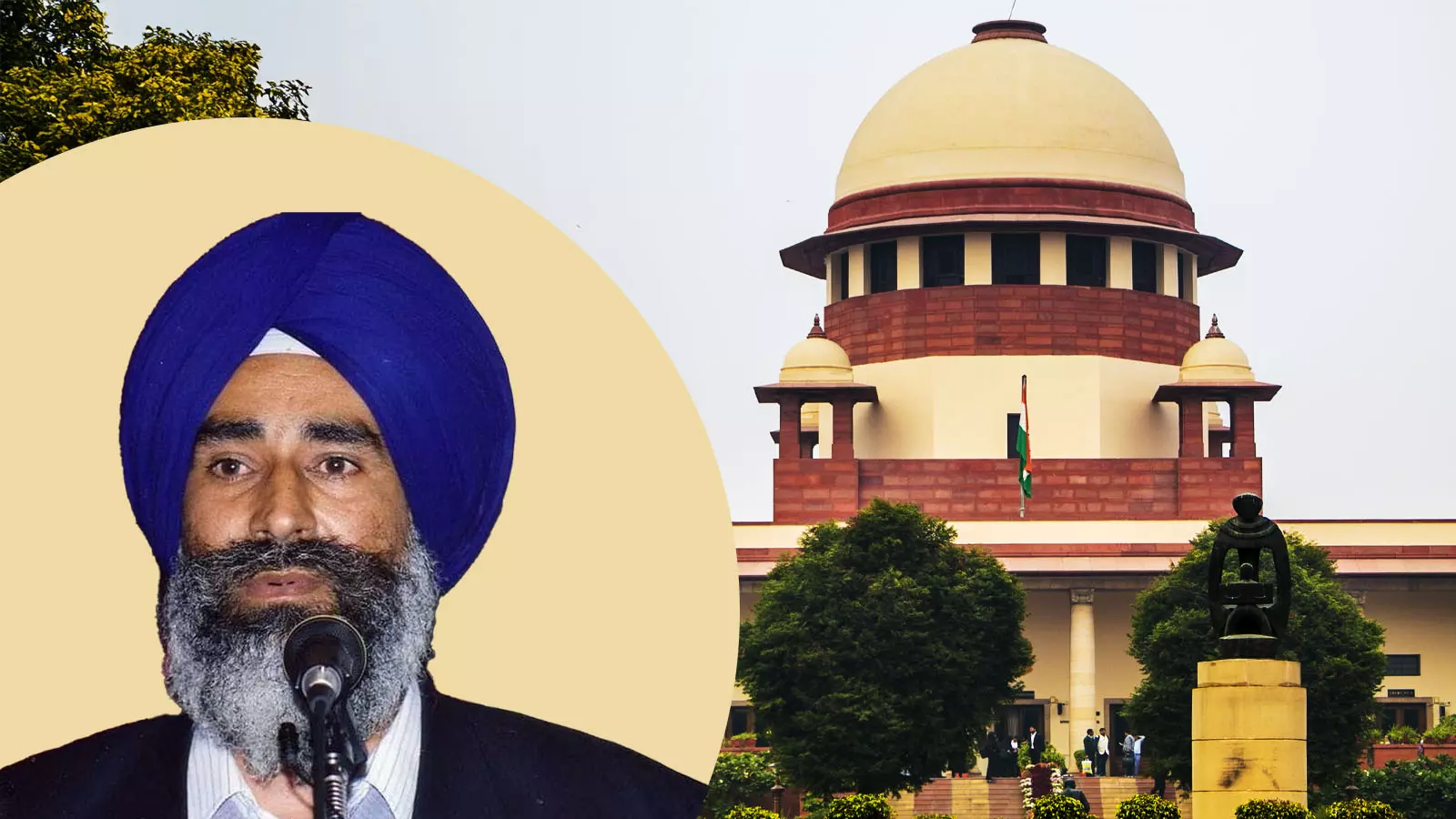
Satluj row: How CBI, SC brought Jaswant Singh Khalra’s killers to justice
Recalling 2011 SC verdict, which noted misdeeds of police and threats to witnesses while upholding conviction of 5 Punjab police officers in abduction-murder case

Kirpal Singh Randhawa, one of the witnesses in the Jaswant Singh Khalra abduction and murder case, was “falsely enroped” in a rape case in 2004.
Another witness, Rajiv Singh, was implicated in four cases, later found false, during the trial. He was also accused of forming a terrorist organisation and detained in July 1998, but later, the case was found to be “totally fake”.
One more witness, Kulwant Singh, was falsely accused and convicted in a narcotics case, but he was later acquitted by the high court. His appeal in the high court could be filed through jail officials only after the Supreme Court passed directions in this regard.
Khalra’s wife Paramjit Kaur too faced fake criminal cases. She testified in court that she had been threatened by the accused persons on the telephone for “pursuing the case of her missing husband”.
The facts mentioned above were recorded by the Supreme Court in 2011 while upholding the conviction and enhancement of sentences of some of the Punjab police officers found guilty of abducting and killing human rights activist Jaswant Singh Khalra in 1995.
Satluj co-writer Niren Bhatt exclusive: 'Film based fully on SC judgment, there's no fiction'
The row over Satluj, a film based on Khalra’s investigation into extrajudicial killings in insurgency-era Punjab and his subsequent abduction and death, and public outrage over its takedown from the OTT platform Zee5 by the government, has once again brought the Supreme Court’s verdict to the spotlight.
Landmark verdict
In 2005, a Patiala court convicted six Punjab police officers for Khalra’s abduction and murder. While only two of the six were sentenced to life imprisonment, a division bench of the Punjab and Haryana High Court, in October 2007, extended the sentences of the four others from seven-year imprisonment to life imprisonment.
The Khalra case at a glance
♦ Khalra abducted outside Amritsar home in September 1995
♦ Supreme Court transfers probe to CBI
♦ CBI charge-sheets nine Punjab police officers in 1996
♦ Trial ends with six officers convicted in 2005
♦ High Court awards life imprisonment to all six
♦ Supreme Court upholds convictions and life terms in 2011
In a landmark verdict in 2011, a Supreme Court bench of Justices P Sathasivam and BS Chauhan rejected the appeals of the convicted Punjab Police officers. “Punjab Police officials persistently made attempts to exert undue pressure on the witnesses throughout the investigation and trial,” it ruled.
With the makers clearly stating that Satluj is based on true events and specifically the Supreme Court’s verdict, here is what the top court ruled in the famous case.
Allegations against police, abduction
Khalra, a director of a bank in Amritsar, gained international recognition over his claims of extra-judicial killings by Punjab police during the insurgency in the state, when police crackdown was at its highest. Khalra had claimed that he, after a thorough investigation, found that the state’s police had unlawfully killed and cremated over 25,000 people in anti-terror operations and around 2,000 police officers for not participating in the operations.
Also read: 'Satluj' OTT takedown sparks political firestorm across poll-bound Punjab
He was abducted from outside his Amritsar residence on September 6, 1995, and subsequently killed. The incident was immediately brought to the notice of higher authorities, but no action was taken by police.
Khalra’s wife Paramjit Kaur, also a complainant in the case, approached the Supreme Court the same year by filing a habeas corpus petition, seeking directions to produce Khalra as she “could not even know whether her husband was alive or dead and, if alive, where he had been and none of the higher authorities in administration helped her or disclosed the whereabouts of her husband”.
CBI takeover, transfers
After the Punjab administration failed to locate the whereabouts of Khalra, the investigation into the case was handed over to the Central Bureau of Investigation (CBI).
The police authorities did not like such activities of Shri Khalra and tried to desist him from the same. Shri Khalra was being threatened over the telephone by the police official: SC in 2011 verdict
The Supreme Court, in its 2011 verdict, noted that the CBI, during the course of investigation, realised that it was not possible to conduct the investigation fairly and properly unless some of the police officers involved in the case were transferred from the districts of Amritsar and Tarn Taran.
Watch/Read | Satluj row: Is banning the film only making more people watch it?
Hence, on the directions of the Supreme Court, these officials were transferred out of Amritsar and Tarn Taran with the instructions that they should not be posted in the adjoining districts as well. The court also directed the police chief of Punjab to provide security to some of the key witnesses.
CBI charge sheet
After a thorough probe, the CBI in 1996 recommended the prosecution of nine Punjab police officers in the kidnapping and murder case.
In its charge sheet filed on October 13, the agency named Ajit Singh Sandhu, the then Senior Superintendent of Police of Tarn Taran, and eight other officers — Ashok Kumar, Satnam Singh, Rachpal Singh, Jasbir Singh, Amarjit Singh, Surinderpal Singh, Prithipal Singh and Jaspal Singh.
But before the charges could be framed in the case, Ajit Singh Sandhu allegedly committed suicide, leaving only eight to face trial.
Also read: 'Satluj' spreads misinformation on Punjab insurgency: Lawyer seeks FIR against Diljit Dosanjh
During the course of the trial, Ashok Kumar, a deputy superintendent of police, died and another accused, Rachpal Singh, was discharged as no incriminating material was found against him. Another accused, Amarjit Singh, was acquitted by the high court. Therefore, only five convicted Punjab police officials appealed against their conviction in the Supreme Court.
‘Khalra exposed misdeeds of police’
The court, in its judgment, noted that Khalra exposed “the misdeeds of police in Districts Amritsar and Taran Taran” who were allegedly killing innocent people after falsely branding them as terrorists, and cremating them without any identification or performing any ritual.
The SC noted that in 1996, the CBI had submitted an interim report to it, revealing that 984 dead bodies had been cremated as ‘lavaris’ (unidentified) in Tarn Taran district alone, and there was sufficient material to register criminal cases against the police officials in many such cases.
The court further said: “The police authorities did not like such activities of Shri Khalra and tried to desist him from the same. Shri Khalra was being threatened over the telephone by the police officials.”
The top court noted that Khalra had informed a large number of persons about the threats, that he was being watched by unidentified suspicious persons, who had been wandering around his house and that he was being followed by such elements. The court blamed SSP Sandhu and other convicted police officials for hatching a conspiracy to eliminate Khalra.
'Police united in unholy alliance'
The court further said: “In spite of transfer of the investigation of the case to the CBI, the Punjab police officials did not cooperate with the CBI and were not lending proper support in conducting the investigation. The police officials of Punjab united in an unholy alliance as their colleagues were involved and the case was going to tarnish the image of Punjab police.”
Also read: Centre forms high-level panel to examine Diljit Dosanjh’s ‘Satluj’
The court added that the witnesses in the case were so terrified of police action that they could not muster the courage to reveal the truth.
CBI’s big breakthrough
This was a case where, despite its best efforts, the CBI too could not locate the whereabouts of Khalra. A reward of Rs 1 lakh was declared as well for providing information on him, but it did not produce desired results.
Kulwant Singh, one of the witnesses, was the first to spill the beans about Khalra. He too was detained in a narcotics case in Chabhal police station when Khalra was brought there on September 6, 1995. But no evidence came up as to what exactly happened to Khalra after he was brought to the police station.
But once the trial in the case started, a witness came forward and told the CBI that Khalra was secretly murdered by the accused police officials and his dead body was thrown in the canal near Harike at midnight just after Diwali in 1995. The witness, Kuldip Singh, was a special police officer attached to Satnam Singh, the station house officer of Chabhal. He had been promised that he would be absorbed in the Punjab police permanently.
Also read: Political row erupts in Punjab after Diljit Dosanjh's 'Satluj' is removed from ZEE5
Kuldip had been assigned the duty to serve meals to Khalra while he was kept there. He also revealed that Khalra was beaten by the accused police officials there and a few days later, he was killed and his body disposed of..
The witness clarified that he could not reveal the truth since he was scared of SSP Ajit Singh Sandhu and was able to muster courage only after the latter’s death.
‘Khalra’s claims on bodies correct’
The top court also noted that in 1996, the CBI had submitted an interim report to it, revealing that 984 dead bodies had been cremated as lavaris (unidentified) in the district of Tarn Taran alone and there was sufficient material to register criminal cases against the police officials in many such cases.
On the basis of the interim report, the Supreme Court directed the CBI to register criminal cases in such matters.
While deciding on the appeal of the convicted police officials, the top court referred to its own order of December 12, 1996, while hearing the same case, where it was noted that as per the CBI, in all 2,097 bodies had been cremated as unidentified and hence the claims made by Khalra in “this respect was found to be correct”.
Also read: Sutluj takedown: State as a super censor, swapping scissors with switch
Sutluj quotes this figure as 25,000 unidentified bodies — an estimate Khalra and his supporters began pushing aggressively around 1994-95 but one that remains highly contested today.
When the accused pointed out that since Khalra’s body was not recovered, they could not be tried and convicted for murder, the top court said it was not a required condition to facilitate a conviction.
“Though the dead body of Shri Jaswant Singh Khalra could not be recovered from the canal as the investigation commenced after a long time, recovery of the dead body is not a condition precedent for conviction of the accused for murder,” it ruled.