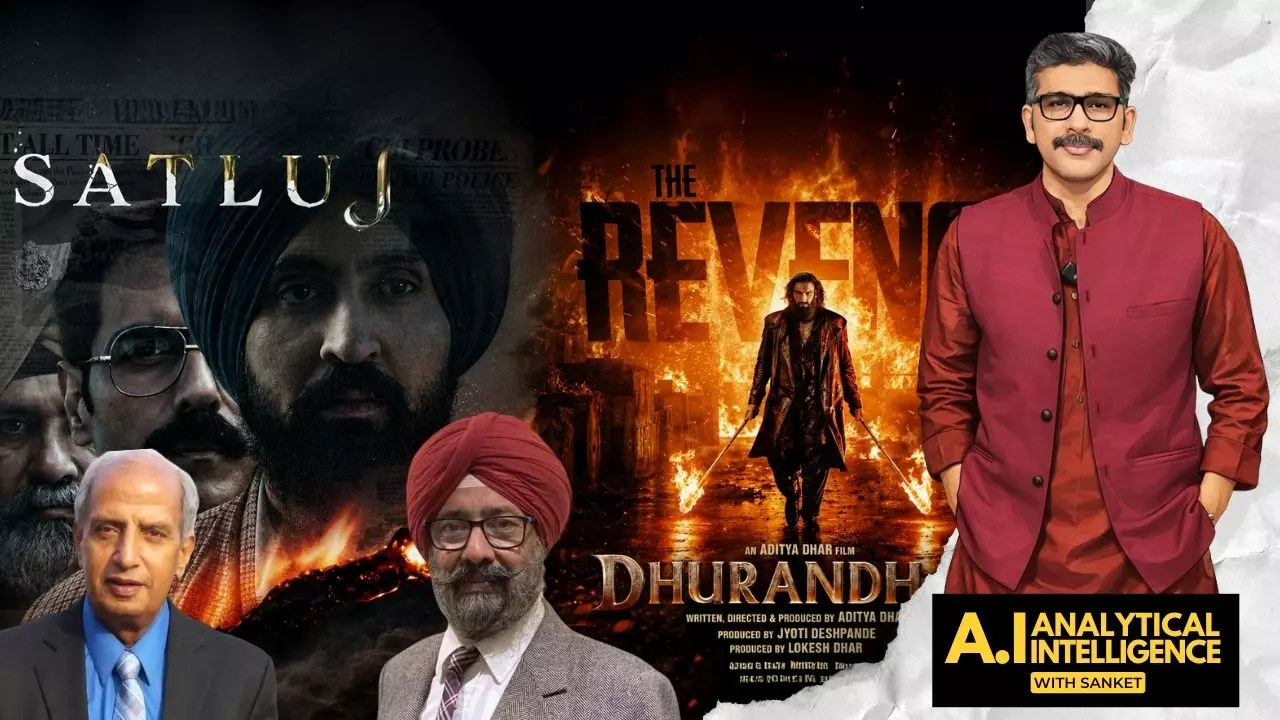
Satluj row: Is banning the film only making more people watch it?
Former bureaucrat Karanbir Singh Sidhu and SAD's HS Bains debate the Satluj controversy, censorship, free speech and whether the ban has backfired

The controversy surrounding Satluj, the Diljit Dosanjh-starrer based on the life of human rights activist Jaswant Singh Khalra, has reignited debate over censorship, artistic freedom and national security. While the film was removed from OTT platform Zee5 after briefly becoming available online, its circulation through piracy and private screenings has only widened its reach.
In this episode of AI with Sanket, The Federal spoke to Karanbir Singh Sidhu, former Special Chief Secretary of Punjab and former Deputy Commissioner of Amritsar, and HS Bains, Principal Advisor to Shiromani Akali Dal president Sukhbir Singh Badal, to understand the legal, political and constitutional questions surrounding the controversy.
Censor board scrutiny
Sidhu said the film underwent nearly three-and-a-half years of scrutiny by the Central Board of Film Certification, during which more than 120 cuts were reportedly suggested. According to him, the producers challenged parts of the certification process but eventually released the film on an OTT platform without incorporating the suggested changes.
Also read | Centre forms high-level panel to examine Diljit Dosanjh’s ‘Satluj’
He pointed out that the film was removed within about 48 hours of its release, but no official explanation has been made public. According to Sidhu, it remains unclear whether the decision came from the platform itself, the filmmakers or an official directive from the government.
Sidhu said the absence of a formal explanation has fuelled speculation over why the film was withdrawn.
Punjab background
Providing historical context, Sidhu said Punjab witnessed prolonged militancy through the 1980s and early 1990s, resulting in the deaths of civilians, police personnel and militants.
He argued that any discussion of the period must consider the broader security situation instead of presenting the conflict as a one-sided narrative. According to him, official figures suggest thousands of civilians and security personnel lost their lives during the insurgency.
Sidhu said the police and security forces were engaged in combating terrorism, making the historical context essential while evaluating any cinematic portrayal of that period.
Khalra investigation
Drawing from his own experience, Sidhu recalled serving as Deputy Commissioner of Amritsar when Jaswant Singh Khalra disappeared in September 1995.
He said Khalra's family informed the administration that unidentified men, believed to be police personnel, had taken him away. Sidhu said he immediately contacted the Amritsar and Tarn Taran police authorities, both of whom denied having Khalra in custody.
He said he subsequently ordered a magisterial inquiry, while the Supreme Court later directed the Central Bureau of Investigation (CBI) to investigate the case after treating communications from Khalra's family as a habeas corpus petition.
Creative freedom
Responding to questions on artistic freedom, Sidhu acknowledged that films based on real events inevitably involve creative interpretation.
However, he argued that Satluj differs from other controversial films because, in his view, it portrays the Indian state and security forces as perpetrators of systematic violence during the anti-insurgency campaign.
Sidhu said such portrayals could have wider implications because they concern state institutions rather than non-state actors depicted in several other politically sensitive films.
He maintained that while artistic freedom is important, India's constitutional framework also permits reasonable restrictions under certain circumstances.
Ban backfired?
When asked whether removing the film had achieved its objective, Sidhu agreed that the ban may have produced the opposite effect.
He observed that the film has spread widely through piracy, WhatsApp circulation and private screenings, allowing many more people to watch it than might otherwise have been the case.
Sidhu said policymakers should examine whether the intended objectives were achieved, adding that the current regulatory framework governing OTT platforms may also require review.
National security debate
Sidhu said references to "national security" remain too broad unless authorities clearly explain the specific concerns involved.
At the same time, he said governments could argue that such content might influence vulnerable sections of society, particularly in Punjab's border districts where concerns relating to cross-border militancy and narco-terrorism continue to exist.
He added that courts generally allow governments considerable discretion in assessing national security threats but said the issue could eventually become part of a larger debate on free speech and constitutional rights.
Sidhu concluded that he generally favours greater freedom of expression while recognising that India's Constitution also permits certain restrictions.
SAD backs screenings
Bains defended the party's decision to support special screenings of Satluj. He argued that the film presents what he described as an honest depiction of events relating to Punjab during the militancy years and therefore deserves to be seen by audiences across the country.
He said people have a right to understand what occurred during the fight against terrorism in Punjab.
Also read | Political row erupts in Punjab after Diljit Dosanjh's 'Satluj' is removed from ZEE5
Bains further questioned what he described as inconsistent standards in dealing with politically sensitive films. He argued that other controversial films have been allowed to release, while Satluj faced repeated hurdles despite being based, according to him, on proceedings and judgments of the Supreme Court relating to the Jaswant Singh Khalra case.
He said that if films based on other political narratives can be screened, there should be no objection to screening a film that draws from judicial proceedings.
Constitutional question
Responding to questions about the government's reported national security concerns, Bains maintained that the film is rooted in court records and therefore should not be treated as anti-national.
He argued that the film reinforces faith in India's constitutional institutions because it depicts the judicial process ultimately delivering justice.
Bains further contended that preventing the screening of such a film raises larger constitutional questions regarding freedom of expression and equal standards for artistic works.
(The content above has been transcribed from video using a fine-tuned AI model. To ensure accuracy, quality, and editorial integrity, we employ a Human-In-The-Loop (HITL) process. While AI assists in creating the initial draft, our experienced editorial team carefully reviews, edits, and refines the content before publication. At The Federal, we combine the efficiency of AI with the expertise of human editors to deliver reliable and insightful journalism.)