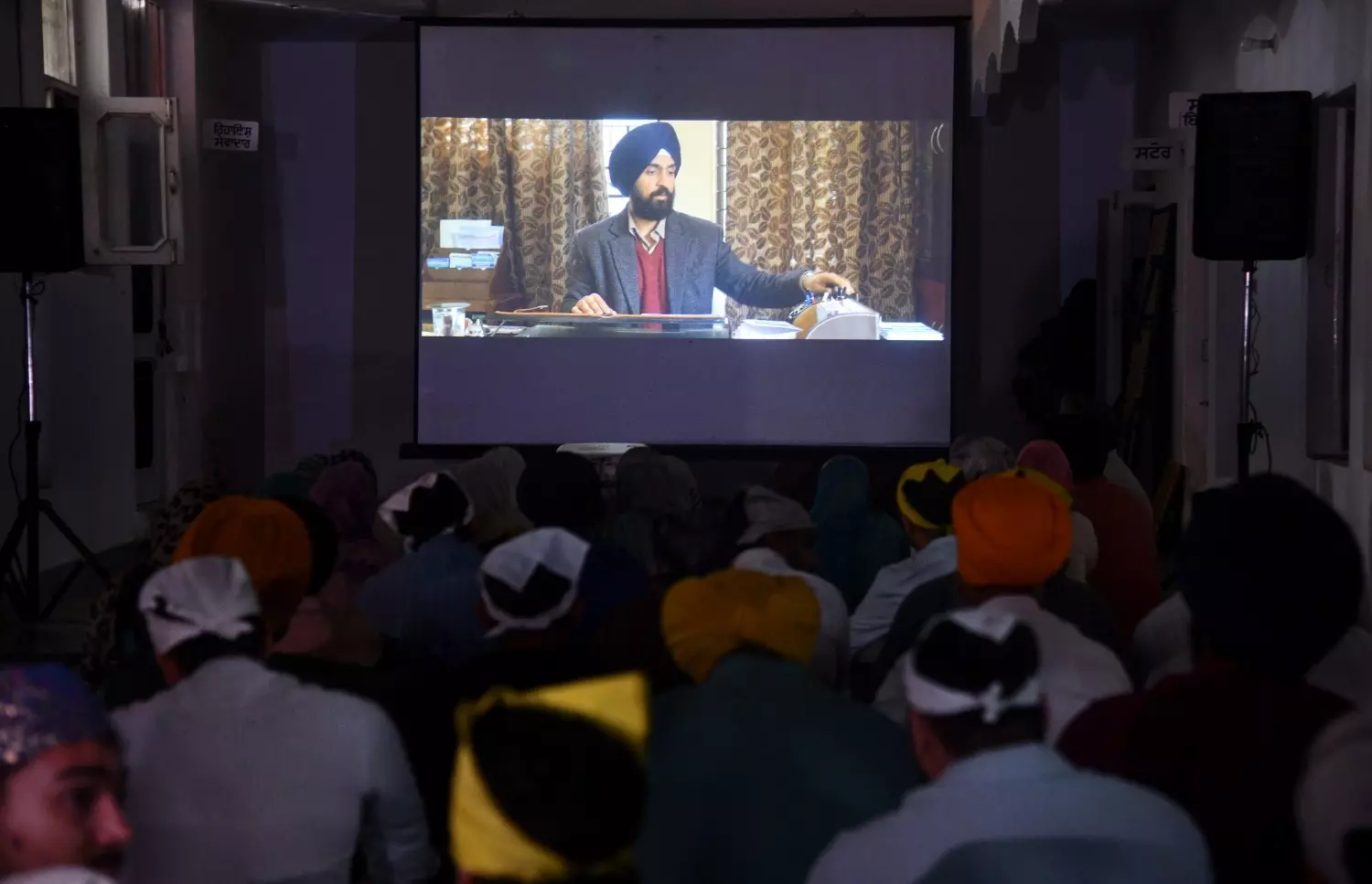
Panjab University students watch a special screening of the film 'Satluj' at the Gurudwara Shri Mukatsar Sahib PU after permission to organise the screening was denied, in Chandigarh, on July 8, 2026. Photo: PTI
'Satluj' OTT takedown sparks political firestorm across poll-bound Punjab
The removal of Diljit Dosanjh's film revives deep communal wounds and Punjab's political parties are trying to reap gains ahead of 2027 Assembly polls

The controversial withdrawal of Diljit Dosanjh-starrer 'Satluj' by OTT platform ZEE5 within 48 hours of its release has triggered a political storm that is rapidly spreading across Punjab.
Also Read: Satluj row | Film based fully on SC judgment; there's no fiction: Niren Bhatt
With the state's Assembly elections still eight months away, it may be premature to judge the row’s electoral impact. What is evident, however, is that the hagiographic tribute to human rights activist and pro-Khalistan Akali Dal campaigner Jaswant Singh Khalra has revived painful and polarising memories of atrocities committed both by the State and by Khalistani terrorists during Punjab’s militancy years.
Directed by Honey Trehan, 'Satluj', which mostly shows the period between 1992 and 1995, struggled for over three years to secure the Censor Board’s approval. Released on ZEE5 on July 3, it immediately became a talking point for its portrayal of Khalra’s efforts to expose alleged extra- judicial killings. Khalra claimed that the Punjab Police had secretly cremated more than 25,000 “unidentified” individuals during counter-terror operations. His quest ended with his own abduction and subsequent murder by the Punjab Police in September 1995.
On July 5, ZEE5 removed the film, citing “current developments”, and said it would remain “unavailable in India until further notice”. Neither the platform nor the filmmakers have explained what prompted the withdrawal.
Political commentator Jagrup Singh Sekhon said 'Satluj' may not be “a brazen propaganda film” like 'Dhurandhar' or 'The Kashmir Files', but it “advances an anti-State narrative through one-sided storytelling”.
The Centre has also remained silent, although the Information and Broadcasting Ministry is learnt to have referred the film to the Inter-Departmental Committee (IDC), constituted under Rule 14 of the Information Technology (Intermediary Guidelines and Digital Media Ethics Code) Rules, 2021, to examine its content.
Meanwhile, Bharatiya Janata Party (BJP) leaders from Punjab have muddled the issue further with the party’s state unit chief Kewal Singh Dhillon claiming he asked Union Information and Broadcasting Minister Ashwini Vaishnaw to order the movie’s takedown and Union minister Ravneet Bittu insisting that the Centre played no role in the matter.
Pirated copies of the film are now circulating widely on WhatsApp and social media, while public screenings are being organised across Punjab by Sukhbir Badal’s Shiromani Akali Dal (SAD), the pro-separatist Akali Dal (Waris Panjab De) led by jailed Khadoor Sahib MP Amritpal Singh, and other local groups.
#WATCH | Jammu | A special community screening of the film Satluj was organized by the District Gurdwara Parbandhak Committee (DGPC) Jammu today at Gurdwara Shri Guru Nanak Dev Ji in Nanak Nagar.
— ANI (@ANI) July 10, 2026
This follows the film's sudden removal from the OTT streaming platform ZEE5 within… pic.twitter.com/FXwm5gumlH
For many viewers, particularly in Punjab, the film is an honest, if painful, reminder of State oppression. For others, it reopens wounds that had never fully healed while remaining conspicuously silent on atrocities committed by Khalistani terrorists.
Critics argue that the film rationalises the assassination of former Punjab chief minister Beant Singh while omitting any meaningful reference to the terror outfits spawned by the Khalistan movement and the violence they unleashed.
It is this sharply divided response that makes the film’s political implications difficult to decipher.
'Film promotes anti-State narrative'
Political commentator and former head of the political science department at the Guru Nanak Dev University, Amritsar, Jagrup Singh Sekhon, said 'Satluj' may not be “a brazen propaganda film” like 'Dhurandhar' or 'The Kashmir Files', but it “advances an anti-State narrative through one-sided storytelling”.
Also read: Congress misreads Punjab again; ‘revamp’ shows leadership’s fear of cracking the whip
That narrative, according to Sekhon, “still finds takers in Punjab because of our past, making it impossible for political parties to ignore the debate it has sparked.”
True enough. Every major political party in Punjab has weighed in on the controversy, hoping to benefit from whichever strand of public opinion ultimately prevails.
How AAP is trying to gain from film row
The ruling Aam Aadmi Party (AAP), already under pressure over governance issues and Chief Minister Bhagwant Mann’s confrontation with the Akal Takht, has demanded that the film be restored. Party sources say the AAP believes defending 'Satluj' could help it recover the credibility it may have lost among Sikh voters due to the Bhagwant-Akal Takht confrontation “by positioning ourselves as supportive of Khalra’s legacy and allowing the truth about persecution of innocent Punjabi civilians during Congress rule to come out through this film”.
Sekhon believes the party’s stand serves a dual purpose.
“It diverts attention from failures on unemployment, Punjab’s finances, the drug menace, law and order and sacrilege. At the same time, projecting sympathy for Khalra may help AAP reconnect with voters in Majha and pockets of Malwa, where anti-establishment sentiment still exists and where the party swept the 2022 elections,” he told The Federal.
Veteran journalist Kanwar Sandhu believes the likely electoral impact of 'Satluj' is being overstated. While the film “reignites sordid memories of the militancy years”, he said, adding, “Everyone, including political parties, is overestimating its influence on how people will vote.”
“There is no doubt Khalra was murdered by the Punjab Police for his activism. That is what makes him a hero for sections of the population, especially after this film,” said Sandhu, who was editor of The Indian Express in Chandigarh when the newspaper first published a detailed account of Khalra’s killing in May 1998.
Sandhu believes the SAD and Akali Dal (Waris Panjab De) hope to consolidate support in Punjab’s Panthic belt — the Majha region comprising Amritsar, Tarn Taran, Pathankot and Gurdaspur, which is the ideological heartland of Sikhism, and in parts of Malwa where disillusionment with mainstream politics has grown.
Once the natural home of Punjab’s Panthic vote, the SAD has been in steady decline for a decade. Its weakening has fragmented Sikh votes. Discontent among Sikhs, particularly the electorally influential Jat Sikhs, over sacrilege, unemployment, agrarian distress and other issues has fuelled a sense of alienation. This has also created political space for more radical and openly separatist outfits, even though both Sandhu and Sekhon insist that “Khalistan has no takers in Punjab today”, even if “the sentiment survives in memory”.
Also read: 'Satluj' spreads misinformation on Punjab insurgency: Lawyer seeks FIR against Diljit Dosanjh
Signs of this political shift have emerged over the past few years. The first came in June 2022, when Shiromani Akali Dal (Amritsar) chief Simranjit Singh Mann won the Sangrur Lok Sabha bypoll within months of the AAP’s landslide Assembly victory.
Pivoting his campaign on the release of Bandhi Singhs (Sikh political prisoners) and action against sacrilege, Simranjit, whose X bio even today reads “striving for Khalistan”, had credited his victory to the “teachings of Jarnail Singh Bhindranwale”.
In the 2024 Lok Sabha elections, although Simranjit lost in Sangrur, Punjab elected two new pro-separatist MPs — Amritpal Singh from Khadoor Sahib and Sarabjeet Singh Khalsa, son of one of Indira Gandhi’s assassins Beant Singh, from Faridkot.
Of the two, Amritpal’s victory was particularly noteworthy not only because he had won the election in absentia, lodged as he is at the Dibrugarh jail under the National Security Act, but because his constituency of Khadoor Sahib is the only one in Punjab that includes Assembly segments from all three regions of the state — Majha, Malwa and Doaba.
In January 2025, Sarabjeet Singh and Amritpal Singh’s father, Tarsem Singh, launched Akali Dal (Waris Panjab De). Six months later, the party fielded Mandeep Singh in the Tarn Taran Assembly bypoll. Among those endorsing his candidature was Paramjit Kaur Khalra, Jaswant Singh Khalra’s widow. Though Mandeep finished a distant third, he secured over 15 per cent of the votes cast.
The party is now preparing for the 2027 Assembly elections, and the 'Satluj' controversy has already become part of its political narrative.
SAD’s Dakha MLA Manpreet Singh Ayali, who joined Akali Dal (Waris Panjab De) last month, says, “Bhai Khalra was a warrior and a hero for Sikhs who stood up to State oppression. We have urged the Centre to restore 'Satluj'. Until that happens, we will screen it in every town and village of Punjab so the young can learn from his struggle and those who lived through those years can finally find some closure.”
Punjab Congress and 'Satluj' row
If the AAP, SAD and Akali Dal (Waris Punjab De) have all come out in unequivocal support of the film, the row has left the Congress in a tight spot at a time when it is already grappling with an ugly leadership tussle between Punjab Congress chief Amarinder Singh Raja Warring and former state chief minister Charanjit Singh Channi.
Also read: Punjab Congress crisis: Baghel holds meetings, assures 'everything will be fine'
Congress leaders such as Channi and Sukhpal Singh Khaira have backed 'Satluj', arguing that it portrays an important and emotive chapter of Punjab’s past. Yet, party sources admit the film could rekindle resentment against the Congress by reviving memories of police excesses under its governments in Punjab and at the Centre, as well as Operation Blue Star, which triggered the decade-long crackdown on Punjab’s radical elements that Khalra is shown resisting.
“We cannot deny that police excesses happened when we were in power, regardless of the circumstances. The film tells only one part of Punjab’s militancy story. It demonises our chief minister, Beant Singh, who was assassinated by Khalistani terrorists for wiping out terrorism, but is silent on the thousands of civilians those terrorists killed. Even so, the film has struck an emotional chord. We cannot oppose it or justify taking it down. We can only hope this response does not turn more radical and that, as elections approach, people prioritise Punjab’s future over the tragedies of its past,” a senior Congress MP from the state told The Federal.
BJP's challenge and opportunity
For the BJP, which is seeking an aggressive electoral expansion in Punjab — the only north Indian state that has eluded it despite Prime Minister Narendra Modi and Union Home Minister Amit Shah's cunning manoeuvres — the film presents a different challenge.
The party could have claimed the moral high ground against the Congress but finds itself constrained by two dilemmas. First, condemning police excesses against Khalistani terrorists and their sympathisers runs counter to the muscular anti-terror image Modi has cultivated.
Second, two figures the film villainises — then chief minister Beant Singh and then Punjab DGP KPS Gill — have unwittingly become associated with the BJP. Beant Singh’s grandson, Union minister Bittu, is now among the party’s key leaders in Punjab and its most vocal critic of 'Satluj'. Gill, years after retiring as Punjab DGP in 1995, served as security adviser to Modi in Gujarat after the 2002 anti-Muslim pogrom and to Raman Singh’s BJP government in Chhattisgarh in 2006.
Yet, Sekhon believes the BJP could derive “indirect benefit” from the 'Satluj' row.
“If, and right now that’s a big if, the film does impact electoral choices, the BJP will not really have any gain or loss because it has no ground in Punjab. What could happen, though, is that if the film triggers a splintering of votes between AAP, Congress, SAD and Waris Panjab De, while the BJP manages to consolidate Hindu votes in its urban pockets, you could have a fractured mandate that the BJP leadership can exploit to its advantage post-poll,” he said.