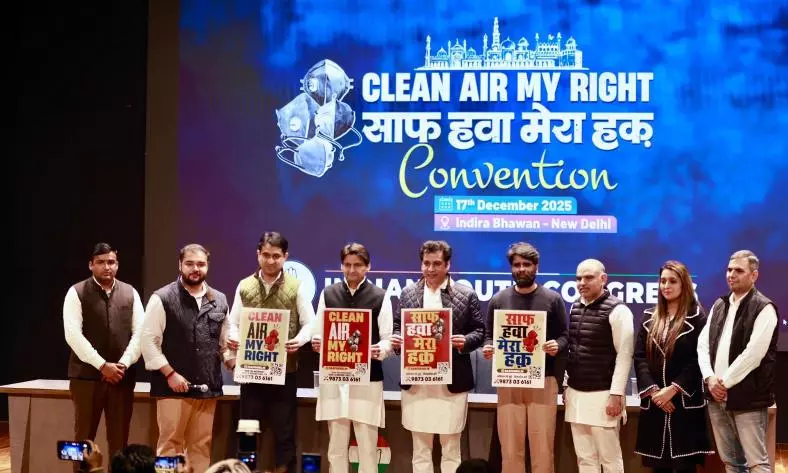
The Indian Youth Congress (IYC) on Wednesday (Dec 17) positioned air pollution as both a public health emergency and a failure of governance at its 'Clean Air, My Right' convention in New Delhi. Photo: X | @IYC
‘Clean Air, My Right’ convention: Youth Congress flags pollution crisis as public health emergency
Congress leaders, experts, and residents critiqued policy inaction, with MP Deepender Hooda demanding a discussion in Parliament on the health emergency

Against the backdrop of worsening winter smog and rising AQI levels, the Indian Youth Congress (IYC) on Wednesday (December 17) positioned air pollution as both a public health emergency and a failure of governance at its “Clean Air, My Right” convention in New Delhi.
With party leaders in attendance, the convention appeared to signal an internal push to elevate air pollution as an important issue for the Congress and its wings in the months ahead.
Organised at Indira Bhawan, the All India Congress Committee headquarters, the convention brought together senior Congress leaders, environmental experts, activists, and residents from pollution-affected neighbourhoods, as the party sharpened its critique of policy inaction and political apathy.
A poster for the “Clean Air, My Right” campaign was released at the event, along with the launch of the SaafHawa.in website – a campaign launched by the IYC, which, according to Delhi Pradesh Youth Congress President Akshay Lakra, has already got over 4,000 responses.
‘Crisis has reached alarming levels’
Inaugurating the convention, IYC National President Uday Bhanu Chib said the crisis had reached alarming levels.
“Air pollution is not a new problem for Delhi and the country, but this time the situation is extremely dangerous and serious, directly affecting the health of common people,” he said.
Also Read: Delhi govt to give Rs 10,000 compensation for workers hit by pollution-battling curbs
Emphasising collective action, he added, “All civil society organisations, NGOs, and environmental experts who are continuously working on the real causes of pollution, policy failures, and concrete solutions deserve appreciation. Everyone can join the ‘Clean Air – My Right’ movement.”
‘Union govt’s responsibility’
The sharpest political attack at the convention came from Lok Sabha MP Deepender Singh Hooda, who attributed responsibility to the Centre.
Referring to Delhi Environment Manjinder Singh Sirsa’s recent video “apology” in which he claimed the government had been in power only for a few months, Hooda said, “Environment is not a state subject; it’s in the Concurrent list because it’s a subject of both the Union and the states…You should have also apologised because you have had a government at the Centre for the last 12 years. In all these years, you have not considered it important to have a discussion on this for even one minute in Parliament on this subject… One has to start somewhere, and one has to start by first accepting that it’s a problem. And for that, we need a discussion in Parliament.”
‘Govt obscuring severity of crisis’
Delhi Congress chief Devender Yadav accused the government of obscuring the severity of the crisis and undoing earlier policy.
“The Delhi government is focussed on manipulating AQI data rather than addressing the root causes of pollution,” he said.
Also Read: Delhi air pollution: ‘Impossible to fix in 9 months’, says minister Sirsa
Drawing a contrast with the previous Congress administration, Yadav said Delhi’s green cover had risen from 1.78 per cent in 1998 to over 20 per cent during 15 years of Congress rule, when plantation was treated as a priority.
He also pointed to major transport reforms from that period, noting that the shift to CNG and the strengthening of public transport, particularly the Delhi metro, took place during Sheila Dikshit’s tenure, and criticised the subsequent reduction of around 2,000 DTC buses, arguing that public transport should have expanded, not shrunk.
‘Political resolve needed’
Rajya Sabha MP Digvijay Singh said the crisis could only be addressed with political resolve.
“Political will and committed people are needed. If London can deal with its pollution, so can Delhi,” he said.
Also Read: Delhi air quality worsens as AQI hits 498, Wazirpur records max of 500
Apart from the politicians, those working on the environment and those bearing the brunt of environmental pollution, also spoke at the convention.
Warning about endangering Aravalli mountain range
Environmental expert Neelam Ahluwalia warned of the consequences of weakening ecological safeguards around the Aravalli range.
“The Aravalli mountain range is the oldest mountain range in our country. It is 2 billion years old and today it is fighting for its very existence. A recent Supreme Court judgement has come on November 20, 2025 in which it has been said that only the mountains which are above 100 metres will be considered as Aravalli. Due to which more than 90 per cent of the range will not be considered as Aravalli anymore… The air pollution in Delhi NCR will increase by 1000x if the Aravallis are not there.”
Toll of toxic air on residents
Residents from pollution-hit areas described the everyday toll of toxic air.
Manju Goel from Gig Workers India spoke of worsening respiratory distress, burning eyes, and overcrowded hospitals, saying workers were bearing the brunt while companies and the state failed to take responsibility or treat them with dignity.
Also Read: Worsening Delhi-NCR air pollution: SC to hear plea on Dec 17
"The companies don't recognise us as workers, they say we're partners. But are they sharing the profits with us? We have no safeguard from the government either," she said.
Rajpal Saini, a resident of an urban village near Bawana, said his neighbourhood had suffered for over a decade due to waste-to-energy plants operating close to homes. He said the long-term exposure had taken a severe toll on health, particularly among the elderly and pregnant women.
Informal labour bears the brunt
Highlighting the invisibility of informal labour in official advisories, Sandeep Verma of the Indian Hawkers Alliance, pointed out that work-from-home guidelines mean little for construction workers and street vendors who remain exposed to polluted air for long hours.
“When the situation gets bad, the government says work from home. How do we expect street vendors to work from home? They have direct exposure to pollution for at least 14 hours every day. Unorganised workers ko roz marna padta hai jeene ke liye (unorganised workers have to die every day to live),” he said.
Future roadmap
At the end of the convention, the IYC national in-charge Manish Sharma outlined the roadmap for the organisation.
“We need to form a collective, start going to Delhi’s wards and campuses, and take the issue to the hyperlocal level to make them understand the connection between pollution and other health problems. A pressure group needs to be formed,” he said.
Also Read: CJI Surya Kant advises hybrid mode for Supreme Court hearings as AQI climbs to 461
“One of the main agendas of the IYC in 2026 will be climate justice, and we will prepare our own vertical to support the movement for pani, pahad, and ped (water, mountains, and trees),” he added.