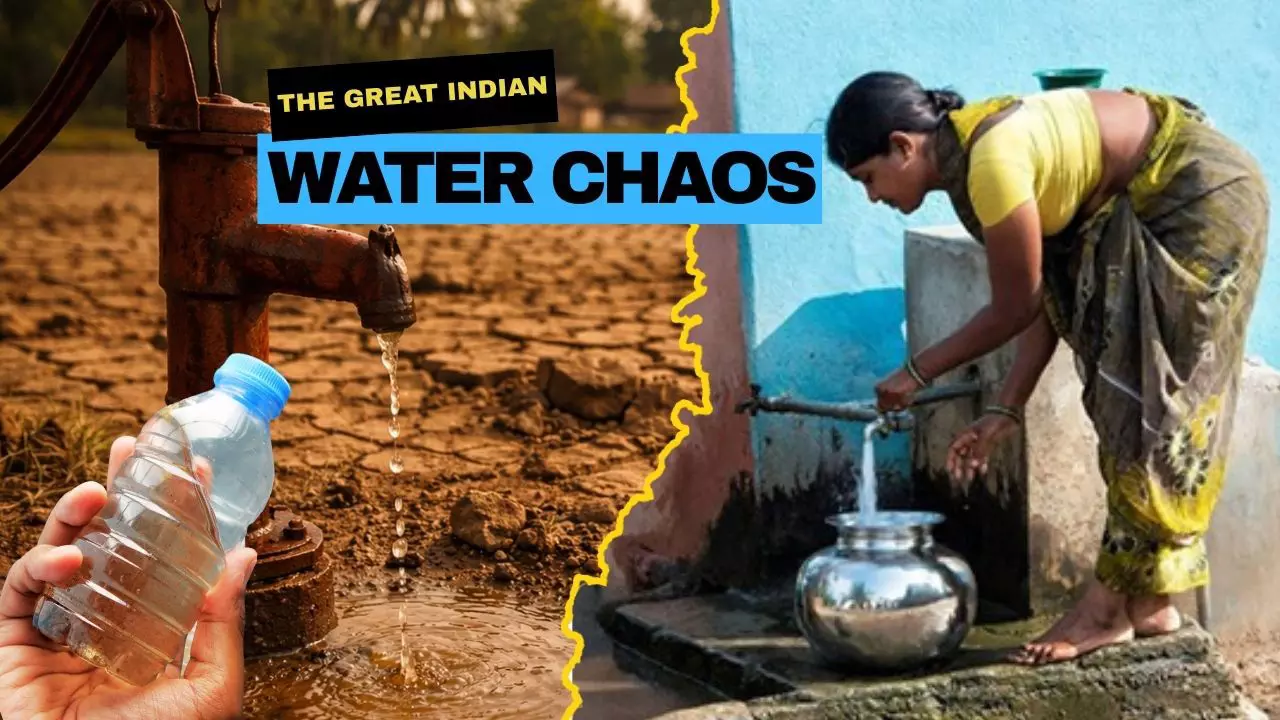
The battle for clean drinking water has become a daily ordeal for thousands of families in Bihar.
Tap water is hardly potable, since it's often dirty, foul-smelling, and poses huge health risks. The issue of contaminated water is rapidly becoming a major challenge in the NDA-ruled state, particularly in urban areas, where sewage often mixes with piped drinking water.
Thousands of residents in different localities in Patna, Muzaffarpur, Bhagalpur and Biharsarif — designated cities under the Centre’s Smart Cities Mission — have been receiving dirty and foul-smelling water in their taps regularly. And, the local authorities have done little to resolve the issue.
Battling health issues
Unlike Indore, there have been no reports of any casualties in Bihar due to contaminated drinking water to date. But, residents of many areas grapple with incessant health issues such as typhoid, hepatitis and prolonged fever, stomach ailments, itching and diarrhoea. These illnesses are all common in several pockets of the state.
In a few places, the fear of catching skin-related diseases is so rampant that residents are not using the piped water supply for bathing as well.
Health experts have warned that contaminated water can cause mild to serious illness, mainly among children, women and elderly people.
Last fortnight, local Hindi dailies reported how contaminated tap water has given sleepless nights to residents in several towns like Saharsa, Bhagalpur, Sasaram, Muzaffarpur, Patna, Gaya, Darbhanga and other towns.
False claims by govt
Contrary to the government's success claims, Chief Minister Nitish Kumar’s pet scheme Har Ghar Nal Jal ('Tap Water for Every Home') has been unable to supply easy access to clean and safe drinking water for a large section of people, especially the poor.
Last March, the state government claimed that under the scheme, 99.2 per cent of the urban and rural households were being provided with clean drinking water. This is far from the truth.
For example, in recent days, contaminated tap water was reported in the Kankarbagh Housing Colony and Phulwari Sharif in Patna, Muzaffarpur, Bhagalpur and over a dozen other cities. In a few places, the fear of skin diseases is so rampant that residents are not using tap water for even bathing or washing clothes.
Sailesh Kumar, a resident of Kankarbagh Housing Colony, told The Federal, “We get tap water, but it is dirty, unclean and unsafe to drink. It has a strange taste and smell. There is no question of drinking it.” Instead, they have been buying drinking water since last year, he added.
For resident Prabhat Kumar, the fear of skin disease has meant no tap water for bathing. "The situation has worsened due to a leakage in the water pipeline near the sewage line and the gross negligence of the concerned department in replacing and repairing the pipes," he told The Federal. "This has led to sewage mixing with the water that reaches our taps."
Old problem
Kanti Devi, yet another resident, pointed out that this is not a new problem. “We have been dealing with dirty and foul-smelling water supply for years,” she lamented.
Patna Municipal Corporation (PMC) officials have denied any water contamination. But on the ground, the situation is all too familiar and grim. Densely populated areas like Harnichak, Balmichak, Kasai Tola, Kachahri Mohalla, Nayatola and Paharpur in Phulwarisarif Nagar Parishad area in Patna are facing much suffering due to water contamination.
Haricharan Rai, a resident of Harnichak, told The Federal, “Our water is bad and not fit to drink. Residents are either using handpump water or bringing safe and clean water from other places to drink.”
Unfit for consumption
Two residents of Nayatola, Md Afzal and Md Nasir, said the water supply pipeline runs through the sewers and is leaking at several points, causing sewage to mix with the tap water. "The water is very dirty. Sometimes, you can even see insects and large dirt particles in the water,” said Nasir.
“How can we expect clean supply water if the broken pipeline runs along the sewer line? It is bound to result in dirty water reaching every household here,” pointed out Md Salam, a Kadab Tola resident.
In Muzaffarpur, residents of ward no 19, 40,41,42 and 47, which come under the Muzaffarpur Municipal Corporation, have been receiving dirty and smelly tap water while the local administration remains largely apathetic.
Another resident, Sobha Devi, rued the fact that they get copious water, but it is unfit for consumption. “The taps are not dry, but the water is useless to us,” she said. "Unlike the rich, we have no money to buy bottled water and we are forced to visit nearby places to fetch clean water to cook and drink," she added.
'Taking serious note'
Muzaffarpur’s Mayor Nirmala Sahoo admitted that there are reports of dirty tap water at a few places, mostly due to old and damaged pipelines. She told
The Federal that they have taken "serious note of it" and directed officials to ensure the supply of clean and safe drinking water."
Residents blamed the Public Health Engineering Department and local officials for not replacing or repairing decades-old pipelines.
Water expert Prof Ramakar Jha of NIT Patna said that in Bihar, groundwater remains the key source of water for drinking, cooking and irrigation.
“We are fully dependent on groundwater since it is easily available, but over-exploitation is a concern. The government and private sector players are drawing water through heavy deep boring. In recent years, the depletion of water tables has been reported," he said.
High toxicity
Ironically, in Bihar, groundwater is already contaminated due to the high presence of arsenic, fluoride, uranium and iron. Per the Bihar Economic Survey (2024-25), there is widespread presence of arsenic and fluoride and iron contamination in the groundwater.
The report highlighted alarming groundwater contamination in the state. It revealed that as many as 30,207 rural wards were exposed to unsafe drinking water. Arsenic has been detected in 4,709 affected wards, fluoride in 3,789 wards, and iron in 21,709.
According to the Public Health Engineering Department (PHED), “Around 26 per cent of the 31 rural wards have groundwater sources affected by arsenic, fluoride, and iron contamination beyond permissible limits.”
Scarcity fears, too
Meanwhile, officials of the Bihar Water Resources Department said since the second week of January, amid severe cold conditions, several small rivers have already dried up, well before summer. The volume of water in the major rivers have been decreasing as well.
Water is also vanishing from other sources in the state such as reservoirs and canals, which will compel people to turn to ground water, which is contaminated.