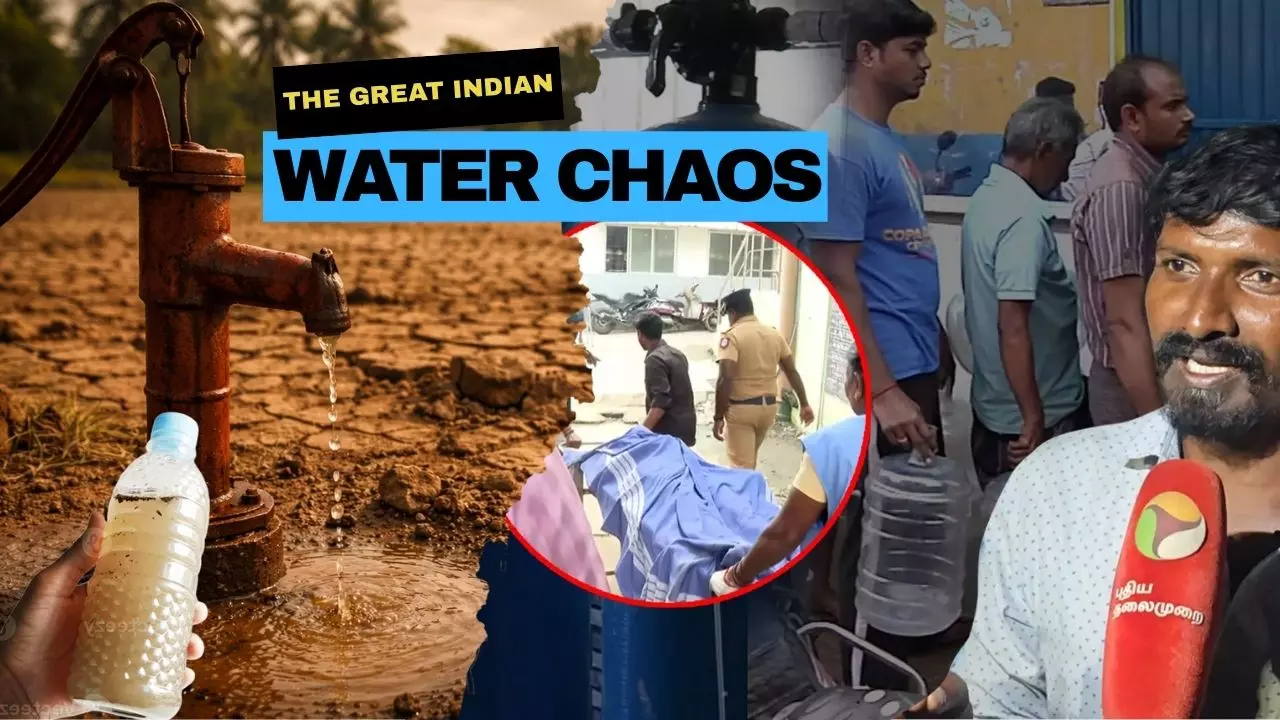
Chennai’s drinking water crisis mirrors deeper urban failures across India
As Indore reels from deadly water contamination, Chennai faces a dual emergency of shortages and unsafe supply, raising questions on water safety in Indian cities

A deadly drinking water crisis in Indore has reignited concerns about water safety across Indian cities, with Chennai emerging as a stark example of a system under strain. While Indore saw contaminated water mixed with sewage entering the municipal supply and sickening hundreds, Chennai is battling a dual crisis — one of scarcity and another of contamination.
In Indore, a six-month-old child died after consuming water linked to the outbreak, raising serious questions about water safety even in cities that are often showcased for cleanliness. The incident has drawn attention to vulnerabilities in urban water supply systems far beyond Madhya Pradesh.
Chennai, nearly 1,300 km away, is facing its own water emergency. Unlike Indore, the problem here is not uniform. Different parts of the city are grappling with contrasting but equally dangerous water challenges.
Desalination strain
Chennai has no perennial river and depends heavily on desalination plants along its coast for drinking water. These plants convert seawater into potable water and supply millions of residents, particularly in North Chennai where groundwater is scarce and reservoirs frequently dry up.
The shutdown of even one desalination plant has immediate consequences. The crisis deepened after the 100-million-litres-per-day Minjur desalination plant was shut down more than a year ago. Large parts of North Chennai have since been struggling to access safe drinking water.
In several neighbourhoods, residents have pooled money to set up reverse osmosis plants as the cost of water continues to rise. A resident described the daily struggle, saying they depend entirely on purchased water cans. “We buy water cans from companies… 20 cans, 30 cans, sometimes 40 cans a day. That is the water we drink,” the resident said, explaining how communities collectively spend thousands of rupees to secure drinking water.
Two crises, one city
Chennai today presents a stark contradiction. While North Chennai residents struggle for even a single pot of drinking water, people in the southern suburbs face a different danger — contaminated water flowing through their taps.
On one side of the city, families queue for water or pay heavily for private supply that barely reaches their homes. On the other, water is available but unsafe to consume. Together, these twin crises expose deep gaps in water management in the capital of Tamil Nadu.
The situation has also extended beyond city limits. Last month, Karlampatham colony in Tiruvallur district near Chennai witnessed a serious drinking water tragedy.
Fear grips colonies
Two people died in Karlampatham colony after consuming contaminated water. The colony, home to more than 200 families, receives drinking water through pipelines connected to a borewell and an overhead tank maintained by the panchayat.
Residents said many people fell ill after consuming the water, reporting stomach pain, vomiting and loose motions. Even weeks later, fear continues to grip the colony.
A resident said sewage had mixed with drinking water, leading to the deaths. “Because of this, we are protesting demanding proper action, compensation for the dead, and justice,” the resident said, adding that families of the deceased include children and dependents who now need support. They also demanded medical treatment for those affected and government jobs or relief for the families of those who died.
Complaints go unanswered
Despite paying water taxes and having legal water connections, residents say repeated complaints to the Metro Water Board and the panchayat have gone unanswered. Irregular supply and poor water quality have forced many families to depend on expensive private water cans.
Even then, uncertainty remains. Residents say they are never sure whether the packaged water they buy every day is actually safe to drink. As Chennai struggles with both scarcity and contamination, the crisis highlights a larger question confronting Indian cities — access to water is no longer just about availability, but about safety and trust.
The content above has been transcribed from video using a fine-tuned AI model. To ensure accuracy, quality, and editorial integrity, we employ a Human-In-The-Loop (HITL) process. While AI assists in creating the initial draft, our experienced editorial team carefully reviews, edits, and refines the content before publication. At The Federal, we combine the efficiency of AI with the expertise of human editors to deliver reliable and insightful journalism.