Illegal infiltration from Bangladesh has remained one of Assam’s most sensitive political issues for decades. From election rallies to Assembly speeches, BJP leaders have repeatedly promised to completely seal the India-Bangladesh border and stop illegal entry into the state.
During the election campaign in West Bengal, Union Home Minister Amit Shah has often claimed that fencing work along India’s eastern border was largely completed during the Modi government’s tenure, except for certain stretches in West Bengal. He blamed the remaining gaps on the alleged non-cooperation of the government led by Mamata Banerjee.
Echoing a similar opinion, Assam Chief Minister Himanta Biswa Sarma also raised the infiltration issue aggressively during campaign rallies across the state. Sarma had told reporters during the campaign that security agencies sometimes carried out “pushback” operations strategically along the Bangladesh border, depending on the movement of Bangladeshi border patrol personnel.
Border issue unresolved
But on the ground, several vulnerable stretches of the Assam-Bangladesh border still remain unresolved despite more than a decade of BJP rule at the Centre and nearly ten years of BJP government in Assam.
Senior journalist and activist Apurba Ballav Goswami said the BJP had built a major part of its Assam politics around the promise of sealing the border. “Before coming to power in 2014, the BJP projected itself as the political force that would permanently stop infiltration from Bangladesh. The party repeatedly assured people that not an inch of Assam’s land would be surrendered and that the border would be completely sealed,” Goswami said.
“After coming to power, the Centre introduced fencing, floodlights, surveillance systems and technological monitoring in vulnerable areas. There has definitely been progress, but the border is still not fully sealed even after all these years,” he added.
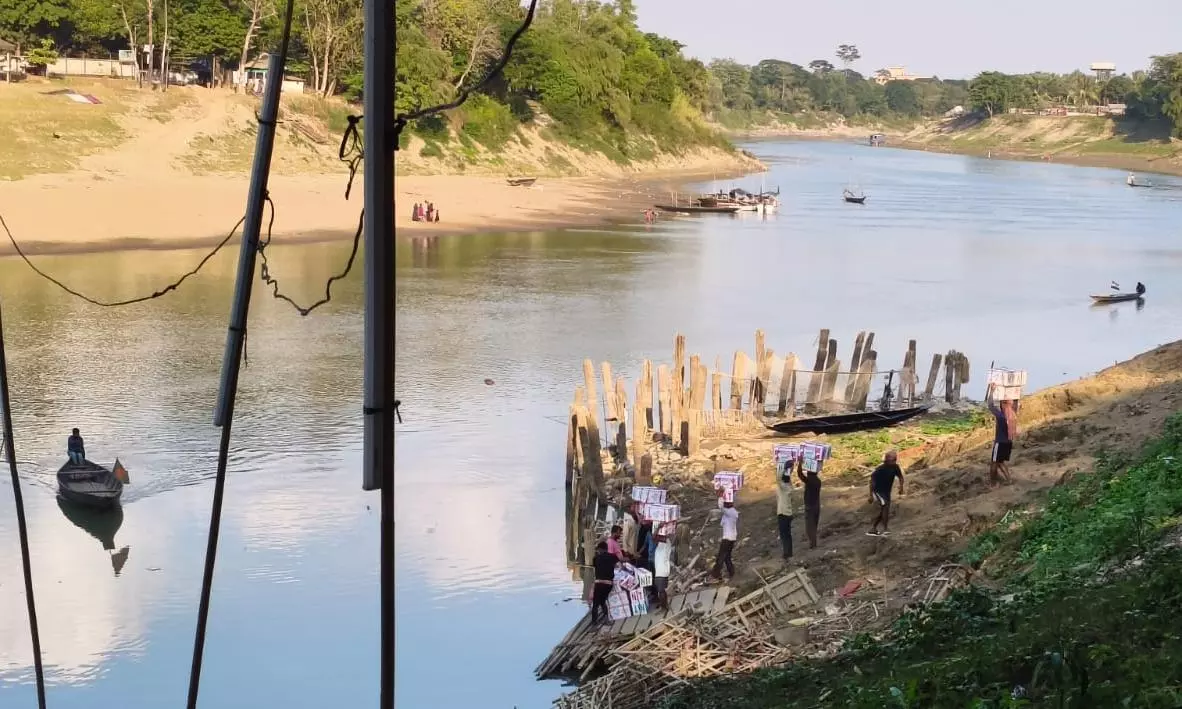
Kushiyara river
According to Goswami, the biggest unresolved concern continues to be the 4.35-km unfenced stretch along the Kushiyara River in Sribhumi district, formerly known as Karimganj. The international zero line passes through the middle of the Kushiyara River, making fencing work extremely difficult.
Border fencing rules generally require construction to remain 150 yards away from the zero line, although adjustments were made in some stretches because of local conditions.
Officials said a protective guard wall is necessary in the area because of strong river currents and erosion. However, Border Guard Bangladesh (BGB) has objected to the height and design of the proposed structure, claiming it could obstruct the river’s natural flow and worsen flooding during the monsoon.
India has reportedly refused to reduce the height of the wall, citing security and structural concerns. Several rounds of talks between the two sides have failed to resolve the issue. Adding to the problem is the continuous erosion caused by the Kushiyara River, which has already damaged fencing in nearby areas.
Barbed wire fencing work in this sector had started under the National Buildings Construction Corporation (NBCC) in 2009. Yet, after nearly 17 years, the stretch remains incomplete. Security agencies continue to treat the area as a sensitive entry point into the Barak Valley.
The Assam-Bangladesh border is divided into three sectors — Dhubri-Kurigram sector covering 134 km, Cachar-Sylhet sector covering 33.6 km and Sribhumi-Sylhet-Moulvibazar sector covering 95.4 km.
Border monitoring systems
Officials maintain that Assam now has one of the most advanced border monitoring systems among the states sharing the Bangladesh border. In several riverine areas, especially in Dhubri district, technological surveillance has replaced conventional fencing.
The Brahmaputra riverine stretches and char areas are monitored through the Comprehensive Integrated Border Management System (CIBMS) and BOLD-QIT technology using sensors, thermal cameras, floodlights and electronic surveillance systems. Government sources claimed that physical fencing has been completed in almost all the technically feasible stretches of Assam’s border.
“The border fencing project along the Kushiyara River in Sribhumi district is largely complete except for the 4.35-km unfenced portion. The remaining riverine stretches are being monitored through surveillance systems like CIBMS,” a senior BSF official said.
Infiltration attempts continue
Despite these measures, infiltration attempts continue to be reported regularly. Only a few days ago, the Border Security Force (BSF) reportedly foiled an infiltration attempt involving nearly 150 suspected illegal Bangladeshi nationals in South Salmara district. Earlier, the deportation of 14 suspected illegal Bangladeshis from the same district had triggered tension in the area.
Incidents of cattle smuggling, illegal crossings and occasional firing along the riverine border also continue to surface from time to time.
Senior journalist Sudip Sarma Chowdhury alleged that political parties continue to use infiltration mainly as an election issue rather than treating it as a long-term security challenge. “These are election jhumlas. Political slogans only. They do not have sincerity in sealing the border. They want to keep the issue alive for political benefit. Barbed wire fencing alone does not mean the border is sealed,” Chowdhury said.
“In Sribhumi district, border fencing has been breached several times, and there were incidents of violence. In some places, there were no border guards,” he added.Referring to neighbouring states, Chowdhury further claimed that infiltration concerns along Tripura’s border were even more serious.
“The situation in Tripura is worse than in West Bengal. A large number of illegal immigrants entered through that stretch last year,” he said.
Students question
The issue has also triggered strong reactions from student bodies in Assam. All Assam Students’ Union (AASU) president Utpal Sarma questioned what he called contradictions in the government’s stand on infiltration and border sealing. “They say infiltrators are being pushed back, but at the same time, they also say infiltrators are entering Assam. If the border is fully sealed, then how are infiltrators entering?” Sarma asked.
The student leader said riverine stretches in Dhubri and Sribhumi still remain vulnerable because physical fencing cannot be constructed in river beds.
“We suggested alternative measures like 24-hour floating BOPs and floodlighting in riverine areas for continuous monitoring. But our suggestions were ignored,” he said. Sarma further said AASU had proposed the creation of a second line of defence involving local indigenous youths to strengthen border security.
“We proposed a second line of defence along with the BSF, using local indigenous youths from border areas. But the government did not act on the proposal as well,” he added.
Even after 41 years of the Assam Accord and despite a BJP-led “double-engine” government in Assam since 2016, vulnerable stretches in Sribhumi and Dhubri sectors continue to remain unresolved. For now, Assam’s border with Bangladesh remains a complicated mix of fencing, surveillance systems, diplomacy, difficult geography and politics — tighter than before, but still porous and not fully sealed.